
Plan your week in 15 to 20 minutes, protect your sleep like a workout you can’t skip, block your study time, and run a 10 to 15 minute weekly review. That four-part system, built on NCAA guidance, CDC sleep science, and the kind of habit coaching we teach, beats daily improvising every time. It’s not complicated. It just has to happen the same way every week.
TL;DR:
- Put class, team, and personal commitments in one calendar before the week starts, then mark deadlines and travel conflicts before scheduling study blocks.
- Place a 45 to 90 minute study block after class, name its specific task, and reserve evening sessions for review rather than new material.
- The CDC recommends 8 to 10 hours for ages 13 to 18; 7 hours or less is linked to poorer school performance and injury risk.
- Email professors at least 48 hours before travel with dates and a specific request, then download readings and lecture slides before leaving campus.
- Use a 10 to 15 minute weekly review to check sleep, missed study blocks, and upcoming deadlines, then choose one change for next week.
Table of Contents
- Build Your Weekly Game Plan in 15 to 20 Minutes
- Prioritize With “Big Rocks First”
- Design Time Blocks That Remove Decision Fatigue
- Protect Sleep Like It’s Part of Your Training Plan
- Game Weeks and Travel: Packing, Batching, and the Bus Ride
- Use Campus Support Instead of Carrying Everything Yourself
- Pick Simple Tools and Stop Shopping for Better Ones
- Run a Weekly Review in Under 15 Minutes
- How Coaching Habits Turn This Into a Team Routine
- What Actually Separates Students Who Make This Work
- Bring This System to Your Whole Team
- FAQ
- Sources
Build Your Weekly Game Plan in 15 to 20 Minutes
Every student-athlete already has three calendars fighting for the same hours: class schedule, team schedule, and life. The fix isn’t a fancier app. It’s pulling all three into one view before the week starts, so conflicts show up on Sunday instead of Wednesday at 11 p.m.
Start by gathering what’s fixed. Your syllabus gives you exam dates and paper deadlines. Your team calendar gives you practice times, lift sessions, and travel. Your own list gives you work shifts, appointments, and family obligations. None of this is new information, but almost nobody puts it in one place.
Here’s the weekly process, done once, usually Sunday evening or Monday morning:
- Pull every fixed commitment for the coming week into a single calendar, color-coded by category.
- Mark every deadline, quiz, and exam next to the day it’s due, not the day you plan to study for it.
- Identify collision points, like a practice that runs late the same night a paper is due.
- Slot in study blocks around the fixed items, favoring the 45 to 90 minutes right after class.
- Confirm travel days and flag which assignments need to move earlier.
A quick checklist keeps this from sliding:
- Did I check the team travel itinerary for this week?
- Are all graded deadlines on the calendar, not just exams?
- Did I leave buffer time around travel days?
- Is there at least one study block before each class that assigns reading?
This fifteen-minute habit is the single most repeated recommendation across college athletic-support resources, and for good reason: it catches conflicts while you still have options.
Prioritize With “Big Rocks First”
The Positive Coaching Alliance frames this well: sort your week by big rocks first, pebbles second, sand last. Big rocks are the fixed, non-negotiable commitments, practice, class, exams, team travel. Pebbles are important but movable, like a study session or a workout you control the timing of. Sand is everything else: scrolling, errands, low-stakes texts.
Typical student-athlete big rocks include:
- Practice, lifts, and film sessions set by your coaching staff.
- Class time and any exam already on the syllabus.
- Team travel and competition days.
- Sleep, which we’ll treat as its own non-negotiable in a minute.
The trap most students fall into is confusing urgent with important. A text from a teammate feels urgent. A paper due in five days feels distant. But the paper is important and the text is just loud. When two things collide, ask which one has a deadline you can’t move versus one you can push by a day.
When a real conflict shows up, a short script beats an apology email written at midnight:
Pro Tip: Email your professor early with something like: “I have an away competition on [date] and won’t be in class. Could I submit the assignment a day early or arrange an alternative?” Most faculty respond better to a plan than to an excuse.
Design Time Blocks That Remove Decision Fatigue
Decision fatigue is the real enemy here, not laziness. Every time you have to decide when to study, you burn energy you could’ve spent studying. Time blocking removes that decision by assigning a job to every hour before the day starts.
A workable daily structure:
- Morning block for class and the densest coursework, when your brain is freshest.
- A 45 to 90 minute study window immediately after your last class and before practice.
- Practice, lift, or training block, treated as fixed and immovable.
- A short recovery and meal block right after training, not squeezed in later.
- A second, shorter study block in the evening for review, not new material.
Travel days need their own shape: a transit block for low-focus tasks, a short window right after arrival for anything that needs real concentration, and an early lights-out instead of a late one.
Pro Tip: Name your study blocks specifically, “Algebra problem set 3,” not “homework.” A labeled task clears the decision before you sit down, which cuts the friction that makes you stall.
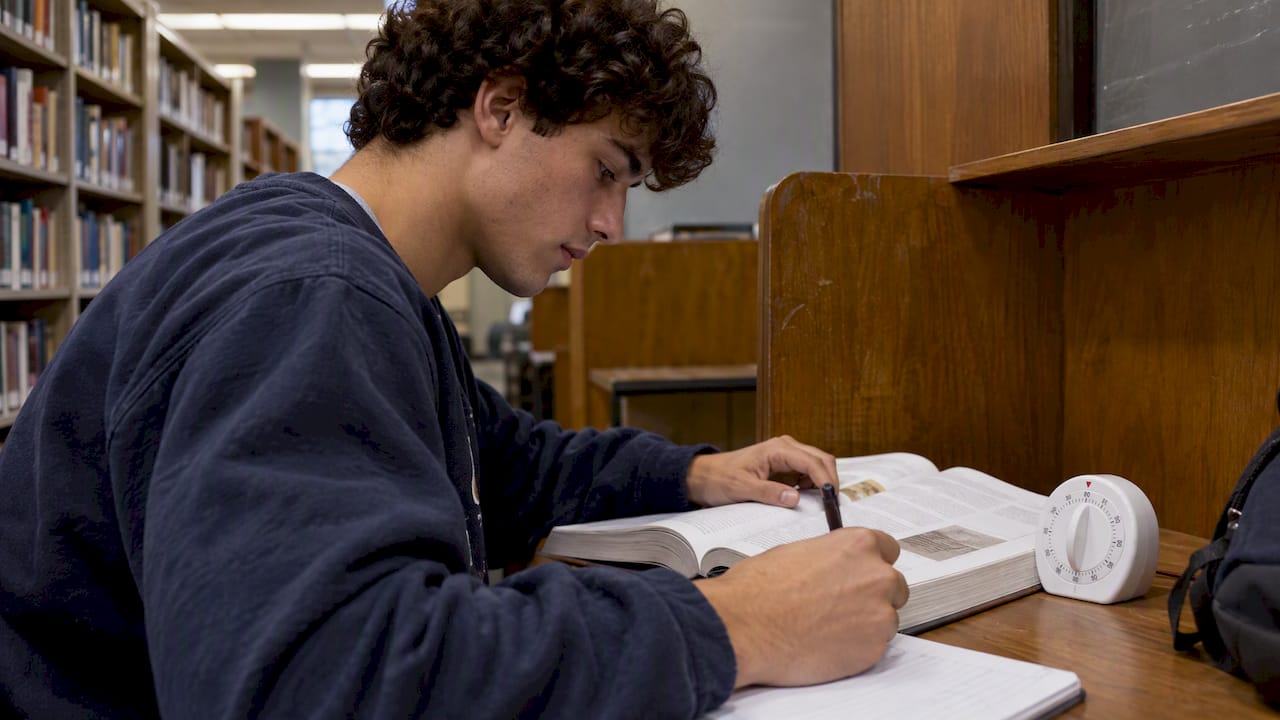
A kitchen timer or phone timer set for 25 or 50 minutes keeps you monotasking instead of drifting between a textbook and your phone. One task, one timer, one block. Resetting the timer for a short break between blocks is part of the system, not a distraction from it.
Protect Sleep Like It’s Part of Your Training Plan
Sleep is not the thing you sacrifice when the week gets tight. It’s the recovery block your training depends on, and it belongs on the calendar the same way practice does.
The CDC recommends 8 to 10 hours of sleep for ages 13 to 18, and sleeping 7 hours or less is linked to worse school performance, higher injury risk, and poorer mental health. A CDC study on adolescent sleep found that students reporting short sleep were also more likely to report difficulty doing schoolwork and poorer mental health, a pattern that tracks directly with late-night cramming and early practice schedules.
Protecting sleep doesn’t require a overhaul, just a few fixed habits:
- Set a media curfew before your target bedtime.
- Keep your wake time consistent, even on weekends, within an hour.
- Move your second study block earlier in the evening instead of letting it eat into bedtime.
- Treat a missed night of sleep like a missed workout: note it, don’t repeat it.
If a deadline is squeezing your sleep, the fix is almost always to move study earlier in the day, not later into the night.
Game Weeks and Travel: Packing, Batching, and the Bus Ride
Travel weeks are where schedules usually break, not because the system fails but because nobody planned for the gap. A little prep before you leave campus keeps the gap small.
Before you go:
- Email professors at least 48 hours ahead with your travel dates and a specific ask, not a vague heads-up.
- Download readings and lecture slides before you lose reliable WiFi.
- Pack a folder with anything due that week, physical or digital.
- Confirm which assignments can shift and which absolutely cannot.
Once you’re moving, match the task to the setting:
- Use transit time for low-focus work: flashcards, reading, email replies.
- Reserve your most demanding work, like problem sets or writing, for a rested window before or after the trip.
- After competition, handle anything time-sensitive immediately, then postpone the rest until you’ve slept.
Post-game triage matters as much as pre-trip planning. A quick email reply can wait until morning. A deadline that falls the next day can’t.
Use Campus Support Instead of Carrying Everything Yourself
Good time management isn’t a solo sport. NCAA guidance calls for written mental-health action plans and accessible mental-health services for student-athletes, which means your school almost certainly has resources built for exactly the pressure you’re under.
Academic support exists for the same reason training staff exists: to catch problems before they become crises.
- Academic counselors can help you sequence a tough semester around your competition calendar.
- Tutors and study halls take pressure off subjects where you’re falling behind.
- Athletics academic staff can coordinate directly with professors on your behalf during travel-heavy stretches.
- Campus counseling centers are a resource to use before a bad week becomes a bad month, not after.
If a workload conflict feels unmanageable, say so early. Requesting an accommodation or flagging a scheduling problem to your academic advisor is a normal part of managing the system, not a sign it’s failing.
Pick Simple Tools and Stop Shopping for Better Ones
You need four tool categories, not twelve apps: one calendar, one task list, one focus timer, and one place to track syllabus deadlines. That’s the whole kit.
A minimal setup that works for most students:
- One digital calendar, synced across phone and laptop, holding every fixed commitment.
- One running task list, whether that’s a notes app or paper planner, with nothing split across two systems.
- A basic timer for focus blocks, no subscription required.
- A single document or app page listing every deadline pulled from your syllabi.
Pick a configuration and give it four full weeks before deciding whether to switch. Tool-switching mid-semester usually costs more time than the better tool saves. For students who want an interactive way to map a full semester, degree planning tools can complement this setup without replacing it.
Run a Weekly Review in Under 15 Minutes
The weekly review is what makes the whole system self-correcting. Without it, you repeat the same mistakes every week instead of fixing them.
- Check how many nights you hit your sleep target.
- Note which study blocks you skipped and why.
- Flag any upcoming deadline crunch two weeks out.
- Send one quick check-in to a coach or professor if a conflict is brewing.
- Pick one change to try next week, not five.
If the week went sideways, don’t rebuild everything. Just restore the sleep block, run the Sunday plan, and treat the rest as a smaller version of normal.
How Coaching Habits Turn This Into a Team Routine
A lot of what makes this system work isn’t the calendar, it’s the repetition, which is the same principle behind the “Training, Not Selling” approach to building habits that last. Incremental practice beats one big pep talk, whether you’re training a sales team or a roster of student-athletes.
Captains and coaches looking to build this into team culture have a few assets worth borrowing: visualization templates for pre-competition routines, and one-on-one meeting agendas for quick accountability check-ins. A 30 to 45 minute team session introducing the weekly planning process, run once at the start of a season, tends to stick better than a single lecture ever does.
What Actually Separates Students Who Make This Work
Most advice on student-athlete time management treats sleep as optional and the weekly review as a nice-to-have. We’d argue it’s the reverse: the review is what makes the whole system adaptive, and sleep is the one block that, if you cut it, quietly breaks everything else downstream.
The conventional wisdom oversells apps and undersells repetition. A fancier planner doesn’t fix a schedule that was never written down in the first place. What matters is the Sunday habit of mapping the week and the Friday habit of checking what worked. Everything else, the specific app, the color-coding system, the brand of timer, is detail.
If you only adopt one piece of this system, make it the weekly planning session. It’s the cheapest fifteen minutes you’ll spend all week, and it’s the one that prevents the 11 p.m. scrambles that cost you sleep, which costs you everything else.
— Middy
Bring This System to Your Whole Team
An individual athlete can run this system solo, but a team adopts it faster when a coach or athletic director introduces it together. We work with coaches, athletic directors, and team captains who want their roster operating on the same weekly rhythm instead of a dozen different systems.

Our Find Your Lane workshop is built for exactly this: a session that gives student-athletes and the coaches who support them a shared habit-playbook instead of generic motivation.
- Repeatable weekly planning routines your whole roster can run the same way.
- Meeting templates coaches can use for quick accountability check-ins.
- Visualization tools student-athletes can apply before competition.
If you’re organizing for a team or department, reach out through our booking page to talk through a session built around your season.
FAQ
What is the best time management system for student-athletes?
A weekly planning session of 15 to 20 minutes, combined with protected sleep, time-blocked study, and a short weekly review, is the core system most college athletic resources recommend. The key is running it the same way every week rather than improvising day to day.
How much sleep do student-athletes actually need?
The CDC recommends 8 to 10 hours per night for ages 13 to 18, and sleeping 7 hours or less is linked to worse academic performance and higher injury risk. Treating sleep as a scheduled block, not an afterthought, protects both recovery and grades.
How do student-athletes handle conflicts between practice and class deadlines?
The most reliable approach is contacting the professor or coach early with a specific request, such as submitting work a day ahead of travel, rather than waiting until the conflict is unavoidable. NCAA guidance supports coordinated academic accommodations for student-athletes managing competition schedules.
What should a weekly review for student-athletes include?
A short review checking sleep consistency, missed study blocks, and upcoming deadline crunches takes 10 to 15 minutes and helps catch problems before they compound. Picking one adjustment for the following week, instead of overhauling the whole system, keeps the habit sustainable.
How can student-athletes avoid burnout during a heavy travel schedule?
Batching low-focus tasks for transit time and reserving demanding work for rested windows before or after travel reduces the academic backlog that often triggers burnout. Using campus academic and mental-health resources early, rather than after a crisis, is part of the NCAA’s recommended approach to supporting student-athletes.
Sources
- CDC — Sleep and Sleep Disorders (sleep guidance)
- Positive Coaching Alliance — Time Management Tips for Student-Athletes
- NCAA — Mental health best practices
Leave a Reply