Yes, visualization is an evidence-backed mental practice that, when done correctly, complements physical training to sharpen skill execution, build confidence, and support recovery. It works best as a planned addition to physical reps, not a replacement for them. Start small: short sessions, vivid sensory detail, real-time timing, and a clear purpose for each one you run.
TL;DR:
- Visualization offers moderate benefits, significantly improving decision-making response times and sport-specific performance in athletes, especially when incorporated consistently.
- Tailoring imagery types to specific goals—such as skill, outcome, strategy, affect, or healing—enhances effectiveness by addressing precise needs.
- Using the PETTLEP framework ensures imagery closely resembles real practice, boosting transferability and performance gains.
- Short, frequent sessions of 5 to 10 minutes daily or longer weekly sessions of 30 to 45 minutes both work, but progress depends on vividness, relevance, and paired physical practice.
- Group training and structured routines help sustain practice, provide accountability, and improve results over unstructured, solo efforts.
Table of Contents
- What the research says about visualization and performance
- Types of imagery and when to use each one
- How to actually practice visualization step by step
- Using the PETTLEP model to make imagery feel like real practice
- How much visualization is enough, and how to track if it’s working
- Imagery for injury recovery and high-pressure moments
- Common mistakes that stall visualization progress
- How we teach visualization in team and athlete workshops
- Bring visualization training into your team or program
- FAQ
- Sources
What the research says about visualization and performance
We get asked constantly whether imagery training is worth the time, and the honest answer is: the evidence is solid, but not absolute. Several recent systematic reviews and meta-analyses have tried to pin down how much visualization actually moves the needle, and the pattern that emerges is encouraging without being overblown.
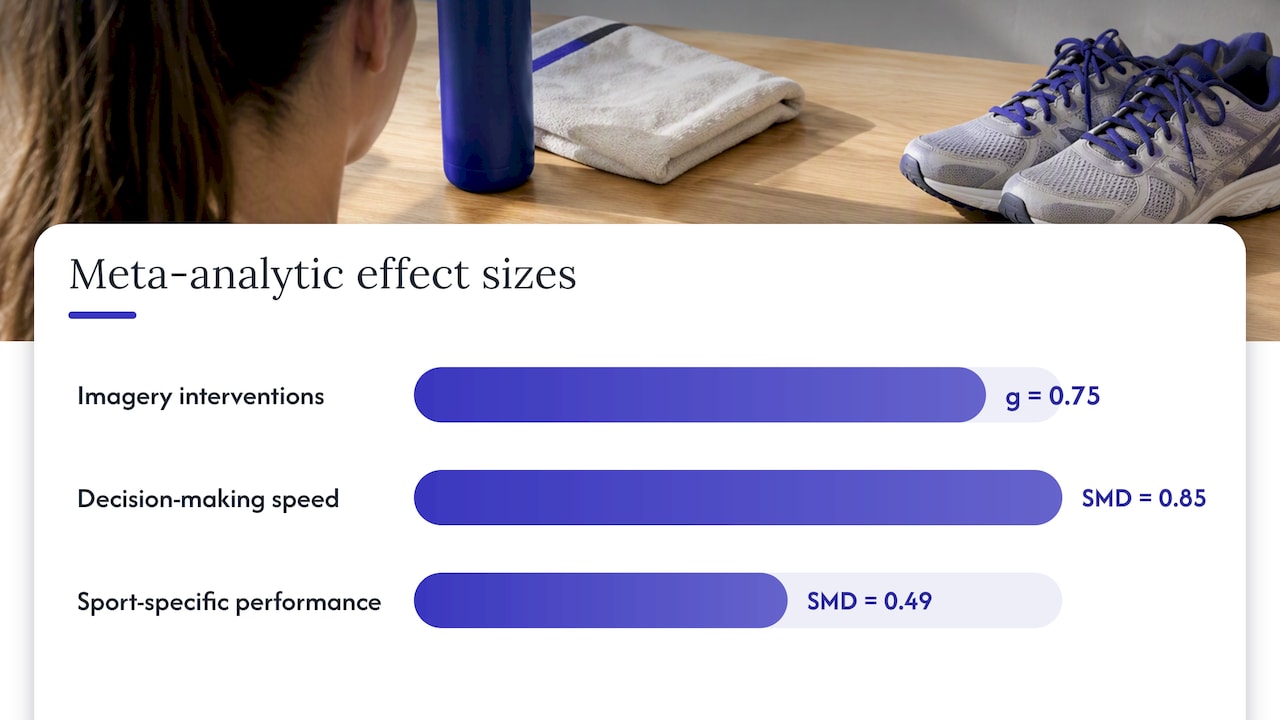
A 2023 meta-analysis of 111 studies on psychological skills training found a moderate effect (g = 0.75) for imagery interventions. That is a meaningful bump, roughly on par with other well-regarded mental training methods. But the same review flagged a problem that shows up across this field: when researchers narrowed the sample to only the highest-quality randomized trials, the effect size estimates became unstable. Translation: imagery helps, but the exact size of the help depends heavily on how rigorously a study was run.
A more targeted 2025 systematic review and meta-analysis on visual training looked specifically at decision-making and sport-specific performance. It reported that visual training significantly improved decision-making response time (SMD = 0.85) and sport-specific performance (SMD = 0.49) across randomized trials through January 2025. The decision-making number is particularly striking, larger than many psychological interventions manage, and it lines up with what coaches have suspected for years: athletes who mentally rehearse reading a defense, anticipating a serve, or reacting to a break actually get faster at those reads in competition.
Dosage is where things get genuinely useful for practitioners. A 2025 Bayesian multilevel meta-analysis on imagery dosage examined how imagery practice affects athletes’ mental health, including anxiety, confidence, and self-efficacy. It reported a dosage signal centered on sessions of moderate length once a week, sustained over several weeks, as associated with favorable outcomes. That is not a strict prescription, the same analysis noted real heterogeneity across the studies it pooled, but it gives coaches a starting point instead of a guess.
A 2025 experimental study published in Frontiers adds another layer: tailored, layered guided imagery, built piece by piece rather than attempted all at once, increased imagery ability and improved performance on the specific tasks being trained. This supports a practical point we lean on heavily in our own sessions: generic imagery scripts underperform imagery built around the athlete’s actual skill gaps, as shown by tested AI video tool resources for coaches.
A few honest caveats belong here, because overselling the research helps no one:
- Sample sizes in many individual studies remain small, which widens the margin of error on any single finding.
- Study designs vary enough (self-report measures, different sports, different session lengths) that pooled effect sizes should be read as directional, not exact.
- Few trials use truly rigorous randomized controlled designs, so researchers keep calling for more robust replication before treating any single number as settled.
One figure worth remembering: the 2025 visual training meta-analysis found a decision-making response time improvement of SMD = 0.85, one of the larger effects reported in this body of research, suggesting imagery work pays off most clearly in fast, reactive sports.
None of this means visualization is a shortcut. It means it is a legitimate tool with real, measurable upside, used alongside physical training rather than instead of it.
Types of imagery and when to use each one
Not all visualization serves the same purpose, and matching the type of imagery to the actual training goal is where most athletes go wrong. Picturing yourself winning a medal does nothing for your backhand technique, and rehearsing your free-throw form does nothing for pre-race nerves. Here is how to sort it.
Skill (motor) imagery rehearses the mechanics of a specific movement. A tennis player might mentally run through a serve: tossing the ball, loading the shoulder, the contact point, the follow-through, feeling the racquet in hand the entire time. This type works best broken into pieces rather than imagined as one smooth blur, since layered imagery interventions that build a movement sequentially have been shown to improve kinesthetic feel and transfer to actual execution more than whole-action attempts from the start.
Outcome (goal) imagery focuses on a desired result rather than the steps to get there, picturing yourself crossing the finish line strong, or sinking the final putt. It is motivating, but weaker on its own for skill development; it pairs well with skill imagery as a closing mental image rather than standing in for it.
Strategy (decision) imagery rehearses reading and reacting: a soccer midfielder imagining where to play a pass under pressure, a point guard running through different defensive looks. This is the category most tied to the decision-making gains found in the visual training research above, and it benefits from pairing with actual game footage.
Affect (emotion) imagery rehearses the feeling state you want during competition, staying calm after a bad call, channeling nervous energy into focus before a start gun. It is less about the physical movement and more about regulating the internal experience.
Healing (rehab) imagery uses mental rehearsal to support recovery, visualizing tissue repairing, blood flow to an injured area, or a return to full movement. Applied sport psychology guidance is clear that this works best as a complement to medical and physiotherapy care, never a substitute for it.
Pro Tip: Pick one imagery type per session based on your single biggest need that week: skill imagery for a technical fix, strategy imagery before a game with a known opponent, affect imagery the night before a high-stakes event.
How to actually practice visualization step by step
Most people who say “visualization doesn’t work for me” were never shown a repeatable process. Vague daydreaming about “doing well” is not visualization. Structured, sensory-rich rehearsal with a clear goal is.
Before any session, settle three things: a quiet-enough environment, a few minutes to physically relax (slow breathing works fine), and one specific focus for that session rather than a vague intention to “visualize success.”
Here is the sequence we teach in our own workshops:
- Choose your perspective. Internal (seeing through your own eyes) tends to suit skill and strategy imagery; external (watching yourself like a replay) often works better for form checks and confidence-building.
- Build the scene visually first. Picture the court, field, or track, the lighting, the people around you, before adding anything else.
- Layer in sound. Add the specific audio: a whistle, crowd noise, your coach’s voice, your own breathing.
- Layer in physical sensation. Feel your feet on the surface, your grip on the equipment, your heart rate. This kinesthetic layer is often the weakest for beginners and the one worth the most attention.
- Control the timing. Run the sequence at real competition speed, not slow motion, since functional equivalence to the real event matters for transfer.
- Practice the rewind. If a mistake creeps into the image, don’t push through it: rewind and rerun it correctly. This “controllability” drill is a skill in itself and tends to improve with repetition.
For actual scheduling, we recommend four session formats depending on the day:
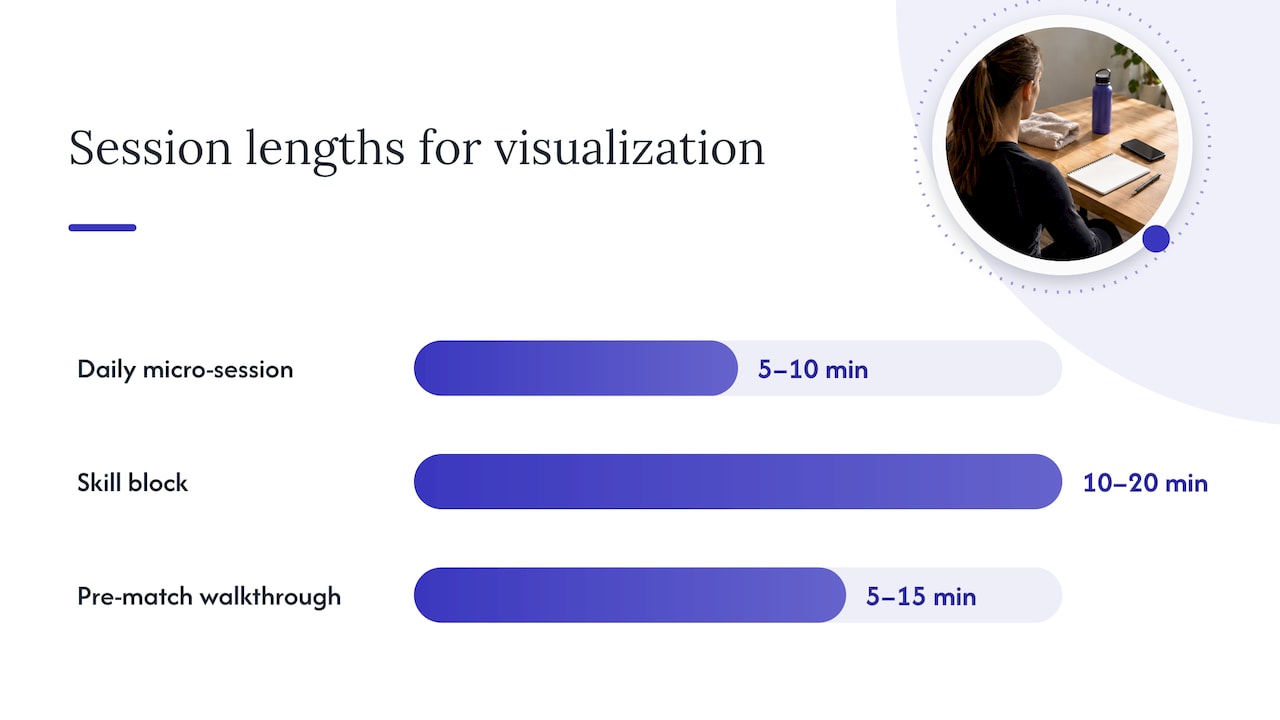
- Daily micro-session (5 to 10 minutes): one skill, run three to five times, used on training days as a warm-up primer.
- Skill block (10 to 20 minutes): deeper layering practice for a technical fix, used once or twice a week.
- Pre-match walkthrough (5 to 15 minutes): a full mental run-through of the upcoming competition, including likely scenarios.
- Mixed weekly plan: several micro-sessions plus one longer skill block, adjusted around the competition calendar.
Over a 4 to 12 week block, the goal is progression, not repetition for its own sake. Early weeks focus on building vividness and getting the sequence right at a slower pace if needed. Middle weeks tighten timing to match real speed. Later weeks integrate imagery directly before physical reps, since mental rehearsal paired with actual practice transfers better than either alone. Coaches running group sessions can borrow a model used in AASP’s practical guidance: short weekly group sessions of 10 to 15 minutes, backed by daily individual micro-sessions, with imagery ability reassessed roughly every four weeks.
Pro Tip: If an athlete struggles to “see” the image clearly, use short video clips of themselves or elite models immediately before the session. Watching the movement primes the mental picture that follows.
Using the PETTLEP model to make imagery feel like real practice
Imagery only transfers well to performance when it closely resembles the real thing. That is the entire premise behind PETTLEP, developed by Holmes and Collins, and it remains the leading practitioner framework for building that resemblance deliberately rather than by accident.
Each letter is a lever coaches can audit:
- Physical: Are you holding the actual equipment or wearing the actual kit while you imagine the movement?
- Environment: Are you imagining the real court, field, or venue, not a generic space?
- Task: Does the imagined task match the skill level and specific version of the movement you actually perform?
- Timing: Is the image running at real competition speed, not slow motion?
- Learning: Has the imagery content been updated as your technique has changed, or are you still rehearsing an outdated version of the skill?
- Emotion: Does the image include the actual emotional intensity of competition, not a flattened, calm version of it?
- Perspective: Are you using the internal or external viewpoint that best matches the skill being rehearsed?
A sprinter auditing the Physical element might start wearing actual spikes during imagery sessions rather than sitting in street shoes. A basketball player auditing Environment might switch from imagining a generic gym to the specific arena where a tournament will be held. A field hockey player auditing Emotion might deliberately add the frustration of a bad first-half call rather than imagining a clean, stress-free game.
| PETTLEP element | Coaching audit question | Quick fix if missing |
|---|---|---|
| Physical | Same equipment and clothing? | Hold actual gear during the session |
| Environment | Real venue details included? | Add specific sights and sounds of that venue |
| Task | Matches current skill level? | Update script after each technique change |
| Timing | Runs at competition speed? | Time the mental rep with a stopwatch |
| Emotion | Includes real competitive intensity? | Add pressure cues like crowd noise or score pressure |
| Perspective | Right viewpoint for the skill? | Switch between internal and external and compare |
Running through this checklist before each new block of sessions takes a few minutes and tends to catch the gaps that quietly cap how much a given athlete gets out of imagery work.
How much visualization is enough, and how to track if it’s working
Dosage research gives a useful anchor without being a rigid rule. The Bayesian multilevel meta-analysis on imagery dosage points to roughly 45-minute sessions, once a week, sustained across 100 days, as linked to favorable mental health outcomes in athletes. That is one valid structure, but it is not the only one that works.
In practice, we see two scheduling patterns perform well for different situations:
- Short daily sessions (5 to 10 minutes, most days): better for athletes building a new skill or working through a technical correction, since frequent short reps reinforce motor patterns.
- Fewer, longer sessions (30 to 45 minutes, once or twice weekly): better suited for confidence building, anxiety regulation, or full competition walkthroughs where depth matters more than frequency.
Tracking does not need to be complicated. A few low-burden tools cover most of what coaches need:
- Vividness rating: a quick 1 to 10 self-score after each session on how clear and realistic the image felt.
- Imagery ability check: periodic use of a validated tool. The COSMIN evaluation of imagery assessments found that instruments like MIQ, MIQ-R, MIQ-3, VMIQ-2, and SIAQ carry the strongest psychometric support among available options.
- Confidence or anxiety VAS: a simple visual analog scale rating before and after a session, tracked over weeks.
- Objective performance metrics: the actual practice or competition numbers the imagery was meant to influence, sprint splits, shooting percentage, error rate.
When vividness scores stay low, shorten the session and add a video prompt right before it rather than pushing through a longer block. When vividness is high but competition performance isn’t moving, that is usually a sign imagery needs to be paired with more physical reps, not swapped in to replace them.
Imagery for injury recovery and high-pressure moments
Two of the most practical uses of visualization sit outside regular skill training: supporting rehab and preparing for pressure.
In rehab, applied sport psychology guidance describes imagery as useful for maintaining a sense of control and reducing the anxiety that often comes with being sidelined. An athlete recovering from a knee injury might mentally rehearse pain-free movement, imagine tissue healing, or visualize a gradual, successful return to full training. This is explicitly a complement to medical and physiotherapy treatment, never a replacement for it, and any rehab imagery plan should be built in coordination with the medical staff managing the actual recovery.
For pressure moments, imagery scripts work best when they recreate the specific stressors an athlete will face:
- Rehearsing a free throw with imagined crowd noise and a tight scoreboard.
- Mentally running through a contested umpire call and the composed response that follows it.
- Practicing a close-score finish with the exact physical sensations of fatigue included.
- Using a short breathing or reset cue built into the image itself, so the mental rehearsal and the physical calming technique become linked.
Coaches handling both rehab and pressure work should keep communication open with any medical or sport psychology staff involved, so imagery content stays aligned with what is medically appropriate and psychologically useful at that stage of recovery.
Common mistakes that stall visualization progress
Most imagery programs fail quietly, not because the method is flawed but because a small, fixable error creeps in. Here is what we see most often, with the direct fix.
- Sessions run too long, too soon. Beginners pushed into 20-minute sessions lose focus halfway through. Fix: start at 5 to 10 minutes and build up gradually, in line with practitioner guidance on avoiding cognitive fatigue.
- The image stays vague. No sensory detail means no real rehearsal. Fix: add one sensory layer at a time (visual, then sound, then physical feel) rather than trying to build the whole scene at once.
- Scripts never get updated. Athletes keep rehearsing an old version of their technique. Fix: revise the imagery script every time a coaching correction changes the actual movement.
- No physical practice attached. Imagery alone, with no corresponding physical reps, rarely transfers well. Fix: pair every imagery block with related physical training in the same week.
- Mistakes left uncorrected in the image. Letting an imagined error play out reinforces the wrong pattern. Fix: rewind and rerun the sequence correctly every time.
Cognitive fatigue is real and shows up as flat, effortful imagery that used to come easily, or a sudden drop in vividness ratings. The fix is simple: shorten the next few sessions and space them further apart rather than pushing through.
Pro Tip: If vividness and consistency don’t improve after a few weeks of troubleshooting, that’s the point to bring in a certified mental performance consultant or sport psychologist rather than keep adjusting alone.
How we teach visualization in team and athlete workshops
We have learned that mental skills land best when they are practical, not abstract. That shapes how we build every session, whether we are working with a sales team, a youth sports program, or a group of young athletes learning to compete under pressure.
A typical workshop runs 45 to 60 minutes and moves through three stages: a short primer on what imagery actually is and why it works, a live walkthrough of a micro-session so the group experiences a real one together, and a PETTLEP audit of each participant’s current mental routine. Groups leave with a take-home practice plan scaled to their schedule, whether that means daily five-minute reps or a single weekly skill block.
The goal is never to make the science sound complicated. It is to hand athletes and coaches something they can start using before the session even ends.
— Middy
Bring visualization training into your team or program
If you organize events for real estate teams, corporate groups, schools, or athletic programs, we built a few formats specifically for turning mental skills like visualization into something a group can actually practice together, not just hear about once and forget.

Our interactive workshop format works well for teams that want a hands-on session where people leave having already run a real imagery sequence, not just notes on one. For organizations that want more depth, the half-day training builds out applied mental skills modules, including visualization, alongside broader leadership and resilience work. School and youth sports programs often fit best with Find Your Lane, which brings motivation and basic mental preparation tools, including short imagery practice, directly to student athletes.
A few reasons a guided session tends to beat a self-taught attempt:
- Group sessions create accountability that solo practice rarely sustains on its own.
- A live walkthrough catches the vague, unstructured imagery habits that quietly limit results.
- Teams leave with a shared vocabulary and a plan, not just a concept.
If your organization is weighing which format fits, reach out through our booking page to talk through the right session for your group.
FAQ
Does visualization work for athletes?
Yes, multiple systematic reviews and meta-analyses report measurable benefits, including a moderate effect size for imagery within psychological skills training and improved decision-making response time in visual training trials. It works best as a planned supplement to physical practice, not a replacement for it.
How do I visualize properly as an athlete?
Build a structured session: set the scene visually, add sound, add physical sensation, then run the sequence at real competition speed rather than slow motion. Using the PETTLEP model to match equipment, environment, and emotional intensity to the real event improves how well the practice transfers.
How did Michael Phelps use visualization?
Public accounts describe Phelps mentally rehearsing races in detail, including imagining setbacks like goggles filling with water, as part of his pre-competition routine. That kind of rehearsal reflects the strategy and affect imagery types covered above, used to prepare for both the expected race and unexpected complications.
What is an example of visualization in sports?
A sprinter mentally rehearsing the exact feel of a start, the sound of the gun, and the sensation of their feet leaving the blocks is a common skill imagery example. A basketball player picturing a free throw under crowd noise and a tight scoreboard is a pressure-simulation example drawn from affect imagery.
How often should athletes practice visualization?
Research suggests flexibility works: some athletes benefit from short daily sessions of 5 to 10 minutes, while a Bayesian meta-analysis on imagery dosage points to roughly 45-minute weekly sessions sustained over about 100 days as linked to favorable outcomes. The right choice depends on whether the goal is skill repetition or deeper confidence and anxiety work.
[…] and coaches looking to build this into team culture have a few assets worth borrowing: visualization templates for pre-competition routines, and one-on-one meeting agendas for quick accountability check-ins. A […]