A one on one meeting is a recurring private conversation between a manager and a single employee, built around relationship, coaching, and clearing obstacles, not status updates. The single highest-impact practice is pairing a shared agenda with a protected, repeating slot on the calendar. Fifteen to thirty minutes, held consistently, beats an hour that keeps getting bumped.
TL;DR:
- Meeting cadence should match the employee’s role stage, with weekly for new hires and monthly as a minimum, to ensure ongoing support and early issue detection.
- Keep meetings to 15 to 30 minutes for frequent check-ins, reserving longer durations for major milestones like onboarding, career planning, or after extended absence.
- Use a structured agenda in a shared document, covering personal check-in, progress review, blockers, coaching, and feedback, to maintain consistency and focus.
- Managers should listen actively, ask open questions, and avoid dominating conversations to foster trust and psychological safety during coaching-focused sessions.
- Repeated cancellations, lack of follow-up, or turning meetings into status updates undermine trust; treating one-on-ones as a fixed priority fixes this widely shared habit problem.
Table of Contents
- Why one on ones matter more than managers think
- Cadence and duration: when to meet and how long
- A practical 30-minute agenda and templates you can copy
- How to run the meeting: roles, listening, and time
- Question banks and conversation prompts
- Common mistakes and red flags to avoid
- Remote and hybrid considerations
- Notes, tracking, and follow-up
- Middy Matthews: a coach’s take on the one on one habit
- Committing to the habit as a manager
- Looking for outside help building this habit across your team
- FAQ
- Sources
Why one on ones matter more than managers think
Here’s the thing most managers get backward: they treat one on ones as optional when the schedule gets tight, when really the schedule getting tight is the reason to keep them. A Humu survey summarized by MIT Sloan found that employees who met weekly with their manager reported 20% less anxiety and 12% greater perceived job success than those who met less often. That’s not a soft benefit. That’s measurable stress reduction tied to a habit any manager can build without a budget or a tool.
Frequent 15 to 30 minute conversations outperform longer, less regular ones for engagement, according to Gallup, which frames this cadence as a core manager habit worth coaching, not a nice-to-have.
Predictability does the heavy lifting here. When an employee knows the meeting is happening, rain or deadline, the relationship stops depending on the manager’s mood or the week’s fires. That predictability is what builds psychological safety, and psychological safety is what surfaces problems early instead of at the performance review, when it’s too late to coach them away. Catch a blocker in week two instead of month three, and you’ve turned a one on one into a retention tool without ever using that phrase in the room.
Cadence and duration: when to meet and how long
Match the rhythm to where the employee is, not to a one-size rule. A new hire or someone in a role transition benefits from weekly meetings, because the volume of questions and context-setting is high and a two-week gap lets small confusions calcify into real mistakes. Once someone is steady in the role, biweekly often works, and university HR guidance from UC Irvine sets monthly as a floor, not a target, for staying connected to someone’s work and priorities.
Length follows the same logic. Gallup’s research points to 15 to 30 minutes as enough when the meetings happen often, because frequency does the work that length would otherwise have to do. Reserve 45 to 60 minutes for the conversations that need room: a quarterly career check-in, a return from leave, or any session where you’re catching up after weeks of thin contact.
A few scheduling habits protect the whole system:
- Set the meeting as a true recurring invite, not a one-off you re-send each week.
- Protect the slot from your own calendar sprawl; treat it the way you’d treat a client meeting.
- Choose a time when neither of you is rushing to another call, ideally not right before lunch or the end of the day.
- If you must move it, reschedule within the same week instead of letting it slide to “next time.”
Canceling repeatedly sends a message louder than anything you’ll say in the meeting itself: this isn’t a priority. Employees notice, and they adjust their own effort to match.
A practical 30-minute agenda and templates you can copy
Structure beats improvisation here. UNC ExecDev frames a strong one on one around three moves: update, inform, consult, and that structure maps cleanly onto a 30-minute block.
A 30-minute template:
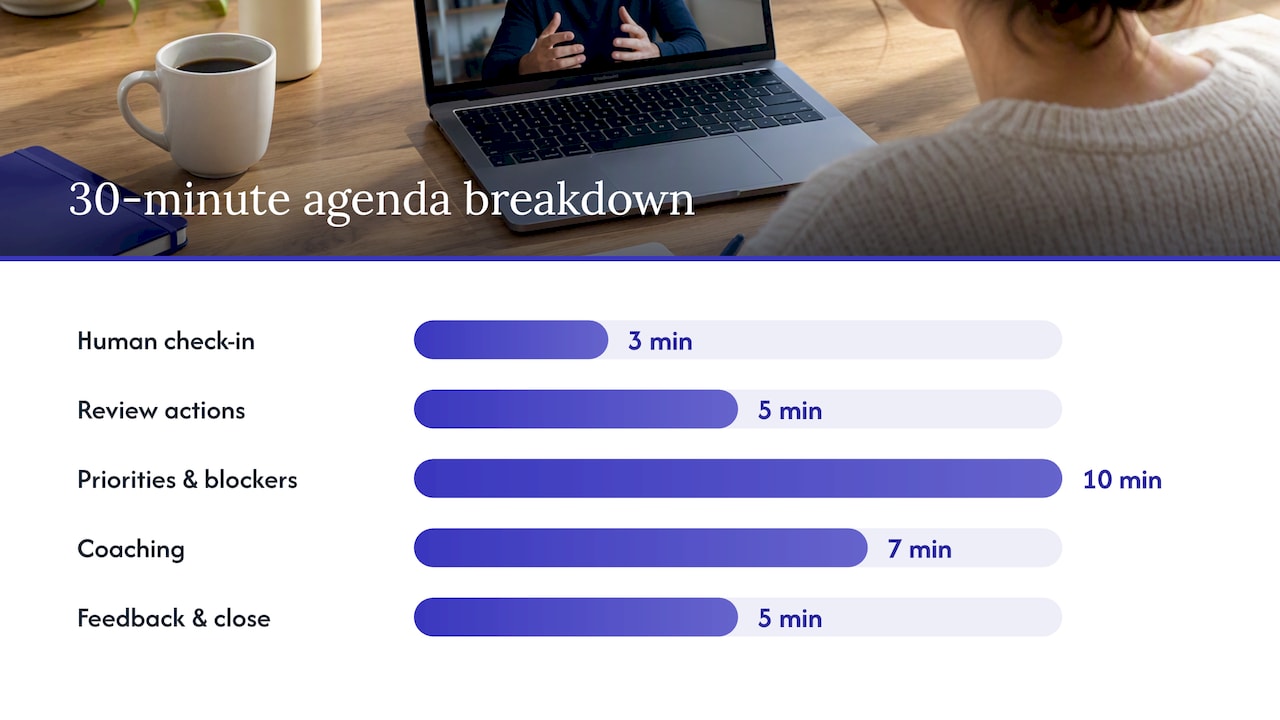
- Minutes 0 to 3: human check-in, no work talk yet.
- Minutes 3 to 8: review prior action items and progress.
- Minutes 8 to 18: employee’s priorities, blockers, and what support they need.
- Minutes 18 to 25: coaching on one or two specific issues, not everything at once.
- Minutes 25 to 30: two-way feedback and a close with named owners and dates.
For a 15-minute check-in, keep only the human check-in, blockers, and action items, and skip deep coaching for a longer session later in the week. For 45 minutes, add real career conversation time. For 60, use it for onboarding weeks or a quarterly deep dive where you’re covering months of context at once.
Here’s a one-paragraph template you can paste into an invite today: “Quick check-in: how are you doing this week? Then let’s review where we landed on [prior item] and talk through anything blocking you right now. I want to spend a few minutes coaching on [specific topic], and I’d like your honest feedback on how I can support you better. We’ll close with clear next steps and who owns what.”
The agenda itself should live in a shared, running document, not a fresh page every week. HBS recommends the employee send proposed topics about 24 hours before the meeting, which does two things at once: it gives the manager time to think instead of improvise, and it signals that the agenda belongs to the employee first. The manager’s job is to add context and priorities underneath, not to overwrite what’s already there. A simple structure works: employee adds items at the top, manager adds notes and follow-up at the bottom, and both can see the history of past weeks scrolling down.
How to run the meeting: roles, listening, and time
If you’re the manager and you’re doing most of the talking, you’ve turned a coaching conversation into a briefing, and briefings don’t build trust the same way.
Your job in the room is less about having answers and more about asking the right question at the right moment. Active listening means following up on what they actually said, not what you expected them to say. Sequence your questions from open to specific: start with “how’s it going,” move to “what’s getting in your way,” and only then get to “what do you need from me.”
Pro Tip: Close every one on one by repeating back the action items out loud before you end the call. It takes thirty seconds and prevents half the “I thought you said” confusion later.
A few habits separate a coaching conversation from a confused one:
- Let silence sit for a beat before jumping in; people often need a few seconds to get to the real answer.
- Ask “what have you tried” before offering a fix, so you’re coaching instead of solving for them.
- Save anything sensitive, disciplinary, or personal for a private setting, never a shared space or a call where someone might walk in.
- If a topic is clearly outside your authority, bank, pay, legal, say so and escalate to HR rather than guessing.
Difficult topics deserve a direct, calm tone rather than a cushioned one. Naming the issue plainly, early in the conversation, respects the person more than circling it for ten minutes before landing on it.
Question banks and conversation prompts
Different moments in the meeting call for different kinds of questions, and having a short bank ready keeps you from defaulting to “how’s everything going” every single week.
- Openers: “What’s the best part of your week so far?” or “Anything on your mind before we get into work?”
- Blockers: “What’s slowing you down right now?” or “What would make next week easier?”
- Development: “What skill do you want to be stronger at in six months?” or “Is there a project here you’d want more exposure to?”
- Feedback: “What’s one thing I could do differently to support you?” phrased as a genuine question, not a formality, tends to get a real answer instead of “nothing, I’m good.”
Career questions deserve regular airtime even when the week feels too busy for them. A quarterly question like “where do you want to be in a year, and what’s one step toward it” keeps growth on the table instead of letting it quietly disappear under deadlines.
Common mistakes and red flags to avoid
Most bad one on ones fail in predictable ways, and most of those failures have a quick fix once you see them.
- The meeting becomes a status update. Fix: push status to an async doc or Slack update before the meeting, and spend the live time on coaching and blockers instead.
- The manager talks the whole time. Fix: literally count it once in a while; if you’re over half the airtime, ask more and talk less.
- The meeting keeps getting canceled or pushed. Fix: treat it as a fixed commitment, and if it truly must move, reschedule within the same week.
- There’s no agenda, so the conversation drifts. Fix: reinstate the shared running document and ask the employee to add at least one item before each meeting.
- Nothing from last week gets followed up on. Fix: start every meeting with a thirty-second review of prior action items before moving forward.
Each of these is a habit problem, not a personality problem, which is good news: habits are fixable in a week or two of consistent effort.
Remote and hybrid considerations
Video should be the default for remote check-ins, and HBS recommends pairing that with occasional in-person sessions when distance allows, since a screen can carry a conversation but not always a relationship on its own. For anything sensitive, a phone call or a closed-door video session beats an open-plan video call where a roommate or officemate might overhear.
Confidentiality matters more, not less, when the meeting happens remotely. Confirm at the start of any sensitive conversation that the setting is private on both ends, and avoid chat tools that generate transcripts or searchable logs for anything personal.
Time zones and workload rhythms are worth adjusting for directly. A biweekly cadence with a slightly longer meeting can work better than a weekly one squeezed into an early morning or late evening slot that neither person is fully present for.
Notes, tracking, and follow-up
A one on one that produces no record is a conversation that evaporates by Thursday. Keep a shared running document with four columns that matter: decisions made, who owns each one, the deadline, and anything carried forward from last time.
- Open every meeting by scanning last week’s action items before adding new ones.
- Close every meeting by naming an owner and a date for anything new, out loud, not just in the notes.
- Use whatever task tool your team already runs, a shared doc, Asana, or even a simple running Google Doc works, as long as it’s reviewed weekly.
- Carry forward unresolved items instead of letting them quietly disappear between meetings.
The format matters less than the discipline of checking it every single time.
Middy Matthews: a coach’s take on the one on one habit
Her coaching philosophy, “Training, Not Selling,” applies directly to how managers should run one on ones: you’re developing a person’s judgment, not handing them a script.
A practical drill Middy’s approach encourages: before a tough conversation, say it out loud once to yourself the way you’d say it to the employee. If it sounds like a lecture, rewrite it as a question. “You need to communicate better” becomes “What’s getting in the way of you looping me in sooner?” The second version invites an answer instead of a defense, and it’s the kind of small rehearsal that makes a real difference in how the actual conversation lands.
Committing to the habit as a manager
I tell new managers the same thing every time: announce the change plainly. Something like, “I want to start meeting with each of you every other week, just you and me, to talk about what’s working and what’s not.” Then hold the first three meetings exactly on schedule, no matter what.
Open the shared agenda doc before the first one and ask each person to add one item. The first three meetings should focus on getting comfortable with the format, not solving everything at once. The habit matters more than the polish early on.
— Middy
Looking for outside help building this habit across your team
Reading a guide gets you the framework. Building the habit across a whole team of managers, especially ones who’ve never been taught to coach instead of direct, usually takes practice with feedback, not just good intentions. That’s where an outside session can do what a document can’t: give managers a chance to rehearse real conversations and get corrected in the room.

Middy Matthews’ workshops are built around the same coaching philosophy behind this guide: “Training, Not Selling” applied to leadership instead of sales. The Coached, Not Bossed. half-day training walks managers through role-play practice on exactly the kinds of conversations covered here, from opening a difficult topic to closing with clear ownership. For teams building a broader communication habit, the Interactive workshop offers the same coaching-based approach with room for live practice. Pricing for both is available on request through Middy’s team, and the quickest way to start is a direct conversation about what your managers need.
FAQ
What is the best agenda for a one-on-one meeting?
A strong 30-minute agenda opens with a short personal check-in, reviews prior action items, covers the employee’s current priorities and blockers, includes brief coaching on one or two issues, and closes with two-way feedback and named next steps, following the update, inform, consult structure recommended by UNC ExecDev. The agenda should live in a shared document the employee contributes to first.
What is a 1 on 1 meeting called?
It’s commonly called a one-on-one, a 1:1, a one-to-one, or simply a check-in, and all four terms describe the same recurring private conversation between a manager and an employee, as described in HBS guidance on the format. The name varies by company culture more than by substance.
What is the purpose of 1 on 1 meetings?
The purpose is relationship-building, coaching, clearing obstacles, and supporting an employee’s growth, not delivering status updates. Regular, predictable one on ones are tied to lower anxiety and stronger perceived job success, according to a Humu survey summarized by MIT Sloan.
What are signs of a bad 1 on 1 meeting?
Warning signs include the meeting turning into a status report, the manager talking for most of the time, the meeting being canceled or rescheduled repeatedly, and no agenda or follow-up between sessions. Each of these breaks the trust and predictability that make one on ones useful in the first place.
Leave a Reply