
Habit stacking at work means attaching one small new behavior to something you already do every day, like opening your laptop, ending a video call or refilling your coffee. You stop relying on motivation and let a routine you already have do the reminding. Below you’ll find the research on why it works, 15 examples you can steal for the office, a way to build your first stack this week, and how a team can do it together.
TL;DR
- Pick an anchor that happens on its own (opening your laptop, ending a call), then write it as “After [anchor], I will [tiny habit].”
- Workplace research on if-then plans found they predict both how often a new habit happens and how automatic it becomes.
- Forget the 21-day rule. A well-known habit study found a median of 66 days, with a range from 18 to 254.
- Start with one stack, keep it under a minute, and don’t panic over a missed day.
- Teams stick with habits faster when the leader models them and builds them into meetings.
Table of Contents
- What habit stacking looks like on a Tuesday
- Why it works: your brain wants to automate
- How long it really takes
- 15 habit stacking examples for the workday
- Build your first stack this week
- Design your environment, not your willpower
- Breaking a bad work habit by stacking a better one
- When the whole team stacks
- Our perspective: habits, not hacks
- Bring this to your team
- Common mistakes to avoid
- FAQ
- Sources
What habit stacking looks like on a Tuesday
Here’s the plain version. You already have a day full of habits you never think about. You open the laptop. You sit down with coffee. You hang up a call. Each one is a cue that fires with no effort from you.
Habit stacking borrows that cue. The American Heart Association describes it as connecting a new habit to an existing one, so one sits on top of the other. The formula is short: after I do X, I will do Y.
At work, that might be: After I close a video call, I will stand up and write down the one next step I promised. That’s it. No app, no new calendar block, no 5 a.m. routine.
I’ll be honest about where I come from on this. I spent decades in competitive sports and real estate, and in both, the people who last are not the ones with the most motivation. They’re the ones with the most boring, repeatable starts. Nobody asks a swimmer how motivated she feels before the first lap of warm-up. The warm-up is just what happens after you get to the pool.
Why it works: your brain wants to automate
Your brain is built to save energy. The habit research out of University College London describes us as cognitive misers: we automate what we can so we have energy left for the hard thinking. Most people try to change a habit with willpower, which is the most expensive tool they own, and willpower runs low by 3 p.m.
Two findings matter for your desk.
Habits are tied to context. The research doesn’t describe a habit as a free-floating behavior. It describes it as an association between a situation and an action. That’s why a cue that happens automatically, such as opening your laptop or ending a call, tends to work better than a time-based cue like “at 2:15,” which you have to keep watching the clock for.
If-then plans help in real offices. A 2024 diary study on promoting new habits at work looked at implementation intentions, the formal name for “if X happens, I will do Y.” These plans predicted habit frequency (estimate = .29) and automaticity (estimate = .12). The authors tie the benefit to conserved attention, which supports work engagement and goal progress. Habit stacking is an if-then plan where the “if” is something you already do.
Notice the second number is smaller. Automaticity builds slowly. Which brings us to the timeline.
How long it really takes
You’ve heard 21 days. It’s a myth. In the Lally study on habit formation, 96 volunteers picked one daily behavior and did it in the same context, such as after breakfast, for 12 weeks. The median time to automaticity was 66 days. Individual results ran from 18 to 254 days, depending on the behavior and the person.
Two takeaways for work:
- A simple habit (drinking water after a meeting) gets automatic faster than a complex one (a 10-minute weekly review). Size your expectations to the task.
- Missing a single day does not reset you. The same research found that an occasional miss doesn’t derail the process.
So if you’re on day 23 and it still feels like work, nothing is wrong. You’re on schedule.
15 habit stacking examples for the workday
Match the anchor to the kind of day you actually have. Each of these takes under two minutes.
Start of the day
- After I open my laptop, I will write down the one thing that makes today a win before I open email.
- After I pour my first coffee, I will read my calendar top to bottom and cross out one meeting I don’t need.
- After I sit down at my desk, I will put my phone in a drawer for the first deep work block.
Around meetings
- After I join a call, I will say hello to the person who joined first and ask one real question.
- After I end a call, I will write the next step and its owner in my notes right then.
- After I leave a meeting room, I will walk the long way to my desk for two minutes.
- After I send a meeting invite, I will add a one-line purpose to the description.
During focused work
- After I finish a task, I will close every tab I no longer need.
- After I finish a draft, I will read the first paragraph out loud once.
- After I check Slack for the third time in an hour, I will turn notifications off for the next 25 minutes.
The Upskillist guide for busy professionals points to similar anchors: the end of a daily meeting, your lunch break or the moment you leave the office are reliable signals even when the rest of your day shifts.
Middle and end of the day
- After I eat lunch, I will take a ten-minute walk without my phone.
- After I refill my water bottle, I will do five slow breaths at the sink.
- After I send my last email, I will write tomorrow’s top three on a sticky note.
- After I shut my laptop, I will say out loud one thing that went well today.
- After I leave the building, I will switch my phone to focus mode until morning.
For sales and real estate readers, here are three that come straight from the field. After I finish a showing, I will send one personal follow-up note before I start the car. After a call with a client, I will log what they asked, in their words. After a closing, I will schedule my next check-in with that person for 90 days out. None of these is a script. They’re the small touches that turn a lead into a person who trusts you.
Build your first stack this week
Most people fail at habit stacking by building five stacks on Monday. Build one.
Step 1: Choose the one thing
What’s the single behavior that would make your week better? Not your year. Your week. Maybe it’s writing next steps after calls. Maybe it’s walking at lunch.
Step 2: Find an anchor that already happens
Look for something you do nearly every workday without thinking. Good anchors are specific and observable: when I end a video call, not when I have a free moment. If you have to decide whether the anchor happened, it’s too fuzzy.
Step 3: Write it down in one sentence
“After I [anchor], I will [tiny habit].” Put it where you’ll see it: a sticky note on the monitor, the first line in your notes app.
Step 4: Shrink it
If the habit takes more than a minute or two, cut it in half. Two sentences of notes, not a full summary. One stretch, not a routine. You can grow it later. Right now you’re building the link between cue and action.
Step 5: Hold the context steady
The workplace field research behind implementation intentions stresses context stability: same trigger, same place, same time of day where you can. A habit hooked to a coffee that you drink at a different spot every day is hard to grow.
Step 6: Review after two weeks, not two days
Ask three questions. Is the anchor reliable? Is the habit small enough? Is anything in the way? Fix one thing, then keep going. Don’t add a second stack until the first one feels a little boring.
Design your environment, not your willpower
There’s a trick that works alongside the stack: make the first step visible. A field experiment on the working floor looked at replacing well-learned habits with new ones using if-then plans, and placing eye-catching cues right at the spot of the old behavior is one of the ways researchers have reduced unwanted habits. Think of the recycling box right on the desk, or gym clothes on the chair the night before.
At the office, it looks like this:
- Leave your notes template open in the window you use right after calls.
- Keep a water bottle on the keyboard side of the desk, not across the room.
- Put the book you want to read on top of your laptop at the end of the day.
You’re reducing the number of decisions between the cue and the action. Fewer decisions, more follow-through.
Breaking a bad work habit by stacking a better one
Here’s where many people get stuck. They try to stop doing something, like checking email forty times a day, and it doesn’t work.
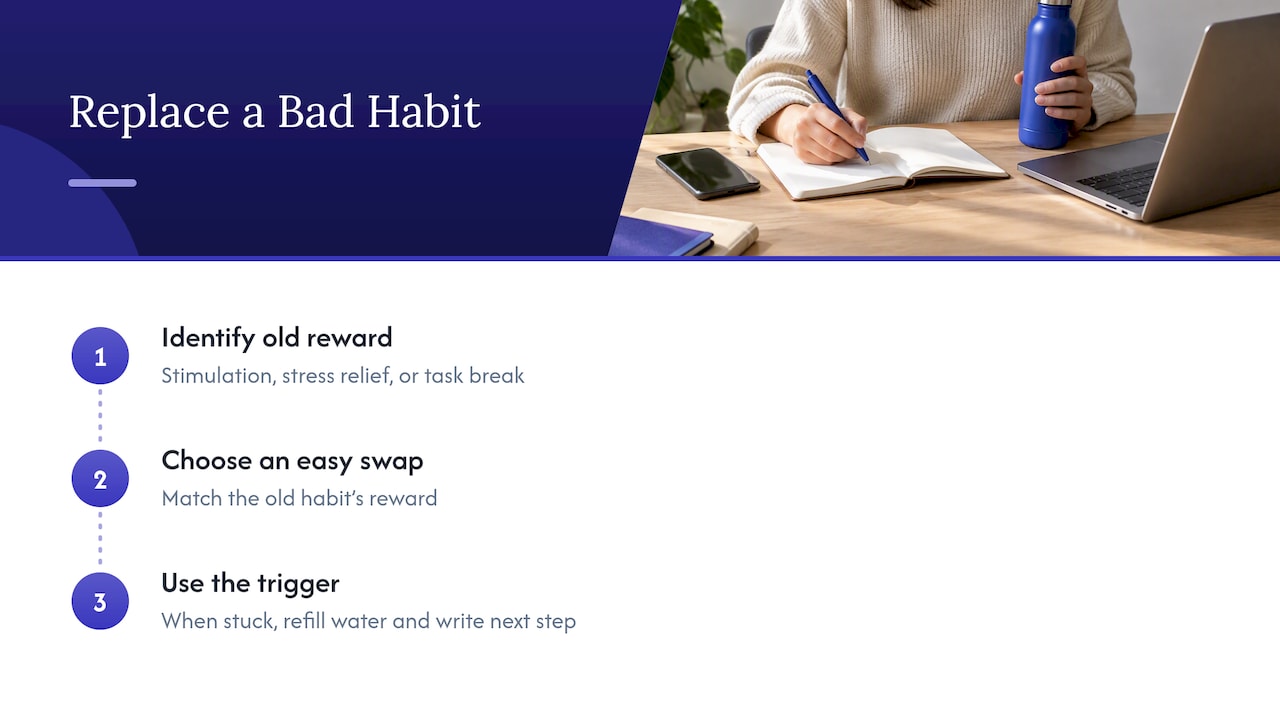
Researchers point out that breaking habits is often harder than forming them, and that replacing the old behavior works better than just trying to stop. The idea is simple. Figure out what the old habit gives you (a quick hit of stimulation, relief from stress, a break from a hard task) and give yourself an equally easy alternative that delivers the same thing.
Example: you open social media every time a hard task stalls. The reward is relief from friction. So the stack becomes: After I notice I’m stuck, I will stand up, refill my water and write the next tiny step on paper. You still get the break. You also get movement on the work.
It also helps to capture the thing you were about to chase. If distractions often start with “I should look that up,” keep one place where you drop it for later. A tool for saving and annotating what you read, like the approach in this 30 to 60 day plan for building a second brain for knowledge work, gives that urge somewhere to go besides a new browser tab.
When the whole team stacks
Individual habits are good. Shared habits are stronger. When a leader models a routine, it lowers what some call the activation energy for everyone else. Slack’s piece on productive work habits points to examples like opening meetings with a check-in and normalizing tech-free deep work blocks.
Those are habit stacks at team scale:
- After a meeting starts, we each give a one-sentence check-in before the agenda.
- After a decision is made, we name the owner and the date before we move on.
- After a project closes, we spend ten minutes on what to keep and what to change.
- After 10 a.m., we hold a quiet block with notifications off.
If you manage people, write these into your team norms so they don’t live only in your head. Our team norms playbook has copy-ready examples, and the 30 minute one-on-one guide shows how to anchor a coaching habit to a meeting you already hold every week. For the bigger picture on how leaders’ daily behavior shapes culture, see our piece on authentic leadership and real meeting habits.
Our perspective: habits, not hacks
We hear the same thing from teams across industries. They’ve tried the app, the planner, the morning-routine podcast. It lasted ten days. Then the calendar filled up and the whole system collapsed.
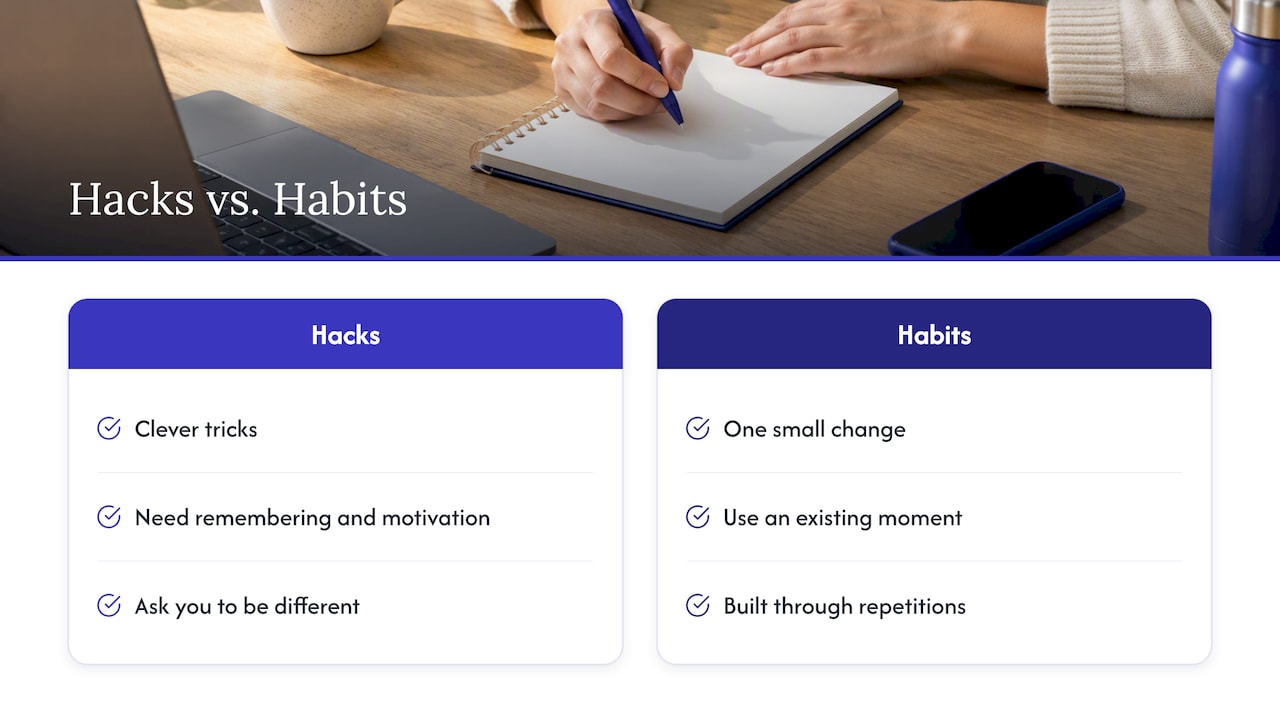
Here’s what we think is going on. Most productivity advice is built on hacks: clever tricks that need you to remember and feel motivated. A hack asks you to be a different person. A habit asks you to be the same person with one small change in the right place.
That comes straight from sports. In competition, nobody builds resilience in the big moment. You build it in the hundred small, boring repetitions before it: the same warm-up, the same first breath, the same reset after a mistake. When we coach sales teams and leaders, we use the same logic. Don’t add a new giant process. Find the existing moment, whether it’s the end of a call, the walk back from an open house or the first minute of a one-on-one, and put one good behavior there.
And then be patient. The research says 66 days is a median, not a deadline. If your team gives up at week three, the problem isn’t the team. It’s the timeline they were sold.
The other thing we’d say: pick habits that serve the people around you, not just your output. A follow-up note, a real question at the start of a call, a clear next step. Those are the habits that build trust, and trust is what keeps people coming back.
— Middy
Bring this to your team
If you’d rather have a room full of people leave with their own working stack than read about it, that’s what our corporate wellness keynote, Habits, Not Hacks, is built for. It’s a practical session for corporate teams on the habits behind sustainable high performance, and attendees can apply what they learn the same day. If your goal is leaders who coach rather than boss, take a look at the Coached, Not Bossed half-day training. For pricing and availability, reach out through middy.pro.
Common mistakes to avoid
- Stacking on a vague anchor. “When I have time” is not a cue.
- Making the new habit too big. A ten-minute review is a project. A two-minute note is a habit.
- Building five at once. One stack for two to three weeks, then add.
- Treating a miss as failure. Pick it back up at the next anchor.
- Ignoring the environment. If starting requires a search for your notebook, the stack breaks.
FAQ
Does habit stacking actually work?
The underlying method does have support. Workplace research on if-then planning found that these plans predicted both frequency and automaticity of new work habits. It works best when the anchor is reliable and the new habit is small. It’s not magic, and results vary from person to person.
What is a good example of habit stacking at work?
A simple one: after I end a video call, I will write down the next step and who owns it. The anchor happens many times a week, the habit takes under a minute, and the payoff is clear. Other good ones are listed in the examples above.
How long does it take for a work habit to stick?
The often-cited 21 days isn’t supported. In the Lally study, the median was 66 days, and individuals ranged from 18 to 254 days. Simple habits come faster, complex ones take longer.
What if I miss a day?
Nothing resets. The same research found that missing an occasional opportunity doesn’t break the formation process. Just do the habit at the next anchor and keep going.
Sources
- Promoting new habits at work through implementation intentions
- How are habits formed: modelling habit formation in the real world (Lally et al.)
- Making Health Habitual: The Psychology of Habit-Formation and General Practice
- Breaking and creating habits on the working floor: a field experiment on implementation intentions
- Habit Stacking for Success, American Heart Association
- Habit Stacking for Busy Professionals, Upskillist
- How to build productive work habits, Slack
Leave a Reply