
Inclusive leadership behaviors are the specific, repeatable actions a leader takes to make people feel heard, valued, and given a fair shot at opportunity. The three to start with are active listening, cognizance of bias, and sponsorship, because they change what happens in a room before culture ever gets discussed. The rest of this piece breaks down the evidence, the full priority list, the mistakes to unlearn, and a 30-day plan to make one of these stick.
TL;DR:
- Leaders should focus on practicing active listening, bias awareness, and sponsorship daily, as these behaviors have the most immediate impact on inclusion.
- Inclusivity requires ongoing relationship-building and behavior reinforcement, not a one-time checklist or values statement.
- Unlearning exclusionary habits like interrupting, favoritism, and tokenizing is crucial and can be addressed with specific, honest corrections.
- Tracking disaggregated data on participation, opportunities, and perceptions by demographic groups provides more actionable insights into progress than general averages.
- Building inclusive habits takes a dedicated 30-day cycle of practice, feedback, and reinforcement, with a focus on one behavior at a time for lasting change.
Table of Contents
- Why Inclusive Leadership Behaviors Matter More Than You Think
- Core Inclusive Leadership Behaviors to Practice Starting Today
- The Exclusionary Habits You Need to Unlearn
- What Questions Reveal Your Inclusive Leadership Blind Spots?
- How to Build the Habit: A 30-Day Behavioral Cycle
- Which Metrics Actually Show Inclusive Leadership Is Working?
- How Middy Matthews Turns Inclusive Behaviors Into Habits
- Why Most Inclusion Advice Skips the Hard Part
- Ready to Build This Into Your Team, Not Just Your Own Habits
- Sources
Why Inclusive Leadership Behaviors Matter More Than You Think
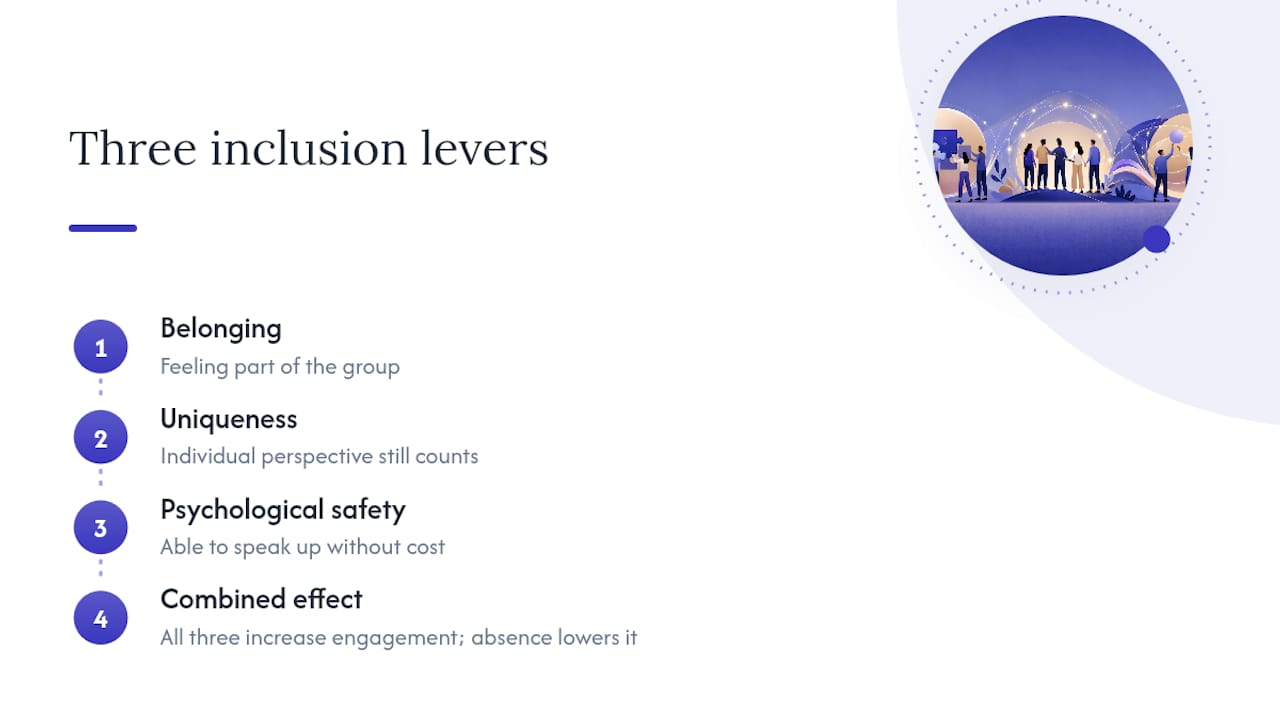
Most leaders treat inclusion as a values statement. That’s backwards. Inclusion is a mechanism, and it runs through three psychological levers: belonging, uniqueness, and safety. People need to feel like they’re part of the group (belonging), that their individual perspective still counts (uniqueness), and that speaking up won’t cost them anything (psychological safety). Miss any one of the three and engagement drops, even if the other two are strong.
A systematic review of inclusive leadership research consolidates this across dozens of studies: leader inclusion consistently predicts stronger problem-solving and higher engagement at the team and individual level. That’s not a soft outcome. Teams that solve problems better and stay more engaged outperform teams that don’t, full stop.
Deloitte’s research on this identifies six traits that separate inclusive leaders from everyone else: commitment, courage, cognizance of bias, curiosity, cultural intelligence, and collaboration. What makes this framework useful is that Deloitte doesn’t stop at naming traits — it ties each one to observable behavior. Courage isn’t a personality descriptor. It’s the leader who challenges the status quo in a meeting when it would be easier to nod along.
Here’s the number that should reframe your thinking: inclusive leadership isn’t a checklist you complete once. Research on how it actually plays out describes it as iterative and relational — leaders have to keep investing in individual relationships, keep counteracting stereotypes, and keep authorizing voice across a shifting mix of people. Treat it like a project with an end date and it decays the moment you stop paying attention.
Core Inclusive Leadership Behaviors to Practice Starting Today
Traits are abstract. Behaviors are what your team actually experiences. Below is a prioritized list, ordered roughly by impact versus effort, so you know where to spend your first hour of practice.
- Active listening. In practice, this means letting someone finish a sentence before you respond, then repeating back what you heard before adding your own take. Micro-habit: in your next three meetings, wait three full seconds after someone stops talking before you speak.
- Cognizance of bias. This is the discipline of noticing when your gut reaction to an idea is shaped by who said it rather than what was said. Micro-habit: before you approve or reject a proposal, ask yourself whether you’d react the same way if a different person on your team had presented it.
- Sponsorship. Mentoring tells someone what to do. Sponsorship puts your name behind them when they’re not in the room. Deloitte’s research on this distinction is blunt: leaders who actively sponsor underrepresented people move the needle on opportunity distribution faster than mentoring ever does, because sponsorship carries real risk for the sponsor. Micro-habit: name one person in your next leadership meeting for a stretch assignment, out loud, before anyone asks.
- Curiosity. Ask one more question than feels natural before you settle on an interpretation of a situation. Micro-habit: replace your first reaction to disagreement with “tell me more about how you got there.”
- Psychological safety building. This is less a single action than a pattern: how you respond the first time someone tells you something went wrong determines whether they’ll tell you the second time. Micro-habit: the next time someone admits a mistake to you directly, thank them for the disclosure before you address the mistake itself.
- Fair distribution of opportunities. Track, don’t assume, who gets the visible assignments, the client-facing work, and the stretch projects. Micro-habit: before assigning the next high-visibility task, glance at who got the last three.
- Inclusive process design. Rotating who facilitates a meeting, sending pre-reads so people who process information differently aren’t put on the spot, and using standardized evaluation criteria instead of gut feel all reduce the chance that bias fills the gaps. Practical guidance on this is consistent: structural guardrails like rotating facilitators and pre-reads work because they don’t depend on your willpower on a bad day.
- Humility, done right. There’s a trap here worth naming directly. Performative modesty, the “oh, I don’t really know anything” routine, actually erodes your credibility as a leader. What works instead is courageous vulnerability: admitting a specific limit and asking for specific help. That distinction between performative humility and genuine vulnerability is one most leadership advice glosses over entirely.
Pro Tip: Pick the behavior that’s easiest for you to practice in the next 24 hours, not the one that sounds most impressive on a leadership competency framework. Momentum beats ambition here.
One thing worth naming up front: doing this well tends to feel uncomfortable at first, especially cognizance of bias and sponsorship, because both ask you to act against a habit you’ve never had to examine. Practitioner guidance on inclusive leadership development treats that discomfort as a signal to keep going, not a sign you’re doing it wrong.
Notice what’s missing from this list: nothing about company values statements, diversity training modules, or annual culture surveys. Those things aren’t useless, but they’re not behaviors. They’re artifacts. The seven items above are things you do in a specific meeting, with a specific person, today.
The Exclusionary Habits You Need to Unlearn
Inclusive leadership behaviors don’t exist in a vacuum. Half the work is subtracting habits you probably don’t even notice you have.
- Interrupting. Cutting someone off, especially someone earlier in their career or from a group underrepresented on your team, signals their input matters less than your timeline. Replace it with the three-second pause from the active listening habit above.
- Favoritism in assignments. Giving the interesting work to the same two or three people because they’re a known quantity feels efficient. It quietly starves everyone else of the experience they’d need to earn that trust. Replace it by tracking assignment distribution for a month, in writing.
- Tokenizing. Asking one person to “represent” their entire demographic’s perspective in a meeting puts an unfair burden on an individual and treats a group as monolithic. Replace it by seeking multiple perspectives from multiple people, on their own terms, not as spokespeople.
- Confusing micro-affirmations with micro-aggressions. A micro-affirmation, quietly crediting someone by name for an idea they raised earlier, builds trust in seconds. Its inverse, a backhanded comment about someone’s “surprising” competence, does damage that outlasts the meeting. Learn to tell the difference and audit your own comments for the second kind.
- Soliciting feedback and doing nothing visible with it. This might be the most underrated failure on the list. Practitioner guidance is direct about this: asking for input without closing the loop publicly breeds cynicism faster than never asking at all. If you survey your team, tell them what changed because of it.
Every one of these has a repair path, and the repair is almost always the same: name what happened, own it specifically, and show the fix in public rather than apologizing in private and changing nothing visible.
What Questions Reveal Your Inclusive Leadership Blind Spots?
You can’t fix what you haven’t measured in yourself first. Run through these before you pick a behavior to work on:
- In my last five meetings, did I speak first or last on contested topics?
- Can I name, without checking notes, who contributed the last three good ideas on my team?
- When someone disagreed with me last month, what was my first reaction, curiosity or defensiveness?
- Who received the last three high-visibility assignments, and why?
- Have I sponsored someone by name in a room they weren’t in, in the past 90 days?
- When was the last time I said “I don’t know, help me understand this” out loud to my team?
- Do my meetings use pre-reads and rotating facilitation, or does the same person always run the show?
- When I’ve collected feedback, can my team point to something that visibly changed as a result?
- Would someone two levels below me describe my door as actually open?
Score yourself honestly, then ask a direct report or peer to score you on the same nine questions anonymously. The gap between your self-score and their score is usually more informative than either score alone. Run this every quarter, and where you can, pull input specifically from people in groups underrepresented on your team. Their view of question four and question seven tends to differ sharply from everyone else’s.
How to Build the Habit: A 30-Day Behavioral Cycle
Reading a list of behaviors changes nothing by itself. Practice does. Here’s a structure that turns one behavior into a habit in a month, borrowed from practitioner guidance on habit formation in leadership development.
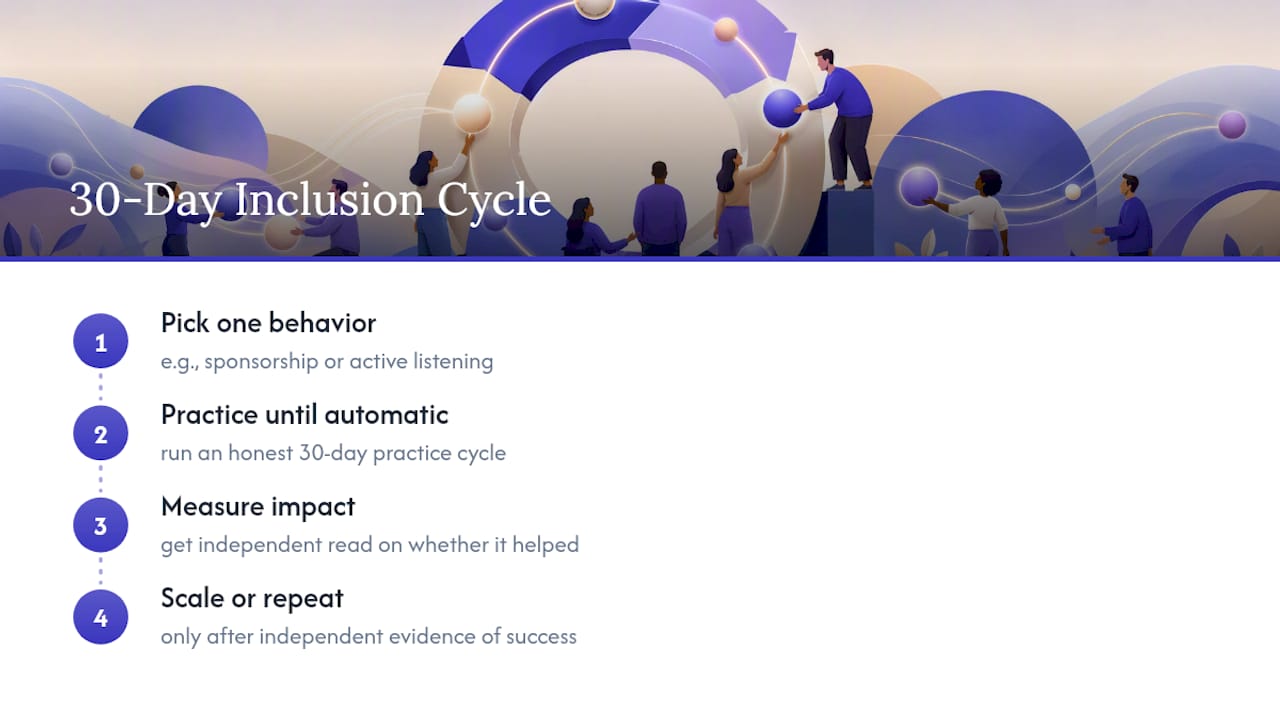
- Pick one behavior and define success in binary terms. Not “be a better listener,” but “wait three seconds before responding in every one-on-one this week.” A vague goal can’t be checked; a binary one can.
- Tell someone. An accountability partner, a peer, your own manager. Set a recurring fifteen-minute check-in, weekly, where you report honestly on how the behavior went.
- Check in at day 15. Are you doing the behavior automatically yet, or still forcing it? If you’re still forcing it, that’s normal. Keep going rather than switching targets.
- At day 30, collect independent feedback. Ask the same people affected by the behavior, directly, whether they’ve noticed a change. Practitioner guidance on this cycle is specific: compare your self-assessment against an independent colleague evaluation at the close of the cycle, because self-perception and observed behavior often diverge more than leaders expect.
- Embed a structural guardrail. Once the behavior feels natural, back it with a process change so it survives a bad week. If your behavior was rotating who speaks first, put it on the meeting agenda template so it doesn’t depend on your memory.
Pro Tip: Don’t stack a second behavior on top of the first until the first one runs without you thinking about it. Trying to fix five habits in one month is how leaders end up fixing none.
Which Metrics Actually Show Inclusive Leadership Is Working?
An average engagement score across your whole team hides the exact problem you’re trying to solve. Real signal comes from disaggregated data.
- Voice participation, tracked by who speaks in meetings and how often, broken out by group, not averaged across the room.
- Assignment and promotion distribution, tracked over quarters, not just at review time.
- Belonging and psychological safety survey items, cut by demographic group rather than reported as a single company-wide number.
- Retention and exit interview themes, watched for patterns that repeat across a specific group rather than isolated incidents.
Research on measuring this kind of change is specific on one point: disaggregate everything by relevant group and track it over time, because small shifts within a subgroup often reveal the most actionable gap, long before it shows up in a company-wide average. Set a short-term target, something checkable in a quarter, and a longer-term target checked annually, and be suspicious of any single metric that looks great in isolation. A rising engagement score paired with flat promotion distribution for one group isn’t progress. It’s a metric that got optimized while the underlying problem stayed put.
How Middy Matthews Turns Inclusive Behaviors Into Habits
The “Training, Not Selling” philosophy behind Middy’s work maps almost exactly onto the 30-day cycle above. Selling gets someone to nod along in a room for an hour. Training gets a behavior to survive contact with a real Tuesday morning meeting three months later. That’s the difference between a keynote that feels good and a workshop that actually changes what people do.
Middy’s formats are built around that distinction: a keynote to set the frame and name the behaviors that matter, a half-day workshop to practice them in real scenarios specific to the room, and cohort-based training with built-in accountability checkpoints for teams that want the full 30-day cycle embedded into their culture rather than left to individual willpower.
Why Most Inclusion Advice Skips the Hard Part
Most inclusive leadership content stops at the list. Six traits, ten behaviors, a values statement to hang in the break room. The research actually supports something narrower and more useful: pick one behavior, practice it until it’s automatic, then measure whether it changed anything for the people it was supposed to help. Everything else is preparation for that one step.
Where conventional advice falls short is treating awareness as the finish line. Knowing that cognizance of bias matters changes nothing if you never build the specific habit of pausing before you approve a familiar name for the next assignment. The traits are the map. The 30-day cycle is the vehicle.
If you’re a leader reading this and feeling like you should start everywhere at once, don’t. Pick sponsorship or active listening, run the 30-day cycle honestly, and get an independent read on whether it worked before you touch a second behavior. Depth on one habit beats breadth across ten every time.
— Middy
Ready to Build This Into Your Team, Not Just Your Own Habits
Reading this list is the easy part. Getting a whole leadership team to practice the same behaviors, with the same accountability, is where most companies stall out on their own. Middy’s workshops exist specifically for that gap: a room full of managers leaves with one behavior each, a way to measure it, and a peer system to check whether it stuck.

If you’re planning a leadership offsite, a manager training day, or a longer cohort program built around habit change rather than another values presentation, sales training built to stick is the place to see how Middy structures that work in practice. Reach out to check dates and scope a session for your team.
Sources
A handful of sources anchor most of the research cited above, and each is worth reading directly if you want to go deeper.
- Inclusive Leadership: Traits, Behaviors, and Examples — Rework resources
- Six signature traits of inclusive leadership — Deloitte Insights
- About and beyond leading uniqueness and belongingness: A systematic review of inclusive leadership research — ScienceDirect
- How to Practice Inclusive Leadership for a Stronger Team — HBS Online Blog
Leave a Reply