
Workplace resilience training is a structured, multi-session program that teaches adaptive skills, emotional regulation, cognitive flexibility, social support, and recovery practices, to improve how employees handle pressure and perform under it. HR and L&D own the design; managers own the reinforcement. A single lunch-and-learn session is unlikely to produce lasting behavior change. A program built on repeat practice, coached by trained facilitators, will.
TL;DR:
- Multi-session resilience training with follow-up and manager involvement produces more durable behavioral change than single workshops or quick wellness perks.
- Effective programs focus on practice-based skills in emotional regulation, cognitive reframing, social support, and recovery, rather than just delivering information.
- Organizations should tailor their training based on needs assessments, set measurable goals, and pilot before scaling to ensure real impact on stress, absence, and engagement metrics.
- Reinforcement strategies such as digital nudges, peer groups, and manager coaching are essential to sustain resilience gains over time.
- Research confirms that resilience skills improve with active practice over weeks, and neglecting ongoing reinforcement results in fading benefits within a few months.
Table of Contents
- What Is Workplace Resilience Training, Exactly?
- Why Resilience Training Matters to Your Organization
- Core Components and Formats of Effective Resilience Programs
- How to Design a Workplace Resilience Training Program
- Sample Curriculum: Session Templates You Can Adapt
- Delivering Resilience Training at Scale
- Measuring the Impact of Resilience Training
- What Research Says About Program Effectiveness
- What 30 Years of Coaching Athletes Taught Middy About Resilience at Work
- The Gap Between What Resilience Training Promises and What Actually Works
- How Middy Matthews Builds Resilience Training That Sticks
- Sources
What Is Workplace Resilience Training, Exactly?
Resilience isn’t a personality trait some employees have and others don’t. It’s a set of learnable skills, and that distinction matters for how you build a program.
The Cleveland Clinic defines resilience training as active, skill-based work suitable for almost any group, from first responders to office teams. That framing matters because it separates resilience training from two things people confuse it with: wellness perks and therapy. A gym stipend or a meditation app subscription is a perk. It might help someone feel better on a given day, but it doesn’t teach a skill. Therapy treats diagnosed conditions with a licensed clinician. Resilience training sits in between: it’s skill-building, delivered to groups, aimed at performance and coping, not diagnosis or treatment.
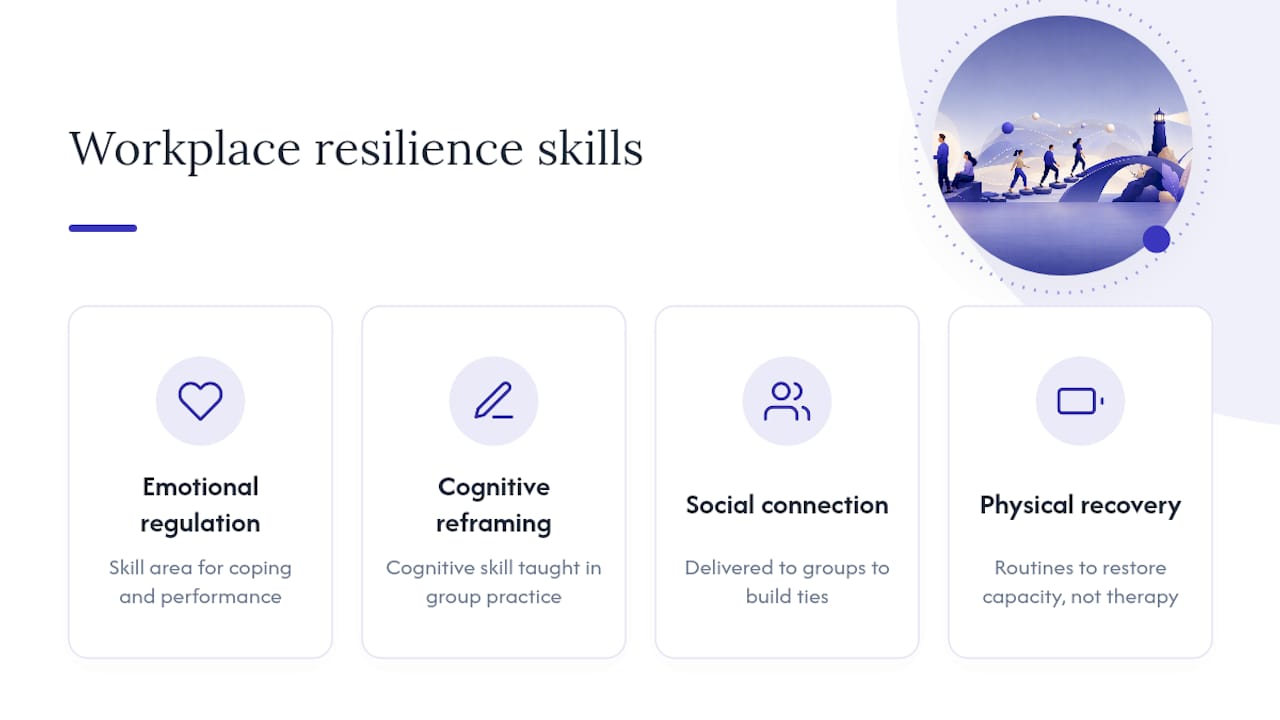
Most credible programs organize skills into key capability areas such as emotional regulation, cognitive reframing, social connection, and physical recovery routines.
Wharton’s executive education program on resilience frames this as a strategic capability leaders build into how a team operates, not a soft add-on. That’s the mindset HR needs going in: resilience training works when it’s designed like a skills program, with practice reps and follow-up, not delivered like an assembly.
Why Resilience Training Matters to Your Organization
The business case isn’t abstract. Burnout contributes to turnover, which increases recruiting costs, an expense tracked by CFOs. Resilience training gives HR a lever that touches retention, engagement, and absence numbers at the same time.
What the data shows: Reviews of structured resilience interventions in peer-reviewed research find meaningful improvements in coping and mental health indicators, but the same research is clear that those gains fade without reinforcement. A one-time workshop produces a short-term mood bump. A program with follow-up produces a shift in how people actually respond to pressure months later.
That reinforcement requirement is the whole ballgame. Organizations that treat resilience as a single event tend to see a temporary lift in survey scores and nothing durable behind it. Organizations that build multi-session programs with manager involvement see different results, because the skill gets practiced in real work situations, not just in a training room.
When you’re building the case to leadership, track these signals before and after rollout:
- Employee engagement survey scores, especially items tied to stress and support.
- Absence and short-term disability trends.
- EAP utilization rates, which often rise (a good sign, meaning people are using support) before they fall.
- Manager-reported observations of team stress responses during high-pressure periods.
None of these numbers move overnight. Give a program sufficient time, generally several months, before you draw conclusions from the data.
Core Components and Formats of Effective Resilience Programs
There’s no single right format, but there are three models HR teams use most often, and each fits a different organizational need.
- Short workshops of under two hours. These serve as introductions or stand-alone sessions for teams unable to commit to longer programs. Large EAP providers offer modular seminars within this timeframe.
- Multi-week skill programs. Harvard Medical School’s SMART program is an intensive series of group sessions spanning multiple weeks, focusing on active practice rather than passive listening. This format is the one most likely to produce lasting behavior change, because participants get multiple reps at the skill before the program ends.
- Leader-specific cohorts. Manager and executive groups often need a separate track focused on modeling resilient behavior for their teams and coaching direct reports through stress, not just managing their own.
Delivery mode is a separate decision from format length. Live in-person sessions build trust fastest and work best for the social-connection skill area. Hybrid and virtual synchronous formats scale across locations without losing the interactive practice piece. On-demand microlearning fills gaps between live sessions but shouldn’t replace them entirely. Train-the-trainer delivery, where you certify internal facilitators to run sessions, is how larger organizations keep costs down while reaching every location.
Most organizations land on a hybrid: a live kickoff, a multi-week core arc (often paced weekly, echoing the eight-week SMART cadence), and manager-led reinforcement sessions afterward.
How to Design a Workplace Resilience Training Program
Building a program from scratch feels big. Broken into steps, it’s manageable in a single planning quarter.
- Run a needs assessment first. Pull existing engagement survey data, absence trends, and EAP utilization before you write a single learning objective. If your data shows burnout concentrated in one department, your program should start there, not with an all-staff rollout.
- Set measurable objectives. “Improve resilience” isn’t measurable. “Reduce reported stress-related absence by a defined margin within two quarters” is. Write objectives your CFO could read and understand.
- Define your audience segments. All-staff sessions build a shared vocabulary. Manager cohorts need coaching skills layered on top. High-stress teams (support desks, frontline healthcare, sales floors under quota pressure) need content tuned to their specific triggers.
- Choose content and delivery together. Decide facilitator qualifications now: internal HR staff trained through a certified program, external practitioners, or a blend. Penn’s resilience training model is built around exactly this kind of train-the-trainer scalability, which keeps quality consistent as you expand beyond a pilot group.
- Pilot before you scale. Run the program with one team or one location. Collect baseline resilience and stress measures before day one, then measure again immediately after and at the 90-day mark.
- Iterate based on what the pilot shows. Adjust pacing, content, or facilitator approach before committing budget to a company-wide rollout.
Pro Tip: Run your pilot with a team that’s moderately stressed, not your most burned-out group. A team in crisis needs immediate support, not a six-week experiment, and a group with too little stress won’t show measurable change either way.
Sample Curriculum: Session Templates You Can Adapt
You don’t need to build content from zero. Here’s a five-session arc, roughly 60 to 75 minutes each, that mirrors the practice-first structure used in longer evidence-based programs.
- Session 1: Naming the stress response. Objective: help participants recognize their own physical and emotional stress signals. Activity: a guided body-scan and journaling exercise, followed by small-group sharing.
- Session 2: Breathwork and physiological reset. Objective: teach one reliable breath-control technique. Harvard Health’s research on breath control shows a physiological basis for slower, deeper breathing calming an activated stress response; the session should have people practice the technique live, not just hear about it.
- Session 3: Cognitive reframing. Objective: catch and rewrite one distorted thought pattern. Activity: pairs work through a real recent work stressor, identifying the automatic thought and building a more balanced alternative.
- Session 4: Peer-support mapping. Objective: identify who on the team can offer support in a stressful stretch. Activity: participants map their existing support network and identify one gap to close.
- Session 5: Role-play for adaptive responses. Objective: practice a resilient response to a realistic work scenario, like a missed deadline or a hostile client call. Activity: scenario-based role-play with facilitator feedback.
Give facilitators a script for each session, not just an outline. A script keeps quality consistent when multiple people are running the same content across departments. End every session with one written takeaway participants can use that same week, not a general reminder to “practice resilience.”
Delivering Resilience Training at Scale
A pilot that works in one department doesn’t automatically work company-wide. Scaling takes a deliberate structure, or quality erodes fast.
Build a train-the-trainer track with a real competency checklist: can this person run the breathwork exercise correctly, handle a participant who gets emotional during the cognitive reframing session, and keep a role-play exercise on time? Certify facilitators against that checklist before they run sessions solo.
Managers need their own enablement track, separate from the general employee program. A short toolkit and a handful of micro-briefings, 15 minutes each, on how to spot a stressed team member and open a supportive conversation, go further than a long manager-only seminar.
Reinforcement is what makes the training stick after the sessions end:
- Send short digital nudges tied to specific skills, timed to when teams typically hit stress spikes (end of quarter, product launches).
- Set up small peer practice groups that meet briefly on a fixed schedule.
- Build one resilience-related question into standard 1:1 check-ins.
- Add resilience behaviors to manager scorecards so coaching this skill isn’t optional.
Pro Tip: Ask managers to model the skill publicly at least once. A manager who says out loud, “I’m going to take three breaths before I respond to this,” does more to normalize the practice than any poster on the break room wall.
Measuring the Impact of Resilience Training
You need numbers before you can defend the budget line next year. Set your measurement plan before the first session, not after.
Baseline every cohort with a validated resilience or stress scale, plus your existing engagement, absence, and EAP contact data. Measure again immediately post-program and again at 90 days. The 90-day mark is the one that actually tells you whether skills stuck.
Structured programs with reinforcement, in contrast to one-off sessions, are what organizational wellbeing guides consistently recommend precisely because single sessions rarely produce measurable behavior change on their own.
Track these indicators on a simple dashboard leadership can read in five minutes:
- Pre/post resilience or stress-scale scores by cohort.
- Engagement survey items tied to stress and manager support.
- Absence and short-term disability trends over two full quarters.
- EAP utilization, watching for the expected early rise followed by a longer-term dip.
- Manager-reported qualitative shifts in team stress handling during known crunch periods.
Report short-term indicators (survey scores, session attendance) separately from long-term outcomes (absence trends, retention). Conflating the two makes your results look weaker or stronger than they actually are.
What Research Says About Program Effectiveness
Two program models anchor most of the credible evidence in this space, and both point to the same conclusion: resilience training works, but only with sustained practice.
- Penn Resilience Training uses a train-the-trainer model specifically because scale without quality control produces weak results, a real constraint for any organization planning a rollout beyond a single site.
- Harvard Medical School’s SMART program runs eight weeks of group sessions built on active practice, not lectures, which is the structural feature most linked to durable change.
- Broader research reviews on structured resilience interventions describe meaningful short-term improvements in coping, paired with a consistent caveat that gains fade without ongoing reinforcement.
The practical implication for HR: budget for reinforcement from day one. A single eight-week cohort with no follow-up will likely show the same fade-out pattern the research describes. Pair any program with manager coaching and a measurement cadence that extends well past the last session.
What 30 Years of Coaching Athletes Taught Middy About Resilience at Work
Competitive sports don’t build resilience through motivational speeches. They build it through drills, repeated until the response becomes automatic under pressure. The “Habits, Not Hacks” approach to corporate resilience training borrows that logic directly: a session isn’t complete until people have practiced the skill, not just discussed it.
Two things translate especially well from the field to the office. First, practice-first facilitation, where the facilitator demonstrates the drill before explaining the theory behind it. Second, manager micro-coaching, short, specific corrections delivered in the moment, the same way a coach corrects a form flaw mid-drill rather than saving it for a season review.
The Gap Between What Resilience Training Promises and What Actually Works
Most resilience programs oversell the single workshop and undersell the follow-up. That’s backward, and the research bears it out: a lecture-style session produces a short-term mood lift and little else, while structured, multi-week practice produces the durable shift HR actually wants to see in absence and engagement data.
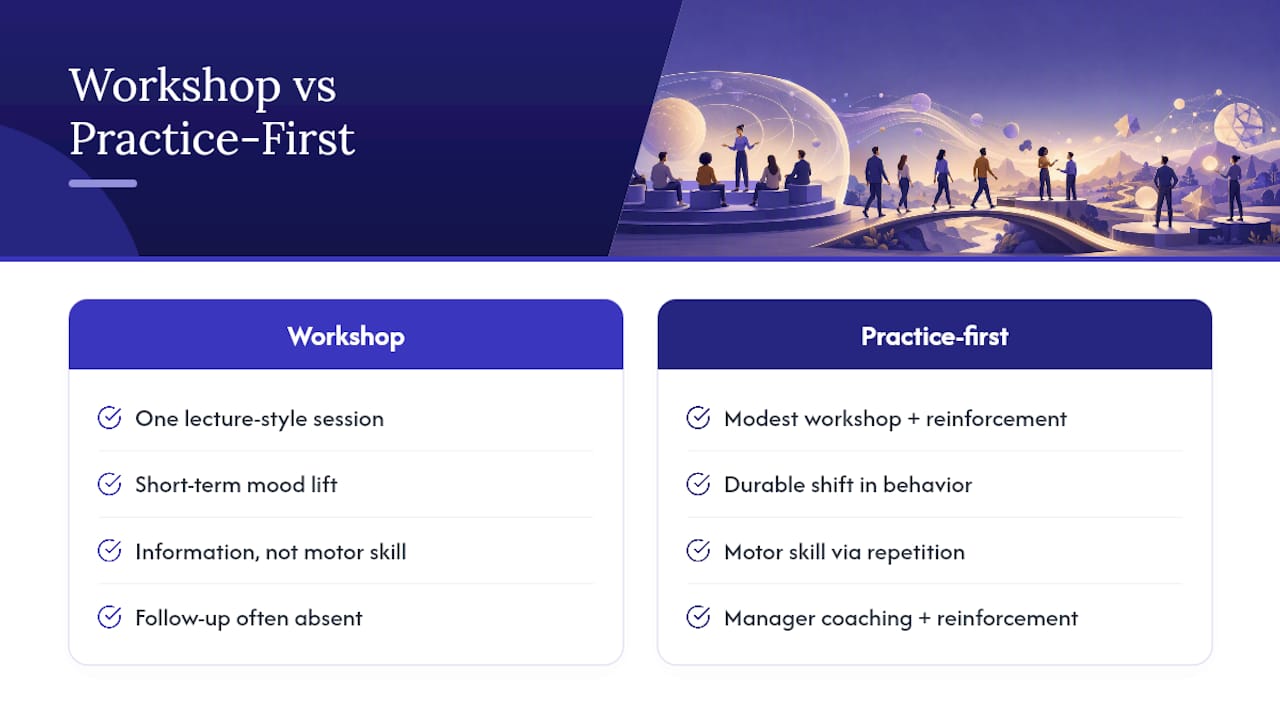
The conventional advice, “bring in a speaker for an hour, check the wellness box,” treats resilience like an information problem. It isn’t. Resilience is a motor skill for the mind, and motor skills come from repetition under realistic pressure, not from hearing a good explanation once.
If you’re prioritizing where to spend limited budget, spend it on the reinforcement layer before you spend it on production value for the kickoff session. A modest workshop followed by real manager coaching and a 90-day practice cadence will outperform a polished one-day event every time. The mistake most organizations make isn’t picking the wrong content. It’s stopping the moment the session ends, right when the actual skill-building was supposed to start.
— Middy
How Middy Matthews Builds Resilience Training That Sticks
Resilience training can be run the way a coach runs a season, not the way a consultant runs a slide deck. Programs may range from a focused half-day workshop for a single department to multi-week cohorts with dedicated manager tracks, often built on a practice-first structure athletes use to make a skill automatic under real pressure.

If your organization is weighing where to start, a short diagnostic call is the fastest way to find out. It is possible to match the format, whether half-day, multi-session, or manager-only cohort, to what your engagement and absence data are actually telling you, rather than defaulting to a generic template. For teams that want to see how this practice-first philosophy plays out in a related setting, sales training ideas that actually stick shows the same coaching method applied to a different skill set. To get a pilot session on the calendar, reach out through Middy’s corporate wellness speaking page and start with the smallest team that will give you a clean read on what’s working.
Sources
- Penn Resilience Training — Positive Psychology Center
- Stress Management and Resiliency Training (SMART) — Harvard Medical School
- The Resilient Leader — Wharton Executive Education
- Resilience Training — Cleveland Clinic
Leave a Reply