
Values-based leadership is the practice of making decisions and modeling behavior that consistently reflect your core values, which produces clearer choices, higher trust, and stronger team alignment. It works because it replaces guesswork with a decision filter everyone can name. The payoff shows up in how fast a team resolves conflict, not in a poster on the wall.
TL;DR:
- Values-based leadership is most effective when leaders clarify their core values through concrete behaviors and embed them into hiring, performance reviews, and daily rituals.
- Successful implementation requires constant communication, real-time decision-making disclosure, and a shared understanding of how values influence choices under pressure.
- Common failures include tokenism, disconnection from strategy, and leader hypocrisy, which can be prevented by integrating values into policies and accountability systems.
- Culture significantly affects a values-based approach, with organizations that reward honesty and collaboration amplifying its impact, while result-driven cultures can dilute individual efforts.
- Practicing core behaviors through role-plays, scripting, and coaching solidifies values into team habits more effectively than theoretical discussions.
Table of Contents
- What Is Values-Based Leadership, and How Does It Fit Other Models?
- What Attributes and Benefits Come With Leading by Values?
- How Do You Actually Put Values-Based Leadership Into Practice?
- Why Do Values Initiatives Fail, and How Do You Avoid It?
- What Does the Research Actually Say About Values-Based Leadership?
- What Are Some Real Examples and Tools You Can Use This Week?
- How Do You Measure Whether Values Are Actually Aligned on Your Team?
- Why Does Communication Make or Break Values-Based Leadership?
- How Do You Navigate Competing Values Without Losing Credibility?
- Does Company Culture Determine Whether Values-Based Leadership Works?
- Why Middy Teaches Values-Based Leadership Through Practice, Not Lectures
- Ready to Build Values-Based Leadership Into Your Team?
- Sources
What Is Values-Based Leadership, and How Does It Fit Other Models?
Values-based leadership means letting a defined set of principles govern how you decide, communicate, and treat people, every single time, not just when it’s convenient. That’s the whole definition. The hard part is living it when it costs you something.
You’ll hear this idea described under different names: authentic leadership, servant leadership, transformational leadership. They’re not competitors. Research treats values-based leadership as an umbrella term that overlaps heavily with all three, because each of those theories shares the same core emphasis on moral and authentic behavior. Authentic leadership focuses on self-awareness. Servant leadership focuses on putting others’ needs first. Transformational leadership focuses on inspiring change. Values-based leadership is the connective tissue running through all of them.
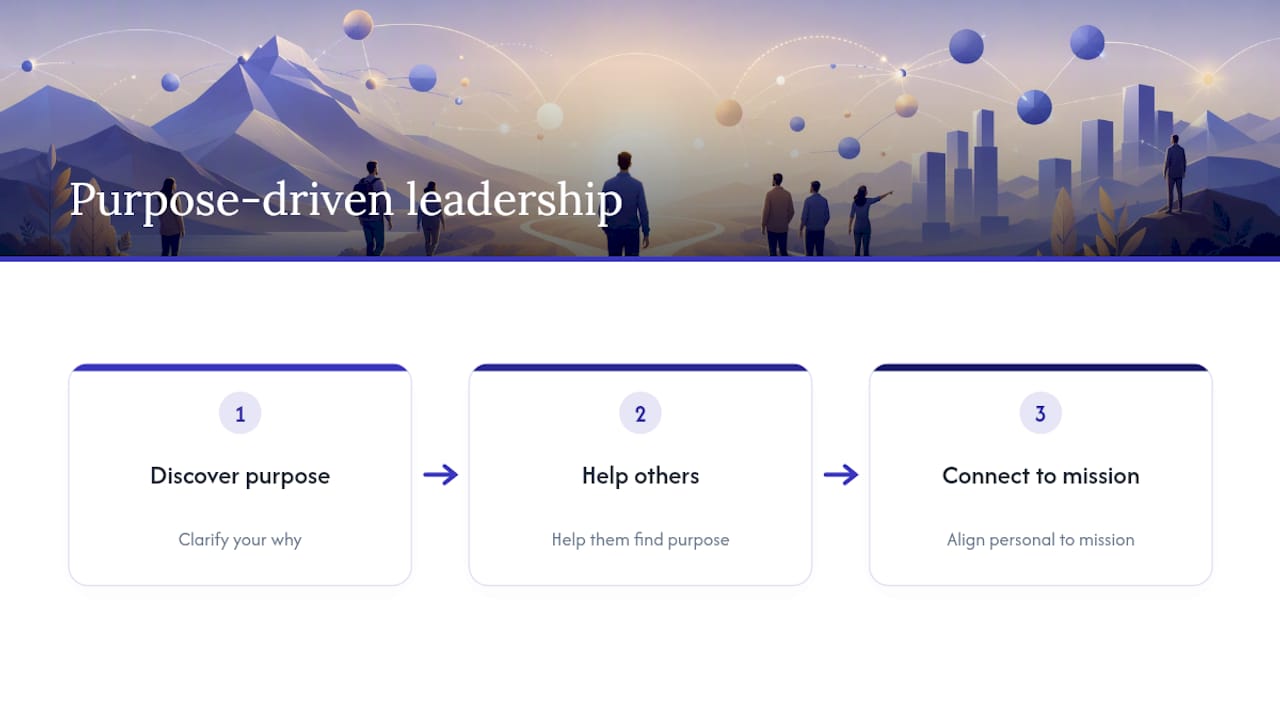
The clearest way to operationalize it comes from purpose-driven leadership literature, which frames the work as three undertakings: discover your own purpose, help the people around you find theirs, and connect your personal purpose to the organization’s mission. Skip any one of those three, and you get a leader who’s clear on values but disconnected from the team, or a team that’s motivated but has no idea what the organization actually stands for.
What Attributes and Benefits Come With Leading by Values?
Values-based leaders share a small set of habits you can actually build, not personality traits you’re born with. Self-reflection comes first: you can’t lead from values you haven’t named. Leaders who write those values down in a personal credo, rather than keeping them in their head, tend to make faster and more consistent calls under pressure, according to practitioner guidance.
The other attributes worth cultivating:
- Humility — treating your own judgment as one input, not the final word
- Consistency — applying the same standard to a good week and a bad one
- Emotional intelligence — reading how a decision lands before you make it
- Enabling others — shifting from managing tasks to creating conditions where people can pursue what they care about
The organizational payoff isn’t abstract. When leaders embed values into how people are hired, reviewed, and promoted, the research points to a measurable lift in behavioral integrity and follower trust, which shows up downstream as stronger engagement and leadership effectiveness.
Pro Tip: Write your personal credo in one page, in plain language, with real examples of decisions you’ve made. If you can’t point to a past decision that demonstrates a value, it’s not a value yet. It’s a wish.
How Do You Actually Put Values-Based Leadership Into Practice?
Values stop being decorative the moment they show up in a policy, not a poster. Here’s the sequence that works.
- Name your values and write the credo. Set aside real time for self-reflection, then write down three to five values with a sentence each on what they look like in action. Vague words like “integrity” mean nothing without a behavior attached.
- Translate values into observable behaviors. Effective leaders convert abstract values into non-negotiable daily habits, so the values guide low-stakes trade-offs, not just the big dramatic ones.
- Wire values into hiring. Add value-based questions to your interview rubric. Ask candidates to describe a time they had to choose between speed and honesty, then listen for what they actually did.
- Embed values into performance reviews and promotion criteria. If someone hits every number but tramples the team to get there, that has to show up in their review. Otherwise the values are optional.
- Build daily and weekly rituals. A two-minute “values moment” at the start of a team meeting, a recognition shout-out tied to a specific behavior, a short story about how someone lived a value under pressure. Small, repeated, visible.
- Run a 30/90-day pilot. In the first 30 days, pick one team and one value. Track a single signal, like how often credit gets shared publicly in meetings. By day 90, expand to a second value and check whether hiring and review language has actually shifted, not just the language in your kickoff deck.
Pro Tip: Track the behavior nobody’s watching: who gets credit in a meeting, how leftover budget gets allocated, who gets the benefit of the doubt when a deadline slips. Those low-stakes moments reveal what a leader actually values faster than any mission statement.
Middy’s coaching-first approach to sales management applies this same logic: values only stick when they’re built into how you coach people day to day, not delivered as a lecture once a year.
Why Do Values Initiatives Fail, and How Do You Avoid It?
Most values programs fail for one of three predictable reasons, and none of them are complicated to spot once you know what you’re looking for.
- Tokenism. Values get printed on a wall, mentioned in an onboarding deck, and never touched again. No system enforces them.
- Missing purpose logic. The values aren’t tied to strategy or incentives, so employees correctly conclude they’re optional. Purpose initiatives stall without integration into the actual business model.
- Leader hypocrisy. A leader who preaches transparency and then hides bad news erodes the whole program in a single incident. This gap between the reputation a leader wants and the behavior people actually observe is one of the fastest ways to lose a team’s trust.
The fix is consistent: wire values into policy, not posters, and make accountability transparent enough that a violation gets addressed the same week, not the same quarter.
What Does the Research Actually Say About Values-Based Leadership?
The academic picture is more useful than most leadership buzzwords, but it’s not a magic guarantee. A systematic review covering roughly two decades of studies confirms values-based leadership functions as an umbrella concept rather than a single, tightly defined theory, which is why you’ll see it described alongside authentic, servant, and ethical leadership without much agreement on one taxonomy.
Values-based leadership requires a leader to know their own values with total clarity. There’s no partial credit here: either you know exactly what you stand for, or you don’t yet.
The practical implication matters more than the theoretical debate, as detailed in business strategy and project management services that emphasize integrating values into core business practices. Purpose and values programs consistently fail when they stay disconnected from the actual business model and incentive structure. Values-based leadership doesn’t guarantee performance on its own. It’s a framework that raises the odds of trust and alignment when it’s built into systems, and does close to nothing when it’s left as a talking point in a keynote.
What Are Some Real Examples and Tools You Can Use This Week?
A one-page “values one-sheet” works better than a values statement buried in a handbook. Put three to five values on one page, each with two example behaviors and one story.
Quick tools to steal:
- Interview question: “Tell me about a time you disagreed with your manager’s decision. What did you do?”
- Recognition script: name the value and the specific action, not just “great job.”
- One-sheet review: post it in the team channel and ask people to add a real example from the past month.
- 4-week pilot: pick one value, track one visible behavior weekly, and compare week 1 to week 4.
Practitioner writeups, including SHRM’s coverage of values-based leadership in action, point to the same pattern: onboarding rituals built around a short, memorable set of values tend to outperform lengthy value statements nobody remembers.
How Do You Measure Whether Values Are Actually Aligned on Your Team?
You can’t manage what you don’t track, and values are no exception. The mistake most leaders make is trying to measure the value itself, which is fuzzy, instead of measuring the behavior that proves it, which is specific.
Start with a short pulse survey, quarterly at most, asking people to rate whether leadership decisions match stated values, and whether they’ve seen a values conflict handled fairly in the last month. The exact wording matters less than asking the same question the same way every time, so you can see a trend instead of a snapshot.
Pair the survey with behavioral data you already collect. Exit interview themes, promotion patterns, and who actually gets credit in performance reviews all tell you more than a satisfaction score. If your top performers on paper are the same people generating the most conflict complaints, that’s a values misalignment showing up in the data before anyone says it out loud.
The most reliable early signal is low-stakes and boring: how often does a manager publicly credit a team member for an idea, and does that pattern hold when the manager is having a bad quarter. Track two or three of these small behaviors consistently, and you’ll catch drift long before it becomes a resignation letter or a culture survey disaster. A quarterly check paired with one or two behavioral proxies beats an annual, 40-question values audit almost every time, because it catches problems while they’re still small.

Why Does Communication Make or Break Values-Based Leadership?
A value nobody talks about is a value nobody follows. Communication is the mechanism that turns a private conviction into a shared standard, and it has to happen more than once, in more than one format.
The strongest version of this isn’t a memo. It’s a leader narrating their own decision-making out loud, in real time, so the team sees the value applied under actual pressure. “I’m turning down this deal because it means cutting corners on the timeline we promised the client” teaches more in ten seconds than a values workshop teaches in an hour.
Repetition matters more than most leaders want to admit. A value stated once in a town hall gets forgotten by the next sprint. A value referenced in a team meeting, then in a one-on-one, then in a performance review, then in a hiring debrief, starts to feel like the operating system it’s supposed to be. Consistency across those channels, not the eloquence of any single speech, is what makes a value stick.
Modeling beats messaging every time there’s a gap between the two. If a leader talks about transparency but hides bad news from the team, that single moment undoes months of consistent messaging. People remember what leaders do under stress far longer than what they said in a kickoff deck.
How Do You Navigate Competing Values Without Losing Credibility?
Every leader eventually hits a moment where two good values point in opposite directions. Speed versus quality. Loyalty to a struggling team member versus fairness to the rest of the team. Transparency versus protecting someone’s privacy during a hard conversation. These aren’t hypothetical dilemmas. They show up weekly for anyone managing people.
The instinct to avoid the tension by picking a side quietly and hoping nobody notices is the wrong move. It almost always gets noticed, and it teaches the team that values are negotiable under pressure, which is the opposite of the point.
A better approach is naming the tension out loud before deciding. Tell the team, “This is a case where I’m choosing speed over full consensus, because the client deadline doesn’t move, and here’s why I think that’s the right trade-off this time.” That single sentence does more for trust than a perfect decision made in silence, because it shows the reasoning, not just the outcome.
Build a rough hierarchy in advance, before you’re in the heat of a decision. Most organizations can rank their top values in rough order of priority when things conflict, even if the order shifts slightly by situation. Deciding that order calmly, ahead of time, beats improvising it during a crisis. It also gives you language to explain a hard call after the fact, which matters more than people expect when a decision looks unpopular in the short term.
Does Company Culture Determine Whether Values-Based Leadership Works?
A leader’s personal values only travel as far as the culture lets them. Drop a values-driven manager into an organization that rewards results at any cost, and their individual efforts get diluted fast, no matter how sincere they are.
Culture acts as either an amplifier or a filter. In a culture that already rewards honesty and collaboration, a values-based leader’s daily choices reinforce norms that are already present, and the effect compounds quickly. In a culture built on internal competition and short-term metrics, the same leader is swimming against a current, and individual willpower rarely wins that fight for long.
This is why the SHRM writeup on values-based leadership in action keeps coming back to systems, not personalities. A “Big 8” style values framework works because it’s baked into onboarding and daily language across an entire organization, not because one manager decided to care more than the others.
If you’re leading inside a culture that doesn’t yet support your values, the honest first move isn’t a speech. It’s picking the one policy or ritual you actually control, hiring criteria, meeting norms, how credit gets assigned, and changing that first. Culture shifts from the accumulation of small, consistent proof points, not from a single values relaunch.
Why Middy Teaches Values-Based Leadership Through Practice, Not Lectures
Training, not selling, applies to leadership the same way it applies to sales. Middy’s workshops use role-play, script practice, and one-sheet creation so leaders rehearse values under pressure instead of just discussing them.
— Middy
Ready to Build Values-Based Leadership Into Your Team?
Reading about values-based leadership gets you halfway there. The other half happens in a room, under pressure, practicing the exact language and decisions your team will actually face. Middy runs that room. Her workshops and keynotes are built around role-play, script practice, and real-time coaching rather than a slide deck of principles nobody remembers by Friday, which is why teams walk out with behaviors they can use Monday morning, not just a new vocabulary.

If you’re a corporate team, a real estate brokerage, or a leadership conference organizer looking to move values from a poster to a daily habit, Middy’s leadership keynote and coaching offerings are built for exactly that shift. Check available dates and book a session through her leadership training programs page today.
Sources
- Effective leaders articulate values and live by them (MIT Sloan Review)
- Purpose-driven Leadership (Springer chapter)
- Purpose-driven transformation: a roadmap (California Management Review)
- A comparative analysis of values-based leadership theories (JVBL systematic review)
[…] estate brokerages, and corporate floors, environments where authenticity is often challenged. Our values-based leadership framework gives teams a 30 to 90 day path for turning stated values into daily decisions, and our team […]