
A team culture workshop is a structured session where a team names the behaviors it wants, tests them out loud, and leaves with owner-assigned actions instead of a poster on the wall. A manager, team lead, or outside facilitator can run it. Pick a format, set a date this week, and send a five-minute prework survey before anyone walks in.
TL;DR:
- A team culture workshop focuses on practicing specific behaviors rather than just discussing values, with objectives like improving psychological safety and establishing team rituals.
- Preparation includes a five-question survey collected 3 to 5 days before, and facilitation requires proactive reading of responses, testing the setup, and clear agendas.
- Activities such as culture mapping, core values design, feedback rounds, and behavior translation target key teamwork mechanisms to drive real behavior change.
- Common facilitation mistakes involve allowing dominance, avoiding difficult topics, or modeling defensiveness, which can hinder open candor and trust-building.
- Regular follow-up with micro-experiments, measurement, and accountability ensures workshop insights translate into lasting cultural improvements.
Table of Contents
- What Is a Team Culture Workshop, and How Do You Structure One?
- How Do You Prepare for a Culture Workshop?
- Eight Workshop Activities That Actually Change Behavior
- What Are Common Facilitation Mistakes in Culture Workshops?
- How Do You Turn Workshop Outputs Into Real Change?
- How some culture workshops differ from others
- Why Quarterly Workshops Beat One-Off Culture Resets
- Book a Workshop Built Around Practice, Not Slides
- Sources
- FAQ
What Is a Team Culture Workshop, and How Do You Structure One?
A team culture workshop is the difference between talking about values and practicing them. You’re not writing “integrity” on a whiteboard. You’re getting people to role-play what integrity sounds like when a deadline slips and someone has to own it out loud.
Three measurable objectives work better than a vague mission statement: improve psychological-safety pulse scores meaningfully, agree on a few team rituals everyone commits to, and produce a written list of behaviors, not adjectives. The 5Cs framework, Connection, Candid Communication, Clarity, Collaboration, and Contribution, gives you a checklist to sort those behaviors into.
Match the format to the time you actually have:
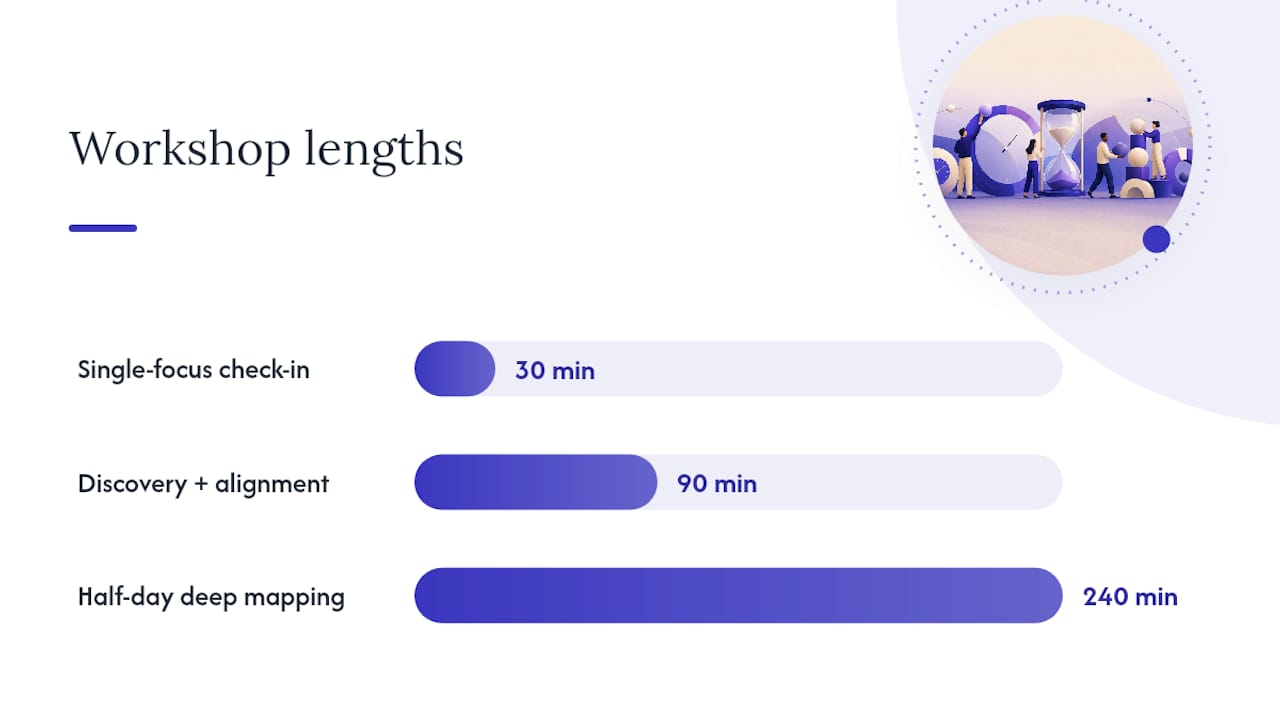
- 30 minutes: A single-focus check-in. Pick one theme (feedback, ownership, follow-through), run one activity, name one commitment. Good for a standing team meeting, not a full reset.
- 90 minutes: Discovery plus alignment. Half the time surfaces how the team actually operates today; the other half aligns on two or three behaviors to practice next.
- 240 minutes (half day): Deep culture mapping, behavior definition, and a full action plan with owners and dates.
For group size, 6 to 12 people keeps discussion honest; above that, split into breakout tables of four. Remote and hybrid teams need small breakout rooms (four people max), a shared digital whiteboard, and a facilitator who calls on quiet voices by name, since chat and video hide hesitation that a room would show you instantly.
How Do You Prepare for a Culture Workshop?
The workshop itself is only as good as what you collect beforehand. A five-question prework survey sent 3 to 5 days out gives you real material to work with instead of guesses. Ask about safety (“I feel comfortable raising a concern with my manager”), clarity (“I understand how my work connects to team goals”), and collaboration (“I know who to go to when I’m stuck”).
Pull in people who do the daily work, not just team leads, and skip anyone who won’t be around for the follow-through. A short list of ground rules read aloud at the start, confidentiality, no interrupting, disagree with ideas not people, sets the tone before the first activity.
Before the session, run through this checklist:
- Survey results summarized into two or three themes, not raw data dumps
- Room or video setup tested, including breakout groups
- A visible agenda with times, so the group can see the plan
- One backup activity if a section runs short
Pro Tip: Read every survey response yourself before the workshop instead of delegating it. Patterns you’d miss in a summary jump out when you read the actual words people used.
Eight Workshop Activities That Actually Change Behavior
These exercises map to four goals: surfacing how the team currently operates, practicing candid feedback, defining specific behaviors, and committing to next steps. Each targets the core teamwork mechanisms of shared mental models, closed-loop communication, and mutual trust that Salas and colleagues identified as the real levers behind team performance.
- Culture mapping. Groups of 4 to 6, 20 minutes. Teams draw their current culture as a map (rituals, unwritten rules, friction points). Remote swap: a shared Miro or Figjam board.
- Core values canvas. Groups of 3 to 5, 25 minutes. Each person picks two personal values, the group finds overlap, then drafts one shared team value. Adapted from SessionLab’s culture library.
- Candid feedback rounds. Pairs, 15 minutes. One gives a specific piece of feedback, the other only asks clarifying questions, no defending. Remote swap: breakout pairs on video.
- Behavior translation. Whole group, 20 minutes. Take an abstract value (“respect”) and write two observable actions it requires. This step alone prevents most workshops from producing nothing but wall art.
- Vulnerability loop. Groups of 4, 15 minutes. Each person shares one recent mistake and what they learned. Modeled on the safety-vulnerability-purpose approach that short culture workshops use to build trust quickly.
- Living core values check. Whole group, 15 minutes. Rate current behaviors against stated values on a 1 to 5 scale, then discuss the gaps.
- Ritual design. Small groups, 20 minutes. Design one recurring team ritual (weekly wins, monthly retro) with a named owner.
- Commitment cards. Individual, 10 minutes. Everyone writes one action they’ll take in the next two weeks and reads it aloud.
| Activity | Group Size | Time | Remote-Friendly |
|---|---|---|---|
| Culture mapping | 4 to 6 | 20 min | Yes, shared whiteboard |
| Core values canvas | 3 to 5 | 25 min | Yes |
| Candid feedback rounds | Pairs | 15 min | Yes, video pairs |
| Behavior translation | Whole group | 20 min | Yes |
| Vulnerability loop | 4 | 15 min | Yes, small breakout |
| Living core values check | Whole group | 15 min | Yes |
| Ritual design | Small groups | 20 min | Yes |
| Commitment cards | Individual | 10 min | Yes |
If you’re short on time, cut vulnerability loop and living core values check first; they add depth but aren’t essential for a 90-minute session. For groups over 15, run culture mapping and core values canvas as table exercises with a report-back instead of full-group discussion.
What Are Common Facilitation Mistakes in Culture Workshops?
The American Psychological Association frames psychological safety as a structure for candid, focused discussion, not an absence of disagreement. Your job as facilitator is managing that candor, not preventing it.
When one person dominates, redirect with a specific ask: “I want to hear from someone who hasn’t spoken yet.” Don’t just say “let’s hear other views,” that’s too vague to work. When a quieter person hesitates, give them a direct, low-stakes opening: “What’s one word you’d use to describe how meetings feel right now?”
Emotional disclosures need a container, not a shutdown. Acknowledge it (“Thank you for sharing that, it takes something to say out loud”), then bring the group back to the activity’s purpose rather than opening it into a full debrief.
- Don’t let silence read as agreement. Ask directly: “Does anyone see this differently?”
- Don’t rush past a hard topic just to hit your agenda. Name it and schedule follow-up time instead of pretending it’s resolved.
- Don’t model defensiveness when you get feedback yourself. How you respond sets the norm for everyone watching.
Pro Tip: Close every difficult topic with a specific next step, even a small one. “We’re not solving this today, but here’s who’s following up and by when” keeps candor from feeling like it went nowhere.
How Do You Turn Workshop Outputs Into Real Change?
Workshop energy fades fast without a plan. Translate each theme into a small experiment, not a policy. Give it an owner, a measure, and a check-in date within 30 days.
Team processes like shared goals and role clarity respond to structured follow-up, not one-time events. A two-to-four week micro-experiment tests a new behavior before the team commits to it permanently, which keeps the change low-risk and easy to adjust.
| Cadence | Action | Owner |
|---|---|---|
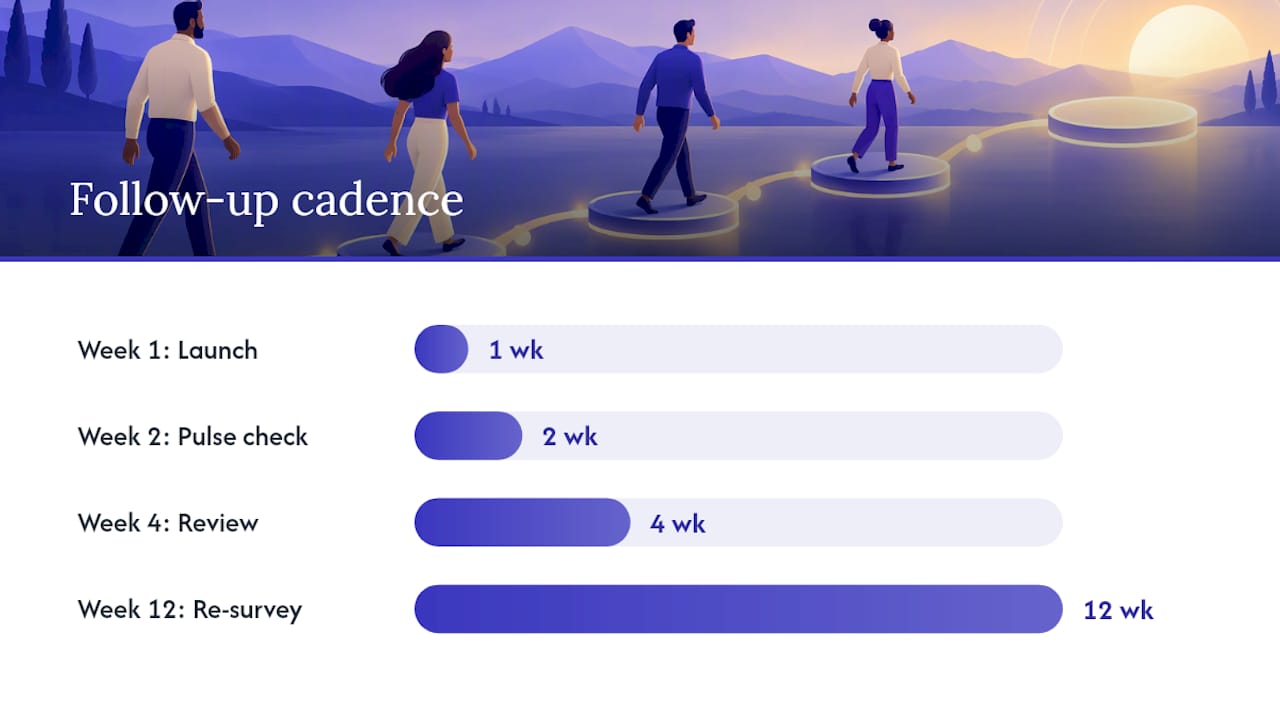
| Week 1 | Launch one micro-experiment per theme | Team lead |
| Week 2 | Anonymous 2-question pulse check | Facilitator or manager |
| Week 4 | Review results, adjust or drop experiment | Team lead |
| Week 12 | Full pulse re-survey, plan next workshop | Manager |
Pulse questions should stay succinct and anonymous, asking about comfort raising concerns and clarity of expectations helps set repeatable baselines.
- Assign one accountability partner per commitment, not a whole committee
- Share results openly, even when they’re not great
- Keep the follow-up ritual shorter than the workshop itself
Service-oriented teams that tie these habits to shared performance expectations tend to see faster buy-in, since the connection between culture work and measurable service outcomes is easier for people to feel day to day.
How some culture workshops differ from others
One effective approach builds on the principle that results come from practiced habits, not motivational speeches. This principle shapes culture workshops to favor role-play over lecture, short experiments over one-time pledges, and follow-up structures that help new behaviors stick past the first week. Teams walk out with something to practice, not just something to remember. To design a session for your team, reach out to a professional workshop facilitator.
Why Quarterly Workshops Beat One-Off Culture Resets
One workshop won’t fix a culture problem, but skipping the follow-up wastes the one you ran. A quarterly cadence with light monthly check-ins, or a session triggered by a major team change, keeps behaviors from sliding back to default. The real work happens in daily rituals: a leader who names a mistake out loud in a stand-up does more for psychological safety than any slide deck ever will.
— Middy
Book a Workshop Built Around Practice, Not Slides
Most culture workshops end with a poster of values nobody remembers by Friday. Middy’s Interactive workshop format flips that: teams practice the hard conversations live, in the room, instead of just discussing them in theory.

If your team needs a full reset rather than a single session, the Half day training goes deeper into leadership behaviors that shape culture from the top down, coaching managers on how to model the exact habits they’re asking their teams to adopt. Teams looking for a lighter, ongoing rhythm around sustainable habits and wellness can look at Habits, Not Hacks as a complementary follow-up format. Every session is built on practice, not a lecture, so people leave with something rehearsed, not just heard. To find the right format for your team, start with the Interactive workshop page and reach out with your group size, timeline, and what you want different in 90 days.
Sources
- American Psychological Association — Psychological safety and healthy workplaces
- Is there a ‘Big Five’ in Teamwork? (Salas et al., 2005)
- Enhancing the effectiveness of team science — overview of research on team effectiveness
- Review of psychological-safety interventions (PMC)
FAQ
What Are the 5 C’s of a Team?
The 5Cs framework covers Connection, Candid Communication, Clarity, Collaboration, and Contribution, five measurable factors that organize how teams build trust and effectiveness. Workshops can target each one with specific activities rather than treating “culture” as one vague goal.
What Are Some Effective Activities for Building Team Culture?
Culture mapping, core values canvases, candid feedback rounds, and vulnerability loops are proven activities adapted from SessionLab’s culture library. Each activity should take 15 to 25 minutes and end with a specific behavior or commitment, not just a discussion.
What Are Examples of a Strong Team Culture?
A strong team culture shows up in specifics: people admit mistakes without being asked twice, feedback happens in the moment instead of in private complaints, and everyone knows who owns what without checking with a manager first. Middy’s workshops are designed to surface exactly these behaviors through practiced role-play rather than abstract discussion.
How Long Should a Team Culture Workshop Be?
It depends on your goal. A 30-minute session works for a single-focus check-in, 90 minutes covers discovery and alignment, and a 240-minute half day allows for full culture mapping and an action plan with owners assigned.
How Much Does a Team Culture Workshop With Middy Cost?
Pricing depends on format and team size, so current rates are listed directly on Middy’s site rather than published as a flat number here.
Leave a Reply