
Pick one observation, name its impact, and attach a recommendation, then say that exact sentence in the first ten minutes of your next meeting. That’s the whole trick to start. The rest of this guide walks you through the three phases that make it stick: a short prep ritual before the meeting, scripts you can lean on while it’s happening, and a two-minute follow-up habit after it ends.
TL;DR:
- Choose one agenda topic, draft an observation, its impact, and a recommendation in one or two sentences, then rehearse the wording aloud three times.
- Use a direct entry phrase, make one point with a clear structure, and, if interrupted, state that you will finish before passing the floor.
- Speak when you add information or need to correct an error; hold back when someone has made your point, then explicitly return the floor.
- Afterward, send the host a recap in two lines or a quick correction, then track speaking turns and responses for three weeks.
Table of Contents
- Before the meeting: pick one contribution and rehearse it
- During the meeting: entry lines, frameworks, and reclaiming the floor
- After the meeting: follow up before your best idea evaporates
- Middy’s scripts and a 2-week practice plan you can start today
- When to speak and when to hold back
- Build this skill with Middy Matthews
- FAQ
- Sources
Before the meeting: pick one contribution and rehearse it
Most people freeze in meetings because they’re trying to think of something smart in real time. That’s backwards. The fix is to decide, in advance, exactly what you’re going to say, then practice saying it out loud until it feels boring.
Here’s a simple structure we use with clients: observation, impact, recommendation. You notice something (the budget assumes flat renewals), you name why it matters (that could underfund Q3 by a meaningful margin), and you suggest a next step (can we stress-test that number before we lock it). Two sentences, maybe three. Write it down. Don’t wing it.
- Choose one topic from the agenda where you have a real opinion, not every topic.
- Draft your observation, impact, and recommendation in one or two sentences, on paper or in your notes app.
- Set a speaking goal that isn’t “sound smart.” Try “ask one clarifying question” or “back up a teammate’s idea out loud.”
- Check who’s in the room. A point for your director lands differently than the same point for peers, so adjust the framing, not the substance.
- Signal ahead of time. Ask the host for two minutes on the agenda, send a one-line pre-read, or message the facilitator that you’d like to weigh in on item three.
- Rehearse it twice, out loud, and pair it with a slow exhale before you speak, which steadies your voice more than most people expect.
Role-playing the moment, even alone in your car or kitchen, does something scripted notes on a page can’t: it trains your mouth and breath, not just your brain.
Pro Tip: Say your observation-impact-recommendation line out loud three times before the meeting starts. By the third repetition, it stops feeling like a performance and starts feeling like a sentence you already know.
If you manage people, turning your one-on-ones into coaching moments is one of the fastest ways to build this muscle in someone else before they ever have to use it in a group setting.
During the meeting: entry lines, frameworks, and reclaiming the floor
Once you’re in the room, the goal shifts from preparation to execution, and execution lives or dies on your opening words. A weak entry (“this might be dumb, but”) undercuts you before you’ve said anything useful. A clean entry does the opposite.
Try one of these, matched to the moment:
- “Building on that, I’d add…” when you want to extend someone else’s point without starting from zero.
- “I see it a little differently.” when you disagree and want to say so without apologizing for it.
- “Quick question before we move on.” when you need thirty seconds to buy time or seek clarity.
- “Here’s a data point that might change the picture.” when you have something concrete to add.
- “Can I jump in here?” when the floor is moving fast and you need a clean entry point.
Once you’re in, structure the point so it lands. The observation, impact, recommendation framework from the prep stage works live too. So does the sandwich method: open with something you agree with, deliver your actual point in the middle, close by handing the conversation back. Both approaches exist to do the same job, which is to stop you from rambling and to give the room a clear place to respond. Recent reporting on workplace speaking tactics points to exactly these two structures as reliable ways to keep a contribution concise and persuasive.
Getting talked over happens, and it isn’t a verdict on the value of what you said. A short, flat line reclaims the floor without drama: “Let me finish this point, then I’ll pass it to you.” or simply “One more sentence.” Pair it with a raised hand or a leaned-forward posture, small nonverbal cues that tell the room you’re not done.
If your chest tightens right before you speak, that’s communication apprehension, and it’s more common than most people assume. A national survey found that communication apprehension is widespread in U.S. workplaces and disproportionately affects early-career professionals, women, introverts, and people with anxiety. Knowing the feeling has a name, and that it’s shared by a lot of competent people around you, takes some of the edge off it.
When the nerves spike mid-meeting, three moves help: a slow breath before your first word, a short pause after you finish instead of filling the silence, and a hard rule that you make one point and then stop. Lingering to soften a point almost always weakens it.
After the meeting: follow up before your best idea evaporates
A lot of the sharpest thinking happens five minutes after the meeting ends, once the pressure’s off. That thinking is wasted if it stays in your head. A short, specific follow-up turns a single comment into a pattern people notice.
- Send a two-line recap to the host or the group: “Wanted to add one more thought on the renewal numbers we discussed, here’s the data point I mentioned.” Keep it shorter than the meeting itself.
- Correct or clarify quickly if you misspoke or want to sharpen something you said live. A quick chat message does this better than waiting for the next meeting.
- Offer something concrete when you have it. Attach the spreadsheet, link the report, volunteer to own the next step.
- Track your own pattern. Note how many times a week you spoke up, whether anyone responded, and what happened next. Three weeks of that log will tell you more about your progress than any single meeting will.
If you want a structured way to build this into a weekly habit, our self-advocacy framework walks through exactly this kind of tracking.
Middy’s scripts and a 2-week practice plan you can start today
Middy Matthews has spent many years in competitive sports and real estate, and that combination shapes a training philosophy built on repetition, not pep talks: say the line enough times in low-stakes settings that it stops costing you anything to say it in a high-stakes one. The scripts below come straight from workshop material used with real estate teams, corporate groups, and young leaders.
- One-on-one prep prompt: before any one-on-one, write one sentence you want your manager to remember, using the 30/70 talk ratio as your guide so you’re not filling the whole slot with status updates.
- Meeting entry script: “I want to flag something before we move to the next item,” said early, claims a window without asking permission for one.
- Manager coach prompt: if you lead a team, ask quieter members directly, “What’s one thing you noticed that we haven’t talked about yet?” It hands them a specific, low-pressure entry point.
Two-week plan: Week one, speak once per meeting using an observation, impact, recommendation line, and log it. Week two, add one reclaiming-the-floor line and one follow-up message per meeting. By day fourteen, you’ll have a dozen logged reps, which is more live practice than most people get in a year of just hoping it gets easier.
Our one-on-one meeting scripts and authentic leadership guide both expand on these drills if you want more reps to pull from.
When to speak and when to hold back
Three rules keep this from becoming noise: speak when you have something the group hasn’t heard yet, hold back when someone else is already making your point well, and always speak when staying quiet would let a mistake go uncorrected.
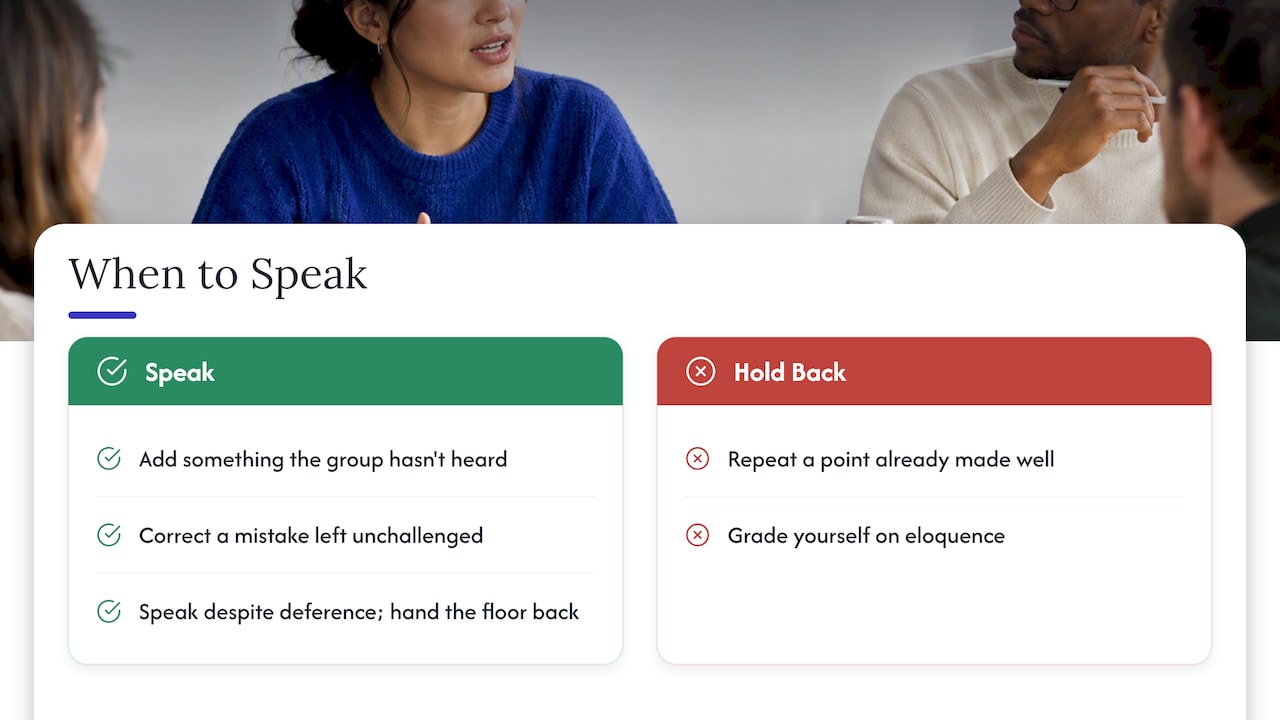
Gender and career stage change the calculus here more than people admit. Research on Q&A participation found that women more often stay quiet out of anxiety or fear of backlash, while men more often step back to make room for others. Neither instinct is wrong, but both are worth noticing in yourself, because the fix is different for each. If your silence comes from fear, the prep and scripts above are your lever. If it comes from deference, the lever is simpler: speak anyway, then hand the floor back explicitly.
Don’t grade yourself on eloquence. Grade yourself on whether people responded, followed up, or acted on what you said. That’s the real measure.
— Middy
Build this skill with Middy Matthews
Teams and individuals get stuck here for the same reason: nobody ever walks them through the scripts, the rehearsal, and the follow-up habit in one sitting with someone pushing them to practice out loud. That’s the gap our workshops close, whether we’re working with a brokerage floor full of agents, a corporate team, or a group of early-career professionals trying to get noticed in their first few years.
A typical session pairs short scripted drills with live role-play, so people leave with phrasing they’ve already said out loud under mild pressure, plus a short practice plan to keep the habit going after we leave the room.
| Who it’s for | What the session covers |
|---|---|
| Real estate teams | Entry scripts, objection-style reclaiming lines, role-play drills |
| Corporate teams and managers | Meeting dynamics, psychological safety moves, coaching prompts |
| Early-career professionals and young leaders | Observation-impact-recommendation drills, confidence-building reps |
If you’re organizing a training day or a keynote slot, our Trained, Not Sold. interactive workshop builds this exact skill set into a session your team can use immediately. Reach out to check available dates.
FAQ
How can I speak up more?
Prepare one short point in advance using the observation, impact, recommendation structure, then rehearse it out loud before the meeting. A specific speaking goal, like asking one question or backing up a colleague, lowers the pressure compared to aiming for a perfect comment every time.
What is a speak-up culture?
A speak-up culture is a workplace where people feel safe raising ideas, questions, or concerns without fear of embarrassment or retaliation. It rests on psychological safety, which Google’s team research identified as the most significant factor separating high-performing teams from low-performing ones.
What is speak up and speak out?
“Speak up” generally refers to voicing an opinion, idea, or question in a group setting like a meeting, while “speak out” often implies publicly challenging a decision, policy, or wrongdoing. Both rely on the same underlying skill: structuring a clear point and delivering it without over-apologizing.
How to speak effectively in a meeting?
Lead with a short, non-apologetic entry phrase, make one clear point using a simple structure like observation, impact, recommendation, and stop talking once you’ve made it. Practical guides on workplace speaking recommend techniques like the sandwich method for keeping contributions concise and easy to follow.
Why do managers matter for getting people to speak up?
A randomized trial found that manager behaviors focused on treating team members as individuals and removing blockers produced measurable increases in team psychological safety over six weeks, with individuation showing the largest gains on lower-safety teams. Managers who ask quieter members a direct, specific question tend to see more consistent participation over time.
Sources
- The five dynamics of effective teams — Think with Google
- Proven tactics for improving teams’ psychological safety — MIT Sloan Management Review
- Communication apprehension in the workplace: Focusing on inclusion
- Stepping up to the mic: Gender gaps in participation in live Q&A sessions
- Five proven strategies to speak with confidence and clarity at work — Forbes
Leave a Reply