
If you’re running on chronic exhaustion, feeling cynical about work you used to care about, and watching your own performance slide, that’s burnout, not a rough week. The World Health Organization’s ICD-11 names three core dimensions: exhaustion, mental distance or cynicism, and reduced professional efficacy. You’ll recognize the everyday versions: you’re tired no matter how much you sleep, you’ve mentally checked out of a job you used to like, and things you once did easily now take twice the effort.
Here’s what to do first:
- Pause and take an honest inventory of how long this has gone on.
- Track whether it’s affecting your sleep, relationships, or work output.
- Set one boundary this week, even a small one.
- If you’re having thoughts of self-harm or can’t function day to day, talk to a clinician now.
Key Takeaways
Burnout is identifiable through three core dimensions, exhaustion, cynicism, and reduced efficacy, catching it early prevents months of harder recovery later.
| Point | Details |
|---|---|
| Check the three dimensions | Look for exhaustion, detachment or cynicism, and a real drop in performance, per the ICD-11 framework. |
| Physical symptoms matter | Rest-resistant fatigue, headaches, GI issues, and frequent illness often show up before emotional symptoms are named. |
| Distinguish from depression | Burnout tends to stay job-focused; depression spreads across every area of life. |
| Recovery takes time | Consistent changes over several months, not a single vacation, typically produce real improvement. |
| Middy’s team-level fix | Middy’s workshops build manager check-ins and boundary-setting habits that catch burnout before it becomes a crisis. |
Table of Contents
- Signs of Burnout in Your Body
- Emotional and Cognitive Signs You Shouldn’t Ignore
- Behavioral Changes That Signal Something Is Off
- What Usually Causes Burnout
- When to Seek Help, and What Counts as Urgent
- Small Steps That Start Reversing Burnout
- What Coaching Teaches You About Catching Burnout Early
- What Happens If Burnout Goes Unmanaged
- How to Support Someone Who Is Burning Out
- Middy’s Take on Preventing Burnout at the Team Level
- A Short Reflection on Catching This Early
- Sources
Signs of Burnout in Your Body
Burnout doesn’t stay in your head. It shows up as fatigue that sleep doesn’t fix, and that’s the tell that separates it from ordinary tiredness. A weekend off usually resets normal exhaustion. Burnout exhaustion lingers through vacations, weekends, even a full night’s sleep, because it’s not a rest deficit. It’s a depletion of your emotional and physical reserves.
The physical symptoms of burnout tend to cluster in predictable ways:
- Headaches that show up more days than not.
- Digestive issues like nausea, stomach pain, or irregular bowel habits.
- Muscle tension and unexplained aches, especially in the neck and shoulders.
- Getting sick more often, since chronic stress wears down immune function.
- Sleep that’s either hard to get into or doesn’t feel restorative.
A 2024 Work in America survey from the American Psychological Association found that a significant portion of U.S. workers report lacking the motivation to do their best work and feeling ineffective. Both are core markers of burnout, and both usually show up in the body before the person consciously names what’s happening.
See a medical provider if you notice chest pain, unexplained weight loss, or sleep disruption severe enough to affect your daily functioning. Those symptoms deserve a clinical workup, not a self-diagnosis of stress.
Emotional and Cognitive Signs You Shouldn’t Ignore
Cynicism is the dimension people miss most often, because it doesn’t feel like sadness. It feels like indifference. You stop caring about outcomes you used to fight for, and colleagues or clients start to feel like obstacles instead of people.
Watch for these patterns:
- A creeping sense of detachment from work that used to feel meaningful.
- Difficulty concentrating on tasks that used to be routine.
- Memory lapses, forgetting details you’d normally retain without effort.
- Trouble making decisions that used to be easy.
- A nagging feeling that nothing you do matters anymore.
The distinction from depression matters here. Mayo Clinic’s guidance treats burnout as job-related rather than a formal medical diagnosis, and clinical reviews back that framing: burnout tends to center on the workplace, while depression spreads across every domain of life. If you still feel like yourself at home with people you love, but you dread opening your laptop, that’s a strong signal it’s burnout. If the flatness follows you everywhere, that’s worth naming as something bigger.
Behavioral Changes That Signal Something Is Off
Burnout eventually changes what you do, not just how you feel. These are the behaviors worth tracking over a few weeks, not a single bad day.
- Withdrawal from people and tasks. You stop responding to messages promptly, skip meetings you’d normally attend, or avoid collaborating with teammates.
- Rising absenteeism. Sick days increase, or you find excuses to work from home more often than usual.
- Productivity decline. Tasks that used to take an hour stretch into an afternoon, and mistakes creep into work you used to nail on the first pass.
- Procrastination on things that matter. You delay decisions or projects you know are important, not because you forgot, but because starting feels impossible.
- Numbing behaviors escalate. More alcohol, more scrolling, more late-night snacking. SHRM research found that a notable portion of U.S. workers report irritability or anger toward coworkers or customers, a behavioral marker tied directly to the cynicism dimension of burnout.
What Usually Causes Burnout
Burnout rarely comes from one bad month. It builds from a mismatch between what a job demands and what a person has to give. The most common drivers include:
- A workload that consistently outpaces the hours available to do it well.
- Low control over how, when, or where the work gets done.
- Unclear expectations, so effort never feels like it’s landing anywhere.
- Little support from managers or peers when things go wrong.
- A values mismatch, where the work asks you to act against what you believe matters.
Caregiving roles, whether at home or in caregiving-heavy jobs like nursing and teaching, compound all of this. So does a workplace culture that rewards overwork and treats boundaries as a lack of commitment.
When to Seek Help, and What Counts as Urgent
Some signals need attention right away. If you’re having thoughts of suicide or self-harm, or if you can’t function at work or at home for more than a few days, that’s urgent. Get help immediately, whether that’s a crisis line, an emergency room, or a same-day appointment with a provider.
For everything short of urgent, see a clinician when symptoms persist for more than a few weeks and start bleeding into your relationships, sleep, or physical health. Burnout that overlaps heavily with depression or anxiety symptoms also deserves a professional evaluation, since the treatment paths differ.
Before your visit, jot down:
- When the symptoms started and how they’ve changed.
- Specific work stressors you can point to.
- Changes in sleep, appetite, or energy.
- How it’s affecting your ability to do your job or show up for people you care about.
Pro Tip: Bring a simple two-week log of your mood, sleep, and energy to your first appointment. Clinicians can spot patterns in a log much faster than in a verbal recap, and it saves you from trying to remember details under stress.
Small Steps That Start Reversing Burnout
Recovery doesn’t require quitting your job or overhauling your life overnight. Small, repeatable changes tend to work better than one big gesture, because they’re easier to sustain.
- Build in micro-recovery. Take real breaks between focused work blocks, roughly every 90 minutes, and get outside for a short walk when you can.
- Set one boundary and hold it. That could be a hard stop on email after 7 p.m. or a firm no to a new project until current ones are done.
- Ask for a workload adjustment. Go to your manager with a specific ask, not a vague complaint. Specificity gets results.
- Try job crafting. Adjust how you do parts of your role to better match your strengths, even in small ways. It’s one of the more practical interventions for catching stress before it becomes burnout.
- Protect your sleep and your support system. Burnout isolates people. Actively keeping social connections and consistent sleep habits blunts a lot of its worst effects.
Pro Tip: If your workplace has an employee assistance program or occupational health resource, use it before things escalate. Most people wait until they’re in crisis to ask, which is exactly backward.
What Coaching Teaches You About Catching Burnout Early
Coaches notice burnout before employees say a word. It shows up as smaller contributions in meetings, slower replies, a person who used to volunteer for stretch projects suddenly going quiet.
Managers can surface this in a ten-minute check-in with two questions: what’s draining you right now, and what would make this week easier? Then act on the answer.
The fastest wins I’ve seen aren’t big restructures. They’re a manager reassigning one draining task off someone’s plate, or a team agreeing to protect two hours of focus time a week. Small, visible changes tell people someone’s actually paying attention.
Two moves worth trying this week: reassign one task that’s quietly burning someone out, and lock in protected focus time as a team norm, not a personal favor.
What Happens If Burnout Goes Unmanaged
Unmanaged burnout doesn’t plateau. It tends to progress, and the longer it runs, the harder it is to reverse. Peer-reviewed research on chronic stress and burnout points to measurable changes in brain regions tied to emotional regulation and cognitive control, which helps explain why people who ignore early symptoms often find themselves worse off months later, not better.

Physically, chronic burnout raises the risk of cardiovascular strain, immune suppression, and sleep disorders that outlast the original stressor. Career-wise, the costs compound too. Performance dips lead to missed opportunities, strained relationships with managers and colleagues, and in some cases, job loss. People who push through burnout without addressing it often make bigger, more consequential decisions while cognitively impaired, quitting abruptly, burning bridges, or making financial choices they later regret.
The progressive nature of burnout is part of why so many people miss the window to intervene early. It’s easy to tell yourself “I just need a vacation,” and a long weekend can genuinely help with ordinary fatigue. But when the underlying causes, workload, control, values mismatch, haven’t changed, the relief is temporary. Recovery from full burnout typically takes several months of consistent change, not a single trip. That’s a hard truth, but it’s also the reason catching the signs early, while they’re still mild, matters so much more than waiting for a breaking point.
How to Support Someone Who Is Burning Out
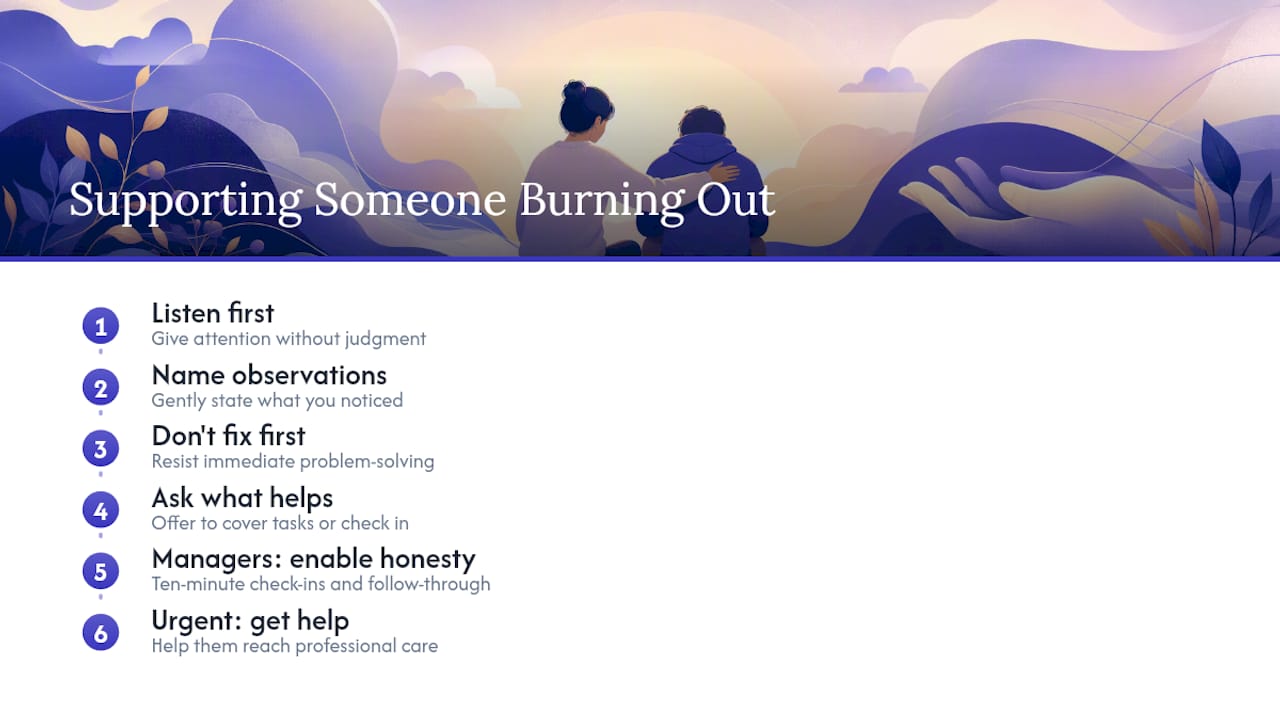
If someone you care about is showing these signs, the most useful thing you can offer is attention without judgment. Burnout carries shame for a lot of people. They worry that admitting exhaustion means admitting failure, so they hide it, which makes it worse.
Start by naming what you’ve noticed, specifically and gently: “You’ve seemed really drained the last few weeks, and I wanted to check in.” That’s more effective than a generic “you okay?” because it shows you’ve actually paid attention.
Resist the urge to immediately problem-solve. Most people experiencing burnout don’t want a list of fixes first. They want to feel heard. Once they’ve talked, you can ask what kind of help would actually be useful, whether that’s covering a task, connecting them with a resource, or simply checking in again next week.
For managers specifically, this means creating room for honest conversations without penalty. A ten-minute check-in that asks what’s draining someone and what would help, then follows through on the answer, does more than any wellness newsletter. For friends and family, it often means normalizing rest and pushing back gently when someone frames burnout as a personal failing rather than a predictable response to unsustainable demands.
If the person shows urgent warning signs, talk of self-harm, inability to function, sudden withdrawal from everyone, don’t wait for them to ask. Help them get to a professional directly.
Middy’s Take on Preventing Burnout at the Team Level
There are other routes to this problem: therapy, time off, a job change. All of them help individuals. None of them fix the workplace conditions that created the burnout in the first place. That’s where a team-level intervention earns its place.

Middy’s workshops focus on the managerial habits that catch burnout before it becomes a resignation letter, teaching leaders how to run short, honest check-ins and how to build boundary-setting into team culture instead of leaving it to individual willpower. One workshop outcome that comes up often: teams that agree on protected focus time as a group norm see fewer of the withdrawal and procrastination patterns tied to early burnout, because the fix isn’t left to one exhausted person to negotiate alone. If your team is showing the signs covered here, from rising irritability to quiet disengagement, a wellness keynote built around sustainable performance gives managers concrete tools instead of another vague reminder to “practice self-care.” Reach out to check dates and get a proposal built around your team’s specific pressure points.
A Short Reflection on Catching This Early
I’ve watched teams turn around fast once one small thing changed, a reassigned task, an honest check-in. Burnout feels permanent when you’re in it. It usually isn’t, if someone catches it in time.
This article is general information, not a substitute for advice from a qualified doctor. Consult a qualified healthcare professional about your own circumstances before acting on anything here.
Sources
- Work in America 2024 — American Psychological Association
- Burn-out an occupational phenomenon — ICD-11 (WHO)
- Job burnout: How to spot it and take action — Mayo Clinic
Recommended
- Wellness Keynote Ideas for Healthcare Teams Facing Burnout – Middy Matthews | Keynote Speaker
- How to Motivate a Real Estate Team That Has Lost Its Spark – Middy Matthews | Keynote Speaker
- The Endurance Athlete’s Guide to Surviving a Sales Slump – Middy Matthews | Keynote Speaker
- What to Look for in a Corporate Wellness Speaker – Middy Matthews | Keynote Speaker
Leave a Reply