
A goal-setting workshop succeeds when the room leaves with two or three prioritized goals, a named owner for each one, and a check-in rhythm already on the calendar. That’s it. If you’re a manager, team lead, or facilitator deciding whether to run one, run one when your team has drifted without shared direction. Pick a half-day agenda, block the calendar, and get started.
TL;DR:
- Most teams benefit from a half-day workshop that results in two or three clear, prioritized goals with assigned owners, measurable metrics, and a check-in schedule.
- Pre-work submissions and a structured agenda with time for ideation, prioritization, and goal writing significantly reduce the risk of goals being forgotten or ignored after the session.
- Limiting goals to a small number and ensuring each has a dedicated owner helps maintain accountability and keeps progress on track in the weeks following.
- The workshop’s success depends on clear framing, structured participation, and immediate ownership assignment, especially when working remotely with digital tools.
- Larger or strategic cross-functional goals may require full-day sessions, but most teams are best served by concise, focused workshops designed for quick, impactful outcomes.
Table of Contents
- What Makes a Goal-Setting Workshop Agenda Work?
- How Do You Facilitate the Session Step by Step?
- Which Goal-Setting Framework Fits Your Team?
- Which Activities Actually Move a Workshop Forward?
- How Do You Keep Workshop Goals From Dying by Week Three?
- What Makes Middy’s Workshop Method Different
- When Should You Run a Full Workshop Instead of a Quick Meeting?
- How Middy Can Run This Workshop for Your Team
- Sources
- FAQ
What Makes a Goal-Setting Workshop Agenda Work?
I’ve watched plenty of well-intentioned planning sessions produce a whiteboard full of sticky notes and nothing else. The room feels productive. Then Monday hits, nobody remembers who owns what, and the sticky notes get erased along with the goals. A workshop that actually works has a structure built for output, not for vibes.
Three agenda lengths cover most situations:
- The 90-minute sprint. Best for a single, focused team that already has strategic context and just needs to convert priorities into measurable goals. Output: 2 to 3 SMART goals with draft owners.
- The half-day workshop. The workhorse format for most teams starting a new quarter. Output: prioritized goals, assigned owners, defined metrics, and a first check-in date.
- The full-day session. Reserved for cross-functional groups aligning multiple teams to a shared strategy, often paired with a Balanced Scorecard style mapping exercise. Output: a shared goal map plus individual team goals nested underneath it.
Here’s a minute-by-minute breakdown for the half-day option, which fits most teams:
- Opening and context (20 minutes). State the business priority driving the session. No vague “let’s align” language. Name the actual problem.
- Review pre-work and data (25 minutes). Walk through the draft goals or performance data participants submitted beforehand.
- Ideation (45 minutes). Generate a wide list of possible goals and initiatives without filtering yet.
- Prioritization (30 minutes). Narrow the list using dot-voting or a simple impact/effort grid.
- Goal writing (60 minutes). Convert the top three priorities into measurable goal statements using a shared framework.
- Ownership and cadence (30 minutes). Assign one owner per goal and set the check-in schedule.
- Wrap-up and commitments (20 minutes). Each owner repeats their goal, metric, and next check-in date out loud.
Pre-work matters more than people expect. Ask participants to submit one goal idea and any relevant performance numbers 48 hours ahead of the session. Draft goals before the workshop and finalize them in the room rather than starting from a blank page. It cuts ideation time nearly in half and gives quieter participants a way to contribute before the room dynamics take over.
By the end of a well-run session, you should have a written goal statement for each priority, a named owner, a defined success metric, and a first check-in date already on the calendar. If any of those four things is missing when people walk out, the workshop isn’t finished yet.
How Do You Facilitate the Session Step by Step?
Running a goal-setting workshop is less about having the right slides and more about having the right prompts ready when the room goes quiet, or worse, when one person won’t stop talking. Here’s how to move through each segment with actual language you can use.
1. Frame the priority before anything else. Open with a direct statement: “We’re here because [specific problem] is costing us [specific consequence]. By the end of today, we’ll leave with two or three goals, owners, and a plan to check on them.” Naming the scope up front stops the session from drifting into unrelated complaints about workload or tools.
2. Run ideation with a low bar for entry. Ask everyone to write down three possible goals on individual sticky notes or a shared digital board, silently, for five minutes. Silent brainstorming before group discussion consistently surfaces more ideas than open discussion, because it removes the anchoring effect of whoever speaks first.
3. Use dot-voting to prioritize, not debate. Give each participant three dots (physical or digital) to place on the ideas they think matter most. Skip the temptation to discuss every idea before voting. The votes tell you where the energy is; discussion afterward just explains the votes that already happened.
4. Convert winning ideas into measurable statements. This is where most workshops fall apart. A goal like “improve customer onboarding” sounds fine in the room and means nothing by Thursday. Walk the group through turning it into something with a number, a deadline, and an owner. A workable prompt: “What number would prove this goal is done, and by when?”
5. Assign ownership out loud, in the room. Never leave ownership assignment for a follow-up email. Ask directly: “Who’s willing to own this one?” Silence usually means you need to nominate someone and ask for a yes or no, not wait it out.
Pro Tip: If three or more people go quiet when you ask for an owner, that’s a signal the goal is either too big or too vague. Split it into a smaller, clearer version before assigning it.
6. Managing the loudest person in the room. Every workshop has one. The fix isn’t confrontation, it’s structure. Use a strict round robin for the ideation and prioritization steps: “We’re going one at a time, starting with Priya.” A facilitator who controls the turn order controls the room without ever raising their voice.
7. Rescuing a session that’s produced too many goals. If the group lands on six or seven “must-have” goals, stop and ask: “If we could only fund and staff two of these this quarter, which two would you pick?” Forcing scarcity does what open discussion can’t. A narrow goal count is one of the strongest predictors of whether goals get managed at all versus quietly forgotten.
8. Adjusting for remote delivery. Swap physical sticky notes for a digital whiteboard tool like Miro or Mural, and use breakout rooms for the silent ideation step so people aren’t typing over each other in a single chat window. Send pre-work as an async form rather than a live discussion, since remote sessions lose energy fast when the first 20 minutes are spent reading data out loud that people could have reviewed on their own time.
9. Closing the loop before anyone logs off. End every remote session, just like an in-person one, with each owner stating their goal, metric, and next check-in date on camera or in the chat. Skipping this step because “we’re running long” is the single most common reason remote workshops fail to convert into real accountability.
Which Goal-Setting Framework Fits Your Team?
Pick the framework based on your team’s timeframe and how much strategic alignment the goal needs, not on which one is trendiest this quarter.
SMART goals work best for individual or team-level goals with a clear, near-term deadline. The structure: Specific, Measurable, Achievable, Relevant, Time-bound. Use SMART when a single team needs clarity fast and doesn’t need heavy cross-departmental coordination.
OKRs (Objectives and Key Results) trace back to Andy Grove’s management practices at Intel and work best for teams operating on a quarterly rhythm with two or three measurable key results tied to each objective. OKRs perform best with a regular check-in cadence and clear ownership built in from the start, not bolted on afterward.
OGSM (Objectives, Goals, Strategies, Measures) suits larger or cross-functional groups that need to connect a big-picture objective to specific measurable targets and the strategies that will get them there. It’s heavier than SMART or OKRs, so save it for full-day sessions with multiple stakeholders in the room.
Stretch goals intentionally push past what feels comfortable and work best with mature teams that already hit their standard goals consistently. Introducing a stretch goal to a team that’s still missing basic targets usually backfires, since it signals the easier goals didn’t matter anyway.
Here’s what the conversion looks like in practice. A vague goal like “improve onboarding” becomes:
- SMART version: “Increase onboarding completion rate from 62% to 80% by September 30. Owner: Jordan. Check-ins: weekly.”
- OKR version: “Objective: Make onboarding effortless for new hires. Key Result 1: Raise completion rate to 80%. Key Result 2: Cut average time-to-complete from 14 days to 7.”
Notice the difference between an outcome and a task. “Send onboarding survey” is a task. A workshop that produces a list of tasks feels productive but rarely changes results, because tasks measure activity and outcomes measure whether the activity worked.
Which Activities Actually Move a Workshop Forward?
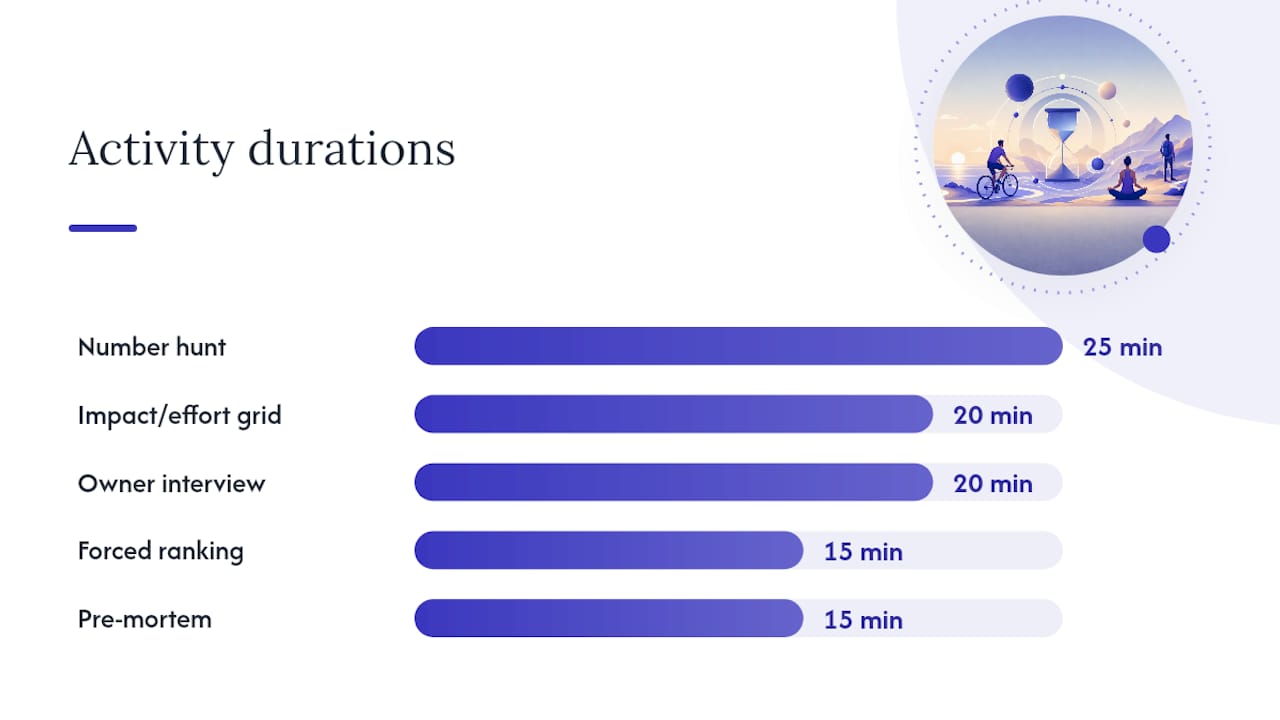
A good activity bank states purpose, timing, and expected output for each exercise so you’re not reading a paragraph of theory while the room waits. Here’s a mix-and-match toolkit organized by what stage of the workshop you’re in.
Visioning and priority-setting:
- Five-year headline: Participants write the headline they’d want to read about the team in five years. 10 minutes. Paper or sticky notes. Output: raw material for long-term goal themes.
- Rose, thorn, bud: Teams name what’s working (rose), what’s painful (thorn), and what’s emerging (bud) about current performance. 15 minutes. Whiteboard or digital board. Output: a grounded starting list for goal ideation.
- Impact/effort grid: Plot candidate goals on a two-by-two grid by expected impact and required effort. 20 minutes. Whiteboard with axes drawn. Output: a visual shortlist of high-impact, low-effort goals to prioritize first.
Prioritization and narrowing:
- Dot voting: Each participant gets three votes to place on their top goal candidates. 10 minutes. Sticky dots or digital polling. Output: a ranked shortlist.
- Forced ranking: Teams must rank their top five goals from most to least critical, no ties allowed. 15 minutes. Notecards. Output: a single ordered priority list.
- Pre-mortem: Ask “if this goal fails, why did it fail?” before committing to it. 15 minutes. Whiteboard. Output: risk factors surfaced before, not after, commitment.
Metric definition:
- Number hunt: For each shortlisted goal, the group has five minutes to propose the single number that would prove success. 25 minutes total across goals. Whiteboard. Output: a draft metric per goal.
- Baseline check: Pull current performance data for each proposed metric before setting a target. 15 minutes. Laptop or printed reports. Output: a realistic starting point, not a guess.
Ownership assignment:
- Volunteer round: Go goal by goal and ask who’s willing to own it, defaulting to nomination if no one raises a hand. 15 minutes. No materials needed. Output: one named owner per goal.
- Owner interview: Each new owner answers three quick questions in front of the group: what does done look like, what resources do you need, and when’s your first check-in. 20 minutes. Output: public accountability and a first cadence date.
Low-tech and remote-friendly variants:
- Paper version: Swap digital whiteboards for large sheets of butcher paper and markers when tech is unreliable or the group prefers analog.
- Async pre-vote: Send a digital poll ahead of a remote session so dot-voting happens before the call, saving live time for discussion of the results instead of the voting itself.
- Breakout sprint: For groups larger than eight on a video call, split into breakout rooms of three or four for ideation, then report top picks back to the main room.
How Do You Keep Workshop Goals From Dying by Week Three?
The workshop is the easy part. Most goals die quietly in the weeks after everyone goes back to their normal workload, and the fix isn’t more motivation, it’s structure.
Every goal needs exactly one owner, never a shared “team” ownership that lets accountability slip through the cracks. Naming a single owner per goal and maintaining a visible weekly or biweekly pulse is consistently what separates goals that get managed from goals that quietly evaporate. The owner’s job isn’t to do all the work personally. It’s to track the metric, flag blockers, and report status at each check-in.
A simple cadence:
- Week 1: Confirm the baseline number and remove any immediate blockers.
- Weeks 2 to 4: Weekly or biweekly check-ins, five minutes per goal, status only.
- Day 30: First real progress review against the target.
- Day 60: Adjust the approach if the metric isn’t trending the right way.
- Day 90: Full retrospective and decision on whether to renew, revise, or retire the goal.
A one-page goal card keeps this visible without needing a full project management tool: metric name, baseline level, target goal, owner, and check-in cadence, all clearly displayed where the team regularly sees it.
Quick stat worth remembering: limiting goals to a small number per team preserves the kind of focus that makes tracking realistic. A team juggling too many “priorities” often loses focus and consistent attention.
Close each quarter with a short retrospective: what worked, what didn’t, and what should change about the next round of goal setting itself. Skipping this step means repeating the same facilitation mistakes every quarter without ever noticing the pattern.
What Makes Middy’s Workshop Method Different
Middy Matthews built her facilitation approach on a simple idea: training beats selling, and that applies to goal-setting sessions just as much as it applies to a sales floor. Instead of handing teams a list of goals to accept, her workshops walk participants through the reasoning behind each priority so they actually own it, not just agree to it in the room.
That coaching-based structure pulls directly from 30 years split between competitive athletics and real estate, where resilience and teamwork weren’t abstract values, they were the difference between hitting a number and missing it. In a live session, that shows up as clear roles: someone drives the agenda, someone tracks the emerging goal list in real time, and every participant leaves having spoken their commitment out loud, not just nodded along. Sessions typically produce a short list of prioritized goals, named owners, and a defined follow-up rhythm, the same outputs this article recommends building into any workshop you run yourself.
When Should You Run a Full Workshop Instead of a Quick Meeting?
Not every goal-setting moment needs a half-day session with sticky notes and a facilitator. Run a full workshop when the trigger is real: a strategy shift, the start of a new quarter, or a team that’s visibly stalled and can’t agree on what matters next. Those situations need the structured ideation and prioritization a workshop provides, because a quick meeting won’t surface disagreement, it’ll just paper over it.
A short alignment meeting or a regular coaching cadence works better when goals are already set and the team just needs a nudge or a minor course correction. Bringing in a professional facilitator makes the most sense when internal politics make it hard for a manager to run an unbiased session, or when the group is large enough that self-facilitation would let the loudest voices dominate. If you notice your team nodding along in meetings but missing every target anyway, that’s usually a signal the goals were handed down, not built together, and a properly run workshop fixes exactly that gap.
— Middy
How Middy Can Run This Workshop for Your Team
If you’d rather not build the agenda, write the scripts, and manage the room dynamics yourself, that’s exactly what Middy’s interactive workshop format is built to handle. Her sessions apply the same “Training, Not Selling” coaching approach covered above, turning a room full of individual opinions into a short list of goals people actually commit to out loud.

For teams needing a deeper reset, the half-day training format covers full ideation, prioritization, and ownership assignment in one sitting, the same structure outlined in the agenda breakdown above. It works well for sales teams, corporate departments, and cross-functional groups heading into a new quarter with no shared direction yet. Once goals are set, tools like AI-generated meeting summaries can help owners document check-ins without adding extra admin work to their week.
Group sizes typically range from a single team of six or eight to a full department, and formats can run in person or remotely depending on your setup. To book a session, reach out through Middy with your preferred date range, group size, and the specific outcome you want the room to leave with, whether that’s quarterly OKRs, a leadership alignment session, or a full strategic reset.
Sources
- Putting the Balanced Scorecard to Work — Harvard Business Review
- Positivepsychology
- How to set team goals your team actually owns — Celorly
FAQ
What Are the 5 R’s of Goal Setting?
Definitions vary across sources, but a common version includes Realistic, Relevant, Rewarding, Recorded, and Reviewed, emphasizing that goals need regular tracking and follow-up, not just a strong initial statement. The follow-up and review pieces matter most in practice, since a goal without a check-in cadence tends to lose momentum within weeks.
What Are the 5 Principles of Goal Setting?
The core principles most goal-setting frameworks share are clarity, measurability, commitment, feedback, and task complexity, drawn from decades of workplace goal-setting research. In a workshop setting, this translates to writing specific goals, assigning an owner who commits publicly, and building in a feedback loop through regular check-ins.
How Long Should a Goal-Setting Workshop Be?
A 90-minute session works for a single focused team with existing context, while a half-day format suits most teams starting a new quarter, and a full-day session fits cross-functional groups aligning to a shared strategy. The right length depends on how many goals need setting and how much prioritization discussion the group requires.
How Many Goals Should Come Out of a Workshop?
Two to three goals per team is the sweet spot, since limiting the goal count preserves focus and makes ongoing tracking realistic. A longer list feels ambitious in the room but usually means nothing gets consistent attention afterward.
Leave a Reply