
Gamification in training can improve engagement, retention, and even on-the-job behavior change, but only when it’s built around what actually motivates people: autonomy, competence, and relatedness. It works best for skill practice, compliance habits, and behavior change tasks, not passive content delivery. Below, we break down the evidence, the design rules, and a pilot roadmap you can run this quarter.
TL;DR:
- Define one observable behavior and KPI before selecting two or three mechanics, then compare a gamified team with a similar control team against a baseline.
- Offer learner choice, visible progress, and team goals, then tailor mechanics to preferences and roles instead of rewarding speed or using one format universally.
- Employee surveys capture reported engagement, not mastery; controlled studies find mixed skill transfer, so evaluate retention and behavior on the job directly.
- Pair game mechanics with realistic practice, immediate feedback, and short debriefs; manager follow ups should connect progress to behavior on the job.
Table of Contents
- Benefits and Evidence: What the Research and Surveys Say
- Core Game Elements and Examples You Can Reuse
- Design Principles: Apply Self-Determination Theory to Gamified Training
- Implementation Roadmap: Scope, Pilot, Integrate, Scale
- Measure Success: Recommended Metrics and Common Evaluation Pitfalls
- Common Challenges and Pitfalls in Implementing Gamification in Training
- Customization and Personalization Strategies for Different Learners
- Case Studies from Sales and Leadership Training
- Integrating Gamification with Experiential Learning and Coaching
- Long-Term Engagement Strategies Beyond the Initial Session
- Practitioner Perspective: Human-First Gamification in Workshops
- Bring Gamified Training Into Your Next Workshop or Keynote
- FAQ
- Sources
Benefits and Evidence: What the Research and Surveys Say
The case for gamification isn’t just a hunch. A TalentLMS survey found most employees reported increased productivity, happiness, and motivation when training was gamified, compared to a substantially lower motivation rate in non-gamified training. Those are self-reported numbers, so treat them as a signal of perceived value, not proof of skill mastery.
The experimental research tells a more layered story. A Harvard Business Review review of gamified training found that progression systems, challenges, instant feedback, and competition can improve performance, but only when applied consistently over time and paired with real practice, not as a one-off novelty.
- Self-reported engagement jumps are strong, but they measure feeling, not mastery.
- Controlled studies show mixed results on skill transfer, which means design quality matters more than game mechanics alone.
- Intensity isn’t the lever: a Frontiers 2025 study found that alignment to learner profiles outperforms high-intensity gamification.
Many employees reported increased productivity with gamified training, as well as rises in happiness and motivation, according to the TalentLMS survey.
Core Game Elements and Examples You Can Reuse
Most gamification programs reuse a small toolkit of mechanics. The trick is matching the mechanic to the learning goal instead of bolting on points because they’re easy to add.
- Points: track effort or completion, useful for building a consistent practice habit.
- Badges: mark skill milestones, useful for signaling mastery of a discrete competency.
- Leaderboards: drive friendly competition, useful for short sales sprints or onboarding cohorts.
- Narrative: frames training as a story with stakes, useful for compliance or ethics scenarios that need emotional weight.
- Branching scenarios: let learners make choices with consequences, useful for negotiation or objection-handling practice.
- Micro-quests: break a skill into small, completable tasks, useful for building competence without overwhelming a new hire.
- Immediate feedback: shows the learner where they stand in real time, useful for any skill that needs correction before it becomes a habit.
In-person workshops can borrow the same logic without software:
- Run role plays as “levels” that increase in difficulty as pairs succeed.
- Use a visible scoreboard on a whiteboard for team challenges during a half-day session.
- Close each round with a 60-second peer debrief instead of a formal scorecard.
Design Principles: Apply Self-Determination Theory to Gamified Training
Points-only gamification burns out fast because it skips the actual drivers of motivation. Research grounded in Self-Determination Theory, including work from Warwick, shows that gamification sustains motivation when it satisfies three needs: autonomy, the sense of choosing your own path; competence, the sense of visible progress; and relatedness, the sense of connection to other people.
Design moves that support each need:
- Offer learners a choice of scenario, order, or format instead of a single fixed path.
- Show clear progression markers, like levels or skill trees, so competence is visible, not assumed.
- Build in team-based goals or peer feedback so relatedness isn’t an afterthought.
Pro Tip: Chunk a big skill into small micro-quests that get slightly harder each time, and pair every quest with a short reflective debrief so the win sticks.
Implementation Roadmap: Scope, Pilot, Integrate, Scale
Running a gamified pilot works best as a sequence, not a launch event.
- Define the behavior first. Name the exact knowledge, skill, or behavior you want to change, and attach a measurable KPI to it before picking any game mechanic.
- Build a minimally viable experience (MVE). Choose two or three mechanics that map directly to that behavior, set a timeline, and write down what success looks like in advance.
- Pilot with a matched comparison. Run the gamified version with one team and a standard version with a similar team, then compare results instead of guessing.
- Check accessibility and manager touchpoints. Make sure the format works for every learner, and build in a manager check-in so the skill gets reinforced outside the training itself.
- Integrate with your LMS and rollout plan. Once the pilot shows a real effect, fold the mechanics into your existing learning platform and phase the rollout across teams.
A few pilot logistics worth locking down early:
- Keep pilot and control groups similar in size and role mix so results are comparable.
- Collect qualitative feedback alongside completion data, not instead of it.
- Set a review date before launch so the pilot doesn’t quietly become permanent.
Pro Tip: Pick one measurable behavior, like correct safety-check completion rates, and design every mechanic in the pilot to reward that single behavior.
For teams that want a structured way to test these ideas in a live session, our interactive workshop activities are built around exactly this kind of scoped, pilotable format.
Measure Success: Recommended Metrics and Common Evaluation Pitfalls
The right metrics depend on what you’re actually trying to change. Track completion rates as a baseline, but weight mastery and retention tests, time-to-proficiency, and manager-observed behavior change far more heavily.
- Set a baseline before launch so you can measure actual lift, not just activity.
- Use a control or matched-team design instead of judging the pilot in isolation.
- Collect manager observations and qualitative feedback alongside the data your LMS reports.
A 2025 field study found that gamification can improve knowledge and attitudes through increased goal commitment and enjoyment, but effects on actual skill acquisition were mixed, which means clicks and active minutes are a weak proxy for job performance. The real test is whether behavior changes on the floor, not whether the dashboard lights up.
Common Challenges and Pitfalls in Implementing Gamification in Training
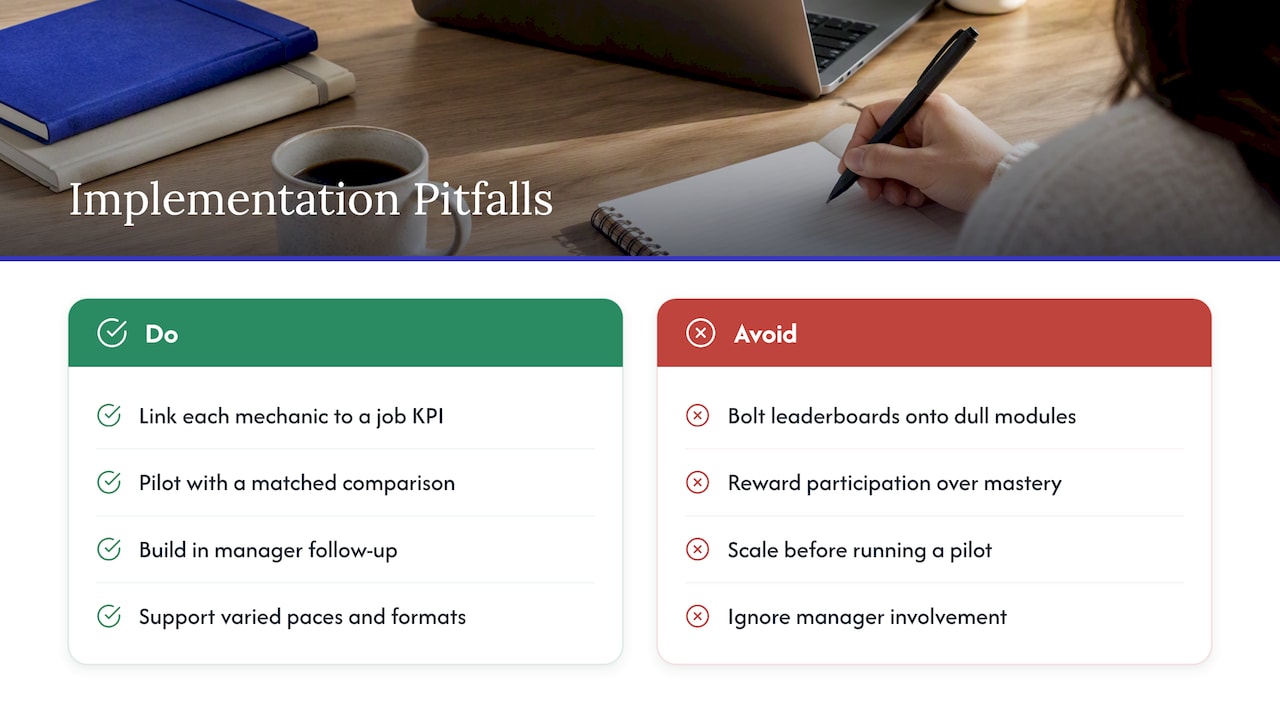
The most common failure mode is what instructional design critics call “chocolate-covered broccoli”: a dull module with a leaderboard bolted on top. A review in instructional design literature warns that technology-first thinking produces exactly this trap, and learners see through it fast.
A second pitfall is chasing engagement metrics that don’t connect to the job. Teams celebrate high leaderboard activity while skill tests stay flat, because points measure participation, not mastery. Fix this by tying every mechanic back to the specific KPI from your implementation plan, not to generic “engagement.”
A third pitfall is rolling out gamification organization-wide before piloting it. Without a pilot, you can’t tell whether a flat or negative result came from the mechanics, the content, or the audience. Run the matched-comparison pilot from the roadmap above before scaling anything.
A fourth pitfall is ignoring manager involvement. Gamified training that ends at the module, with no manager follow-up or real-world application, tends to fade within weeks. Build a manager touchpoint into the design from the start, not as an afterthought once engagement drops.
Finally, teams often underestimate accessibility. A leaderboard that rewards speed can disadvantage learners who need more time to process material, so design for a range of paces and formats, not a single fastest-wins structure.
Customization and Personalization Strategies for Different Learners
A 2025 Frontiers study found that personalization, not feature count, drives better engagement outcomes. A small set of mechanics matched to learner profiles beats a heavily gamified program applied uniformly.
Start by segmenting learners by what actually motivates them. Competitive learners respond to leaderboards and timed challenges, while collaborative learners respond better to team quests and shared goals. A sales floor and a compliance team rarely need the same mechanic mix, even inside the same company.
Organizational culture matters just as much as individual preference. A culture built on public recognition can lean into leaderboards and badges without friction, while a culture that prizes privacy or seniority may need progress tracked privately, with recognition delivered through manager conversations instead of a public board.
Role also shapes design. New hires benefit from narrative and micro-quests that build confidence step by step, while experienced staff often respond better to branching scenarios that test judgment rather than basic recall. Real estate agents, for instance, often respond better to scenario-based negotiation practice than to point accumulation, because the skill they’re building is judgment under pressure, not repetition.
The practical move is to build your MVE with one primary mechanic and one optional variant, test both with a small group, and let the data tell you which version to scale, rather than assuming one design fits every team.
Case Studies from Sales and Leadership Training
Sales and leadership training are two of the clearest fits for gamification, because both depend on repeated practice under realistic pressure rather than one-time information transfer.
In sales training, branching scenarios that simulate objection handling let reps practice difficult conversations without the cost of a lost deal. A real estate brokerage running a script-practice pilot might use a leaderboard tracking role-play completions over two weeks, paired with manager-observed call reviews, so the leaderboard measures practice volume while the manager review measures actual skill. That combination addresses the core weakness of leaderboards alone: they reward activity, not quality.
In leadership training, the stronger pattern is cohort-based progression rather than individual competition. A team working through a 90-day leadership program can use milestone badges tied to specific behaviors, like running a documented one-on-one or delivering structured feedback, rather than points for attendance. Our 90-day leadership workshop structure uses exactly this kind of pillar-based progression, where each stage ties to a retention-linked behavior instead of a generic activity count.
Both examples share the same underlying lesson: gamification works in sales and leadership contexts when it rewards the specific behavior the role actually requires, not general participation.
Integrating Gamification with Experiential Learning and Coaching
Gamification works best as a layer on top of existing training methods, not a replacement for them. Experiential learning, where people learn by doing and reflecting, pairs naturally with game mechanics because both rely on practice, feedback, and iteration.
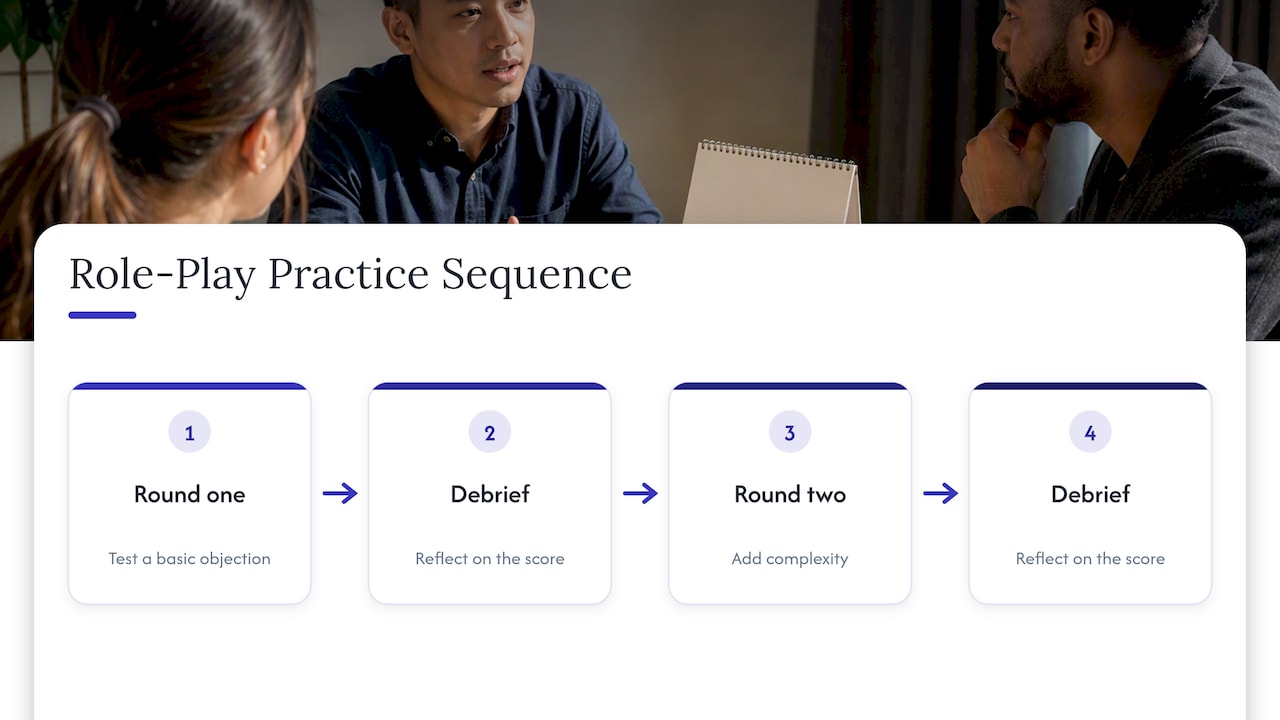
A role-play exercise becomes more effective when it’s structured as a leveled challenge: round one tests a basic objection, round two adds complexity, and each round ends with a short reflective debrief. That debrief step is what turns a game mechanic into actual learning, because the point isn’t the score, it’s the reflection the score prompts.
Coaching fits the same pattern. A manager using a GROW-style coaching conversation can reference a learner’s badge progress or micro-quest completion as a concrete talking point, turning an abstract check-in into a specific conversation about a specific skill gap. This is where gamification earns its keep: not as entertainment, but as a shared reference point between a coach and a learner that makes the coaching conversation more concrete.
The mistake to avoid is treating gamification as a separate initiative that runs parallel to coaching and experiential practice. When the three are integrated, the game data gives coaches something real to discuss, and the coaching conversation gives the game data meaning it wouldn’t have on its own.
Long-Term Engagement Strategies Beyond the Initial Session
Gamified training often produces a strong spike in engagement during the first session, then fades once the novelty wears off. Sustaining motivation past that first spike takes a different set of moves than the ones that generate initial excitement.
Rotate mechanics periodically instead of running the same leaderboard indefinitely. A format that feels fresh in week one feels routine by week eight, so introducing a new challenge type or a seasonal theme resets interest without requiring a full redesign.
Tie gamified milestones to real career moments, like a promotion conversation or a skill certification, so the badge or level means something beyond the platform itself. A security behavior study found that gamified interventions reduced risky behavior most effectively when game elements targeted specific behavior change and gave ongoing feedback, not a one-time push.
Manager involvement remains the strongest lever for sustained engagement. A quick manager check-in referencing recent progress keeps the training connected to daily work, rather than letting it live only inside a platform that gets opened less and less over time.
Finally, build a content refresh cycle into your plan from the start. Training content that stays static drifts out of sync with changing products, policies, or market conditions, which quietly erodes both relevance and engagement. Partner tools like Continuity’s content governance workflows are built specifically to catch that drift and keep gamified content synced with your LMS, so the experience stays current instead of going stale.
Practitioner Perspective: Human-First Gamification in Workshops
With over 30 years in competitive sports and real estate, we’ve seen plenty of gamified programs chase shiny mechanics instead of real skill. Our “Training, Not Selling” approach treats any game element as a tool for practice, never a substitute for it. In a workshop, that means every challenge ends with a real debrief, not just a score, and every leaderboard connects to a skill a manager can actually observe afterward.
— Middy
Bring Gamified Training Into Your Next Workshop or Keynote
Gamification works when it’s built around real practice, not novelty, and that’s exactly how we structure every session. Whether it’s a sales team practicing objection handling or a leadership cohort working through a 90-day program, we design the mechanics around one measurable behavior, coach facilitators on running the debrief, and leave you with a simple way to track whether it worked.

Our interactive workshops and half-day leadership training sessions both build in this kind of pilot-ready structure from the start. If you’re planning a session and want gamified elements that connect to a real KPI instead of a generic leaderboard, book a conversation with us to scope it out.
FAQ
What is an example of gamification in learning?
A common example is a branching scenario where a learner practices a sales objection and the outcome changes based on their choices, combined with a progress badge for completing each scenario. Points, leaderboards, and narrative-based micro-quests are also widely used examples.
How do you gamify in-person training?
Use visible progression, like a whiteboard scoreboard, for team-based challenges during a workshop, and structure role plays as rounds that increase in difficulty as pairs succeed. Closing each round with a short peer debrief keeps the focus on the skill, not just the score.
How does gamification affect employee training?
A TalentLMS survey found that many employees reported increased productivity and motivation with gamified training, compared to a notably lower motivation rate in non-gamified formats. Experimental research from Harvard Business Review adds that these effects hold best when gamification is applied consistently over time and paired with real practice.
What are the benefits of gamified training?
The main benefits are higher reported engagement and motivation, clearer skill progression through visible milestones, and in some cases measurable behavior change, such as reduced risky behavior in security training shown in a 2024 study. The strongest results come from designs that align mechanics to a specific behavior rather than adding game features broadly.
What should I check before choosing a gamification approach?
Confirm the mechanics map to a specific, measurable behavior rather than general engagement, and plan a small pilot with a matched comparison group before rolling anything out widely. A Frontiers study found that personalized alignment to learner profiles matters more than the intensity or number of game features used.
Sources
- TalentLMS gamification survey results
- Does gamified training get results? — Harvard Business Review (2023)
- Motivational gamification strategies rooted in SDT — Warwick/WRAP
- Gamified human resource management as a driver of employee engagement — Frontiers (2025)
Leave a Reply