
Organize your program into three or four curriculum pillars, not a scattered topic wish list, and prioritize key subjects such as emotional intelligence, feedback and coaching, delegation, change management, strategic thinking, hybrid leadership, difficult conversations, and psychological safety. Each one maps to something a CFO actually cares about. Retention, promotion velocity, and team performance are the metrics that justify the training budget, and every topic below earns its spot by connecting to one of them.
TL;DR:
- Focusing on emotional intelligence, feedback, and conflict resolution is essential because they consistently impact team trust, engagement, and conflict management outcomes.
- Incorporating practical exercises like role-plays and simulations enhances retention and skill transfer compared to passive training methods.
- Sequencing topics over time, especially for new managers, prevents bad habits and reinforces learning, with the hardest skills trained later in the 60 to 90 day window.
- Emphasizing outcomes such as retention, internal mobility, and team engagement makes leadership training more defensible and aligned with business results.
- Ready-built programs grounded in pillar-based design and live practice can save months of development time and improve training effectiveness.
Table of Contents
- Leadership Workshop Topics Organized by Curriculum Pillar
- How to Sequence Topics Into a Real Program
- Measuring Whether the Training Actually Worked
- Why Middy Matthews Is Qualified to Design This Curriculum
- Handling Conflict and Difficult Conversations in the Room
- What the Data Actually Supports (And What It Doesn’t)
- Bring in Middy’s Ready-Built Leadership Program
- Where to Go Deeper on Leadership Workshop Design
- Sources
Leadership Workshop Topics Organized by Curriculum Pillar
Most L&D teams build topic lists the wrong way around. They start with what sounds interesting, then hunt for a business reason afterward. Flip that order. Pick two or three organizational priorities first, then let the pillar structure tell you which leadership training topics actually deserve a session.
Here’s the catalog broken into four pillars, with who it’s for, how long it needs, and what to do in the room.
Pillar 1: Foundational leadership
Emotional intelligence and self-awareness. Outcome: fewer escalated conflicts, better peer trust scores. Best for new and mid-level managers. Run it as a 90-minute session with a self-assessment plus a structured peer feedback exchange, where pairs identify one blind spot and one strength in each other. This is consistently one of the highest-requested leadership development topics because it underlies almost everything else on this list.
Coaching and feedback fundamentals, including one-on-ones. Outcome: faster skill transfer, better direct-report engagement scores. Best for new managers, ideal in a cohort format so peers can practice on each other. A 2-hour workshop built around role-play, where each participant delivers one piece of real feedback to a volunteer “direct report” (played by a peer), works better than any slide deck on feedback models.
Time, energy, and delegation management. Outcome: reduced manager burnout, more delegated work completed on time. Best for new managers who are six to twelve weeks into the role. Try a 60-minute session centered on a task-sorting exercise: participants list their actual weekly tasks, then sort them into “must do myself,” “coach someone else through,” and “just hand off.”
Pillar 2: Management mechanics
Delegation and accountability systems. Outcome: measurable increase in team output without manager overload. Best for new and mid-level managers, works well as cohort training. A 90-minute case study format, where groups diagnose a fictional manager who delegates tasks but not authority, tends to surface real habits people recognize in themselves.
Coaching versus managing. Outcome: improved manager quality scores, better succession readiness. Best for mid-level leaders transitioning from doing the work to leading people who do it. A half-day module with a fishbowl exercise (one pair coaches live while the group observes and debriefs) builds the muscle faster than lecture.
Prioritization and decision-making under ambiguity. Outcome: fewer stalled projects, faster escalation resolution. Best for mid-level managers. A 90-minute simulation where teams triage a pile of competing “urgent” requests against a stated business priority works better than a framework handout alone.
Pillar 3: Leading teams and inclusion
Conflict resolution and difficult conversations. Outcome: fewer HR escalations, higher psychological safety scores. Relevant at every level, but the stakes and scripts change by seniority. A 2 hour session using scripted role-play scenarios, rehearsed in pairs before anyone touches a real conversation, is the format that sticks. More on this below.
Managing remote and hybrid teams. Outcome: sustained engagement scores across distributed team members, fewer “out of sight, out of mind” performance surprises. Best for managers of hybrid teams at any level. A 90-minute workshop with a structured audit, where participants map their last two weeks of communication and flag who got left out, tends to produce immediate behavior change.
Diversity, equity, and inclusion in day-to-day leadership. Outcome: broader promotion pipelines, more equitable performance review outcomes. Best woven into manager mechanics rather than run as a standalone lecture. A 90-minute session built around case studies of biased promotion decisions, discussed in small groups before a full debrief, keeps this practical instead of theoretical. DEI content works best integrated into feedback, coaching, and delegation modules rather than isolated as a single “diversity training” event that people mentally file away and forget.
Pillar 4: Strategic leadership and future readiness
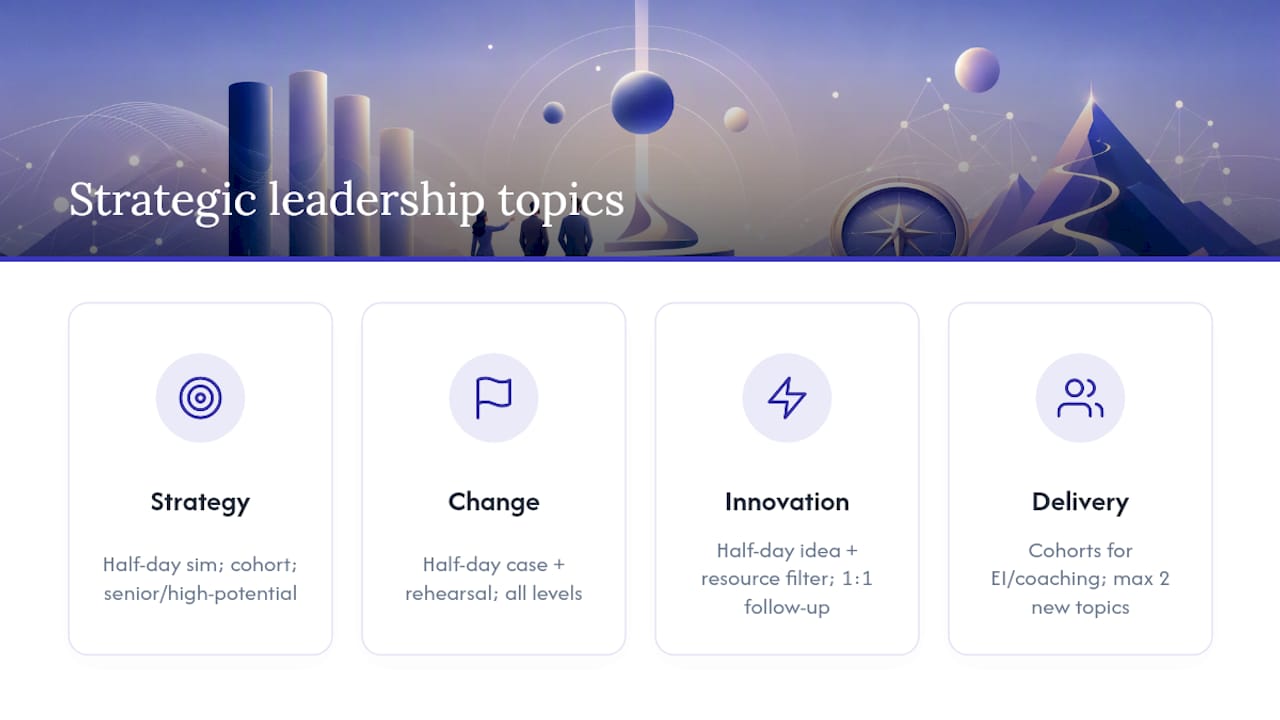
Strategic thinking and decision-making. Outcome: better cross-functional alignment, more initiatives that survive past the planning stage. Best for senior and high-potential mid-level leaders, usually run as a cohort. A half-day format with a business simulation, where teams allocate a fictional budget against competing priorities, forces the tradeoffs real strategy requires.
Change management. Outcome: faster adoption of new systems or restructures, lower attrition during transitions. Relevant at every level but especially senior leaders who need to communicate change downward. A half-day workshop combining a case study with a communication rehearsal, where participants draft and deliver a change announcement to a skeptical “team,” builds real capability.
Innovation and strategic planning. Outcome: more ideas that make it from whiteboard to execution. Best for senior leaders and high-potential mid-level managers, works well as a 1:1 coaching follow-up after a group session. A half-day format pairing an idea-generation exercise with a resource-constraint filter (kill any idea that can’t survive a real budget conversation) keeps this grounded.
The topics with the clearest line to business outcomes, emotional intelligence, coaching and feedback, and conflict resolution, deserve cohort formats where peer practice compounds the learning. Strategic thinking and innovation topics often work better paired with 1:1 coaching follow-up, since the real test is applying the framework to a leader’s actual portfolio, not a hypothetical.
Pro Tip: Never run more than two new topics in a single session. Managers retain skills through repetition, not exposure. A workshop that introduces five frameworks in ninety minutes produces zero behavior change.
How to Sequence Topics Into a Real Program
A topic list is not a curriculum. The difference is sequencing, and the biggest sequencing mistake most organizations make is training brand-new managers on everything at once, three months after they’ve already formed bad habits.
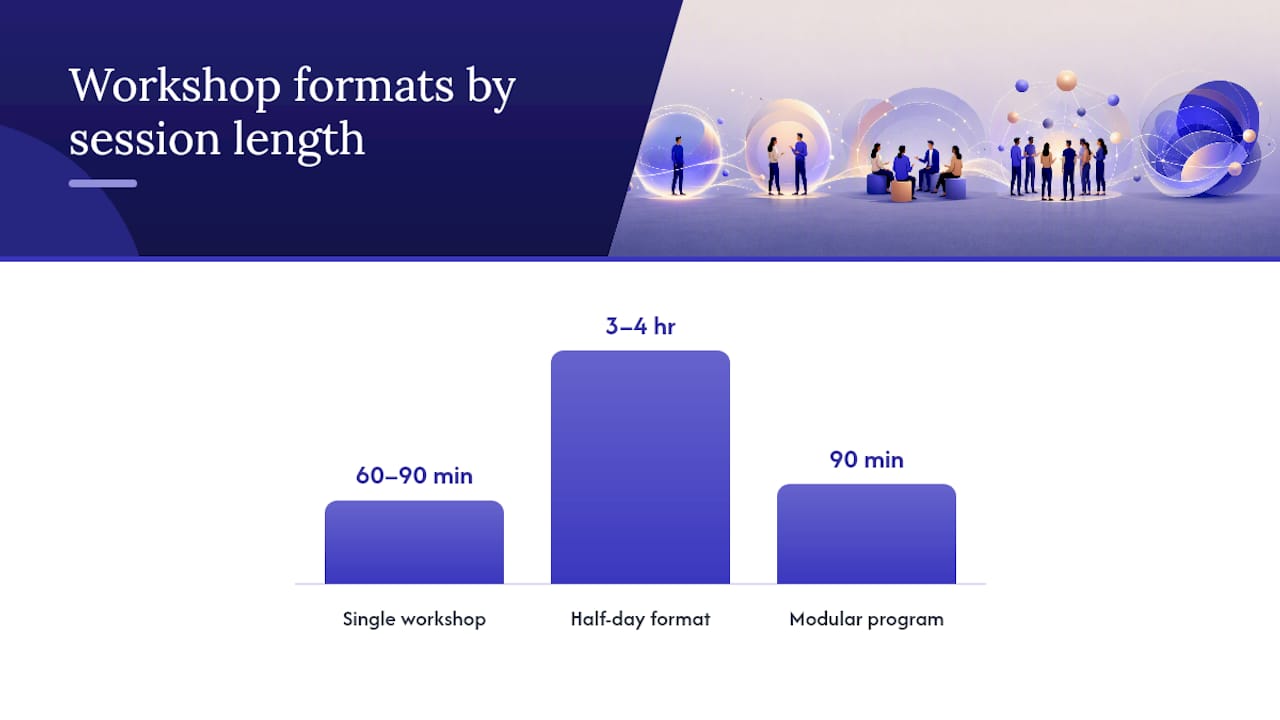
Three formats cover almost every use case:
- Single 60 to 90 minute workshop. Best for one focused skill (feedback delivery, delegation triage). Structure: 10 minutes framing, 50 to 60 minutes practice or simulation, 15 minutes debrief and commitment statement.
- Half-day format (3 to 4 hours). Best for topics with multiple layers (change management, strategic thinking). Structure: two related modules with a break between them, each ending in an applied exercise, not just discussion.
- Modular multi-week program. Best for new manager cohorts or leadership pipelines. Structure: weekly or biweekly 90-minute sessions spaced over 8 to 12 weeks, with a micro-assignment between each session.
That third format is where the new leader first 90 days sequence matters most. Best-practice guidance recommends spacing modules to match what a new manager is actually facing on the job, not front-loading everything before week one:
- Pre-promotion primer (before the title changes). A short session on the mental shift from peer to manager, plus expectation-setting with their own manager. Timing here matters more than content. Training delivered before someone steps into the role beats training delivered three months in, once habits have already calcified.
- Weeks 1 to 4. Focus on mechanics: running effective one-on-ones, setting expectations, early feedback conversations kept low-stakes and frequent.
- Days 30 to 60. Focus on delegation practice and prioritization, now that the new manager has enough context to know what actually needs to move.
- Days 60 to 90. Focus on harder performance conversations and conflict resolution, rehearsed before they happen for real. Our leadership lessons for new sales managers resource walks through this exact arc with sales-specific scenarios.
Pro Tip: Schedule the hardest-skill module (difficult conversations) for the 60 to 90 day window, not week one. New managers need lived experience with the easy stuff first, or the harder conversations training won’t have anything real to attach to.
Live practice consistently outperforms passive content delivery, which is the entire argument for role-play and scenario-based facilitation over slide-driven lectures. Spaced micro-assignments between sessions, a short reflection question, a real conversation attempted and reported back, do more for retention than any single workshop length.
Measuring Whether the Training Actually Worked
Attendance numbers tell you nothing about whether a manager got better. Track outcomes instead.
Four KPIs matter more than the rest:
- Retention lift among teams led by trained managers versus untrained ones, measured over two quarters.
- Promotion and internal mobility velocity, since a real signal of leadership quality is how fast people below a trained manager advance.
- Manager quality index, built from a short 90-day behavior checklist (does this manager run regular 1:1s, delegate visibly, handle conflict directly).
- Team engagement scores, tracked specifically by manager, not averaged across the whole org, so you can see which trained leaders moved the needle.
Shifting KPIs from hours logged to outcomes like retention and internal mobility is what makes a training budget defensible in front of finance. Run a baseline survey before the program, a 90-day behavior checklist after, and compare a trained cohort against a similar untrained group when you can. Even a small pilot, one team trained, one team not, run over a single quarter, gives you a comparison stronger than “everyone said the workshop was great.”
Why Middy Matthews Is Qualified to Design This Curriculum
Middy Matthews built her training philosophy, “Training, Not Selling,” around a simple observation: people retain skills they rehearse, not skills they’re told about.
- Over 30 years of combined experience across competitive sports and real estate, drawing directly on lessons about resilience and teamwork under pressure.
- A workshop methodology built on role-play, rehearsal, and coaching rather than lecture, matching the live-practice facilitation this article recommends throughout.
- A track record with real estate brokerages, corporate teams, and leadership conferences that need practical strategies participants can use the next day, not theory they forget by Friday.
Middy’s session recipes, the fishbowl coaching exercises, the rehearsed difficult-conversation scripts, the delegation triage drills, come straight from an athlete’s instinct for practicing under conditions that mimic the real thing. [Client outcome data and testimonials to be added by editor.]
Handling Conflict and Difficult Conversations in the Room
Conflict resolution shows up on nearly every list of common leadership training topics, and for good reason: it’s the skill most new managers avoid until it becomes a crisis.
The mistake most workshops make is teaching a conflict resolution model without ever making anyone practice an actual conversation. A framework slide does nothing for someone who has never said the words “I need to talk to you about something” out loud to another human being under time pressure.
Structure this topic around three levels of difficulty. Start with low-stakes scripted role-play (a peer is chronically five minutes late to meetings). Move to moderate stakes (a direct report’s work has slipped for two weeks straight). End with high stakes (addressing a peer conflict that’s affecting team morale). Rehearse each scenario in pairs before debriefing as a group, and rotate who plays the “difficult” role so everyone experiences both sides.
Timing matters as much as content. Rehearsing a real, upcoming conversation right before it happens, not months in advance, produces far better transfer than generic scenario practice detached from someone’s actual situation. If a manager has a hard conversation scheduled for next week, that’s the conversation to rehearse in the workshop. Generic scenarios are a fallback, not the ideal.
What the Data Actually Supports (And What It Doesn’t)
Most leadership development advice treats every topic as equally important, and that’s the first mistake worth correcting. Not every topic deserves the same investment. Emotional intelligence, feedback, and conflict resolution touch nearly every other skill on the list, so they earn cohort formats and repeated practice. Strategic thinking and innovation topics matter, but they’re better suited to smaller, senior-level groups paired with individual coaching, not a company-wide workshop that tries to cover everything at once.
The second overrated idea is that more topics equal a stronger program. A twelve-module curriculum that skims everything produces managers who recognize frameworks but can’t execute them. Four pillars, covered with real depth and real practice, beat a sprawling syllabus every time.
What gets underrated is timing. Organizations spend enormous energy debating which topics to include and almost none deciding when to deliver them. A pre-promotion primer costs almost nothing to run and prevents months of bad habits that later training has to unwind. If you fix one thing about your current program, fix the sequence before you fix the topic list.
— Middy
Bring in Middy’s Ready-Built Leadership Program
Building this curriculum from scratch, sourcing facilitators, writing role-play scripts, sequencing a 90-day program, testing what actually lands in the room, takes months most L&D teams don’t have. Middy Matthews offers the alternative: workshops and keynotes built on the exact pillar structure and facilitation techniques covered above, ready to book instead of built from zero.

Her programs cover the new-manager 90-day arc, coaching-versus-managing sessions, and difficult-conversation rehearsal formats, all grounded in “Training, Not Selling,” an approach designed for teams and leaders who want skills that stick past the training day. If you’re planning a leadership development track for new managers, explore Middy’s new-manager leadership program and get a session structure mapped to your team’s actual 90-day timeline instead of a generic template.
Where to Go Deeper on Leadership Workshop Design
- HBR’s leadership training topic list covers the core subjects most teams request first.
- Together’s strategic L&D framework explains pillar-based curriculum design tied to business outcomes.
- TIQPlus’s 90-day new manager guide offers a detailed sequencing checklist.
- Electives’ first-time manager training breakdown details the facilitation elements that drive real behavior change.
- Indeed’s leadership training topic roundup rounds out practical topic examples.
- The ESG Training Institute’s corporate capacity building resources offer a useful lens for tying workshops to strategic organizational priorities.
Sources
- 14 Top Leadership Development Training Topics for Teams
- 15+ Leadership Training Topics for Strategic L&D Programs | Together Mentoring Software
- New Manager Training: Topics, Timing and 90-Day Checklist | TIQPlus
- 8 elements of first-time manager training in 2026
- 12 Examples of Leadership Training Topics
Leave a Reply