
The fastest way to get usable results from a wellness program is to start small and prioritize adoption. Run a five-question pulse survey, pick two or three initiatives your employees actually asked for, name an executive sponsor, and build toward those choices with a 90-day rollout. Adoption drives ROI. A tightly scoped launch beats a sprawling one every time.
TL;DR:
- Launch small, scoped wellness initiatives based on employee input to achieve higher participation and better ROI than sprawling programs.
- Conduct a brief pulse survey and designate an executive sponsor within the first three weeks to build trust and gauge employee needs.
- Use a phased 90-day rollout with specific goals: listen and prepare, launch with incentives, then measure and decide on scaling or retiring initiatives.
- Choose cost-effective, inclusive activities like walking meetings, virtual fitness classes, and support for shift workers to reach diverse employee groups.
- Focus on measuring participation through anonymous, aggregate data and reinforce leadership involvement to sustain long-term adoption.
Table of Contents
- Corporate Wellness Ideas HR Can Actually Launch This Quarter
- 90-Day Quick-Start Rollout and Governance
- The Corporate Wellness Idea Bank, by Dimension and Budget
- Low-Cost, High-Impact Wins for Tight Budgets and Remote Teams
- Measuring Participation and ROI Without Violating Privacy
- Building Inclusive, Accessible Wellness Programs
- Middy’s Practitioner Playbook for Making Wellness Stick
- What HR Gets Wrong About Wellness Programs
- Bring in a Workshop When Adoption Stalls
- Where to Find Templates, Evidence, and Benchmarks
- Sources
Corporate Wellness Ideas HR Can Actually Launch This Quarter
Most wellness programs fail for a boring reason: nobody asked employees what they wanted first. HR picks a vendor, rolls out a gym discount, and wonders six months later why usage sits near zero. Programs that start with employee input and scale only what works tend to deliver three to four times better results than the low-participation kind, according to SmartSMS Solutions’ analysis of 90-day wellness launches. That gap is the whole story. It is not about budget size. It is about whether people show up.
Your first move this week should be simple and cheap: send a short pulse survey. Five to seven questions is plenty, according to the Global Wellness Institute, and it prevents the classic mistake of launching a gym subsidy when your workforce actually wanted childcare support or financial coaching. Pair that survey with one visible signal: an announced executive sponsor. Leadership modeling participation, not just approving a budget line, materially increases how safe people feel showing up, according to Harvard Business Review’s reporting on flexible work. Do those two things this week and you already have a program that outperforms most of what gets launched cold.
90-Day Quick-Start Rollout and Governance
A 90-day rollout works because it forces sequencing. You cannot fix engagement, satisfaction, and measurement all in the same week, so don’t try. Break the quarter into three phases and give each one a single job.
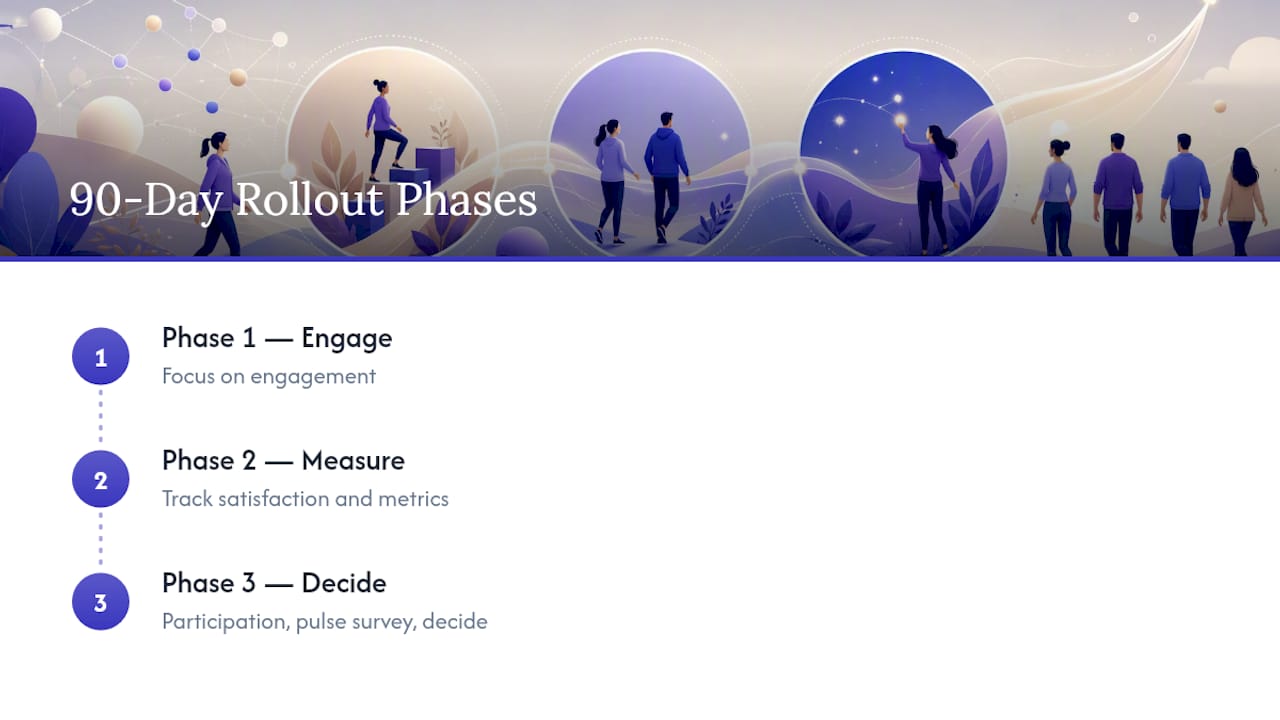
Phase 1: Weeks 1 to 3, listen and staff up
This phase is about information, not activity. Skip straight to programming and you risk building around guesses.
- Run the five-question pulse survey across the full workforce, not just headquarters staff.
- Name an executive sponsor publicly, ideally in an all-hands or company-wide email.
- Form a small wellness committee, three to five people, spanning departments and seniority levels.
- Distribute a one-page summary of existing benefits and Employee Assistance Program coverage. Many employees never use their EAP simply because they don’t know what it covers, and a plain-language recap measurably increases utilization, according to HR Cloud.
Phase 2: Weeks 4 to 8, launch and incentivize
Now you build, but only around what the survey told you people wanted. Launch exactly two or three initiatives, no more. One should be nearly frictionless to join, one should reach people who might otherwise sit out (remote workers, night-shift staff, new parents), and one should generate a number you can report back to leadership by week 12.
- Announce the initiatives through a single channel or calendar system. Fragmenting sign-up across three apps kills participation before it starts, per SmartSMS Solutions.
- Attach a light incentive: a recognition shout-out, a small gift card, or a team reward for group participation.
- Ask managers to model the behavior themselves in week one, not delegate it downward.
Phase 3: Weeks 9 to 12, measure and decide
Pull participation numbers, run a short follow-up pulse survey, and make a real call: scale the initiative, adjust it, or retire it. Retiring something that flopped is not failure. Keeping a dead initiative alive out of embarrassment is the actual failure.
Pro Tip: Assign one person as your “data steward” from day one, even if it’s a part-time responsibility. Someone needs to own the enrollment numbers and pulse-survey results, or they quietly stop getting collected by week six.
Simple governance keeps this from falling apart: an owner who is accountable for the calendar, a communications lead who sends reminders, and a data steward who tracks the numbers. Three people, clear jobs, no committee bloat.
The Corporate Wellness Idea Bank, by Dimension and Budget
Once you know what your employees actually want, pull ideas from the category that matches. Every entry below carries a rough cost tier, an inclusion tweak, and a remote-friendly variant, because a program that only works for in-office staff isn’t a program, it’s a perk for half your headcount.
Physical wellness ideas
Walking meetings. No-cost. Move any one-on-one or small group check-in outdoors instead of into a conference room. Walking increases creative output and folds movement into the workday without anyone needing gym access, according to Avidon Health. Inclusion tweak: offer a seated or stationary alternative for anyone with mobility limits. Remote variant: a “walk and call” norm, where phone calls (not video) happen on a walk.
Standing desks. Low-cost, one-time expense. A simple sit-stand converter runs far less than a full desk replacement. Inclusion tweak: make requesting one opt-in and confidential, since some employees may not want to explain a physical need. Remote variant: a small stipend toward a home-office converter.
On-site or virtual fitness classes. Low to medium cost depending on whether you bring in an instructor or license a streaming platform. Inclusion tweak: offer both high-intensity and low-impact versions of the same session so it isn’t only the already-fit who show up. Remote variant: record sessions so people in other time zones or with caregiving duties can join asynchronously.
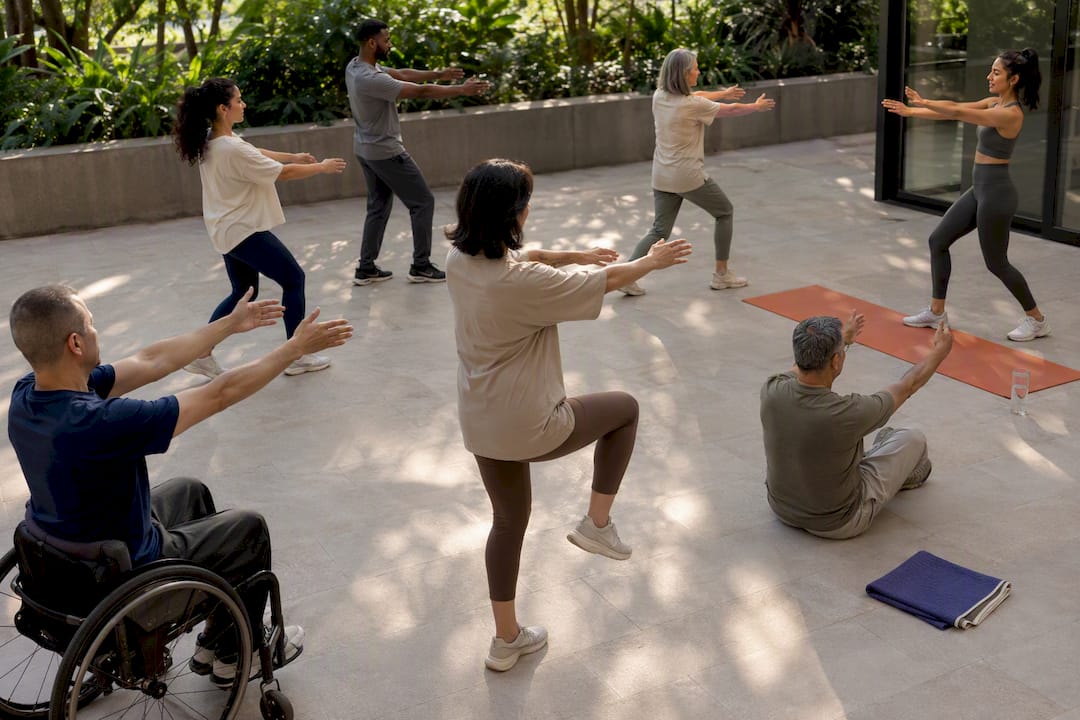
Team step challenges. No-cost to low-cost, depending on whether you use a free tracking spreadsheet or a paid app. Inclusion tweak: count minutes of movement, not just steps, so wheelchair users and people recovering from injury can compete on equal footing. Remote variant: team-based totals instead of individual leaderboards reduce the sting of uneven participation across time zones.
Mental wellness ideas
Guided meditation micro-sessions. No-cost if led internally, low-cost if you license an app. Short, guided mindfulness practices are a genuinely effective tool for reducing workplace stress, according to Harvard Health, and a 10-minute session before a Monday planning meeting is enough to matter. Inclusion tweak: make attendance camera-off and opt-in; some people find guided breathing exercises uncomfortable to do on video. Remote variant: a recorded audio library people can use on their own schedule.
Manager training on supportive conversations. Low-cost, mostly a time investment. Teach managers how to respond when someone says they’re struggling, without turning it into an amateur therapy session. Inclusion tweak: build in scenario practice for cultural and generational differences in how stress gets disclosed. Remote variant: a scripted one-pager managers can reference during a video check-in.
Mental health days. No-cost beyond existing PTO structure. The value here is entirely in the framing: call them what they are, and let leaders take them visibly. Inclusion tweak: separate them from sick days in policy language so no one has to fake a cold. Remote variant: none needed, this one travels naturally.
Mental health stipends. Medium cost. A modest quarterly allowance toward therapy, coaching, or a subscription app. Inclusion tweak: allow the stipend to cover a range of providers, not just one preferred vendor, since therapist fit matters enormously. Remote variant: fully remote by design, since most providers now offer virtual sessions.
Nutritional wellness ideas
Healthy catering standards. Low-cost, mostly a policy shift rather than a new expense. Set a baseline (a vegetable option, a lower-sugar option) for any catered meeting. Inclusion tweak: always list ingredients for allergy and religious dietary needs. Remote variant: a modest meal stipend for remote employees during all-hands events, so office perks don’t become office-only perks.
Cooking demos or recipe channels. No-cost to low-cost. A monthly recipe shared in a company channel, or a live 20-minute demo from an employee who cooks well. Inclusion tweak: rotate cuisines to reflect the actual makeup of your workforce, not just the easiest recipes to source. Remote variant: runs natively as a video call, no adaptation needed.

Subsidized healthy snacks. Low to medium cost depending on office size. Inclusion tweak: stock options for common allergies and dietary restrictions, not just a token gluten-free box. Remote variant: a quarterly snack-box stipend or delivery credit.
Hydration stations. Low-cost, one-time setup. A filtered water station with reusable bottles beats a case of bottled water on cost and waste. Remote variant: doesn’t translate directly, but a small home-office supply stipend covers the intent.
Financial wellness ideas
Lunch-and-learn financial workshops. No-cost if led by an internal HR benefits expert, low-cost if you bring in an outside financial educator. Cover retirement contributions, budgeting basics, or how to read a benefits statement. Inclusion tweak: offer sessions at different times to reach shift workers and parents managing school pickup. Remote variant: record every session; financial topics are exactly the kind people revisit privately later.
One-on-one financial coaching. Medium cost, usually through a benefits partner or EAP add-on. Inclusion tweak: keep enrollment confidential from managers. Remote variant: virtual by default; most financial coaching already happens over video or phone.
Student loan repayment assistance. Medium to high cost, but increasingly common as a differentiator for younger hires. Even a modest monthly contribution signals real investment. Inclusion tweak: pair it with a parallel benefit (like a 401(k) match boost) for employees without loans, so the perk doesn’t only serve one demographic. Remote variant: fully remote by nature.
Social and career wellness ideas
Mentoring programs. No-cost beyond time investment. Pair junior employees with senior staff outside their direct reporting line. Inclusion tweak: let mentees opt into pairing criteria (shared background, similar career path) rather than assigning at random. Remote variant: video-based mentoring works well; the format barely suffers.
Skills swap sessions. No-cost. Employees teach each other something outside their job function, from a language to a spreadsheet trick to a hobby. Inclusion tweak: actively recruit teachers from underrepresented departments so it isn’t always the same voices presenting. Remote variant: runs natively over video.
Volunteer days. Low-cost, mainly the cost of paid time off for the activity. Employees who volunteer are notably more likely to rate their company culture positively, according to Mayo Clinic Health System. Inclusion tweak: offer several cause options, not one company-mandated charity. Remote variant: a virtual volunteer day (tutoring, mentoring nonprofits online) or a flexible “use it anytime this quarter” policy for distributed teams.
Learning stipends. Medium cost. A modest annual budget toward courses, certifications, or conferences. Inclusion tweak: allow stipends to cover soft-skill and career-adjacent learning, not only role-specific technical training. Remote variant: fully remote by nature, since most learning platforms are already online.
Low-Cost, High-Impact Wins for Tight Budgets and Remote Teams
If your budget is thin or your team is scattered across time zones, you don’t need fewer ideas, you need sharper ones. A handful of near-zero-cost moves consistently outperform expensive perks nobody uses.
- EAP awareness one-pager. Free to produce, and it directly addresses the fact that most employees have no idea what their EAP actually covers, per HR Cloud.
- Walking meetings as a default for one-on-ones, no cost, no scheduling overhead.
- Meeting-free blocks, one afternoon a week where no internal meetings get scheduled. Flexible scheduling and greater control over your workday are tied to measurably better mental health outcomes, according to Boston University’s School of Public Health.
- Interest groups, employee-run clubs (book club, running group, parenting group) that need nothing from HR but a channel and light encouragement.
Remote and hybrid teams need a slightly different version of each idea, not a scaled-down one. Virtual fitness sessions should be recorded, not just live-streamed, so a night-shift employee in a different time zone isn’t permanently excluded. Step challenges and habit trackers work better as asynchronous team totals than live leaderboards. Buddy systems, pairing two employees for a weekly five-minute check-in, translate almost perfectly to remote settings and cost nothing but a calendar invite. Recorded workshops beat live-only ones every time distributed teams are involved; a session recorded once and viewed 40 times has better ROI than a live session 15 people could attend.
Pro Tip: When budgets are tight, spend your limited dollars on incentives that scale with participation, not fixed perks that cost the same whether five people or five hundred show up. A $10 gift card per completed challenge scales. A catered lunch does not.
Incentives that scale well include public recognition, small per-milestone gift cards, and team-based rewards tied to group participation rather than individual performance. Avoid incentives that only reward the already-engaged, like a raffle limited to people who attended every single session; that structure quietly punishes anyone with a caregiving schedule or a rotating shift.
Measuring Participation and ROI Without Violating Privacy
You cannot report “employees feel better” to a CFO and expect the budget to survive next year’s review. You need numbers, and you need them collected in a way that never lets anyone trace a data point back to an individual.
The core KPI set that matters most:
- Enrollment rate: the percentage of eligible employees who sign up for at least one initiative.
- Active engagement rate: the percentage of enrolled employees who actually participate monthly, not just registered once and vanished.
- Event attendance: raw headcount per session, tracked over time to catch fatigue early.
- Anonymous pulse score changes: aggregate shifts in wellbeing or stress ratings, never tied to individual respondents.
- Absenteeism trend: a directional signal, not a precise causal claim.
- Voluntary turnover trend: slower moving, but the number leadership ultimately cares about most.
Aggregate, anonymized measures like these are the recommended approach for demonstrating program impact without compromising individual privacy, according to SHRM’s wellness program toolkit. Run a short baseline survey before you launch anything, then repeat a compressed version quarterly. Aggregate every result at the team or department level, never smaller, so no individual’s stress score or absentee day is ever identifiable.
Reasonable Early Target: Aim for 40 to 60 percent enrollment in your first 90 days, with active monthly engagement of enrolled participants as your real success metric rather than raw sign-up counts alone.
When you present results to leadership, lead with the trend line, not a single snapshot. A jump from 20% to 45% engagement over two quarters tells a far more convincing story than a static “45% of employees are enrolled” headline ever could.
Building Inclusive, Accessible Wellness Programs
A wellness program that only works for able-bodied, fully-employed, English-speaking office staff on a nine-to-five schedule isn’t really a company-wide program. It’s a benefit for whichever slice of your workforce most resembles the people who designed it.
Four design principles catch most of the common blind spots:
- Offer intensity variety. A fitness challenge needs a low-impact track alongside the high-intensity one, or you exclude anyone managing an injury, a chronic condition, or simply a preference for walking over sprinting.
- Keep the barrier to entry low. If joining requires downloading a third app, creating a new login, and syncing a wearable device, you’ve already lost a third of your workforce before day one.
- Watch language and cultural framing. A “step challenge” assumes everyone can walk comfortably. A “healthy eating” campaign built entirely around one cuisine assumes everyone shares one food culture.
- Build in real accommodations. Schedule sessions at multiple times to reach shift workers, and always offer an asynchronous or recorded alternative to a live-only event.
Pro Tip: Run every new initiative through one question before launch: “Who on our team would find this impossible or uncomfortable to join, and what’s the workaround?” If you can’t answer it, you’re not ready to announce it.
Scalable intensity, asynchronous options, and noncompetitive recognition structures solve most of this in practice. A meditation session that offers both a 5-minute and 20-minute version. A step challenge scored on team totals instead of individual rankings. A volunteer day with five cause options instead of one mandated charity. None of these cost more money. They just require someone to think about who gets left out before the invite goes out, not after.
Middy’s Practitioner Playbook for Making Wellness Stick
Most wellness rollouts collapse for the same reason most sales training collapses: someone tells people what to do instead of training them to actually do it. The philosophy of training rather than selling applies just as directly to wellness adoption as it does to a sales floor. Announcing a benefit is not the same as building a habit around it.
A workshop format that tends to work well runs 30 to 60 minutes and focuses on exactly one resilience or habit skill, not a broad wellness overview. A sample 45-minute agenda: 10 minutes framing why the habit matters using a concrete, relatable scenario, 20 minutes of guided practice (not lecture), and 15 minutes where each participant commits, out loud, to one specific action they’ll take that week. The outcome you’re looking for isn’t applause. It’s a room full of people who can tell you exactly what they’re doing differently on Monday.
Leadership participation is what separates a workshop that sticks from one that fades by Friday. When an executive publicly takes a mental health day, or visibly joins the step challenge instead of just funding it, that single act does more to reduce stigma than any policy memo. Language matters here too: call it a “mental health day,” not a euphemism, and normalize it the same way you’d normalize a sick day.
Adoption is not about how good the initiative is. It’s about whether people believe the person who announced it actually believes in it too.
A simple one-page kickoff template covers what the initiative is, why it exists, who to contact, and one clear first action. Follow up at week two, week six, and week ten, not just at launch. Momentum dies in silence, not in disinterest.
What HR Gets Wrong About Wellness Programs
The conventional advice treats wellness as a menu problem: pick enough perks, and engagement follows. It doesn’t. I’d argue the real failure point is sequencing. Most programs launch every initiative at once, in month one, before anyone has confirmed employees actually wanted any of it.
The research backs a narrower, less flattering truth: adoption is a design choice, not a byproduct of generosity. A company offering five mediocre-fit benefits will lose to a company offering two well-chosen ones, every time. The instinct to be comprehensive is exactly what kills comprehensiveness in practice, because a scattered launch gives employees permission to ignore all of it.
If you take one thing from this, take the sequencing: survey first, launch two things, measure honestly, then expand. Everything else, the catalog of ideas, the KPI dashboard, the inclusive design checklist, matters only once that first loop is running. Skip the sequencing and even a generous, well-funded program will look, from the employee’s chair, exactly like noise.
— Middy
Bring in a Workshop When Adoption Stalls
A survey and a phased rollout get most programs moving. But some launches need a jolt, especially when early buy-in is thin, participation has stalled after the honeymoon period, or your culture needs a visible reset rather than another email announcement. That’s the specific gap a live keynote or workshop fills that a policy memo never will: it gives people a shared moment and a leader standing in front of them, modeling the behavior out loud.
Middy runs corporate wellness keynotes and workshops built around practical habit change rather than generic motivation. The sessions translate directly into the kind of program adoption this article covers: a room leaves with one specific action, not a vague inspirational memory. For teams dealing with burnout specifically, there’s a workshop format built around resilience for high-stress environments that pairs well with a phase-two rollout launch.
If you’re an event planner or HR lead weighing whether a speaker fits your timeline, this guide to choosing a corporate wellness speaker walks through what to ask before booking. When you’re ready, request a sample agenda or check availability for a keynote or workshop timed to your Phase 2 launch window.
Where to Find Templates, Evidence, and Benchmarks
A few sources are worth bookmarking before you build anything further:
- SHRM’s wellness program toolkit provides program design frameworks and the privacy-safe metrics guidance referenced throughout this piece.
- Harvard Health’s meditation guide offers the clinical-adjacent evidence behind short guided mindfulness sessions.
- Boston University School of Public Health’s research on flexible work connects scheduling flexibility to measurable mental health outcomes.
- SmartSMS Solutions’ 90-day launch framework is the clearest public breakdown of phased rollout mechanics and adoption targets.
- Global Wellness Institute’s commentary on workforce wellbeing covers the shift toward listening-first program design across organizations.
Sources
- Designing and Managing Effective Wellness Programs — SHRM
- Learning how to meditate — Harvard Health
- Job flexibility and security promotes better mental health — BU School of Public Health
- Corporate wellness program ideas: a 90-day launch plan — SmartSMS Solutions
Leave a Reply