
The essential leadership communication skills are clarity, active listening, empathy, adaptability, feedback, and consistent follow-up. Research links a leader’s mindfulness in communication to employees’ psychological safety, with a regression coefficient of 0.419 (p < 0.01). Below you get a prioritized skills list, a difficult-conversation protocol, practice routines, and a path to training.
TL;DR:
- A 2025 study linked mindful leader communication to psychological safety, with a regression coefficient of 0.419 (p < 0.01) and empathy and trust as mediators.
- For high risk conversations, consult a neutral third party when feelings and risk are high, lead with observed facts, and document agreements with a scheduled check in.
- Track talk time in two meetings each week, rehearse one difficult conversation with a peer, and close every promise with a specific date.
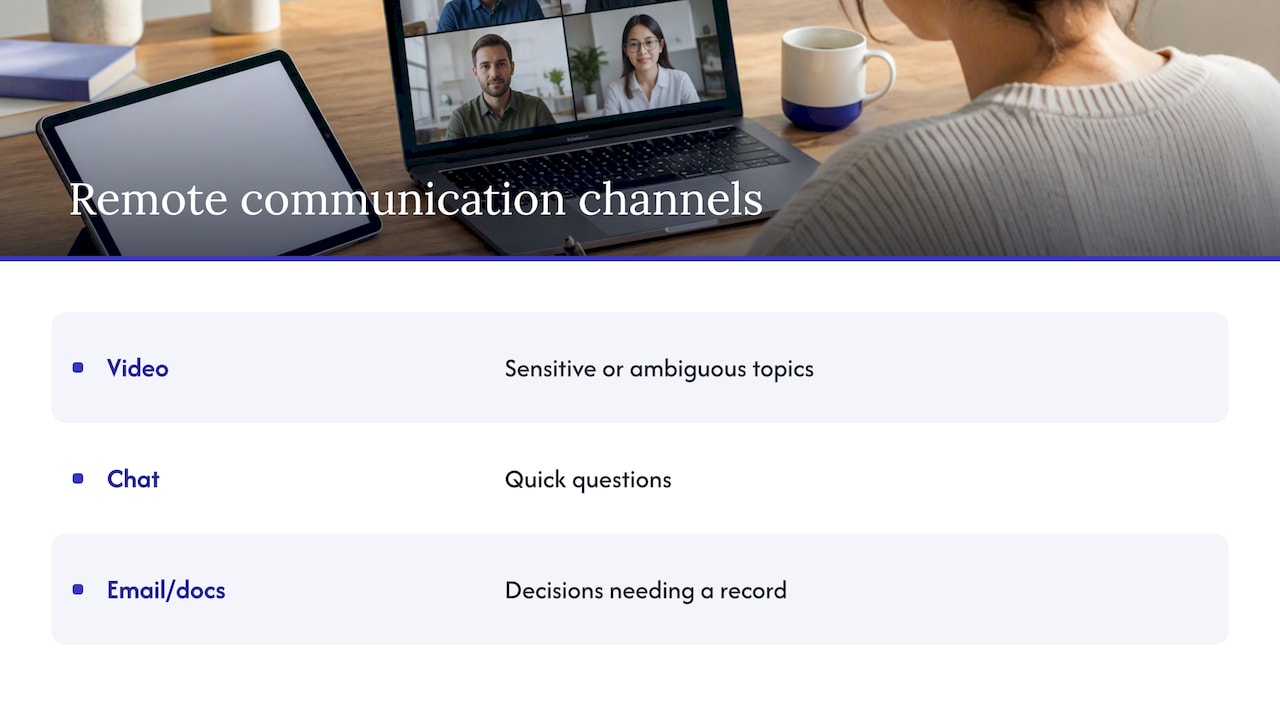
- Remote leaders should reserve video for sensitive or unclear topics, chat for quick questions, and email or documents for decisions that need a record.
Table of Contents
- 1. The leadership communication skills worth practicing first
- 2. How do you run a difficult conversation without losing the relationship?
- 3. How does mindful communication build psychological safety?
- 4. What practice plan turns these skills into habits?
- 5. How do you use storytelling to lead?
- 6. How do communication styles and personality types change your approach?
- 7. What digital communication skills do remote leaders need?
- 8. How do you motivate and inspire a team through communication?
- 9. Why training beats scripts
- 10. How we help your team build these skills
- FAQ
- Sources
1. The leadership communication skills worth practicing first
Most leaders know they should “communicate better.” Few have a drill for it. Here is each skill with a definition, a brief practice, and what it improves. Harvard Business School Online makes the case that how you communicate, through transparency, empathy, and active listening, often matters more than the message itself, because those behaviors build the trust you need to rally a team.
- Clarity and concise messaging. Say one point, then the reason. Practice: write your next update in two sentences before the meeting. It cuts follow-up questions.
- Active listening. Hear the whole thought before you answer. Practice: repeat back what you heard in one sentence (“So the real blocker is the handoff, right?”). It makes people feel heard.
- Empathy. Name the other person’s experience before you solve it. Practice: open with “That sounds like a heavy week.” It lowers defensiveness.
- Adaptability and audience awareness. Change your style for the person in front of you. Practice: ask yourself “What does this person need from me today?” before each conversation. It prevents the one-size-fits-all lecture.
- Transparency. Share what you knowwhat you don’t, and when you’ll know more. Practice: say “Here’s what I can’t tell you yet.” It builds credibility.
- Open-ended questions. Ask “what” and “how” instead of yes/no. Practice: swap “Is that clear?” for “What questions does this raise?” It surfaces real concerns.
- Courageous questions. Ask the one everyone is avoiding. Practice: “What are we not saying out loud?” It exposes problems early.
- Body language and nonverbal cues. Your face and posture arrive before your words. Practice: put the phone face down, turn toward the speaker, and keep your arms open. It signals attention.
- Giving and receiving feedback. Be specific about behavior and impact. Practice: use “When you X, the result was Y. Next time, try Z.” For ready templates, see our guide to evidence-based performance feedback. When you receive feedback, say “Thank you, tell me more” first.
- Follow-up and timelines. Every promise gets a date. Practice: end each conversation with “I’ll send X by Thursday.” It turns talk into trust.
Pro Tip: Aim to speak less and give the other person room to talk in one-on-ones. Our active listening drills show how to practice it.
2. How do you run a difficult conversation without losing the relationship?
Treat it as a process, not a performance. Experts advise that you listen and learn first rather than leading with your own story. The Allen Lab at the University of Colorado Boulder offers a brief protocol that we’ve adapted below.
- Clarify your purpose. Write one sentence: “I want this person to leave knowing X.”
- Map options and values. List your realistic options and what each stakeholder cares about.
- Check the gradient. When feelings and risk are both high, a neutral third party helps you regain perspective before you speak.
- Prepare your facts. Stick to what you observed, not what you assume.
- Choose the channel. Use a rich channel (face to face or video) for sensitive topics.
- Practice out loud. Rehearse your opening with a colleague.
- Hold the conversation. Open with “Here’s what I’m seeing, and I’d like to hear your side.”
- Document and schedule. Write down agreements and book the check-in before you part.
Pro Tip: Debrief afterward. Note what worked, then decompress before your next meeting. For scripts, see our workplace conflict playbook.
3. How does mindful communication build psychological safety?
The evidence is direct. A 2025 study found that leader mindfulness in communication has a significant positive link with employees’ psychological safety.
Regression coefficient of 0.419 (p < 0.01): leader mindfulness in communication positively predicts employees’ psychological safety, with leader empathy and interpersonal trust as key mediating factors.
In plain terms, people speak up when they trust that you are paying attention. These behaviors carry the effect:
- Focused listening. Close the laptop and give one person your full attention.
- Feedback-sharing. Offer feedback and invite it back in the same conversation.
- Acknowledging experience. Say what the team is going through. Kellogg guidance recommends separating what is known from what is unknown, especially in uncertain times.
- Needs-first one-on-ones. Harvard Business School research indicates that one-to-ones focused on psychological needs raise safety more than task-only check-ins.
For templates, try our four leader moves for psychological safety.
4. What practice plan turns these skills into habits?
Skills stick through repetition, so we build routines, not resolutions. Use these exercises:
- Talk-time balance drills: track your speaking time in two meetings per week.
- Role-play: rehearse one difficult conversation with a peer, then swap roles.
- One-on-one agendas: start with the person, then the work. Our manager-as-coach guide and GROW coaching scripts help.
- Values mapping: before a decision, list what each stakeholder values.
- Feedback-sharing templates: keep a short script on your desk.
A weekly rhythm: focused one-on-ones, a feedback moment, and mindful listening drills.
| Timeframe | Focus | Goal |
|---|---|---|
| Early practice | Listening and clarity | Give the other person room to speak in one-on-ones |
| Ongoing practice | Feedback and follow-up | Give specific feedback regularly and close every loop |
| Further practice | Difficult conversations | Run a prepared high-stakes conversation using the protocol |
5. How do you use storytelling to lead?
Facts inform. Stories make people act. A leader’s story gives a team a reason to care about the numbers, and it lets you carry a value without lecturing about it.
Keep the structure simple: a situation, a struggle, and a lesson. Start with a moment people can picture, such as the Monday a project almost fell apart. Name the tension honestly, including your own mistake when you made one. End with the one takeaway you want them to carry into their work.
Three habits make stories land. Pick stories that match your message, not just your favorites. Keep them brief. And tie the ending to a specific behavior you want to see next week.
A quick drill: write three stories from your own career, one about a failure, one about a win someone else earned, and one about a lesson from a difficult customer or colleague. Rehearse each aloud until it feels concise. Then use them in kickoff meetings, onboarding, and feedback conversations, where a short story often softens a hard message better than a list of rules.
6. How do communication styles and personality types change your approach?
People take in information differently, and good leaders adjust. Some teammates want the bottom line first. Others need context and time. Some want the numbers, and some want to know how a change affects people. When you talk to everyone the same way, you reach only the ones who happen to share your style.
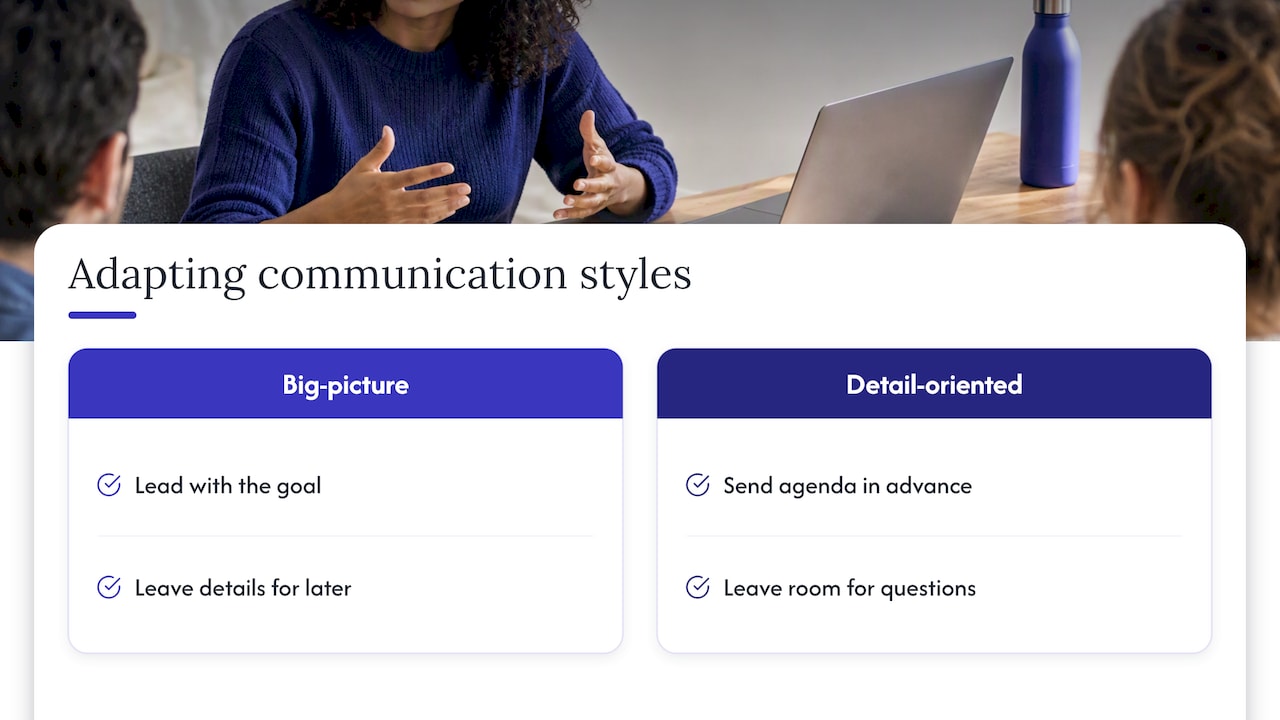
You don’t need a personality test to start. Watch for cues. Does this person ask for details or for the big picture? Do they decide fast or reflect? Do they prefer a quick message or a conversation? Then adapt. With a big-picture thinker, lead with the goal and leave the details for later. With a detail-oriented one, send an agenda in advance and leave room for questions.
Adapting is not faking. It is a form of respect, the same adaptability that Penn LPS names as a core leadership communication skill. Ask your team directly: “How do you like to receive feedback?” and “What is the best way to reach you when something is urgent?” Write the answers down and use them. A brief question can help prevent misunderstandings.
7. What digital communication skills do remote leaders need?
When you can’t read a room, you have to build the signals on purpose. Remote leaders lose the hallway moments where small concerns surface, so you replace them with structure.
Start with channel discipline. Use video for sensitive or ambiguous topics, chat for quick questions, and email or documents for decisions that need a record. This is the rich-versus-lean channel choice that Brown University’s communication steps describe. Say out loud which channel you will use for what, so no one guesses.
Write for skimmers. Put the ask in the first line, the deadline in bold, and the context below. Tone disappears in text, so add a short human line: “Thanks for turning this around so fast.”
Keep shared workflows tidy too. Teams that route customer and internal messages through a clear structure waste less time, and a professional client inbox for teams is one example of how shared channels reduce dropped threads.
Finally, protect the one-on-one. In a remote team it is often the only place a person is truly heard, so never cancel it casually.
8. How do you motivate and inspire a team through communication?
Motivation rarely comes from a speech. It comes from people knowing why their work matters and feeling that you notice it. Start with purpose: connect each task to the customer, the team goal, or a value your group shares. Kellogg guidance recommends reinforcing shared values and purpose, especially when things are uncertain.
Next, make recognition specific. “Great job” fades by lunch. “You caught the pricing error before it reached the client, and that protected our reputation” gets remembered. Praise the behavior you want repeated, and do it in front of peers when the person is comfortable with that.
Then give people a say. Ask for their ideas before you hand down a plan, and show later how their input shaped the outcome. People defend what they help build.
Last, be honest in hard moments. A team follows a leader who says “This quarter will be tough, and here’s how we’ll handle it” far more readily than one who paints everything bright. Inspiration is trust, repeated daily.
9. Why training beats scripts
We follow a simple rule: Training, Not Selling. The same applies to communication. You can hand a leader a script, and it will sound like a script. What changes behavior is repeated practice with a coach who watches, adjusts, and asks you to try again. That is how a micro-practice becomes a habit that survives a stressful Tuesday. Our workshops exist to turn the drills in this article into routines your team actually uses.
— Middy
10. How we help your team build these skills
If you want facilitated practice instead of going it alone, we can design it around your team. Our leadership half-day training and interactive workshops put the drills from this article into live practice. Here is what teams leave with:
- Practice-ready skills they can use in their next one-on-one
- One-on-one meetings as a place for real conversation
Ready to start? Contact us to book a leadership workshop and we’ll shape the session around the skills your leaders need most.

FAQ
What are the 7 C’s of effective leadership communication?
The 7 C’s are commonly listed as clear, concise, concrete, correct, coherent, complete, and courteous. Definitions vary by source, but they all push you toward messages people can understand and act on the first time.
What are five good communication skills for leaders?
Clarity, active listening, empathy, adaptability, and feedback are a strong core set. Penn LPS also names transparency among the skills that strengthen leadership communication.
What are the four pillars of leadership communication?
There is no single official list, and sources define them differently. A practical version is purpose, audience, message, and follow-up, which mirrors the steps in Brown University’s communication process.
How can I improve team communication quickly?
Start by making room for the other person to talk in one-on-ones and setting a specific follow-up date after every conversation. Both take seconds to practice and show results within a few weeks.
Sources
- The impact of leader mindfulness in communication on employees’ psychological safety
- 8 Essential Leadership Communication Skills | HBS Online
Leave a Reply