
When stakes are high, use a brief situational-awareness pause, pick one decision horizon like the 40-70 rule, then commit. That single move, backed by frameworks like OODA and POP-DOC, beats freezing or guessing. Take 5 to 10 seconds to breathe, name the one variable that matters most, then act. The rest of this guide gives you the frameworks and drills that make this reliable instead of lucky.
TL;DR:
- Use OODA when one person must act in seconds; choose POP-DOC when several teams need coordinated execution and communication during outages or safety incidents.
- After an acute stressor, avoid complex analysis for the first minute or two; use a pause and identify one decisive variable, then revisit detailed tradeoffs.
- A weighted matrix ranks two or three options in 60 to 90 seconds by scoring three factors, such as cost, speed, and reliability.
- For team decisions, name one owner and a fallback in advance, set escalation rules, and protect a quiet decision window from interruptions.
- Hold monthly scenario drills for 10 to 20 minutes and quarterly full simulations; review decision time, outcomes, and whether the team followed its process.
Table of Contents
- Priority tactics for making decisions under pressure
- Decision frameworks: OODA and POP-DOC compared
- How stress changes your brain’s decision-making
- Fast decision tools you can use in the moment
- How to train for reliable decisions under pressure
- Leading your team through high-pressure decisions
- How Middy Matthews builds this into workshops
- Why practicing fast decisions matters
- Book a workshop built around pressure-tested decisions
- FAQ
- Sources
Priority tactics for making decisions under pressure
Most leaders do not fail under pressure because they lack intelligence. They fail because they try to think the way they do on a calm Tuesday morning, except now the clock is running and everyone is watching. The fix is not more analysis. It is a short, repeatable sequence you trust enough to use without debating it first.
Here is the order we recommend, built from research on structured decision speed and tested in workshop settings:
- Tactical pause. Take one breath, count to five, and let your eyes move around the room or situation before you speak. This interrupts the stress spike long enough to think instead of react.
- Cut your options to two or three. A sales director choosing between three vendor quotes under a Friday deadline does not need a fourth option. More choices just burn time you do not have.
- Name the single critical variable. Ask yourself what one fact, if it changed, would flip your decision. Decide around that, not around everything.
- Set a decision horizon. Give yourself a fixed window, two minutes, ten minutes, end of day, and commit to deciding inside it.
- Protect one decision owner. When a team is involved, pressure invites too many voices. One person decides; others advise.
- Frame around outcome, not process. Ask “what result do we need” before “how should we do this.” Process questions eat time that outcome questions save.
- Run a 30-second pre-mortem if you have the time. Picture the choice failing and ask why, out loud, once.
- Trust checked intuition. Pair your gut call with a 15 to 60 second gut check against the facts you actually have, not the ones you assume.
Each of these works because it narrows the decision space instead of widening it. A fire captain does not debate five entry strategies mid-blaze. She runs one, built from training, and adjusts as new information arrives. Leaders can borrow that same discipline for a product recall, a client blowup, or a sudden staffing gap.
Pro Tip: Write your top three decision variables on an index card before a high-stakes meeting. When pressure hits, you read the card instead of inventing criteria on the spot.
Decision frameworks: OODA and POP-DOC compared
You do not need to build a decision process from scratch every time a crisis lands on your desk. Two frameworks cover almost every situation a leader faces under pressure, and knowing which one fits saves precious seconds.
OODA stands for Observe, Orient, Decide, Act. It was built for fast, individual decision cycles where one person needs to move before the situation shifts again.
POP-DOC stands for Perceive, Orient, Predict, Decide, Operationalize, Communicate. It extends the same situational awareness that OODA offers, but adds the operational and communication steps a multi-stakeholder crisis demands.
Here is how to tell them apart in the moment:
- Use OODA when you are the single decision-maker and the loop needs to run in seconds: a negotiation pivot, a live customer escalation, a split-second call on the sales floor.
- Use POP-DOC when the decision touches multiple teams and needs coordinated follow-through: a product outage, a safety incident, a PR crisis that spans departments.
- Both frameworks share the same backbone: perceive the situation accurately, decide fast, then act. POP-DOC simply builds in the communication layer that group decisions require.
For the first 30 seconds of any high-pressure moment, here is a micro-version worth memorizing: see it, decide the one thing that matters, say it out loud. That compresses either framework into something you can run while standing up, phone in hand, with no time to consult a chart.
How stress changes your brain’s decision-making
Understanding why pressure messes with your judgment makes the tactics above easier to trust instead of skip.
One study found reduced activity in the dorsolateral prefrontal cortex during decisions made immediately after a stressful event, which research shows correlates with less deliberate, more risk-averse choices. The dorsolateral prefrontal cortex is the part of your brain that handles planning, weighing trade-offs, and resisting impulsive shortcuts. When it goes quiet, you lean on habit instead of analysis, and you tend to avoid risk even when the safer-looking option is actually worse.
That matters for a very practical reason: stress does not just make you anxious, it changes what kind of thinker you are for the next several minutes. Attention narrows onto the most obvious threat and tunes out peripheral information that might be just as important. Risk preferences shift, often toward whatever feels safest in the moment rather than what the data supports.
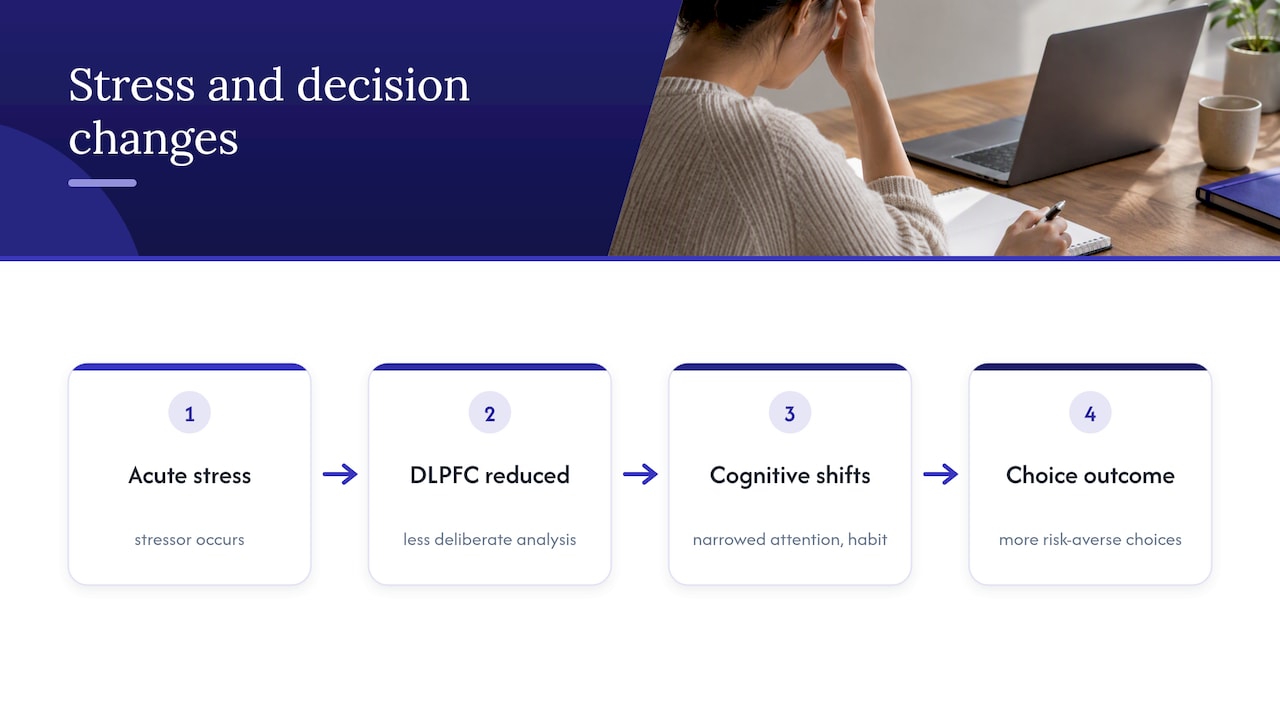
The leadership implication is direct. In the first minute or two after an acute stressor, hard analytic work is the wrong move. A pricing recalculation, a complex staffing trade-off, or a detailed contract review will suffer if you try to do it right after the bad news lands. Instead, use that window for the tactical pause and the single-variable framing described earlier, then save the harder analysis for a few minutes later once your prefrontal function has caught back up.
This is also why pre-built decision templates matter so much. When your brain is biased toward habit, a template gives you a good habit to fall back on instead of a panicked one.
Fast decision tools you can use in the moment
Sometimes you need a tool, not a theory. These three fit in your pocket.
Business school guidance on decision speed backs this kind of time-boxed heuristic as a reliable way to balance speed against accuracy.
A 60 to 90 second weighted matrix works when you have two or three options and a few minutes to spare. Picture a vendor decision, three choices, three factors that matter: cost, speed, and reliability.
| Option | Cost (weight 3) | Speed (weight 2) | Reliability (weight 5) |
|---|---|---|---|
| Vendor A | 2 | 3 | 4 |
| Vendor B | 4 | 2 | 3 |
| Vendor C | 3 | 4 | 2 |
Multiply each score by its weight, add the rows, and the highest total wins. It takes less time than arguing about it in a meeting.
A three-question triage checklist covers you when there is no time for a matrix at all:
- What must go right for this decision to work?
- What is the best outcome that is still realistically plausible?
- Who decides, right now, if we cannot agree in the next sixty seconds?
Answer those three and you usually have your decision before you finish asking them.
How to train for reliable decisions under pressure
Decision skill under pressure is trainable the same way a jump shot or a sales pitch is trainable, through repetition under realistic conditions rather than through reading about it once. Management research on decision training backs this: structured practice, not raw experience alone, builds cognitive agility.
Here is a simple way to build the habit into a busy leadership schedule:
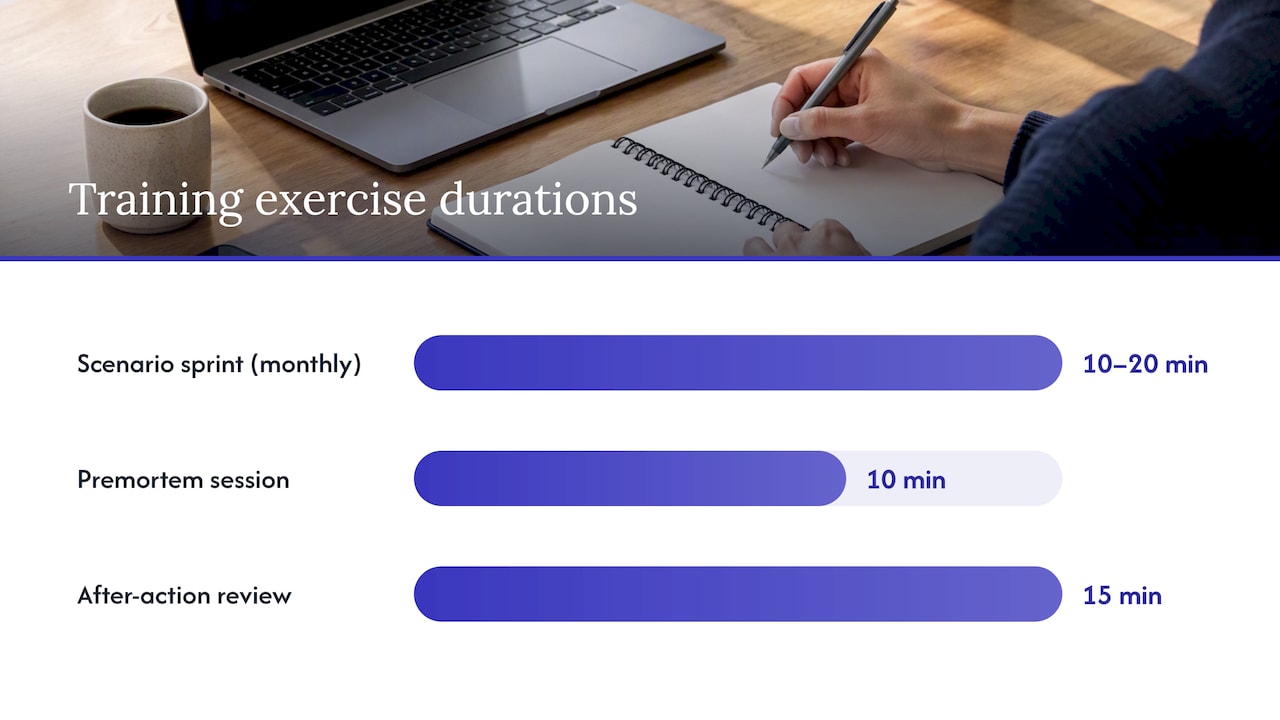
- Run 10 to 20 minute scenario sprints monthly. Pick a realistic crisis, a lost client, a safety incident, a data breach, and have your team walk through the decision in real time.
- Add a premortem session before major launches. Spend ten minutes imagining the project has failed and work backward to find the cause. A structured premortem script can give your team a ready-made format instead of starting from a blank page.
- Throw in a surprise inject. Midway through a drill, change one variable, a deadline moves up, a key person becomes unavailable, and watch how the team adapts.
- Run a tight after-action review immediately afterward. Track decision time, the outcome, and whether the team actually followed the agreed process or abandoned it under stress.
- Repeat the full simulation quarterly. Monthly short drills keep the reflexes sharp; a quarterly full-scale simulation tests whether those reflexes hold up when more is on the line.
Pro Tip: Keep your after-action review to fifteen minutes. Ask what happened, why, and what you will do differently next time. Longer reviews tend to drift into blame instead of learning.
Leading your team through high-pressure decisions
A team under pressure does not need more opinions. It needs clarity about who decides and how information moves.
- Name a single decision owner and a fallback. Everyone should know, before the crisis starts, who has final say and who steps in if that person is unreachable.
- Use short commander’s intent statements. Tell the team the outcome you need and the constraints you are working within, then let them fill in the how.
- Set rules for escalation. Decide in advance what triggers a call up the chain versus what a team member can handle solo.
- Protect a decision window. Once the owner starts deciding, give them a quiet stretch of time rather than a stream of interrupting updates.
This is the same discipline that separates a team that freezes under a surprise product recall from one that executes a plan while everyone else is still debating. The structure does the heavy lifting so individual nerves do not have to.
How Middy Matthews builds this into workshops
Interactive workshops put these tactics into leaders’ hands rather than onto a slide. A typical module runs a short scenario sprint, has participants practice the tactical pause and single-variable framing live, then closes with a compressed after-action review so the lesson sticks before the room empties.
This is the heart of the Training, Not Selling philosophy: the focus is on building habits that outlast the session instead of handing out a motivational talk and hoping it holds. Event planners can request drill scripts, decision templates, and a facilitator guide so the practice continues long after the session ends.
Why practicing fast decisions matters
Thirty years on a field and in real estate taught me the same lesson twice: the athletes and agents who perform best under pressure are not the most talented ones, they are the ones who rehearsed the moment before it arrived. Start small. Pick one upcoming decision this week and run the three-question triage before you make it.
— Middy
Book a workshop built around pressure-tested decisions
The Interactive Workshop is designed to turn exactly the tactics above into muscle memory for teams, not a one-day inspiration spike that fades by Friday. Leaders leave with decision templates, drill scripts, and a shared vocabulary for high-pressure moments, whether that pressure shows up on a sales floor, in a leadership meeting, or during a client crisis.

For leadership teams who want a deeper dive, the Half Day Training walks through the full OODA and POP-DOC application, runs a live scenario sprint, and ends with a structured after-action review a team can repeat on its own.
- Interactive workshop: hands-on drills, pre-mortems, and decision templates for sales and client-facing teams.
- Half day training: a deeper leadership session covering frameworks, team decision hygiene, and after-action review practice.
- Panels and moderation: options exist for conference events who want these ideas woven into a broader event.
Reach out through Middy to request a sample drill script or a workshop outline built around your team’s specific pressure points.
FAQ
How do you respond to decision-making while under pressure?
Start with a brief tactical pause, five to ten seconds of breathing and observing, then narrow your choices to two or three and commit within a fixed time window. This interrupts the stress response long enough to engage deliberate thinking instead of pure habit.
What is decision-making under pressure in leadership?
It refers to a leader’s ability to assess a fast-moving situation accurately and choose a course of action within a limited time frame, often with incomplete information. Frameworks like OODA and POP-DOC give leaders a repeatable structure for this instead of relying on improvisation.
How to make a difficult decision under pressure?
Identify the single critical variable that will determine success, apply a time-boxed rule like the 40-70 rule, and protect one clear decision owner so the choice does not get diluted by too many voices. A short pre-mortem, if time allows, catches obvious failure points before you commit.
How to make right decisions under pressure?
There is no guaranteed “right” choice under uncertainty, but research on dorsolateral prefrontal cortex activity suggests avoiding complex analytical work in the first minute after a stressful event improves decision quality. Pairing checked intuition with a short structured review, rather than raw gut instinct alone, tends to produce more reliable outcomes.
How can leaders practice decision-making under pressure?
Short monthly scenario sprints combined with quarterly full simulations build the skill the way repeated drills build any other reflex. Our after-action review guide outlines how to debrief each drill so the lessons actually transfer to live situations.
Sources
- The POP-DOC Loop: A continuous process for situational awareness and situational action – PMC
- Six strategies for making better decisions under pressure – IMD
Leave a Reply