
Psychological safety is the shared belief that people on a team can speak up, admit a mistake, or challenge a decision without getting punished or humiliated for it. Leaders don’t get it by being nice. They get it by modeling vulnerability first and responding to bad news with curiosity instead of blame. The evidence backs this hard: the U.S. Surgeon General’s workplace well-being framework names it a foundation of worker health, and a meta-analysis of 123 studies covering 8,452 teams ties team trust directly to performance.
TL;DR:
- Building psychological safety requires leaders to model vulnerability and respond to poor news with curiosity, not blame or punishment.
- Teams with higher trust and safety outperform others in learning, innovation, and performance across industries, according to extensive research and meta-analyses.
- Leaders should start by naming mistakes early, normalizing dissent, and visibly following up on feedback to foster ongoing safety rather than treating it as a one-time training.
- Long-term safety development takes months, especially for challenger safety, and should be measured through specific, anonymous pulse surveys and operational indicators.
- The most effective way to build safety is through consistent leader behaviors that reward candor and handle bad news well, rather than through culture change initiatives or slogans.
Table of Contents
- What Psychological Safety Actually Means
- Why Psychological Safety Actually Moves the Numbers
- How Do You Actually Build Psychological Safety?
- The Practical Checklist: Where to Start This Week
- The Four Stages of Psychological Safety
- How to Measure Whether It’s Actually Working
- Warning Signs You’re Getting It Wrong
- Turning the Research Into a Workshop Leaders Can Actually Run
- What Most Leaders Get Backwards About This
- Ready to Build This Into Your Team, Not Just Talk About It
- Where to Go Deeper on the Research
- Sources
What Psychological Safety Actually Means
Amy Edmondson coined the term in 1999, and her framing still holds up better than most of what’s been built on top of it since. Psychological safety, in her words, is the shared belief that a team is safe for interpersonal risk-taking. That’s it. Not comfort. Not consensus. Just enough safety that a person will raise a hand and say “I think we’re about to make a mistake” instead of staying quiet and hoping someone else says it first.
Here’s where most leaders trip up. They hear “psychological safety” and picture a soft, conflict-free office where everyone get along. That’s backwards. Real safety is what makes conflict productive instead of dangerous. A team with genuine safety can argue hard about a decision, disagree with the boss in the room, and still trust each other after the meeting ends. A team without it either goes silent or turns disagreement personal, because nobody trusts that a challenge will be read as anything other than an attack.
It also isn’t the same thing as low accountability. You can hold people to a high bar and still have a psychologically safe team, as long as the consequences for missing that bar are fair and predictable, not humiliating or arbitrary. Confusing the two is how well-meaning leaders end up with teams that feel safe and perform badly, because nobody ever gets honest feedback.
What interpersonal risk-taking looks like on a real team:
- Admitting “I messed up the numbers on that deal” in a meeting instead of quietly fixing it and hoping nobody notices
- Asking a question that might reveal you don’t fully understand something everyone else seems to get
- Telling your manager their plan has a hole in it, before it becomes an expensive problem
- Disagreeing with the most senior person in the room on a call that matters
One more distinction leaders miss: safety at the team level and safety at the organizational level aren’t the same thing, which is why corporate capacity building plays a critical role in ensuring lasting psychological safety across the entire organization. You can have a psychologically safe team inside a company culture that punishes candor everywhere else. That team will hold together for a while on the strength of its immediate leader, but it’s fragile. Lasting safety needs both the team habit and the organizational backing.
Why Psychological Safety Actually Moves the Numbers
The business case isn’t a nice-to-have story. It’s a performance story, backed by research that spans thousands of teams. Teams with higher trust and safety consistently show better learning, better innovation, and better performance than teams without it, according to a synthesis of multi-study reviews from INSEAD Knowledge. That relationship holds up across industries, team sizes, and time horizons, which is rare for anything in organizational research.
The trust and performance link, by the numbers: A meta-analysis cumulating 123 independent studies across 8,452 teams found intrateam trust positively related to team performance. That’s not one study with a convenient sample. That’s a pattern repeated across more than a hundred separate research efforts.
McKinsey’s own synthesis of practitioner research finds that psychological safety predicts better decisions, stronger retention, and more innovation, and that leaders who invest in inclusive leadership development are more likely to build the behaviors that create it. That last part matters. Safety doesn’t show up because a company writes it into a values poster. It shows up because specific leaders act differently in specific moments.
On the well-being side, the case is just as direct. The Surgeon General’s Framework for Workplace Mental Health treats psychological safety as foundational, not decorative, tying it to reduced burnout and stronger retention. That framing matters for any leader who’s been told wellness and performance are competing priorities. They’re not. They run on the same track.
Put together, the practical outcomes leaders should expect from real progress on safety:
- Fewer decisions made on bad information, because people flag problems before they become disasters
- Lower voluntary turnover, especially among your best performers, who leave first when they feel unheard
- More ideas surfacing from people who aren’t in the room where decisions usually get made
- Less burnout, because carrying silent worry about a mistake is exhausting in a way most leaders underestimate
How Do You Actually Build Psychological Safety?
Building psychological safety starts with what the leader does first, not what the team is told to do. Edmondson’s research and the McKinsey synthesis both point to the same lever: leaders who model fallibility and respond to candor with curiosity instead of punishment are the ones who see it spread through their teams.
First-week moves, if you’re starting from scratch:
- Open your next team meeting by naming something you got wrong recently, briefly and without self-flagellation. This sets the tone faster than any policy statement.
- Start check-ins with a real question, not a status update. “What’s something you’re stuck on?” works better than “any updates?”
- Say out loud, in front of the team, that disagreement during decisions is expected and welcome. Then actually welcome it when it shows up.
- Ask one person directly for their honest opinion on a decision you’ve already half made. Then listen to the answer, even if it’s inconvenient.
Medium-term routines, once the basics are in place:
Structured retrospectives beat casual “how’s it going” check-ins because they force specific questions instead of vague vibes. Build in a recurring slot, weekly or biweekly, for “what went well” and “what worried you,” a rhythm that normalizes learning and candor over time rather than treating it as a one-off event. Rotate who facilitates these sessions. When the same person always runs the meeting, the team starts performing safety for that person instead of practicing it for real.
Devote actual calendar time to dissent before big decisions, not after. A five-minute round where everyone has to name one risk or objection, before the group commits, catches problems that a general “any concerns?” question never surfaces.
How you respond in the moment someone speaks up is the whole game. Get this wrong once, visibly, and you can undo months of work.
- Lead with inquiry, not judgment. “Tell me more about what you’re seeing” beats “are you sure about that?” every time.
- Name the courage explicitly. “I’m glad you brought that up” costs you nothing and buys you the next hard truth.
- Follow through visibly. If someone flags a problem, close the loop publicly on what changed because of it. Silence after candor reads as punishment, even when it isn’t meant that way.
Short scripts worth keeping in your back pocket:
- “What am I missing here?”
- “Say the part you’re hesitant to say.”
- “I got that wrong. Here’s what I’m doing differently.”
- “What would make this safer to bring up next time?”
- “Thank you for telling me before it became a bigger problem.”
Pro Tip: Practice these scripts out loud before you need them. The first time you try to say “I got that wrong” in front of your team, it should not be the first time you’ve said it at all. Rehearse it in the mirror, or better, in a workshop setting where the stakes are low.
The Practical Checklist: Where to Start This Week
Not every leader needs all of these at once. Pick two or three from the top of this list before adding more.
- Ban punitive language around mistakes in team settings. “Who did this?” trains people to hide problems. “What happened, and what do we do now?” doesn’t.
- Celebrate the person who raised the flag, not just the person who fixed the problem. Catching an issue early is a skill worth rewarding on its own.
- Set an explicit speaking-up norm in writing. A one-line team agreement, posted somewhere visible, does more work than most people expect.
- Ask quieter team members directly for their view, by name, before the loudest voice weighs in. This single habit changes who gets heard in a meeting.
- Run a blameless retro after any real failure. The goal is a fix, not a target.
- Model uncertainty out loud. “I don’t know, let’s find out” from a leader gives everyone else permission to say it too.
- Rotate facilitation of key meetings. It breaks the pattern of safety being performed for one person only.
- Follow up visibly on feedback you receive. If nothing changes after someone speaks up, don’t expect them to speak up again.
- Separate the debrief from the performance review. Mixing them turns honest reflection into a defense strategy.
- Address dominant voices privately. If one person crowds out the room, safety for everyone else quietly disappears.
Start with numbers one, two, and eight. They cost nothing, they’re visible fast, and they signal more than any policy document could.
The Four Stages of Psychological Safety
Timothy Clark’s four-stage model gives leaders a useful way to diagnose where a team actually stands, rather than assuming safety is a single on/off switch. Each stage builds on the last, and skipping ahead rarely works.
- Inclusion safety: People feel accepted as members of the group. Without this, nothing else is possible. Signs of stalling here include newer or different team members staying visibly quiet.
- Learner safety: People feel safe asking questions and admitting they don’t know something. Teams stuck here often have senior members who model competence but never model not knowing.
- Contributor safety: People feel safe using their skills to make a meaningful difference. This stage stalls when leaders keep decision-making too centralized.
- Challenger safety: People feel safe questioning the status quo, including the leader’s own decisions. Few teams reach this stage, and it’s usually the leader’s own defensiveness that blocks it.
A related framing worth knowing is Ron Westrum’s typology of organizational cultures, which separates pathological, bureaucratic, and generative cultures based on how information and bad news flow upward. It’s a useful cross check: a team can hit challenger safety internally while sitting inside a bureaucratic organization that quietly punishes the behavior anyway.
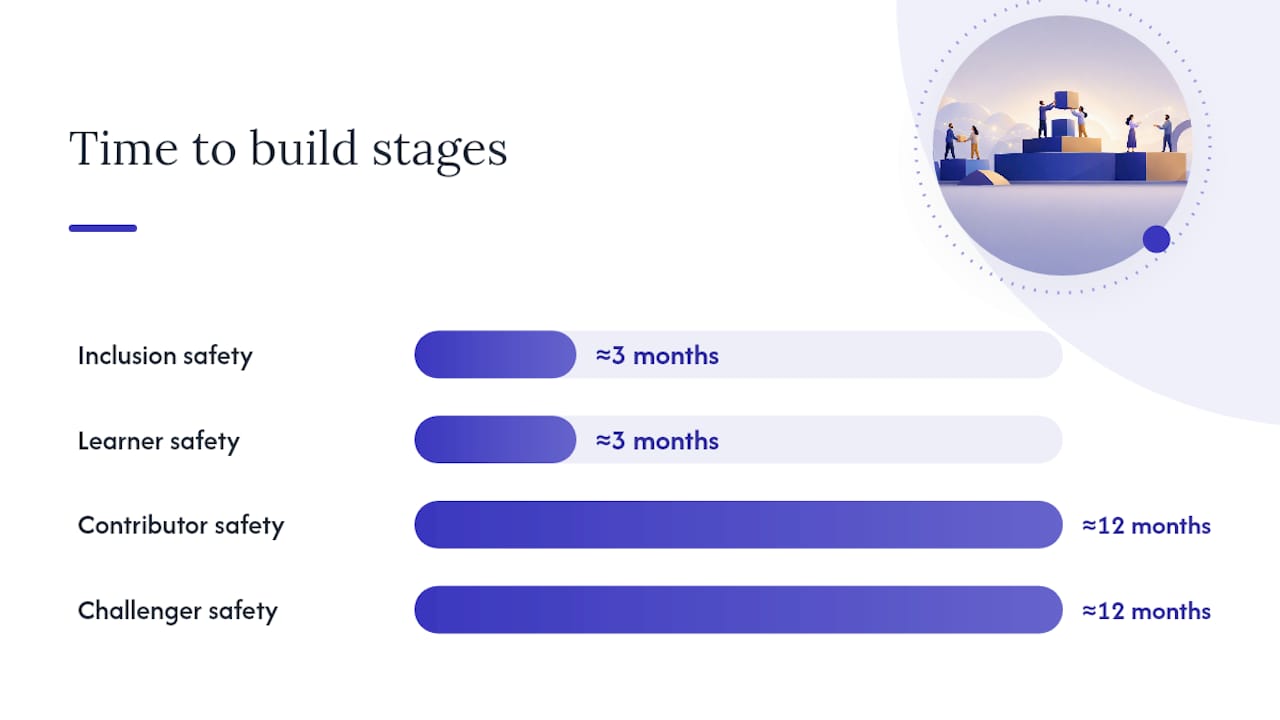
Movement through these stages takes months, not a single workshop. Expect inclusion and learner safety to build within a quarter of consistent leader behavior. Contributor and challenger safety usually take longer, closer to a year, because they require the leader to give up some control.
How to Measure Whether It’s Actually Working
Skip the vague “does the team feel safe?” gut check. Use a handful of specific pulse items instead, delivered anonymously on a regular cadence:
- “I can bring up a problem or tough issue with my team.”
- “It’s safe to take a risk on this team.”
- “No one on this team would deliberately act to undermine my efforts.”
- “My unique skills and talents are valued and utilized on this team.”
- “It’s easy to ask other members of this team for help.”
The Agency for Healthcare Research and Quality applies these same principles in operating rooms, where staying quiet about a concern carries life-and-death stakes, not just missed revenue. If the framework holds up in surgery, it holds up in your quarterly planning meeting.
Beyond survey scores, watch a few operational metrics: frequency of upward feedback reaching leadership unprompted, near-miss or early-warning reports filed before something breaks, and voluntary turnover among high performers specifically, since they’re the ones with options.
If you want to test whether an intervention is actually working, run it as a small pilot with one team before rolling it company-wide. Track the pulse items before and four to six weeks after, and be honest about what anonymity actually requires: results reported only in aggregate, and never in groups small enough that one person’s answer is identifiable.
The retention link: teams with stronger trust and safety measurably retain talent longer, according to the same body of research linking intrateam trust to team performance across more than a hundred independent studies.
Warning Signs You’re Getting It Wrong
Silence in meetings is the loudest warning sign there is. If every decision gets unanimous agreement with no debate, you don’t have alignment. You have a team that’s learned not to bother speaking up.
Watch for:
- Meetings where the most senior voice always wins, without pushback
- Problems that surface only after they’ve become expensive
- A blame reflex whenever something goes wrong, before anyone asks what happened
The most common leader mistake is treating psychological safety as a one-off training event instead of an ongoing leadership practice. A single workshop without a real change in leadership behavior afterward rarely produces lasting improvement. The second most common mistake: confusing niceness with safety, and avoiding hard feedback because it feels uncomfortable to give.
If an initiative backfires, the recovery playbook is short. Name what went wrong out loud, apologize specifically rather than generally, and change one visible behavior immediately rather than promising a bigger fix later.
Turning the Research Into a Workshop Leaders Can Actually Run
The “Coached, Not Bossed” approach treats psychological safety the same way a good coach treats a team down a point at halftime: not with a lecture, but with drills people practice until the behavior becomes automatic. Feedback practice sessions, where leaders rehearse delivering hard truths in a way people can actually hear, map directly onto the challenger and contributor safety stages described earlier. Vulnerability modeling exercises, where leaders practice naming a mistake in front of peers before doing it in front of their own team, build the exact muscle the research points to as the strongest lever available.
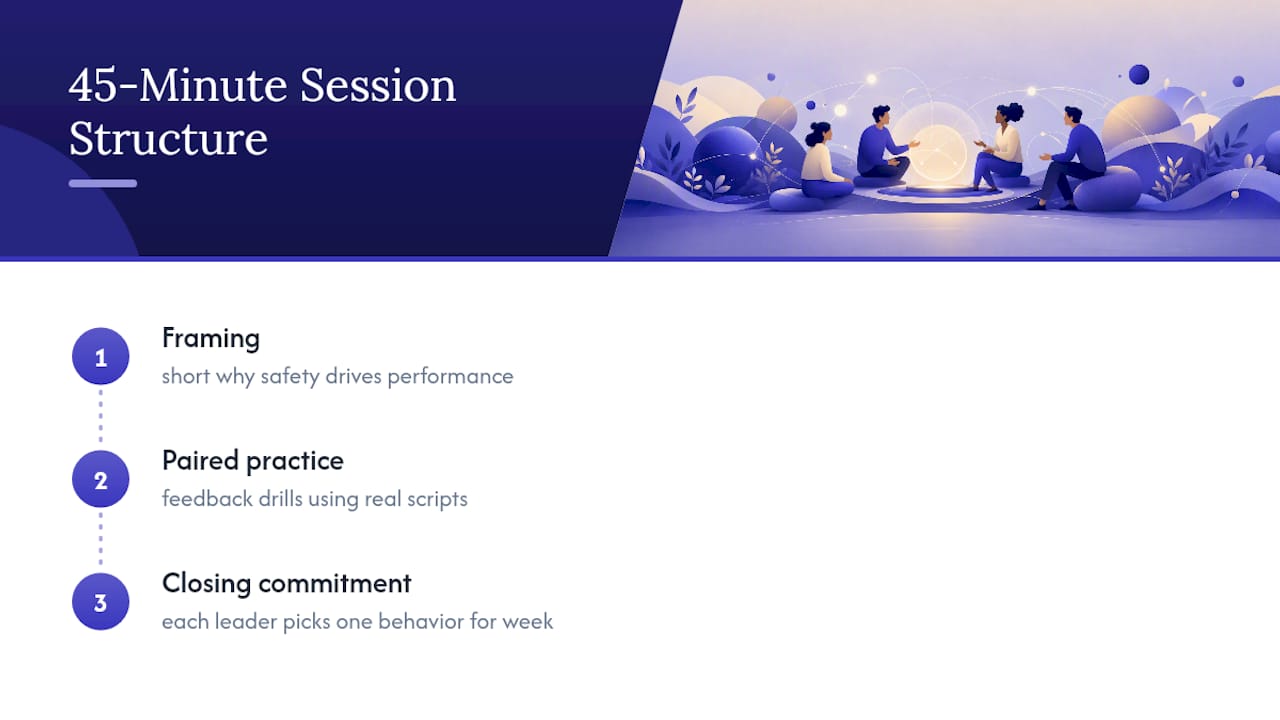
A typical 45 minute session runs three parts: a short framing on why safety drives performance, a paired practice round using real scripts like the ones above, and a closing round where each leader commits to one specific behavior for the following week. The feedback frameworks Middy uses in “Coached, Not Bossed” sessions adapt cleanly to hybrid teams, since the paired practice works over video just as well as in a conference room, as long as leaders commit to the same follow up discipline either way.
What Most Leaders Get Backwards About This
The conventional advice treats psychological safety like a culture problem you solve with a slogan or a values workshop. That’s the part that consistently fails. The research doesn’t support “communicate the values better.” It supports “change what the leader does in the next uncomfortable moment,” and there’s a real difference between the two.
Here’s what’s underrated: the leader’s own response to bad news is the entire mechanism. Not the team charter, not the offsite, not the poster in the break room. One leader who visibly rewards a person for flagging a mistake does more for a team’s safety than a year of values training. One leader who punishes candor, even quietly, undoes it just as fast.
If you’re prioritizing where to start, skip the culture deck and start with your own next reaction to bad news. Practice the response before you need it, because the moment always arrives faster than expected, and it never announces itself in advance.
— Middy
Ready to Build This Into Your Team, Not Just Talk About It
Reading about psychological safety and actually building it into how your team operates are two different jobs. Keynotes, half-day workshops, and training series are built specifically for leaders who want their teams speaking up, not staying quiet until a problem becomes a crisis. Sessions cover the same ground this guide does: modeling vulnerability, running feedback that people can actually hear, and building the meeting rituals that make candor normal instead of risky.

Leaders who participate in these workshops leave with scripts they can use the same week, not just a framework to file away. If your team’s silence in meetings has started to worry you, or your best people are leaving quietly instead of raising concerns loudly, book a sales training session that actually sticks and start the conversation about what a session looks like for your team.
Where to Go Deeper on the Research
For leaders who want the primary sources behind this guide: Amy Edmondson and Zhike Lei’s construct history in the Annual Review of Organizational Psychology traces the concept from its origins through current research directions. The Surgeon General’s Workplace Well-Being framework gives the public-health case. McKinsey’s explainer on psychological safety covers practical business framing, and the meta-analysis on trust and team performance provides the strongest quantitative evidence available on the link between trust and results.
Sources
- Workplace Well-Being — U.S. Department of Health & Human Services (Surgeon General)
- Trust and Team Performance: A Meta-Analysis
- Psychological Safety: The History, Renaissance, and Future of an Interpersonal Construct — Annual Reviews
Leave a Reply