
Women leadership coaching pairs one-on-one executive coaching with peer cohort work to close the specific gaps that stall women’s careers, things like visibility, sponsorship, and negotiation confidence. If you’re comparing programs, look for three things: a real peer cohort (not just a class roster), a coach with documented experience working with women executives, and measurable outcomes the provider will actually show you.
- Cohort peer network so you’re building relationships with women facing the same roadblocks, not just absorbing theory alone.
- A qualified executive coach with years of experience coaching women specifically, not a generalist applying the same playbook to everyone.
- Measurable outcomes like promotion rates, negotiation wins, or confidence scores the provider tracks and shares.
Ready to compare formats? Keep reading, or book a discovery call to talk through what fits your stage.
Key Takeaways
Women leadership coaching works best when cohort peer networks pair with individual executive coaching to build confidence, executive presence, and measurable promotion outcomes.
| Point | Details |
|---|---|
| Combine cohort and 1:1 coaching | Peer validation plus individualized coaching produces stronger, longer-lasting results than either alone. |
| Ask for measurable outcomes | Request alumni promotion rates and confidence survey data before enrolling in any program. |
| Match format to career stage | Rising managers need presence training; senior leaders need board-level sponsorship work. |
| Budget realistically | Costs range from a few hundred dollars for workshops to several thousand for multi-week cohorts. |
| Consider Middy’s tailored approach | Middy offers keynotes, cohort workshops, and 1:1 executive coaching built around your specific role and timeline. |
Table of Contents
- What Makes Women Leadership Coaching Different From General Coaching?
- What Outcomes Should You Expect From a Strong Program?
- What Does a Typical Program Actually Include?
- Which Women Benefit Most From These Programs?
- How Do You Choose the Right Program or Coach?
- Why Does the Cohort Plus Coaching Model Actually Work?
- What Does It Cost, and What Happens in a First Session?
- What Do Credible Testimonials and Credentials Look Like?
- How I Think About Building Women Leadership Coaching Programs
- Ready to Talk Through Your Options?
- Where to Learn More
- Frequently Asked Questions
- Sources
What Makes Women Leadership Coaching Different From General Coaching?
General leadership coaching teaches delegation, strategy, and communication. Women leadership coaching does that too, but it also tackles the barriers that show up disproportionately for women: being talked over in meetings, getting passed over for stretch assignments, or hesitating to apply for a role unless they check every box. Research from Harvard Business Review found women are less likely to apply for jobs unless they feel fully qualified, a pattern coaching programs now build curriculum around.
The curriculum differences show up fast:
- Negotiation role plays that rehearse pushback specific to gendered dynamics, not generic scripts.
- Sponsorship activation work, teaching you how to get decision-makers to advocate for you when you’re not in the room.
- Executive presence labs focused on how women are perceived versus how men in the same room are perceived.
Pro Tip: Programs that pair cohort learning with individual coaching tend to produce stickier results than either format alone. The group validates what you’re feeling; the coach helps you act on it.
What Outcomes Should You Expect From a Strong Program?
The best programs move you on five fronts: confidence, executive presence, negotiation skill, visibility, and promotion velocity. None of that happens by accident. It happens because a coach and a cohort force you to practice the exact behaviors that get rewarded at the next level.
- Confidence gains, usually measured through pre and post self-assessment surveys.
- Sharper negotiation outcomes, including comp and scope conversations you’d have avoided before.
- Higher visibility with senior leadership through structured sponsor-activation exercises.
- Promotion or role-change activity within 12 to 18 months of completing a program.
A participant in a multi-month cohort program described moving from avoiding salary conversations entirely to negotiating a title change and a raise in the same quarter, crediting the rehearsal work done inside the cohort.
Yale Insights has documented a related pattern: managers often underestimate women’s potential, which slows promotion timelines regardless of actual performance. That’s precisely the gap visibility and sponsorship training is designed to close.
When you’re vetting a provider, ask them directly what percentage of alumni were promoted or changed roles within a year of finishing. If they can’t answer with a number, that’s worth noting.
What Does a Typical Program Actually Include?
Most credible programs build around the same six components, just in different proportions depending on format: individual executive coaching, cohort peer sessions, communication and executive presence workshops, negotiation labs, an action-learning project tied to your real job, and an alumni network you can tap after the program ends.

Yale School of Management’s Women’s Leadership Program, for example, structures its cohort-based executive education around self-reflection, emotional intelligence, and peer networking as the spine of the curriculum. Cambridge Judge Business School takes a similar approach in its Rising Women Leaders programme, layering psychometric assessment and negotiation training into a compressed, intensive format.
A typical session mixes role play (negotiating a raise with a coach playing your manager), real-time feedback on how you’re presenting an idea, and an accountability assignment you bring back to the next session. It’s rehearsal, not lecture.
Formats vary widely by time commitment:
| Format | Typical Duration | Session Cadence |
|---|---|---|
| Standalone workshop | 1 to 2 days | Single intensive session |
| Short intensive | 3 days | Consecutive, in-person |
| Multi-month cohort | 6 to 12 weeks or longer | Weekly or biweekly sessions |
| Ongoing 1:1 coaching | Open-ended | Monthly or biweekly calls |
| Executive residential program | 3 to 5 days | Intensive plus follow-up coaching |
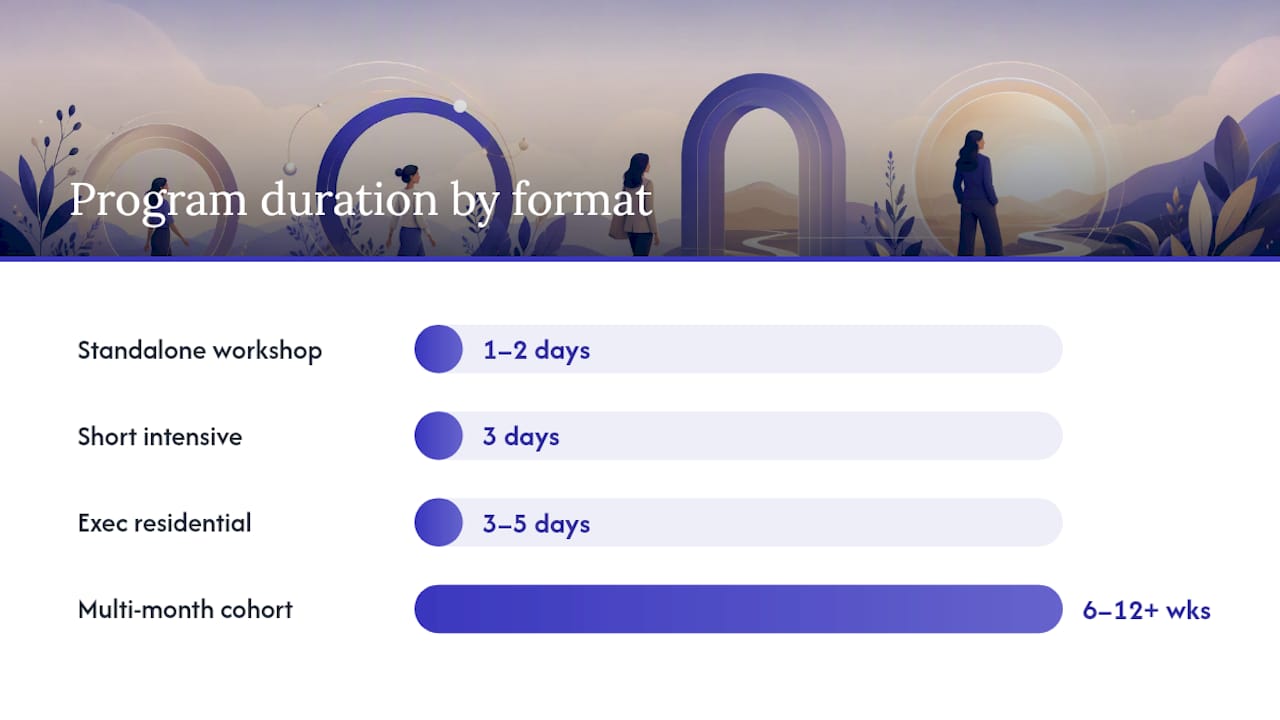
Coro New York’s Women in Executive Leadership Program illustrates the cohort model in practice, with over 60 hours of structured training delivered across a multi-session schedule.
Which Women Benefit Most From These Programs?
Not every stage of a career needs the same intervention. Rising managers three to ten years in usually need executive presence and delegation skills. Mid-career leaders eyeing a senior title usually need sponsorship activation and negotiation practice. Senior executives preparing for a board seat need something closer to the immersive, residential model.
Common use cases include:
- Prepping for a specific promotion cycle within the next 6 to 12 months.
- Rebuilding visibility and confidence after returning from parental or medical leave.
- Navigating a male-dominated leadership team where your input keeps getting overlooked.
- Transitioning from a functional leadership role into a C-suite or board position.
Pro Tip: Choose a cohort model if you want peer validation and a support network. Choose intensive 1:1 coaching if you’re facing a specific, time-sensitive performance issue that can’t wait for a group’s schedule.
How Do You Choose the Right Program or Coach?
Start with a short checklist before you spend a dollar or a discovery call. Ask about curriculum fit first: does the program address your actual career stage, or is it a one-size-fits-all deck recycled for every cohort? Check the coach’s credentials next, specifically years of experience coaching women executives, not just leadership coaching generally. Ask about cohort composition (industry mix, seniority mix) and whether the program tracks and shares alumni outcomes.
Bring these five questions to a discovery call:
- What’s the typical participant profile in your cohorts (title, industry, years of experience)?
- What outcomes do you measure, and what percentage of alumni report a promotion or role change?
- Can I see a sample curriculum or module list before enrolling?
- What are the coach’s credentials and background working specifically with women leaders?
- What’s the typical cohort size, and how much 1:1 time is included?
Watch for red flags along the way:
- Vague, unverifiable claims like “transformative results” with no numbers attached.
- No alumni follow-up program or measurable outcome tracking.
- A generic curriculum that doesn’t flex for industry or seniority.
- No clear coach bio or credentials listed anywhere on the program page.
On cost versus return, weigh tuition against three things: the probability of a promotion within your target window, the likely salary increase from stronger negotiation skills, and whether your employer will sponsor part or all of the cost. A $4,000 program that leads to a five-figure raise pays for itself many times over. Many employers cover tuition for programs tied to succession planning, so ask HR before assuming the cost is entirely on you.
Why Does the Cohort Plus Coaching Model Actually Work?
The research backing this approach isn’t new, it’s just underused. Yale Insights has found that female peer groups provide crucial validation and tactical experience that individual coaching alone doesn’t replicate. A cohort normalizes the problem: you’re not the only one whose ideas got credited to someone else in a meeting.
There’s also a strengths case for this model, not just a deficit one. A 2019 Harvard Business Review analysis found that women scored higher than men on most leadership skills measured across the study’s samples. That reframes the whole premise: coaching isn’t fixing a skills gap. It’s removing the external barriers, visibility, sponsorship, bias, that keep those skills from translating into promotions. Catalyst’s research on women’s underrepresentation in management backs up why targeted programs still matter despite that skills data.
Middy Matthews brings over 30 years of experience across competitive sports and real estate leadership to this work, built on a “Training, Not Selling” philosophy that treats coaching as skill-building, not persuasion. That framing matters for women leadership coaching specifically: it’s about developing what you already have, not correcting a deficiency.
- Ask any provider for alumni promotion metrics, not just testimonials.
- Ask what percentage of the program is 1:1 versus group work.
- Ask how long the coach has specifically worked with women executives.
What Does It Cost, and What Happens in a First Session?
Pricing varies a lot by format. A single workshop typically runs a few hundred to a couple thousand dollars per participant. Multi-week cohort programs, using Coro’s tuition figure of $4,000 as a benchmark, sit in the low thousands. Executive residential programs and ongoing 1:1 coaching engagements run higher, driven by coach seniority, cohort size, and institutional brand.
Timelines generally follow this arc:
- Onboarding and intake, usually one to two weeks before the program starts.
- Baseline assessment through surveys or psychometric tools.
- Regular coaching cadence, weekly to monthly depending on format.
- Alumni engagement and follow-up, typically running 3 to 12 months post-program.
Your first session should include these five elements:
- An intake conversation covering your role, goals, and current challenges.
- A baseline confidence or leadership-style assessment.
- Concrete goal-setting for the program’s duration.
- A coach chemistry check, this relationship needs to work both ways.
- A confidentiality and accountability agreement outlining how progress gets tracked.
If a provider skips the baseline assessment or jumps straight to generic advice, that’s a sign the process isn’t built to measure anything.
What Do Credible Testimonials and Credentials Look Like?
Real trust signals are specific. A vague “this changed my life” quote tells you nothing. A useful testimonial names the shift: a title change, a negotiated raise, a specific confidence gain tied to a specific event, like finally speaking up in a board meeting.
“Six months after finishing the cohort, I asked for the promotion I’d been putting off for two years, and got it,” one participant in a multi-month leadership cohort noted, describing the shift as less about new skills and more about finally acting on skills she already had.
Look for these credentials before you commit:
- Years of experience specifically coaching women executives, not just leadership coaching in general.
- Any published research, articles, or practitioner writing that shows depth beyond a sales page.
- Concrete alumni outcomes: promotions, negotiated raises, retention improvements.
- An active cohort network alumni can still tap into after the program ends.
Ask for two or three references you can actually contact. A provider confident in their results won’t hesitate.
How I Think About Building Women Leadership Coaching Programs
I’ve spent over 30 years between competitive sports and real estate leadership, two worlds that don’t tolerate excuses and don’t reward talent that never gets used. What I’ve seen in both is the same thing I see in coaching women leaders: the skill is rarely the problem. Confidence to use it, on time, in the room, is the problem.
That’s why I build coaching around cohort work paired with individual sessions. A team teaches you resilience faster than a solo drill ever will, and a coach makes sure that resilience turns into a real career move instead of just a good feeling. My leadership coaching approach draws directly from both arenas.
Ready to Talk Through Your Options?
If you’re weighing a university-branded cohort program against something more tailored, here’s the honest trade-off: big-name programs give you prestige and a wide alumni network, but they rarely flex around your specific role, industry, or timeline. Middy builds women leadership coaching around your actual situation, whether that’s a keynote for your organization’s women’s leadership event, a cohort workshop for a rising-leader group, or one-on-one executive coaching tied to a specific promotion cycle.

Middy’s approach draws on the same “Training, Not Selling” philosophy applied across real estate teams and corporate leadership programs, built to make skills stick rather than deliver a one-time inspiration hit. A discovery call covers your goals, a coach match, and a straightforward pricing estimate, no pressure, no generic pitch deck. Ask about alumni outcomes when you call; a program confident in its results will hand them over without hesitation.
Book a discovery conversation to find out what a tailored women leadership program would look like for your team or your own career stage.
Where to Learn More
- Yale’s Women’s Leadership Program outlines cohort-based curriculum design.
- Yale Insights on female peer groups explains why cohorts matter.
- Cambridge’s Rising Women Leaders Programme shows a strength-based module structure.
- Catalyst’s research on women in management documents the underlying representation gap.
- Coro New York’s program page offers a real-world cost and hours benchmark.
Frequently Asked Questions
What is women leadership coaching, exactly?
It’s leadership development that combines executive coaching with training specifically aimed at barriers women face at work, things like being overlooked for stretch roles, hesitating to negotiate, or lacking sponsor advocacy.
How is it different from general executive coaching?
General coaching covers strategy and delegation. Women leadership coaching adds sponsorship activation, negotiation training for gendered dynamics, and cohort validation from peers facing the same specific barriers.
How long does a typical program run?
It varies widely, from a single one or two day workshop up to multi-month cohorts running 6 to 12 weeks, plus ongoing 1:1 coaching that can continue for a year or more.
What does women leadership coaching cost?
Workshops run a few hundred to a couple thousand dollars. Multi-week cohort programs often land near $4,000, with executive residential programs and ongoing coaching priced higher depending on coach seniority and format.
Can my employer pay for this?
Often, yes. Many employers sponsor tuition for programs tied to succession planning or leadership pipelines, so it’s worth asking HR before assuming the full cost falls on you.
Sources
- Women’s Leadership Program | Yale School of Management
- Women in Executive Leadership Program – Coro New York
- Women in management — Catalyst
- Cambridge Rising Women Leaders Programme – Cambridge Judge Business School
Recommended
- Hiring a Women in Leadership Keynote Speaker: A Planner’s Guide – Middy Matthews | Keynote Speaker
- What the Best Women’s Leadership Keynotes Have in Common – Middy Matthews | Keynote Speaker
- Coaching vs. Managing: Sales Lessons from the Sideline – Middy Matthews | Keynote Speaker
- Coached, not bossed: feedback people can actually hear. – Middy Matthews | Keynote Speaker
Leave a Reply