
Team norms are the agreed behaviors your team uses to communicate, decide, and resolve conflict, and explicit norms reduce friction and speed up collaboration. When they are written down and specific, they stop the guessing game about who talks over whom in meetings or how fast a Slack message deserves a reply. Below you will find copy-ready examples, a one-meeting playbook, and a plan for keeping them alive past the first week.
TL;DR:
- Explicitly written norms prevent dominance by the loudest or most senior team members, promoting fairness and clearer behavior expectations.
- Norms should be specific and action-oriented, covering categories like communication, meetings, accountability, conflict, and remote work to reduce friction.
- Regular review and embedding of norms, along with involving team members in creation, increase their adoption and longevity.
- Tailoring norms to industry, culture, and team size improves relevance and effectiveness, especially when addressing different communication styles and hierarchical sensitivities.
- Training and practicing norms as habits, rather than just posting them, significantly improve their integration into team behavior.
Table of Contents
- Why explicit norms matter more than you think
- Core types of team norms to consider
- Copy-ready team norms examples by category
- A 6-step playbook you can run in one meeting
- Keeping norms alive after the first meeting
- Common pitfalls when establishing team norms
- Adapting norms to different teams and industries
- Cultural differences shape how norms should be written
- What a coaching mindset changes about adoption
- Templates, activity guides, and research worth bookmarking
- Sources
- FAQ
Why explicit norms matter more than you think
Most teams have norms already. Nobody wrote them down, so the loudest voice or the most senior person ends up setting the tone by default. That is the problem with unspoken rules: they favor whoever talks first, not whoever has the best idea.
A team charter or working agreement fixes that by making the behavior explicit instead of assumed, which is different from a formal policy. Policies get enforced by HR. Norms get enforced by the team, together, because everyone helped write them.
The case for doing this work is not just gut feeling. Amy Edmondson’s research on psychological safety found that teams who felt safe speaking up reported errors more often and learned faster from them, a pattern first documented in her study of hospital teams. Safety to speak up does not happen by accident. Norms are how you build it on purpose.
Core types of team norms to consider
Before you write a single statement, sort your options into categories. It keeps the brainstorm focused and stops the list from turning into forty vague ideas about “respect.”
- Communication norms: which channel for what, expected response times, async as the default for updates
- Meeting norms: agendas shared in advance, rotating roles, punctuality, who owns the notes
- Accountability norms: how status gets reported, what happens near a missed deadline, how mistakes get owned
- Conflict and feedback norms: how directness is expected to sound, assuming good intent, when to escalate
- Remote and hybrid norms: shared overlap hours, whether meetings get recorded, camera expectations
Start there, then add more once the first batch is working.
Copy-ready team norms examples by category
These are meant to be lifted straight into a team charter and edited to fit your language. The goal is specificity: a vague norm like “be respectful” gives people nothing to act on, while a behavior-specific version tells them exactly what to do, which is why practitioners recommend rewriting broad values into concrete actions.
Communication
- Default to async for status updates; save live calls for decisions that need real-time back and forth.
- Reply to direct messages within four working hours; flag anything urgent with a clear subject line instead of an all-caps message.
- Use the team channel for anything more than two people need to see, not direct messages.
Meetings
4. Share the agenda 24 hours before any recurring meeting so people can prepare instead of reacting.
5. Every meeting has a note-taker and a facilitator, and those roles rotate weekly.
6. Start and end on time, even if that means tabling an unresolved item for a follow-up.
Accountability
7. Post a two-line status update every Friday: what shipped, what is blocked.
8. If a deadline will be missed, say so 48 hours ahead, not on the due date.
9. Own mistakes out loud in the next team check-in rather than letting someone else discover them.
Conflict and feedback
10. Raise a disagreement with the person directly before bringing it to the group.
11. Assume good intent first, then ask a clarifying question before responding to something that stings.
12. Escalate only after a direct conversation has been tried and did not resolve it.
Remote and hybrid
- Keep a two-hour daily overlap window when the whole team is reachable, regardless of time zone.
- Record any meeting where a remote teammate could not attend live.
- Cameras on for planning and retro sessions, optional for quick daily check-ins.
Growth and feedback
- Ask for one piece of feedback in every one-on-one, not just at review time.
- Celebrate a finished project publicly before moving to the next one.
For leadership or executive teams: agree that disagreements aired in the room stay in the room until a decision is announced, and that the meeting owner decides when a topic has had enough airtime.
For newly formed teams: write your first five norms in the kickoff meeting itself, before the first project starts, so nobody has to guess what “normal” looks like.
A 6-step playbook you can run in one meeting
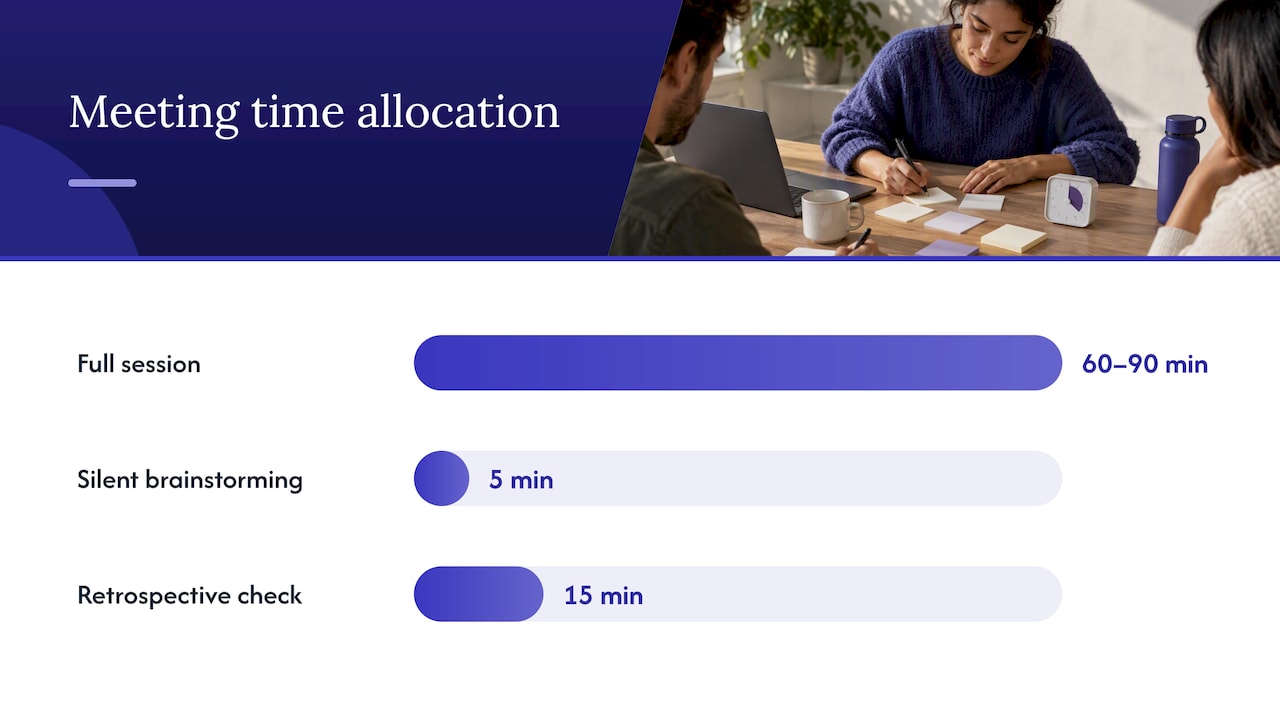
You do not need a retreat to do this. A focused 60 to 90 minute session gets most teams to a working first draft.
- Prepare: ask each person to note one recurring friction point and share a short list of candidate norms beforehand.
- Brainstorm: give everyone five minutes to write proposals silently, then read them out loud without discussion.
- Cluster: group similar proposals by the categories above so duplicates merge naturally.
- Decide: vote on which clusters to formalize, using dot voting or a quick Fist to Five check for consent.
- Draft: turn the winning clusters into short, specific statements and assign an owner for each.
- Embed: add the finished list to onboarding material and the team charter, and post it somewhere visible, following the co-creation and visibility guidance in most working agreement templates.
Set a 15-minute check on these in your next retrospective, then a fuller review every quarter.
Pro Tip: Let people submit friction points anonymously before the meeting. It surfaces the real issues that nobody wants to say out loud in front of the group.
Keeping norms alive after the first meeting
A norms list that lives in a forgotten document dies within a month. Pin it somewhere the team already looks: the top of the team channel, the first slide of weekly meetings, or inside the onboarding checklist for new hires.
- Revisit norms when the team grows, a role changes, or the same friction keeps resurfacing despite a norm supposedly covering it.
- Set a standing quarterly review instead of waiting for a crisis to trigger one.
- If a norm gets ignored repeatedly, that is a signal, not a discipline problem: rewrite the statement, test the new version for 30 days, and assign a steward to check in on it.
Common pitfalls when establishing team norms
The most common mistake is writing norms that sound nice but describe nothing: “communicate openly” tells nobody what to actually do differently on a Tuesday. Fix vague language by rewriting each norm as a specific action someone can point to and check off.
The second pitfall is skipping buy-in. Norms handed down from a manager get treated like rules, and rules get resented. Co-creating them, even briefly, changes the tone from compliance to ownership.
A third failure point is enforcement that feels punitive. Calling out a broken norm in front of the group turns a shared agreement into a public correction. Framing the conversation as a reminder rather than a reprimand, and building some empathy and feedback skill into the team first, makes enforcement land as coaching instead of punishment.
Finally, teams often set norms once and never look at them again. A norm that made sense for a five-person team can quietly stop working at fifteen. Treat the list as a draft you revisit, not a plaque you hang.
Adapting norms to different teams and industries
A sales team’s norms will look different from an engineering team’s, and that is fine. Sales teams often need norms around call cadence, CRM logging discipline, and how quickly a lead gets a follow-up. Engineering teams lean toward code review turnaround, deployment windows, and how bugs get triaged and owned.
Healthcare and clinical teams tend to formalize norms around speaking up during a procedure or handoff, since the cost of silence is higher there than in most office settings. Inclusion-focused ground rules built for exactly this kind of high-stakes collaboration, such as committing to dignity and avoiding hidden agendas, translate well into any team that handles sensitive decisions.
Creative teams often prioritize norms around feedback framing, since critique on creative work lands differently than critique on a spreadsheet. Whatever the industry, start from the category list, then weight it toward wherever your team’s actual friction lives.
Cultural differences shape how norms should be written
A norm that works for one team can misfire for another simply because of how directness, hierarchy, or silence get read across cultures. A norm like “speak up immediately if you disagree” assumes a comfort with direct confrontation that not every team member shares, especially on teams spanning different cultural backgrounds or communication styles.
The fix is not to drop the norm, it is to build in more than one way to meet it. Offer an anonymous input option alongside open discussion, and make written follow-up as valid as speaking in the room. Norms about response time should account for different working hours and holidays rather than assuming everyone operates on the same calendar. The goal of any norm is participation, not a single approved style of participating.
What a coaching mindset changes about adoption
Norms fail when they get treated as policy. Middy Matthews has spent over 30 years in competitive sports and real estate, and both taught her the same lesson: rules people memorize get ignored, behaviors people practice become habits.
Training a norm the way you would train a skill, through practice and role-play, gets it adopted faster than posting it on a wall ever will.
— Middy
Templates, activity guides, and research worth bookmarking
For structured sessions, the Establishing Team Norms Activity Guide offers worksheets and prompts. For meeting-note practices, see The Intent Ledger.
Sources
- Monday
- Team Charter, Working Agreement, & Social Contract – Template and Guide for Product and Engineering Teams | Easy Agile
- The Intelligent Failure that Led to the Discovery of Psychological Safety – Behavioral Scientist
- Sample Team Norms or Guidelines (UCSF inclusion ground rules PDF)
FAQ
What are 5 examples of team norms?
Common examples include replying to messages within a set window, sharing meeting agendas 24 hours ahead, giving a weekly status update, raising disagreements directly with the person involved, and flagging missed deadlines before they happen. These work because each one describes a specific action rather than a general value.
Can you give examples of workplace norms beyond communication?
Beyond communication, workplace norms often cover meeting punctuality, rotating note-taking duties, owning mistakes openly, escalating conflict only after a direct conversation, and setting overlap hours for remote teams. Each targets a different source of friction, so most teams need a mix across categories rather than a single long list.
What are the 5 C’s of a team?
Definitions vary depending on the source, and there is no single agreed standard for the “5 C’s of a team.” Rather than relying on a catchy framework, most working teams get further by naming their own specific norms around communication, accountability, and conflict resolution.
What are the 7 norms of collaboration?
This framework also varies by source, so treat any specific list with some caution. The underlying idea across most versions is consistent: collaboration improves when teams agree on how they will listen, pause, paraphrase, and inquire before responding, which lines up with the broader case for explicit, agreed norms covered above.
How do team norms connect to psychological safety?
Team norms create the specific behaviors that make psychological safety possible, such as inviting disagreement or normalizing owning a mistake out loud. Amy Edmondson’s research found that teams reporting a safer environment were more open about errors, which is where the psychological safety concept originated.
Leave a Reply