
Yes, you can run a team charter workshop this week and walk out with a document your team actually uses. A short sprint works for small, aligned teams; a half-day session fits teams with real friction to resolve; a multi-session series works best for larger reorgs. What follows are the exact agendas, facilitator scripts, and templates to run any of them.
TL;DR:
- A team charter workshop should include clear definitions of purpose, roles, decision rights, and working norms, tailored to address specific team conflicts or misalignments.
- A concise 90 to 120-minute session suits small, mostly aligned teams, focusing on drafting key elements like goals, roles, and success measures.
- For teams with significant friction or larger reorgs, a half-day or four-session series allows deeper validation through discovery, debate, and iterative refinement.
- Successful charters require active team participation, specific language, and scheduled review points, or they risk becoming unused documents.
- External facilitation adds value when unresolved power dynamics or tensions exist, helping quieter voices contribute and ensuring the team builds shared ownership.
Table of Contents
- What Is a Team Charter Workshop, and When Should You Run One?
- What Belongs in an Effective Team Charter?
- Step-by-Step Workshop Agendas You Can Run This Week
- Facilitation Exercises, Canvases, and Sample Activities
- Templates and Sample Charter Language You Can Reuse
- Keeping the Charter Alive After the Workshop Ends
- Common Pitfalls That Kill a Charter Before It’s Used
- Why Middy Facilitates Charter Workshops Differently
- Should You Run This Yourself or Bring in a Facilitator?
- How Middy Can Facilitate Your Team’s Charter Workshop
- Sources
What Is a Team Charter Workshop, and When Should You Run One?
A team charter workshop is a structured session where a team builds shared agreement on purpose, roles, working norms, and decision rights, then writes it down as a reference document the team actually opens again. The output isn’t a poster for the wall. It’s a living reference that gets pulled up during onboarding, conflict, and prioritization fights, according to Slack’s guidance on team charters.
Run one when a team forms, when a reorg scrambles reporting lines, when alignment has quietly stalled, or when roles have shifted but nobody updated the rules of engagement. I’ve watched teams limp along for months assuming everyone agreed on priorities, only to discover in a charter session that three people had three different definitions of “done.” That gap doesn’t show up in a status meeting. It shows up when you force people to write the answer down.
A well-facilitated charter workshop creates shared ownership of team culture rather than a directive handed down from above, and practitioner write-ups on charter facilitation consistently show this ownership matters more than the document’s polish. Expect three things from a solid session: clarity on who decides what, a norms document people can point to instead of relitigating the same argument every sprint, and a baseline for measuring whether the team is actually working the way it says it wants to work. Teams that go through structured trust-building and role-clarity exercises tend to outperform teams that skip straight to “let’s just figure it out as we go,” per TeamBonding’s research on high-performing team workshops.
What Belongs in an Effective Team Charter?
A charter earns its keep only if it covers the things people actually argue about later. Skip the fluffy mission-statement-only version. Authoritative guidance on charter construction points to seven categories that hold up under real use, and your workshop should produce a draft for each one:
- Purpose and objectives: why this team exists and two to four SMART goals tied to real outcomes, not vibes.
- Roles and accountabilities: who owns which decisions and deliverables, named specifically rather than “the team will.”
- Working agreements: how you communicate, which channels for what, response-time expectations, and meeting norms.
- Decision rights and escalation: who has final say on what, and the exact path when people disagree.
- Success measures: what “working well” looks like in numbers or observable behavior, not adjectives.
- Resources and authority: budget, tools, and the boundaries of what the team can decide without asking permission.
- Review cadence and sign-off: when you’ll revisit the charter and who signs off on the current version.
Mind Tools’ breakdown of team charter components frames this as context, mission, composition, authority, resources, operations, and negotiated agreement, essentially the same seven buckets in different language. The negotiation step matters more than people expect. A charter that gets typed up by one person and emailed around dies fast. A charter the team argues over, edits, and signs off on together survives contact with a hard Tuesday.
Step-by-Step Workshop Agendas You Can Run This Week
Pick the format that matches your team’s size and the depth of misalignment you’re solving for. All three below map to the same seven charter elements; they just spend different amounts of time getting there.
The 90 to 120 minute sprint
Use this for a small team (four to eight people) that’s mostly aligned and needs to formalize what’s already working.
- Opening frame (5 minutes). Facilitator script: “By the end of today, we’ll have a draft charter covering why this team exists, who owns what, and how we’ll handle disagreements. This isn’t final. We’re building a draft we’ll revisit in 30 days.”
- Purpose and goals (20 minutes). Ask each person to write one sentence answering “Why does this team exist?” Compare answers out loud. Merge into one shared statement, then draft two or three SMART goals for the next quarter.
- Roles and decision rights (25 minutes). Go role by role. For each, ask: “What does this person own, and what can they decide without checking in?” Write it on the board as you go.
- Working agreements (25 minutes). Prompt: “What’s one thing about how we currently work together that’s actually working, and one thing that’s causing friction?” Capture both lists, then convert the friction items into agreements.
- Success measures and close (20 minutes). Ask: “How will we know in 60 days that this charter is working?” Assign one owner to compile the draft and set a 30-day review date.
The half-day session
Use this when there’s real friction, unresolved conflict, or a team that’s grown fast without ever aligning on the basics. Add a discovery phase before synthesis: start with individual reflection on what’s working and what isn’t (30 minutes), move into small-group discussion of patterns (45 minutes), then run the same purpose, roles, and norms activities from the sprint agenda but with double the time for debate and reworking language until it holds up to pushback. Build in a 15 minute break after the discovery phase; that’s usually where the real tension surfaces, and people need a minute before synthesizing it into agreements.

The four-session series
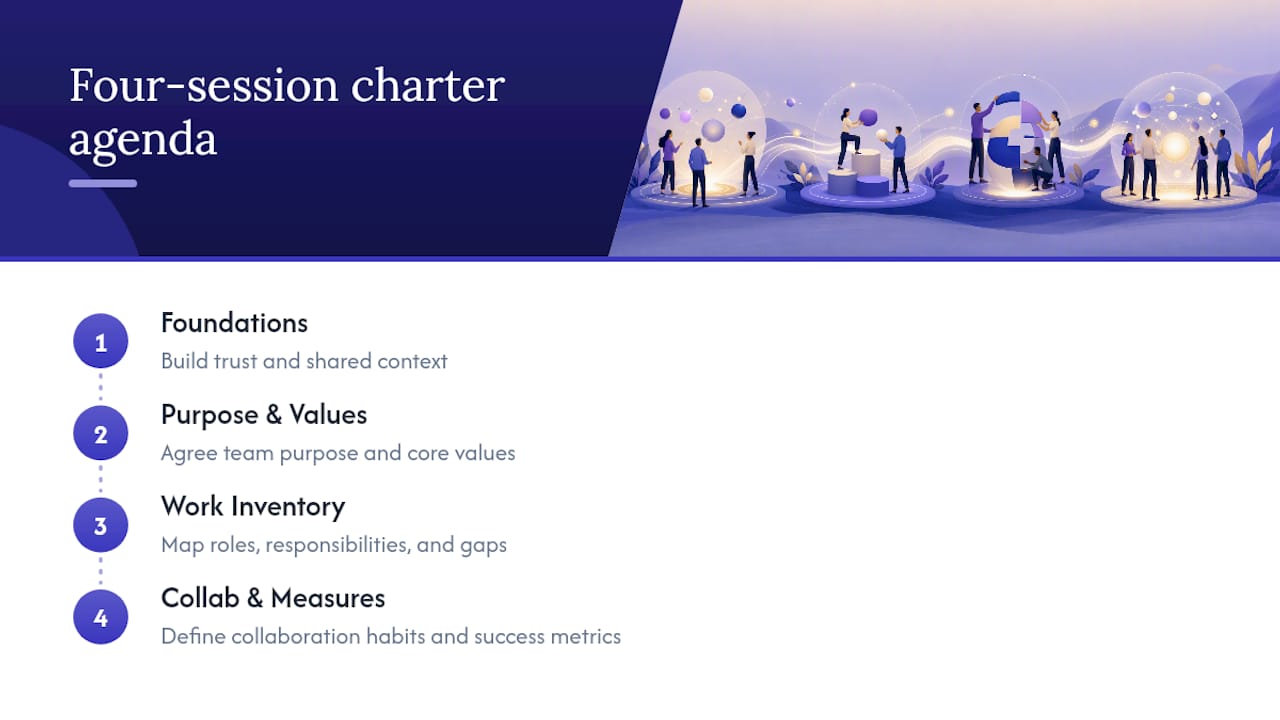
For reorgs or teams rebuilding from scratch, break the work into four separate sessions of 60 to 90 minutes each, spaced a week apart: foundations (trust and context), purpose and values, work inventory (who does what, where the gaps are), and collaboration plus success measures. This structure, described in facilitation write-ups on multi-session charter design, moves teams from abstract values to testable behaviors because each session builds on the last instead of compressing everything into one exhausting day.
Facilitation Exercises, Canvases, and Sample Activities
The agenda tells you when to run something. These are the actual exercises that fill each slot, plus what they produce.
Team manual (pre-work, 15 to 20 minutes per person before the session). Each team member answers a short set of structured questions on their own: how they like to receive feedback, when they do their best focused work, what frustrates them in meetings, how they prefer conflict handled. Compiling these before the workshop, as described in practitioner guides on running team manual exercises, means the working-agreements portion of your live session starts from real data instead of guesses.

Clarity Canvas (25 to 30 minutes, live). A shared grid with columns for purpose, roles, decisions, and success measures. Teams fill it in together, one column at a time, using sticky notes or a digital board. It forces specificity because a blank cell is visibly a blank cell, not a vague sentence people can nod past.
Boundary mapping (20 minutes). Draw a simple circle. Inside it: decisions this team can make alone. Outside it: decisions that need sign-off from someone else. This single exercise resolves more escalation confusion than an hour of discussion, because it makes the boundary visual instead of implied.
Values-to-behaviors exercise (20 minutes). List the team’s stated values, then for each one ask: “What does this look like in an actual meeting?” A value like “transparency” becomes “we share blockers in standup before someone asks.”
- Keep breakout groups to three or four people for any of these exercises.
- Assign one note-taker per breakout so output survives past the conversation.
- On video calls, use a shared digital canvas (tools like Miro work well) so remote participants aren’t just watching someone else type.
Pro Tip: Run the boundary mapping exercise before the roles discussion, not after. Once people see the decision boundary drawn out, the roles conversation gets shorter because half the disagreements were actually about authority, not job titles.
Templates and Sample Charter Language You Can Reuse
A charter reads better when the language is specific instead of aspirational. Here’s what that looks like in practice.
Sample mission statement: “We exist to get qualified leads into active client conversations within 48 hours, without sacrificing the trust that makes those conversations convert.”
Sample working agreements:
- “We respond to Slack messages tagged ‘urgent’ within two hours during business hours; everything else can wait until the next standup.”
- “Disagreements about priority get raised in the Monday planning meeting, not resolved one-on-one and announced after the fact.”
Role and decision-rule format: name the person, the thing they own, and the boundary of their authority in one line: “Maria owns client onboarding and can approve schedule changes under 48 hours without sign-off.”
For structure and storage:
- Store the charter in the same tool your team already lives in, not a separate document nobody opens.
- Use a simple four-section template: purpose and goals, roles and decisions, working agreements, and review dates.
- Version it with a visible “last updated” date and owner name at the top.
- Link the charter directly from your team’s meeting agenda template so it’s one click away, not a search.
Keeping the Charter Alive After the Workshop Ends
A charter that sits in a shared drive untouched is worse than no charter. It gives people false confidence that alignment exists.
- Days 1 to 30: Circulate the draft, collect edits, and get formal sign-off from the sponsor and every team member.
- Days 30 to 60: Reference the charter explicitly in at least one recurring meeting. Pull it up when a decision-rights question comes up.
- Days 60 to 90: Run a short pulse check. Ask the team what’s holding up and what’s already stale.
- Ongoing: Set a quarterly review on the calendar now, not “whenever we get around to it.”
Track something simple: how often the charter gets referenced in meetings, and how many decision-rights conflicts get resolved by pointing to it instead of relitigating. Assign one person as the charter’s owner for updates. Anyone can propose a change, but that owner decides when it’s time to reopen the document.
Pro Tip: Put the 30 day review on the calendar before the workshop even ends. A “we’ll schedule it later” review almost never happens.
Common Pitfalls That Kill a Charter Before It’s Used
Most failed charters die from the same handful of causes.
- Vague values instead of concrete behaviors. “We value collaboration” means nothing until it’s tied to an observable action in a meeting.
- No sponsor buy-in. If leadership doesn’t attend or endorse the final version, the team has no cover to enforce it later.
- No scheduled review. A charter without a calendar date attached to its next revisit becomes archive material within a quarter.
- Dominant voices crowding out quiet ones. Use silent brainstorming (everyone writes before anyone talks) to prevent the loudest person in the room from becoming the default charter author.
Why Middy Facilitates Charter Workshops Differently
Middy Matthews built her “Training, Not Selling” approach on the idea that people commit harder to decisions they helped write than to rules handed to them. That same principle drives how she runs a charter session: less lecturing, more structured discovery where the team surfaces its own answers before she helps synthesize them into something usable.
A charter built through guided discovery, not dictation, is the one a team actually defends six months later, because they argued their way into every line of it.
Facilitating your own workshop works fine for smaller, low-conflict teams. Bring in an outside facilitator when there’s real tension, a power imbalance in the room, or when a leader’s presence in the discussion would suppress honest input. What Middy delivers on a contracted session: full facilitator scripts, timed activities scaled to your team size, and a follow-up coaching touchpoint to check whether the charter actually got used 30 days out.
Should You Run This Yourself or Bring in a Facilitator?
The honest answer the research supports: DIY works fine for aligned teams with low conflict, and it fails fast for teams where politics, seniority gaps, or unresolved history are already in the room. Most guides treat facilitation as optional polish. It isn’t. The value of an outside facilitator isn’t running the agenda. It’s giving the quiet person in the meeting permission to say the thing everyone already knows but won’t say to their manager’s face.
What the conventional advice gets wrong is treating the charter document as the deliverable. The document is a side effect. The real output is a team that has practiced disagreeing productively once, in a structured setting, so they know how to do it again without a facilitator in the room. If you take one thing from this article, prioritize the discovery conversation over the final template. A beautifully formatted charter built on surface-level agreement will fail faster than a messy one built on real friction that got resolved in the room.
— Middy
How Middy Can Facilitate Your Team’s Charter Workshop
If you’d rather not carry the weight of facilitating your own team’s hardest conversations, Middy runs charter workshops directly, in half-day, full-day, and multi-session formats scaled to your team’s size and the amount of unresolved friction in the room.
Every engagement includes the facilitator scripts and timed activities outlined above, customized to your team’s actual roles and history, plus a follow-up coaching call to check whether the charter survived contact with a real workweek. Before booking, gather a rough sense of your team’s current pain points and who the sponsor is, since that person’s presence during negotiation matters more than most teams expect. If you’re weighing whether your team needs a single inspirational session or something with more structure and follow-through, Middy’s breakdown of speaker versus trainer engagements can help you decide. When you’re ready to scope a session, Middy’s workshop offerings outline formats and what to prepare beforehand.
Sources
- Team charter workshop | Liam Greig
- Team Charters
- What Is a Team Charter? Benefits, Steps, and Examples | Slack
- High-Performing Team Workshop | TeamBonding
Recommended
- How to Motivate a Real Estate Team That Has Lost Its Spark – Middy Matthews | Keynote Speaker
- Sales Training Ideas That Actually Stick – Middy Matthews | Keynote Speaker
- Hiring a Sports Motivational Speaker for Your Sales Team – Middy Matthews | Keynote Speaker
- From the Starting Line to the Sale: A Sports Keynote for Revenue Teams – Middy Matthews | Keynote Speaker
Leave a Reply