
Self-advocacy at work means naming what you need, what you’ve done, and what you’re worth, clearly enough that your manager can actually act on it. The payoff is visibility, fair credit, better resources, and a career that moves instead of stalls. The one thing to do in the next ten minutes: pick one specific, measurable goal, and write down one recent accomplishment you haven’t told anyone about yet. Everything below, the steps, the scripts, the documentation habits, builds from that single move.
TL;DR:
- Self-advocacy requires a single, clear goal and supporting evidence, such as metrics or praise, to make requests actionable for managers.
- Choosing the right forum and timing is crucial, with larger requests scheduled during formal meetings and smaller issues addressed promptly and calmly via email.
- Maintaining a detailed brag file of accomplishments and feedback enables confident, evidence-backed requests during reviews or promotions.
- Role models and organizational culture influence whether direct, data-driven asks or more subtle approaches will be more effective.
- Consistent practice, rehearsal, and systematized documentation over months build the confidence needed to advocate effectively without relying solely on feeling ready.
Table of Contents
- What Does Self-Advocacy at Work Actually Look Like?
- Real Scenarios You Can Model Word for Word
- The Brag File: Your Evidence Locker for Every Review
- Scripts You Can Use This Week
- When You Hit Pushback or Silence
- Why Middy Treats Self-Advocacy as a Trained Skill, Not a Speech
- Where Confidence Actually Comes From
- Reading the Room Before You Speak
- Finding the People Who Will Back You Up
- Setting Career Goals That Match Your Advocacy
- Staying Assertive Without Burning Bridges
- The Gap Between What Advocacy Advice Promises and What Actually Works
- Ready to Practice This Instead of Just Reading About It
- Where to Go for Deeper Guidance
- Sources
- FAQ
What Does Self-Advocacy at Work Actually Look Like?
Most people think self-advocacy means being loud. It doesn’t. It means being specific.
I’ve watched plenty of talented people lose ground not because they lacked results, but because they lacked a request. MIT’s career advising office points to this as the most common early-career mistake: a vague sense of “I deserve more” that never turns into a sentence a manager can act on. Your boss cannot fix “I feel underappreciated.” Your boss can fix “I’d like to lead the Q3 client onboarding project.”
Here is the five-step framework that turns wanting something into getting it.
- Clarify one goal. Not three. One. A promotion, a raise, credit for a specific project, a workload boundary, or an accommodation. Trying to advocate for everything at once dilutes all of it.
- Collect your evidence. Metrics, finished deliverables, emails that show your role, and any praise you’ve received. HBR’s guidance is blunt about this: know your strengths, tie them to company goals, and quantify your contributions before you open your mouth.
- Choose your forum and your timing. A raise conversation belongs in a scheduled one-on-one, not a hallway. A credit issue might need a quick, calm email sent the same day. Match the weight of the ask to the setting.
- Frame it as a win for the team, not just for you. “I’d like to own this account because I already know the client’s history and can ramp faster than a new lead” lands differently than “I want more responsibility.”
- Follow up and document. Send a short recap email after any real conversation. It protects both of you and gives you a paper trail if the request stalls.
Pro Tip: Practice your ask out loud before the meeting, even alone in your car. The first time you say a number or a request out loud should never be in front of your manager.
Real Scenarios You Can Model Word for Word
Frameworks are only useful once you see them applied. Here’s how each situation actually plays out.
- Someone takes credit for your work in a meeting. Don’t accuse. SHRM recommends a curiosity-based question, something like asking whether they’d mentioned your role in the original analysis. It signals awareness without starting a fight, and you can always follow up privately afterward with a short, factual email.
- You want a raise or promotion. Bring three to five quantified wins, tie them to a business outcome, and ask for a specific number or title. Time the conversation around your review cycle or right after a visible win, not on a random Tuesday when your manager is buried.
- Your workload has exceeded what’s sustainable. Set the boundary with a trade-off attached: “I can take on the new client, but something else needs to move to next quarter, which project should I deprioritize?” That puts the decision back on your manager instead of just absorbing more.
- You need an accommodation. Keep the ask factual and documented. The Job Accommodation Network offers sample language and formal request pathways if your workplace doesn’t already have a clear process.
The Brag File: Your Evidence Locker for Every Review
A brag file is a running, dated record of everything you’ve contributed, and it’s the single most underused tool in career advancement. Atlassian recommends keeping one going year round, not scrambling to remember your wins the week before a review.
What goes in it:
- Screenshots of praise, thank-you emails, and Slack messages
- Metrics tied to your work (revenue, retention, time saved, error reduction)
- Finished deliverables and links to shipped projects
- A one-line note after any meeting where you contributed something notable
Update it weekly, or immediately after any project wraps. A dedicated digital folder works fine, and copying feedback into it the moment you get it keeps the record accurate instead of reconstructed from memory.
Pro Tip: After a meeting where you presented an idea or solved a problem, send a two-line recap email to your manager: “Quick follow-up on today, glad the proposal I put together for the vendor switch landed well.” That email becomes brag file material and a credit-marker at the same time.
Scripts You Can Use This Week
Language matters more than confidence. Here are three you can adapt right now.
- Asking for credit in the moment: “I want to make sure the client understands I led the technical build on this, can we clarify that in the follow-up?” Calm, factual, no accusation.
- Requesting a raise conversation: “I’d like to set up time to talk about my compensation. I’ve pulled together the results from this year and want to walk through them with you.” Send this by email first so your manager can prepare.
- Asking for an accommodation: “I’d like to request an adjustment to my schedule to support [need]. Is there a process for that, or should I put this in writing to HR?”
Follow any real conversation with a short written recap within 24 hours. Include what was discussed, what was agreed, and any next steps with dates. Adjust tone for seniority: junior employees can lean more on questions (“Would it help if I…”), while senior professionals can state requests more directly (“I’m asking for…”). Culture matters too. A fast-moving startup tolerates more direct asks than a traditional finance firm.
When You Hit Pushback or Silence
Defensiveness usually means you’ve touched a nerve, not that you’re wrong. Stay curious instead of accusatory.
- If someone gets defensive, ask a clarifying question rather than restating your point louder.
- Document the date and content of any conversation that goes nowhere, especially if it repeats.
- Escalate to a manager or HR when an issue repeats, involves discrimination, or an accommodation request gets denied without explanation.
- A simple escalation script: “I raised this on [date] and wanted to follow up since the situation hasn’t changed. Can we talk through next steps?”
Why Middy Treats Self-Advocacy as a Trained Skill, Not a Speech
Middy’s “Training, Not Selling” approach treats advocacy the same way: practiced, not performed. Drawing on 30-plus years across competitive sports and real estate, Middy builds workshops around simulated asks, live feedback, and follow-up templates, so the skill sticks past the session. A corporate wellness speaker worth booking should teach exactly this kind of repeatable practice, not just deliver a motivating hour.
Where Confidence Actually Comes From
Confidence doesn’t precede self-advocacy. It follows it. Waiting to feel ready before you ask for anything is a trap, because the feeling rarely shows up first.
Start smaller than feels necessary. If asking for a raise feels too big, practice on lower-stakes requests: correcting a meeting note, asking a colleague to loop you in earlier on a project, or requesting feedback after a presentation. Each small, successful ask rewires the nervous system’s response to the next one.

Self-doubt tends to spike right before you speak, not after. That’s normal, and it’s not a signal to stop. Write your ask down beforehand in plain language, no hedging words like “just” or “maybe.” Reading a clean, direct sentence out loud a few times before the real conversation does more for confidence than any pep talk.
It also helps to separate the outcome from the ask itself. You can advocate well and still hear no. A well-made request that gets declined is not a failure of confidence, it’s information. Track how often your asks succeed over a few months rather than judging yourself on any single conversation. Most people who practice self-advocacy regularly find the ratio improves faster than they expected, largely because they get more precise about what they ask for and when.
Reading the Room Before You Speak
The same request lands differently depending on where you work. A blunt, data-forward ask that works at a fast-scaling tech company might read as aggressive at a hundred-year-old law firm. Before you advocate for anything, spend a week just watching: how do people here actually ask for things? In meetings or in writing? Do requests go straight to a manager, or informally to a peer first?
Look at how your organization handles disagreement generally. If leadership visibly rewards people who speak up in meetings, direct advocacy will likely work well. If the culture leans heavily on consensus and hierarchy, a quieter, more private approach, a one-on-one instead of a group ask, usually lands better.
Watch who gets promoted and why. That pattern tells you more about what your workplace actually values than any stated policy. If the people who move up are the ones who document their wins and ask directly for the next role, that’s your signal to do the same. If advancement seems to follow tenure or relationships more than performance, your self-advocacy might need to focus more on visibility and relationship-building than on data alone.
Finding the People Who Will Back You Up
Self-advocacy rarely happens in a vacuum. The people who advance fastest usually have someone else in the room, or at least in their corner, who can vouch for their work when they’re not there to say it themselves.
Start with peers doing adjacent work. A colleague on another team who understands what you do can mention your name when a relevant project comes up, something you’d never hear about otherwise. Build that relationship by being genuinely useful to them first, sharing a resource, making an introduction, offering to help on something outside your job description.
Mentors matter differently than sponsors. A mentor gives you advice. A sponsor spends their own credibility recommending you for something. Look for both, but don’t expect one person to be both at once. Often the best sponsor is someone senior who has seen your work directly, not someone assigned to you through a formal program.
Internal networking also means simply being visible outside your immediate team. Volunteer for cross-functional projects. Show up in optional meetings where decisions get made. Say yes to presenting your team’s work to a wider audience when the chance comes up. Allies form through shared work, not just shared coffee.
Setting Career Goals That Match Your Advocacy
Self-advocacy without a direction is just noise. The people who advance fastest tend to know roughly where they’re headed one, three, and five years out, and they use that map to decide which asks matter now.
Start by naming the role or scope you want in the next twelve months. That single target should shape every request you make this year, which projects you volunteer for, which skills you ask to develop, which visibility opportunities you chase. If you want to move into management, ask for chances to lead a project before you ask for the title. The title request becomes far easier once you have that evidence.
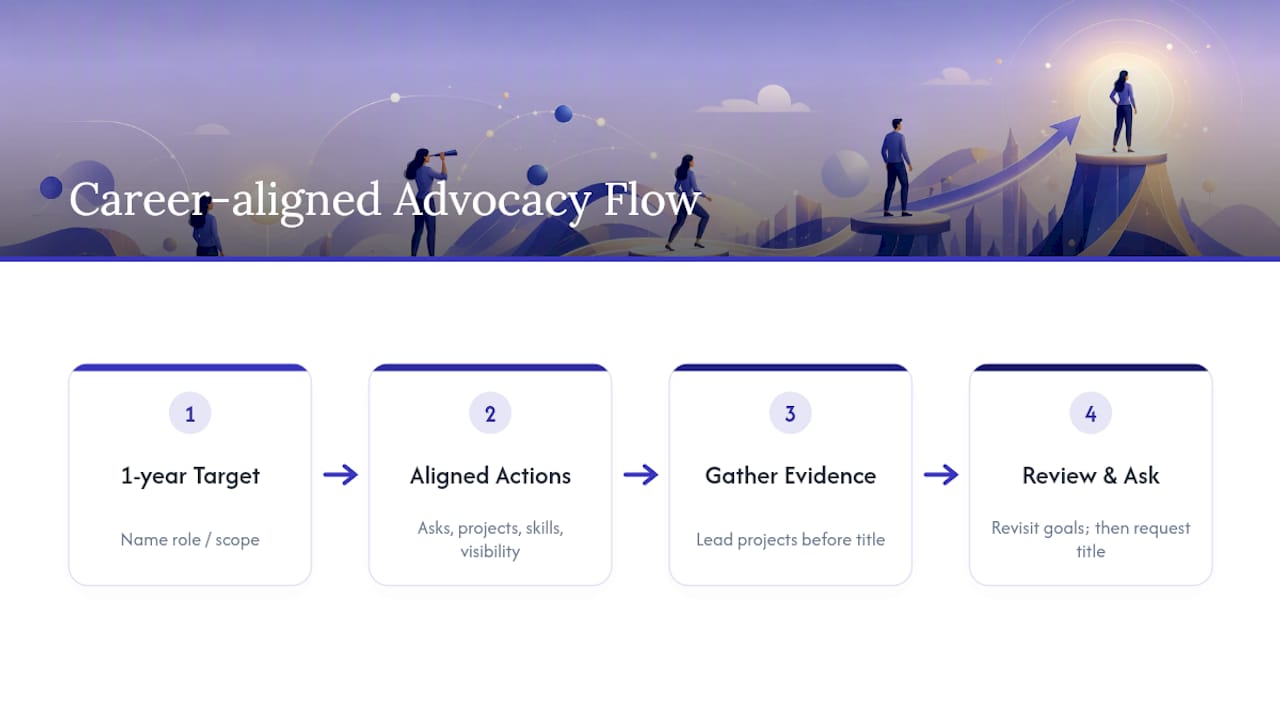
Revisit the goal every few months, not just once a year during a formal review. Priorities shift, teams reorganize, and a goal set in January can be stale by June. SHRM notes that consistent, routine self-advocacy, not just crisis-driven asks, builds an accurate professional narrative over time. That narrative becomes the foundation every future raise or promotion conversation stands on.
Staying Assertive Without Burning Bridges
Assertiveness and aggression get confused constantly, and that confusion stops good people from speaking up. The difference is simple: assertiveness states a need. Aggression demands one while dismissing everyone else’s.
Keep your language focused on facts and outcomes rather than blame. “This deadline doesn’t leave room for quality testing” holds up better than “you’re setting me up to fail.” Both might describe the same problem, but only one keeps the relationship intact while still making the point.
Timing protects relationships as much as wording does. Raise a boundary issue in a calm one-on-one, not in the middle of a tense team meeting where your manager has an audience and less room to say yes. Give people a way to say yes gracefully, and they usually will.
The Gap Between What Advocacy Advice Promises and What Actually Works
Most career advice treats self-advocacy as a mindset problem, something you fix by feeling braver. That’s backwards. The professionals who advocate well aren’t necessarily more confident, they’re better prepared. They know their one ask, they have the numbers ready, and they’ve said the words out loud before the meeting starts.
The conventional advice oversells the moment of asking and undersells the twelve months of quiet documentation before it, which is why having a reliable system like Kept to keep your team’s knowledge makes a critical difference. A brag file kept for one week before a review is nearly useless. A brag file kept for a year is leverage. That’s the part most people skip, because it’s boring and it doesn’t feel like progress the way a bold conversation does.
If you take one thing from this, prioritize the habit over the speech. Build the evidence first. The script matters less once you’re walking into a conversation with real numbers behind you instead of a feeling you’re hoping lands. Practice helps too, actual rehearsal, not just planning, which is exactly where most people stop short.
— Middy
Ready to Practice This Instead of Just Reading About It
Workshops can treat self-advocacy the way athletes treat drills: repeated, coached, and refined until the language feels natural instead of rehearsed. Sessions can include simulated asks, live feedback on tone and framing, and follow-up templates teams can use immediately after the room empties, drawing on experience across competitive sports and real estate coaching.

Reading a framework builds awareness. Practicing it out loud, with a coach who can tell you exactly where your ask gets muddy, builds a skill that holds up under pressure. That’s the gap between knowing what to say and actually saying it well when the stakes are real. If your team or organization wants that kind of practice-based training, explore Middy’s sales training programs built around exactly this kind of hands-on skill work, or check her “Training, Not Selling” philosophy to see if the approach fits your team before you book a session.
Where to Go for Deeper Guidance
- Indeed: Self-advocacy at work
- SHRM: What to do when colleagues take credit for your ideas
- Atlassian: Advocating for yourself at work
- Job Accommodation Network
Sources
- Self-advocacy at work | Indeed career advice
- Ask HR: What to do when colleagues take credit for your ideas | SHRM
- Advocating for yourself at work | Atlassian blog
- Ask an expert: How do I advocate for myself at work? | Harvard Business Review
FAQ
What Are Some Examples of Self-Advocacy at Work?
Common examples include correcting a meeting where someone else took credit for your idea, asking directly for a raise backed by quantified results, setting a workload boundary with a trade-off attached, and requesting a documented accommodation through HR.
What Are the Steps of Self-Advocacy?
A practical version runs five steps: clarify one specific goal, gather evidence like metrics and emails, choose the right forum and timing, frame the ask as a mutual win, and follow up in writing to document the conversation.
How Do I Address an Issue in the Workplace?
Start with a calm, factual, non-confrontational conversation focused on the specific behavior or outcome, not blame. If the issue repeats or involves discrimination or a denied accommodation, document each instance and escalate to your manager or HR.
Can You Give Examples of Self-Advocacy Goals?
Strong goals are specific and measurable: leading a named project by a certain quarter, securing a raise within a defined percentage range, getting public credit on a completed deliverable, or formalizing a schedule accommodation in writing.
Leave a Reply