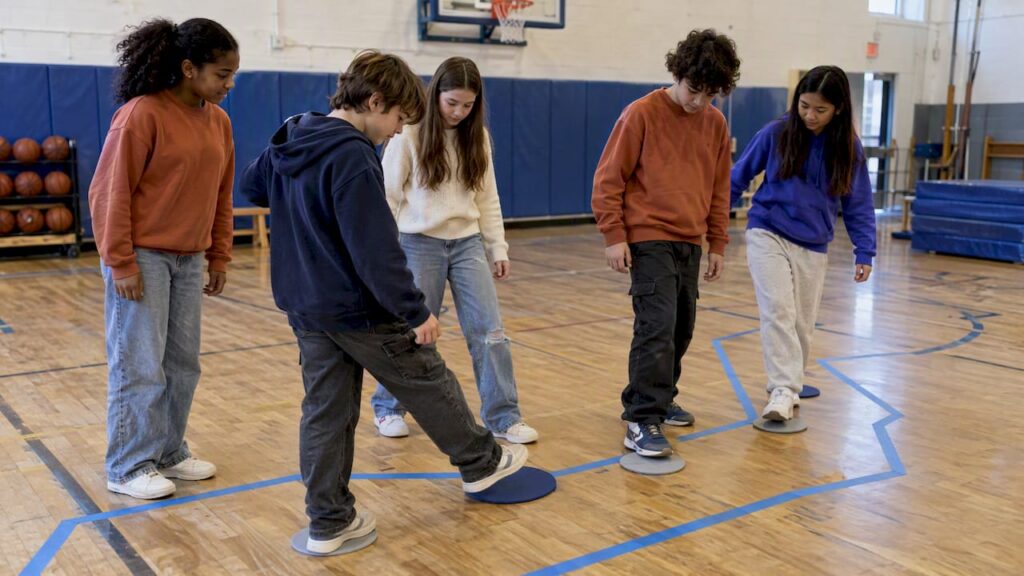
The best resilience activities for students are short, repeated, and end with the student doing something. A bounce-back ball toss, a one-week stress diary, a values writing exercise, a team challenge followed by an honest debrief: each one works because students rehearse a small behavior they can use today. Staying positive is not the skill. Choosing a next step when something goes wrong is.
Below are eight activities you can run in a classroom, a practice, or a youth program, with timing, steps, and the research behind them. After that, we cover how to string them into a routine and when an activity is not enough.
TL;DR
- Resilience can be trained like a muscle, so short recurring practice beats a one-off pep talk.
- Pair reflection with action: name the thought or feeling, test a better interpretation, pick the next behavior.
- Always build in a follow-up. Students who never review what worked rarely learn which strategy helps them.
- Games and worksheets are not a substitute for support. Build trusted-adult and referral paths into every session.
- Pick two or three activities and repeat them over weeks rather than trying all eight once.
Table of Contents
- What makes a resilience activity work
- Eight resilience activities to run with students
- Turning activities into a routine
- When an activity is not enough
- Our perspective: train it, don’t announce it
- Bring this to your school or team
- FAQ
- Sources
What makes a resilience activity work
Most resilience lessons fail the same way. Students enjoy the game, laugh, fill out the sheet, and nothing changes the next time they bomb a quiz or get cut from a team. We see the same pattern with adults: a motivating hour feels great and fades by Friday.
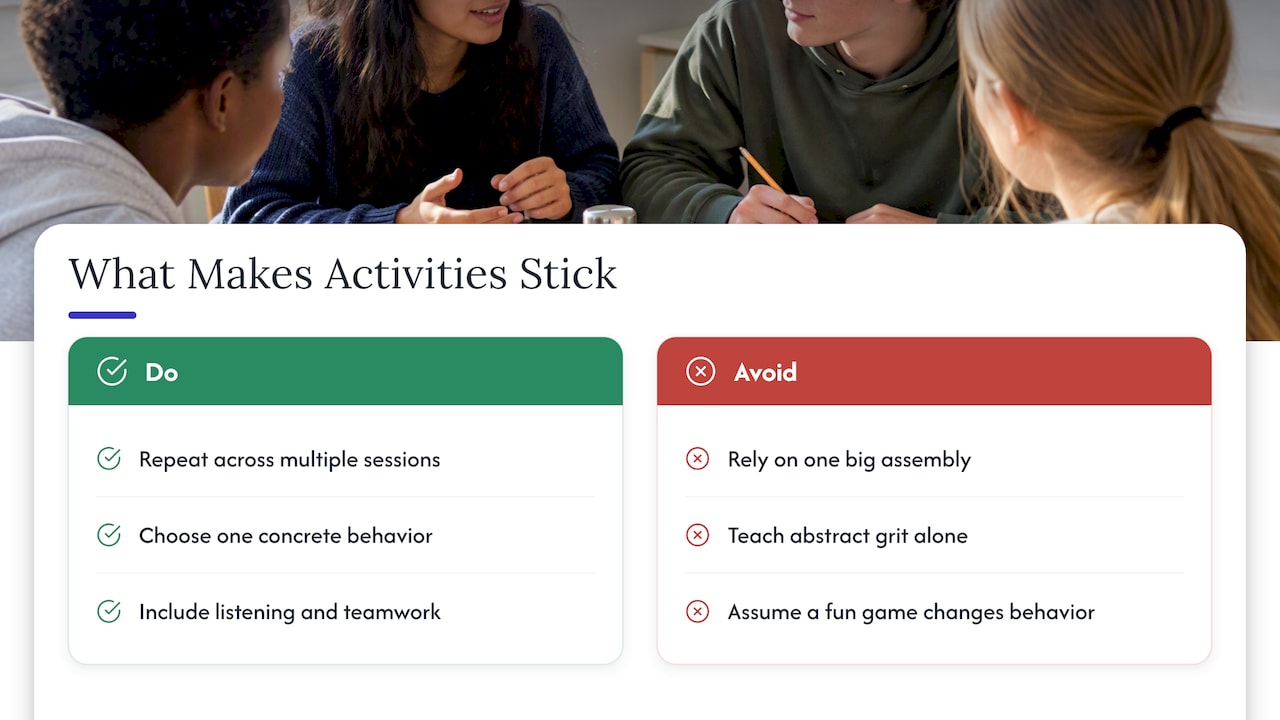
Three things separate activities that stick from ones that don’t.
Repetition. The American Psychological Association describes resilience as an ability to handle stress and respond more positively to difficult events, and says students can build it much like building muscles. Muscles need reps. Its classroom resource for high school is built as five sessions of at least 10 to 15 minutes each, not one big assembly.
A concrete behavior. Students need to leave knowing one thing they will do: take three slow breaths, text a friend, break the assignment into a first step. Abstract talk about grit does not transfer to a tough Tuesday.
Connection to a wider system. RAND’s evidence review of social and emotional learning interventions under the Every Student Succeeds Act found 60 school-based programs meeting evidence requirements. Interpersonal skills were the most commonly improved outcome, followed by intrapersonal skills such as attention, emotional regulation, and resilience. So activities that include listening, teamwork, and repairing after conflict are worth as much as solo self-talk exercises.
Eight resilience activities to run with students
Times are estimates you can adjust. Most work from upper elementary through high school with small changes in language.
1. The bounce-back ball
Time: 10 to 15 minutes. Best for: all ages.
The APA’s resilience examples include practicing “bounce back” thinking with a tennis ball or a similar object. Here is one way to run it.
- Hold up the ball and ask what happens when you drop it. It comes back.
- Ask students to name a setback: a bad grade, a lost game, a friend fight.
- Toss the ball to a student, who says the setback, then one thing they could do next. They toss it on.
- Close with the rule: a bounce needs a push. Resilience is the push you choose.
Keep the next steps small and physical. “Ask the teacher what I missed” beats “try harder.”
2. Strength story
Time: 10 minutes. Best for: middle and high school.
The APA’s examples also have students identify a strength and how they developed it. Pair students up. Each names one strength, then tells a two-minute story of how they got it. Usually the answer includes a failure, a coach, a parent, or a lot of boring practice.
The listener’s job is to name the habit inside the story: “You kept showing up even when you were bad at it.” That language gives students a way to describe themselves when they hit the next wall.
3. One-week stress diary
Time: 65 minutes of class time across two meetings, plus a week of notes. Best for: grades 6 to 12.
This is the one most teachers skip, and the follow-up is the whole point. A CDC classroom lesson on stress has students log, for a week, when stress occurs, what caused it, how they felt, what they did, and what happened next. They test a coping strategy such as deep breathing or taking a break, then review the result in a follow-up class one week later. The lesson is designed for 65 minutes, including a 10-minute individual exploration and a 10-minute explanation.
The review questions we would add: Which strategy helped most? Which one did you forget to use? What will you try next week? Without that conversation, students may enjoy the activity and never learn which strategy actually works for them.
4. Values writing
Time: 15 to 20 minutes. Best for: middle and high school.
Students write about two or three values that matter to them, such as family, music, or being good at a sport, and why. A Journal of Educational Psychology study of seventh graders used four brief self-affirmation writing exercises, delivered as ordinary 15 to 20 minute classroom assignments. The authors report that the exercises cut growing achievement gaps in half and raised on-time graduation rates for students of color by 10 percentage points in that district.
That is one study in one context, so treat it as a strong reason to try the exercise, not a guarantee. It also fits the APA’s V→BAM sequence (Values, Body, Actions, Mind), which starts with what matters to the student and then moves to practical responses.
5. Thinking-trap swap
Time: 15 minutes. Best for: grades 5 to 12.
CDC’s school mental health action guide supports teaching students to identify unhelpful thoughts and replace them with alternative thinking strategies, alongside positive coping behaviors. Make it a three-column card:
- The thought: “I failed the test, so I’m dumb.”
- A more useful read: “I didn’t study the right chapters. That’s fixable.”
- The next move: “Ask for the review sheet and book 20 minutes tomorrow.”
The third column is what keeps this from becoming positive self-talk. Name the thought, test a better interpretation, choose the behavior.
6. Support map
Time: 10 minutes. Best for: all ages.
Students draw themselves in the center of a page and place the people they would go to around them: a friend, a family member, a coach, a teacher, a counselor. The APA’s examples include identifying a supportive friend, and CDC’s guidance on healthy coping skills includes building a support system by reaching out to family and friends.
Then ask the useful question: what would you actually say to start that conversation? Have students write the first sentence. A blank spot on the map is not a failure. It tells you who needs a trusted adult introduced.
7. Challenge course debrief
Time: a class period or a field trip. Best for: middle school.
The National Park Service’s Mission: Resilience curriculum gives middle schoolers eight adaptable challenge activities organized around six competencies: self-awareness, self-regulation, mental agility, strengths of character, connection, and optimism. It was designed to be adaptable, affordable, and accessible to park units, and you can borrow the structure on a school field or in a gym.
Build a team challenge, like moving a group across a taped “river” with limited supplies. Let it fail once. Then run the debrief with three questions: What did you feel when it fell apart? What did you do next? What would you tell your teammate next time? The debrief is where the learning happens, not the obstacle.
8. Repair after conflict
Time: 15 minutes. Best for: all ages, especially teams and athletes.
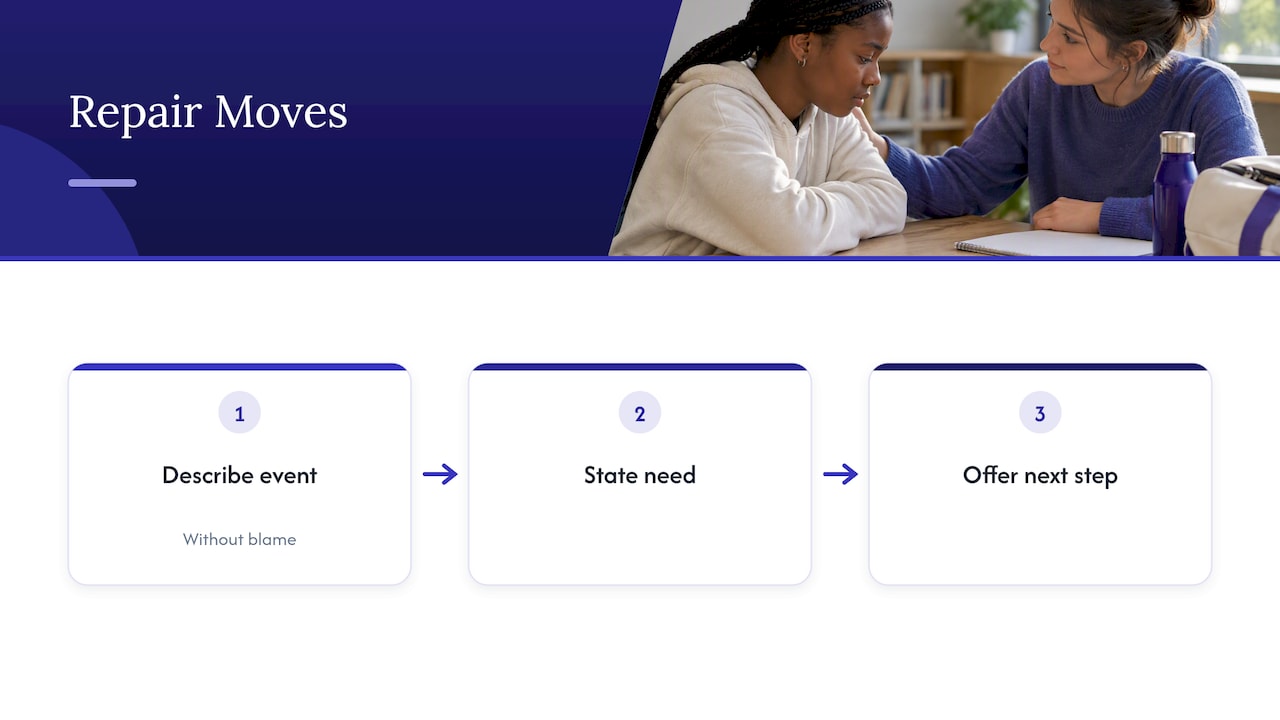
Because interpersonal skills are the most commonly improved outcomes in the RAND review, resilience practice should include relationships. Run a short role play: a teammate blames you for a loss, a group member didn’t do their part. Students practice three moves: say what happened without blame, say what you need, and offer a next step.
For athletes, this connects directly to how a team recovers after a bad game. If you coach, our piece on building a coachable mindset in eight weeks covers habits that pair well with this drill.
Turning activities into a routine
A scattered set of games will not do much. Here is a simple four-week pattern that fits inside existing class or practice time.
| Week | Activity | Time |
|---|---|---|
| 1 | Strength story, then bounce-back ball | 20 to 25 minutes |
| 2 | Start the stress diary, plus a thinking-trap swap | 25 minutes, then a week of notes |
| 3 | Diary review, values writing | 30 minutes |
| 4 | Team challenge with a debrief, support map | 40 to 50 minutes |
Two habits keep it alive. First, use a two-minute check-in at the start of any class: “What’s one thing that went sideways this week, and what did you do?” Second, name resilient behavior when you see it. “You asked for help before the deadline” teaches more than “good job.”
Implementation matters too. RAND’s 2024 report found that 83 percent of principals reported using an SEL curriculum in the 2023 to 2024 school year, up from 76 percent in 2021 to 2022. Having a curriculum on the shelf is not the same as teaching it well. Teacher preparation, a supportive climate, and consistent practice decide whether any of these activities land. If you want more classroom-tested options, see our student motivation strategies for teachers.
Resilience games versus resilience lessons
Games are a good way in. They lower the stakes, get quiet students talking, and make the idea memorable. But a game with no debrief is just a game. For every game you run, ask what it felt like, what the student did when it got hard, and where that shows up in real life. Two minutes of questions is what turns play into practice.
When an activity is not enough
Resilience activities build everyday coping skills. They do not treat anxiety, depression, trauma, or a crisis at home. CDC’s school action guide separates classroom-level, small-group, and individual cognitive-behavioral supports, which is a useful reminder that a worksheet cannot carry the whole job.
If a student writes something in a diary or a support map that worries you, such as hopelessness, self-harm, abuse, or a sudden change in behavior, follow your school’s referral process and bring in the school counselor, psychologist, or social worker the same day. If you are a coach or program leader without that structure, tell the student’s parent or guardian and the school. In the US, anyone can call or text 988 for the Suicide and Crisis Lifeline if a young person may be in immediate danger. Decide the referral path before you run the first activity, not after.
Our perspective: train it, don’t announce it
We spent more than 30 years in competitive sports and real estate, and the lesson was the same in both: nobody gets better because someone told them to be tougher. Athletes bounce back from a missed shot because they have rehearsed what comes next. Agents handle a lost listing the same way. They have practiced the call, the follow-up, the reset.
Students are no different. Our “Training, Not Selling” philosophy starts from the idea that people do better when they understand their choices and practice them, not when they are pushed or pitched. In a school setting, that means we don’t hand teenagers a poster that says “never give up.” We give them a small move, let them try it while the stakes are low, and then ask what happened.
The pattern we trust: pick a concrete behavior, practice it in a team, debrief honestly, repeat. Frustration is part of the process, and it’s fine to say so. Kids can tell when an adult is performing positivity. They respond to candor and to a plan.
If you coach athletes, mental rehearsal is another good tool: see our guide to visualization for athletes and our article on performance anxiety in sport.
— Middy
Bring this to your school or team
If you would rather have these ideas delivered live, our student keynote, Find Your Lane, is built around resilience and mindset for students and young athletes. We can pair it with a workshop so students practice during the event instead of just listening. Pricing is not published, so reach out through the site with your group size, age range, and goals.
FAQ
How long should a resilience activity take?
Ten to fifteen minutes is enough for most. The APA’s high school resource is built around five sessions of at least 10 to 15 minutes, and the stress diary adds a short follow-up a week later. Short and repeated beats long and rare.
Are there resilience games that work for older students?
Yes, if you respect their intelligence. Team challenges with a real debrief, role plays about conflict, and the thinking-trap swap work well with high schoolers. Drop the childish framing, keep the stakes real, and let them lead the discussion.
How do I know whether the activities are working?
Look for behavior, not smiles. Do students ask for help earlier, name a coping strategy, or recover faster after a setback? The stress diary gives you data from the students themselves, because they record what they tried and what happened.
Can I use these activities with a whole class if some students are struggling?
Yes, as a universal, whole-class practice. But they do not replace individual support. Know who your counselor is, tell students how to reach a trusted adult, and refer any student showing signs of significant distress.
Sources
- APA: Building student resilience (K-12 classroom resource)
- APA Monitor: Resilience, the mental muscle everyone has
- CDC: Feeling Frazzled? Stress and What to Do About It
- CDC: Promoting Mental Health and Well-Being in Schools, an action guide
- CDC: Empower youth with healthy coping skills
- National Park Service: Mission: Resilience
- RAND: SEL interventions under the Every Student Succeeds Act
- RAND: Social and emotional learning in U.S. schools, 2024
- Journal of Educational Psychology: self-affirmation study
Leave a Reply