
Question-Based Selling (QBS) is a discovery method built by Thomas Freese around one idea: whoever asks the questions controls the conversation. Sequence the right questions in the right order, and you get better discovery, shorter sales cycles, and tighter qualification, without ever sounding like you’re pitching.
Here’s the practical shape of it, before we get into the mechanics:
- Four question types, one roadmap: probing, value/impact, solution-focused, and closed confirmation, used in that order.
- Sequencing beats scripting: the order you ask questions matters more than the exact words you use.
- Practice in four moves: prepare, ask, listen, confirm. Skip the listening step and the rest falls apart.
Key Takeaways
Question-based selling works because sequencing four distinct question types builds trust and surfaces impact before you ever pitch a solution.
| Point | Details |
|---|---|
| Follow the four-type sequence | Move from probing to value/impact to solution-focused to closed confirmation, in that order. |
| Hit the question sweet spot | Aim for 11 to 15 questions on a 30-minute call, not fewer than six and not a rapid-fire dozen. |
| Watch your talk ratio | Keep rep talk time low so the prospect does most of the talking. |
| Use “tell me more” liberally | This single follow-up phrase often doubles the depth of a prospect’s answer. |
| Practice with role-play, not just reading | Middy’s workshops pair live role-play with direct feedback to build these habits faster than passive learning. |
Table of Contents
- What Is Question-Based Selling and Why Does It Work?
- The Four Types of QBS Questions
- How Do You Run a Discovery Call Using QBS?
- What Questions Should You Ask on a Discovery Call?
- What Are the Most Common QBS Mistakes?
- QBS vs SPIN Selling and Consultative Selling: Which Should You Use?
- What Do Call Metrics Say About Effective Discovery?
- Why This Framework Fits How Middy Coaches Sales Teams
- Bring QBS Into Your Team’s Discovery Calls
- Frequently Asked Questions
- Sources
What Is Question-Based Selling and Why Does It Work?
Freese didn’t invent the idea that questions matter in sales. What he did was turn it into a repeatable system. His core claim, laid out in Secrets of Question-Based Selling, is that the person asking questions holds control of a conversation, and that control is earned through sequence, not volume. Ask a stranger about their budget in minute one and you get silence or a lie. Ask about their current process, their frustration with it, and what it’s costing them first, and the budget question practically answers itself by the time you get there.
That’s the mechanism: sequenced questions build enough trust and context that harder questions later in the call stop feeling invasive.
It works especially well now because buyers walk into calls already educated. They’ve read your website, compared you to two competitors, and probably watched a demo video before ever talking to a rep. Pitching them your standard deck is a waste of everyone’s time, and it also signals you didn’t bother finding out what they actually need. Worse, most B2B deals now run through a committee, not a single decision maker, which means your discovery has to surface who else is in the room and what each of them cares about. A generic pitch can’t do that. A sequence of targeted questions can.
The evidence backs this up at the call level. Reps who ask roughly 11 to 15 thoughtful questions during a 30-minute discovery call consistently outperform reps who ask fewer than six, and the gap in win rate is not small. Quantity alone doesn’t do it, though. QBS Research’s own summary of the methodology frames it as a shift from pitching to consulting, where questions surface business impact and urgency before you ever open your solution deck.
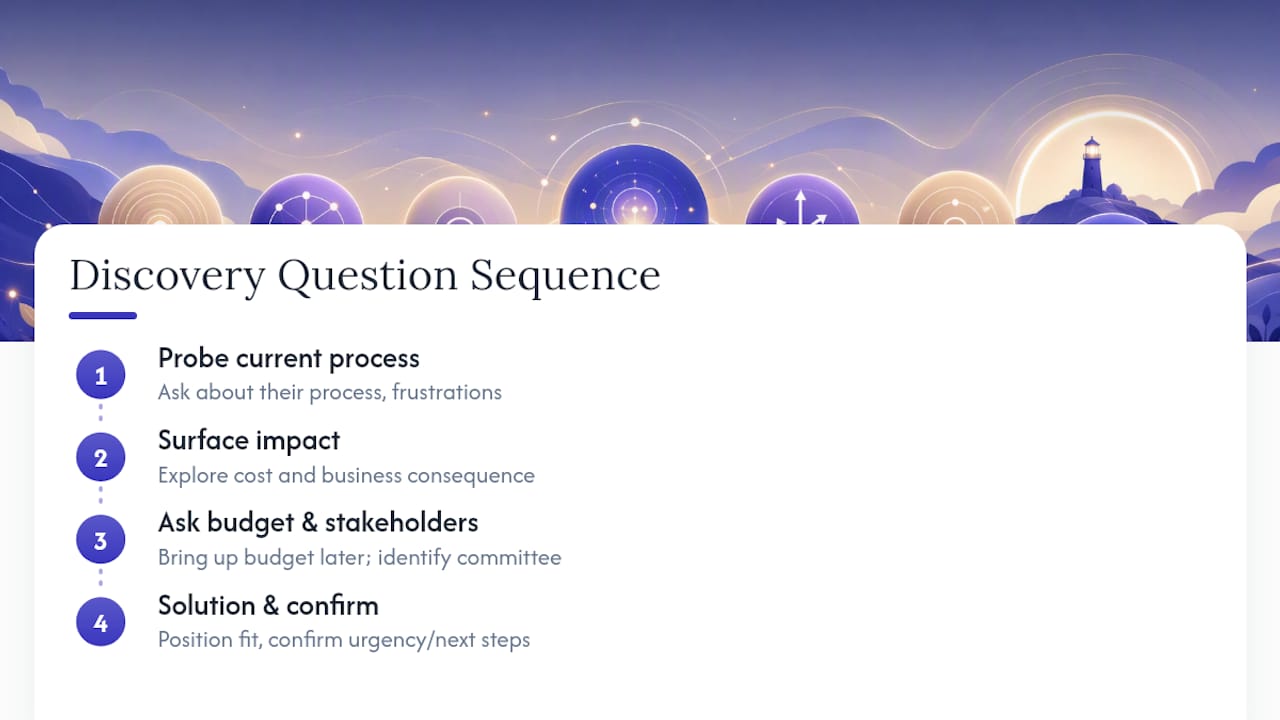
Consider the difference in a real scenario: a rep who opens with “Tell me about your current process for handling this” versus one who opens with “Can I show you what we built?” The first rep is one sentence into building the case for change. The second rep is already selling, and the prospect hasn’t even said what’s broken yet.
The Four Types of QBS Questions
QBS breaks discovery into four distinct question types, each with its own job and its own moment in the call. Mixing them up, or skipping straight to the third or fourth type, is the fastest way to make a prospect feel interrogated instead of understood.
-
Probing questions. These come first and exist to map the current situation without judgment. They’re open-ended by design, because a yes/no answer here tells you nothing useful.
- “Walk me through how your team handles this today.”
- “What’s driving you to look at this now, as opposed to six months ago?”
- “Who else is involved in how this gets decided?”
-
Value or impact questions. Once you understand the situation, you ask what the problem actually costs. This is where urgency gets built, not manufactured.
- “What does that delay end up costing you each month?”
- “If this doesn’t get fixed this quarter, what happens?”
- “How is your team compensating for this gap right now?”
-
Solution-focused questions. These narrow the conversation toward what a fix would need to look like, still without you pitching anything yet.
- “If you could wave a wand and fix one part of this, what would it be?”
- “What would need to be true for this to be a top priority next quarter?”
-
Closed confirmation questions. Short, direct, and used to lock in agreement or move the process forward.
- “So the main blocker is approval speed, not budget. Is that fair?”
- “Does next Thursday work for a follow-up with your ops lead?”
Phrasing matters as much as sequence. Open your probing questions with “tell me” or “walk me through” rather than “can you,” which invites a one-word answer. When a prospect gives you a vague response, follow up with “tell me more about that.” It’s a small phrase, but it’s one of the most effective tools in discovery because it signals genuine curiosity, and it often doubles the depth of what you get back.
How Do You Run a Discovery Call Using QBS?
A 30 to 45 minute discovery call has room for exactly one thing done well: understanding the prospect’s situation deeply enough to know if you can help. Here’s how to structure it.
Before the call, spend 15 minutes on preparation. Pull up their LinkedIn, recent company news, and anything public about their current tools or vendors. Write down your call objective in one sentence, and draft 6 to 12 questions tailored to what you found, not a generic list you use on every call. Generic questions are the number one giveaway that a rep didn’t do the homework.
-
Open with agenda and permission (minutes 0 to 5). Skip small talk that eats the clock. Say something like: “Here’s what I’d like to cover today, I’ll ask a few questions about where things stand, and then we can talk through whether this makes sense to pursue further. Sound good?” That single sentence, asking permission before probing, measurably reduces defensiveness and gets you longer, more honest answers for the rest of the call.
-
Probe and uncover impact (minutes 5 to 25 or 30). This is the bulk of the call. Start broad with probing questions, then move into value and impact questions as the picture gets clearer. If the prospect mentions a problem, always follow with “tell me more about that” before moving on. Resist the urge to fill silence. A five to seven second pause after a question feels long to you and completely normal to the prospect, and it consistently pulls out fuller answers.
-
Align and confirm next steps (final 5 to 10 minutes). Shift to solution-focused and closed confirmation questions. Summarize what you heard in your own words, check it’s accurate, and ask directly what happens next on their end. “Based on what you’ve told me, it sounds like the real issue is X. Did I get that right?”
Pro Tip: Record your first ten discovery calls and count how many of your questions were closed versus open in the first fifteen minutes. Most reps are shocked to find they went closed far too early.
The shift from open to closed questions should happen gradually, not abruptly. If you jump from “tell me about your process” straight to “so you want to buy this quarter,” you’ll get a guarded answer. Let the closed questions arrive naturally once you’ve built enough context that the prospect already sees where the conversation is headed.
What Questions Should You Ask on a Discovery Call?
Below is a working question bank, organized by stage, along with a few two-line scripts you can adapt on your next call.
Opening:
- “What prompted you to take this call today?”
- “Before we dig in, what would make this conversation worth your time?”
Discovery:
- “How is this handled today, and who owns it?”
- “What have you already tried, and what happened?”
- “What’s working fine that we shouldn’t touch?”
Impact:
- “What’s the cost of this staying the same for another year?”
- “How does this affect other teams downstream?”
Decision process:
- “Who else needs to weigh in before a decision gets made?”
- “What does your evaluation timeline usually look like?”
Closing:
- “What would need to happen for this to move forward?”
- “What’s a realistic timeline on your end?”
Micro-scripts combine an opener, a core question, and a follow-up in two lines. For example: “I noticed you mentioned turnover on your last earnings call. What’s that doing to your onboarding timeline?” Or for objection handling: “That’s a fair concern about cost. Compared to what you’re spending today to work around this, how does that number actually sit?”
Customize by role. A CRO wants impact questions tied to revenue and forecast accuracy. A VP of Ops wants questions about process friction and headcount. Procurement wants decision-process and timeline questions almost exclusively, and they’ll tune out probing questions that feel like they belong earlier in the funnel. Industry matters too: a healthcare buyer expects a question about compliance before you ever ask about budget, while a retail buyer usually wants to talk seasonality and margin first.
What Are the Most Common QBS Mistakes?
The single biggest failure mode in QBS is volume without pacing. Reps who read about the four question types often try to cram all of them into the first ten minutes, which turns a discovery call into an interrogation. Call analysis consistently points to 11 to 15 thoughtful questions as the sweet spot for a 30-minute call, roughly one every two minutes, with room to breathe between them.
Talk ratio matters just as much as question count. The prospect should be doing most of the talking, and your job is to guide, not fill space.
A few fixes that work in real time:
- Slow down between questions. Count to five in your head before your next question. It feels awkward at first and stops feeling that way within a few calls.
- Use tone, not just wording, to soften probing questions. “Help me understand” lands differently than “why haven’t you fixed this yet,” even when the intent is the same.
- Watch for short answers as a signal, not a dead end. If a prospect gives you one word, don’t move to the next item on your list. Ask “what makes you say that?” instead.
Pro Tip: If a prospect goes quiet or gives clipped answers three questions in a row, stop and name it directly: “I feel like I might be moving faster than makes sense, want me to back up?” That single line resets the whole call.
QBS vs SPIN Selling and Consultative Selling: Which Should You Use?
QBS and SPIN selling overlap more than they conflict. SPIN, built around Situation, Problem, Implication, and Need-payoff questions, is really a thinking sequence, and it fits neatly inside QBS’s broader four-type structure. Situation and Problem questions map almost directly onto QBS probing questions. Implication questions are QBS value and impact questions with a different label. Need-payoff questions do the same job as QBS’s solution-focused stage.
The practical difference is emphasis. SPIN was built for complex, high-stakes B2B sales where implication questions do the heavy lifting of building urgency. QBS is broader, treating the entire call, including tone, pacing, and permission-seeking, as part of the system, not just the question content.
When to blend them: if a deal has real complexity and multiple stakeholders, borrow SPIN’s implication questions and drop them into the value/impact stage of your QBS sequence. It sharpens the urgency-building portion of the call without you needing to run two separate frameworks.
When to go lean instead: short buying cycles and transactional deals rarely need the full four-stage sequence. A single round of probing questions followed by a quick confirmation close is often enough. Full QBS discovery makes the most sense when the deal has real complexity, real stakeholders, and real risk of stalling out. Consultative selling as a broader philosophy, listening first, prescribing second, is the umbrella both frameworks sit under.
What Do Call Metrics Say About Effective Discovery?
The numbers back up what good reps already sense intuitively: discovery calls have a sweet spot, and most reps miss it in one direction or the other.
Reps asking 11 to 15 thoughtful questions on a 30-minute call see meaningfully higher win rates than reps asking fewer than six. The quality metric that matters more than raw count, though, is follow-up depth: whether an answer reveals actual decision criteria or just restates a surface fact.
That distinction, surface fact versus decision criteria, is the difference between a rep who checks a box and one who actually understands the deal.
A few drills build this skill faster than reading about it ever will:
- One-call review checklist. After each discovery call, count your questions, estimate your talk ratio, and flag any spot where you filled silence instead of waiting it out.
- 20-minute role-play template. Pair up, give the “prospect” a scenario with a hidden decision criterion, and cap the “rep” at ten questions. Score them only on whether they uncovered the hidden criterion, not on how many questions they used.
- The five-second rule drill. Practice pausing five to seven seconds after every question for one full week of calls. Most reps report it feels excruciating for the first three calls and invisible by the fifth.
Practice paired with direct feedback moves the needle faster than solo reading ever will, which is the whole premise behind hands-on sales training exercises built around role-play and critique rather than lecture.
Why This Framework Fits How Middy Coaches Sales Teams
Thirty years of competitive sports and real estate taught me the same lesson QBS teaches: the person asking good questions, of a teammate, an opponent, a client, is the one steering the outcome. In real estate, the agents who thrived weren’t the ones with the slickest pitch. They were the ones who asked a homeowner three follow-up questions before ever mentioning a listing price.
That’s the whole spirit behind Training, Not Selling: teach people to understand their own situation clearly enough that the right decision becomes obvious, rather than convincing them of one. QBS is a tool for that, not a trick for closing faster.

Bring QBS Into Your Team’s Discovery Calls
Reading about question sequencing is one thing. Running it under pressure, on a live call, with a prospect who gives one-word answers, is another. That gap is exactly what Middy’s workshops close: hands-on sessions where reps practice the four question types through role-play, get direct feedback on pacing and talk ratio, and leave with a discovery script tailored to their actual pipeline instead of a generic template.
The sales training programs are built for teams who already know the theory and need the repetition, the critique, and the muscle memory that only comes from practicing in front of a coach. Sessions run as half-day workshops or standalone keynotes, and they work for real estate brokerages, corporate sales teams, and anyone whose current approach to discovery still leans on pitching instead of asking. If your team’s calls sound more like presentations than conversations, book a session and find out what changes in thirty days.
Frequently Asked Questions
What is question-based selling in simple terms?
Question-based selling is a discovery method where reps sequence four types of questions, probing, value, solution-focused, and closed confirmation, to understand a prospect’s situation before proposing anything.
How many discovery call questions should a rep ask?
Aim for roughly 11 to 15 questions on a 30-minute call. Fewer than six correlates with noticeably lower win rates, and far more than 15 often tips into interrogation.
What’s the difference between QBS and SPIN selling?
SPIN’s four question types, Situation, Problem, Implication, Need-payoff, map closely onto QBS’s own structure. QBS is the broader system, covering tone, pacing, and permission-seeking alongside question content.
What are the best open-ended questions for a discovery call?
Questions starting with “tell me,” “walk me through,” or “what’s driving” tend to outperform “can you” questions, which invite short, closed answers.
How do you avoid sounding like you’re interrogating a prospect?
Slow your pace, pause five to seven seconds after each question, and soften probing language with phrases like “help me understand” instead of direct “why” questions.
Leave a Reply