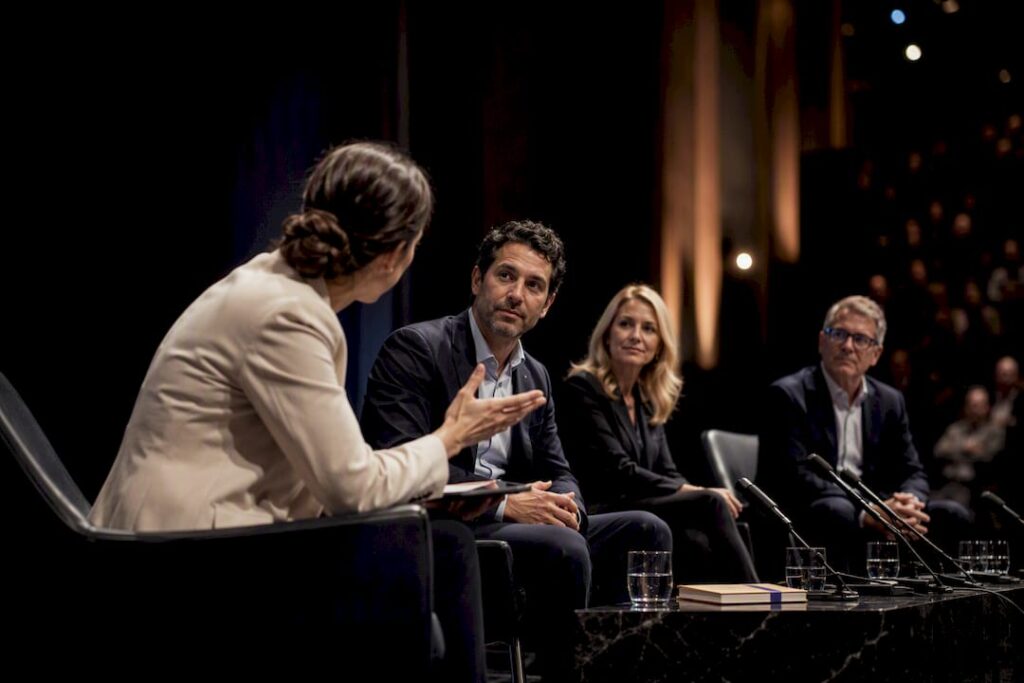
Use one warm-up question, four or five specific and experience-based prompts per panelist, and one closing takeaway question. That mix works because vague questions invite vague answers, while a dated, personal ask forces a real one. Grab three openers and a closer from the bank below, then build your run-of-show around them.
TL;DR:
- Asking specific, experience-based questions generates more detailed and actionable responses than broad, rehearsed inquiries.
- The timing and sequencing of questions, including anchoring topics and backup prompts, are crucial for maintaining a dynamic panel flow.
- Managing dominant or quiet panelists requires strategic prompts like the Three-Beat Pivot and specific name calling to ensure balanced participation.
- Effective moderation involves strict audience Q&A rules, pre-seeding questions, and keeping talk time within 15-20 percent of the session.
- Focusing questions on next-step actions rather than insights turns panel discussions into practical, decision-driving sessions.
Table of Contents
- The Panel Moderator Question Bank You Can Copy Today
- Structuring the Flow: Sequencing Questions by Panel Length
- Writing Questions That Beat the Corporate Non-Answer
- Handling Dominators, Quiet Panelists, and Audience Q&A
- The Day-of Moderator Checklist and Run-of-Show
- Middy’s Take: Turning Panel Insight Into Action
- A Moderator’s Note on Getting Out of the Way
- How Middy Can Help You Moderate or Train Your Next Panel
- Sources
The Panel Moderator Question Bank You Can Copy Today
You don’t need fifty perfect questions. You need six or seven strong ones per category, chosen to fit the panel in front of you. Here’s the bank, organized by function so you can grab and adapt on the fly.
Openers and icebreakers get panelists talking as people before they talk as experts:
- What’s one thing about your work that would surprise this audience?
- If you had to describe your current role in one sentence to a stranger, what would you say?
- What’s a piece of advice you got early in your career that you’d now push back on?
- Where were you, and what were you doing, when you realized this was the path for you?
- What’s a small win from the last month you’re still thinking about?
- Who’s someone in this room or industry you’ve learned something from recently?
Strategic and definition questions orient the room and establish why the topic matters now:
- How would you define this problem for someone who’s never encountered it?
- What changed in the last two years that makes this conversation more urgent?
- What’s the most common misconception people have walking into this topic?
- Who wins and who loses if this trend continues unchecked?
- What’s the one number or trend everyone here should be watching?
Challenges, risks, and benefits questions dig for the trade-offs guests would rather smooth over:
- What did this cost you that you didn’t expect going in?
- What’s a decision here you’d make differently with what you know now?
- Where does this approach fall apart, and for whom?
- What’s the tension between doing this well and doing it fast?
- What’s a risk you’re still managing that hasn’t gone away?
Specifics, examples, and application questions are where the real insight lives:
- Walk us through the last time this went wrong. What happened first?
- What did you change after that, specifically?
- Give us a number. What did that result actually look like?
- Who on your team pushed back, and what did they say?
- What’s a tool, script, or system you built because of that experience?
- What would you tell someone trying this for the first time next month?
- What’s the exact moment you knew your approach was working?
- If someone in this room tried this tomorrow, what’s the first step?
Lightning round and fun prompts reset energy and reveal personality:
- One word to describe your industry right now?
- Best piece of career advice in ten words or less?
- What’s overrated in your field?
- What’s underrated?
- Favorite tool you couldn’t do your job without?
- What’s a rule you break on purpose?
Closing and takeaway questions give the audience something to leave with:
- If the audience remembers one thing from today, what should it be?
- What’s one action someone could take this week based on what we discussed?
- What question should we have asked but didn’t?
- Where should someone start if they want to go deeper on this?
Pull three or four from each category before the event, star your favorites, and cross off the rest as the conversation naturally covers them.
Structuring the Flow: Sequencing Questions by Panel Length
A panel discussion format lives or dies on pacing. Start too slow and you lose the room before the good stuff. Rush the middle and audience questions get cut. Talks breaks the session into four blocks: intro, quick round, substantive arc, and audience Q&A with a closing takeaway. Here’s how that stretches across common formats.
- 30-minute panel: 3 minutes intro and quick panelist rounds, 15 minutes on two anchor topics with follow-ups, 8 minutes audience Q&A, 4 minutes for one closing takeaway question each.
- 45-minute panel: 5 minutes intro, 8 minutes opener round, 20 minutes across three anchor topics, 8 minutes Q&A, 4 minutes closing.
- 60-minute panel: 5 minutes intro, 8 minutes opener round, 30 minutes across four anchor topics with a lightning round mixed in around minute 35, 12 minutes Q&A, 5 minutes closing.
Pick two or three anchor topics ahead of time and hold two backups in your pocket. If a thread catches fire, follow it and drop a backup rather than forcing the schedule. Toastmasters recommends getting your first real question out within two minutes of introductions, and it’s good advice: dead air at the start sets the tone for the whole hour.
Writing Questions That Beat the Corporate Non-Answer
Ask “What are the biggest challenges in your industry?” and you’ll get a rehearsed paragraph the panelist has given fifty times before. Ask “What’s the last challenge that actually cost you a client, and what did you do about it?” and you get a story. The formula is specific, personal, and dated: name a moment, tie it to that panelist, anchor it in time.
Good moderators lean on experiential prompts instead of broad inquiries precisely because broad questions let guests retreat into talking points. Here’s the rewrite pattern in practice:
- Weak: “What trends are you seeing?” Strong: “What’s a trend you dismissed last year that you now regret ignoring?”
- Weak: “What’s your leadership philosophy?” Strong: “Tell us about a decision last quarter where your philosophy got tested.”
- Weak: “How do you handle failure?” Strong: “What’s the last project that failed on your watch, and what did you do the next morning?”
Once you get an answer, follow up with “What did that look like in practice?” or “What would have happened if you hadn’t caught that?” Those two follow-ups alone will pull more detail out of a guarded panelist than any list of prepared questions.
Pro Tip: Keep a running list of “and then what happened?” as your default follow-up. It works on almost any answer and rarely fails to produce a better second answer than the first.
Handling Dominators, Quiet Panelists, and Audience Q&A
Every panel has one guest who won’t stop talking and one who won’t start. Both are fixable in real time if you’ve got the scripts ready.
- Redirect the dominator with the Three-Beat Pivot. Reflect briefly on what they said, name the next panelist, and ask one concise question, then stop talking yourself. InstantPress calls this the Three-Beat Pivot, and it works because it closes a thought instead of cutting someone off mid-sentence.
- Draw out the quiet panelist by name. Try: “Jordan, you’ve done this from the buyer side. Does that match what you’ve seen?” Naming them with a specific angle beats a generic “anyone else?”
- Set audience Q&A rules out loud, before you open the floor. State it plainly: one question, no preamble, under 20 seconds. Announcing the rule up front cuts down on the long statement disguised as a question far more effectively than interrupting one in progress.
- Interrupt a runaway “question” politely but fast. Something like “I want to get to your question so we have time for others, what’s the one line?” works better the earlier you use it.
- Consider pre-submitted questions or a Q&A app for panels with 100 or more attendees. Seeded and app-based questions protect the session from hijacking and let you plan a strong close instead of ending on whoever grabbed the mic last.
Eventbrite’s guidance to keep moderator talk time around 15 to 20 percent of the total session applies just as much here. Once you cross 30 percent, you’ve stopped moderating and started lecturing.
The Day-of Moderator Checklist and Run-of-Show
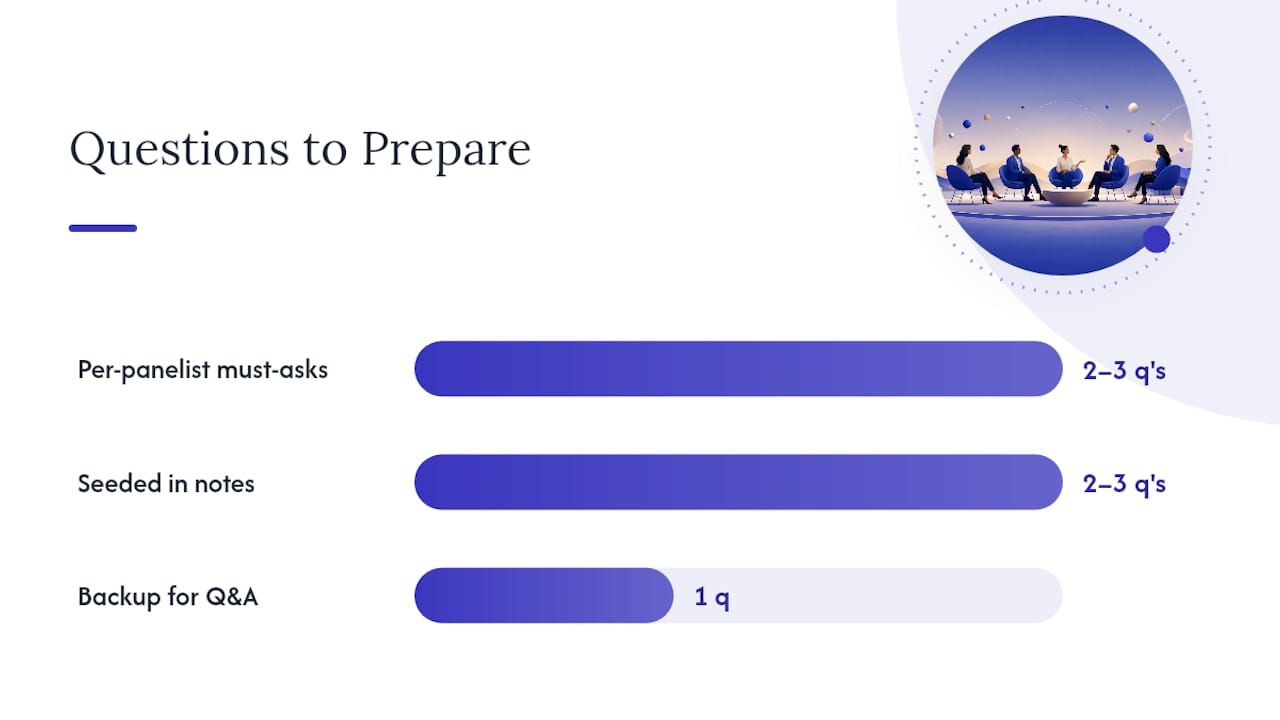
Prep happens well before you walk on stage. Book a 15-minute call with each panelist ahead of time to confirm sensitive topics, what they want to surface, and two or three must-ask questions per person, a step most moderator training guides treat as non-negotiable.
Your day-of checklist:
- Confirm seating order and name cards match your run-of-show
- Do a tech and mic check with every panelist, not just the loudest one
- Put a visible clock or timer where you (not the audience) can see it
- Seed two or three questions in your notes in case audience Q&A stalls
- Write your opening and closing lines word for word
If the room stays quiet during Q&A, have one seeded question ready to ask yourself: “One thing I’m curious about: what would you tell someone starting this in the next 90 days?” It almost always breaks the silence.
Middy’s Take: Turning Panel Insight Into Action
Most panels collect nods and forget them by the parking lot. My “Training, Not Selling” philosophy applies just as directly to moderating as it does to sales: the goal isn’t to impress the audience with a smart conversation, it’s to hand them a decision they can actually make. That changes which questions I pick. I skip anything that produces a talking point and chase anything that produces a next step.
The best panel question isn’t the one that makes a panelist sound smart. It’s the one that gives the audience something they can do differently on Monday morning.
In our workshop formats, we train moderators and speakers to close every segment with a version of “what would you do with this by next quarter?” It’s a small phrasing shift that turns a panel from entertainment into a working session.
A Moderator’s Note on Getting Out of the Way
Your job is to disappear the moment the conversation is working. Use the Three-Beat Pivot to hand off, keep that clock visible, and resist the urge to add your own opinion after every answer. Pick three openers from the bank above before your next panel and trust the follow-up questions to do the rest.
— Middy
How Middy Can Help You Moderate or Train Your Next Panel
If you’re staring down a panel with three strong-willed executives and forty-five minutes on the clock, hiring an experienced moderator saves you from learning these lessons live, on stage, in front of your audience. Middy offers both: booking her to moderate directly, or running a half-day training that turns your internal team into confident, prepared moderators who can handle a dominator and a dead-air silence without blinking.

The practical difference shows up in the run-of-show itself. Instead of guessing at timing or scrambling for a backup question when a thread dies, you walk in with a turnkey structure, seeded questions, and a closing sequence built to leave the audience with something they’ll actually use. That’s the same “Training, Not Selling” approach behind Middy’s sales training programs applied to the stage instead of the sales floor. If your next event needs a moderator who can run the room or a session that trains your team to do it themselves, check availability and get a quote through Middy’s sales training page.
Sources
- How to Moderate a Panel Discussion — Toastmasters
- The best way to moderate a panel — Eventbrite
- How to moderate a panel (InstantPress)
- Talks
Leave a Reply