
A growth mindset treats abilities as things you build through effort, strategy, and feedback. A fixed mindset treats them as traits you either have or don’t. That difference sounds small until you watch what it does to how someone handles a hard quarter, a bad game, or a tough conversation with a client, which is why Carol Dweck’s research at Stanford still shapes how coaches, managers, and teachers talk about effort today.
TL;DR:
- Growth mindset interventions are most effective during key transitions when they include structured support, practice, and reinforcement of growth behaviors.
- Merely delivering motivational messages without practical instruction, feedback, or repeated exercises often results in minimal long-term impact on mindset shifts.
- Success relies on focusing on process goals, giving specific feedback, and cultivating a culture of iteration and learning rather than relying solely on effort-based praise.
- Research shows that targeted training during specific change points produces more consistent improvements than generic encouragement or slogans.
- Practical programs with practice, feedback, and environment support outperform quick motivational pep talks in fostering lasting growth mindsets.
Table of Contents
- Growth mindset vs fixed mindset: the core definitions
- What growth and fixed mindsets look like in real life
- Where mindset actually moves the needle
- How to actually build a growth mindset
- What the research actually shows, and where it gets shaky
- What thirty years on courts and in real estate taught me about mindset
- Workshops built around practice, not pep talks
- Where to go for more on this research
- Sources
- FAQ
Growth mindset vs fixed mindset: the core definitions
Here’s the plain version: a growth mindset assumes intelligence and skill can be developed through practice, coaching, and repetition. A fixed mindset assumes you’re born with a set amount of talent, and that’s what you’re stuck with.
HBS Online defines growth mindset as the belief that abilities, intelligence, and talents are malleable and can be developed through effort, strategy, and learning, while a fixed mindset assumes those traits are static. Neither one is a personality type you’re locked into. Mindset runs on a continuum, and most people slide between the two depending on the stakes. You might have a growth mindset about your sales pitch and a completely fixed one about your ability to network at a conference.
The two mindsets diverge fastest on how they treat effort, feedback, and failure:
- Intelligence: Growth mindset sees it as trainable; fixed mindset sees it as inherited and permanent.
- Effort: Growth mindset treats effort as the mechanism for improvement; fixed mindset treats needing effort as proof you’re not naturally good enough.
- Feedback: Growth mindset uses criticism as data to adjust; fixed mindset hears it as a verdict on identity.
- Failure: Growth mindset reads failure as information; fixed mindset reads it as exposure.
- Comparison to others: Growth mindset asks “what can I learn from them?”; fixed mindset asks “am I better or worse?”
None of this means growth mindset guarantees success. It means the door to improvement stays open instead of slamming shut the moment something gets hard.
What growth and fixed mindsets look like in real life
You can spot these patterns faster than you’d think, once you know what to look for. A person with a growth mindset sets learning goals, not just outcome goals. They ask for specific feedback instead of general praise. They treat a setback as a signal to adjust strategy, not a signal to quit.
Growth mindset traits show up as:
- Seeking out harder tasks because they build skill, not just comfort.
- Asking “what should I try differently next time?” after a loss.
- Viewing a critical manager’s note as useful, not personal.
- Persisting through a plateau instead of assuming talent has capped out.
- Crediting a win to preparation and iteration, not just natural ability.
Fixed mindset traits tend to cluster the opposite way:
- Avoiding challenges that risk looking incompetent.
- Treating a need for extra practice as embarrassing.
- Giving up quickly after a poor result, assuming it confirms a ceiling.
- Getting defensive or dismissive when given corrective feedback.
- Attributing success purely to talent, which makes failure feel like a talent deficit.
Picture two new real estate agents after a slow month. One reworks her script, asks her broker for a call review, and books more practice conversations. The other decides she’s “just not a sales person” and pulls back. Same setback, two different trajectories.
Where mindset actually moves the needle
Growth mindset produces the clearest benefits in feedback-rich environments: classrooms with active coaching, sales teams with real script review, sports programs with structured practice. Students moving through a school transition, new hires in their first ninety days, and athletes adjusting to a new level of competition are all in what researchers call high-leverage windows, periods where a short, well-designed intervention can shift outcomes more than the same message delivered later when the surrounding culture supports it.
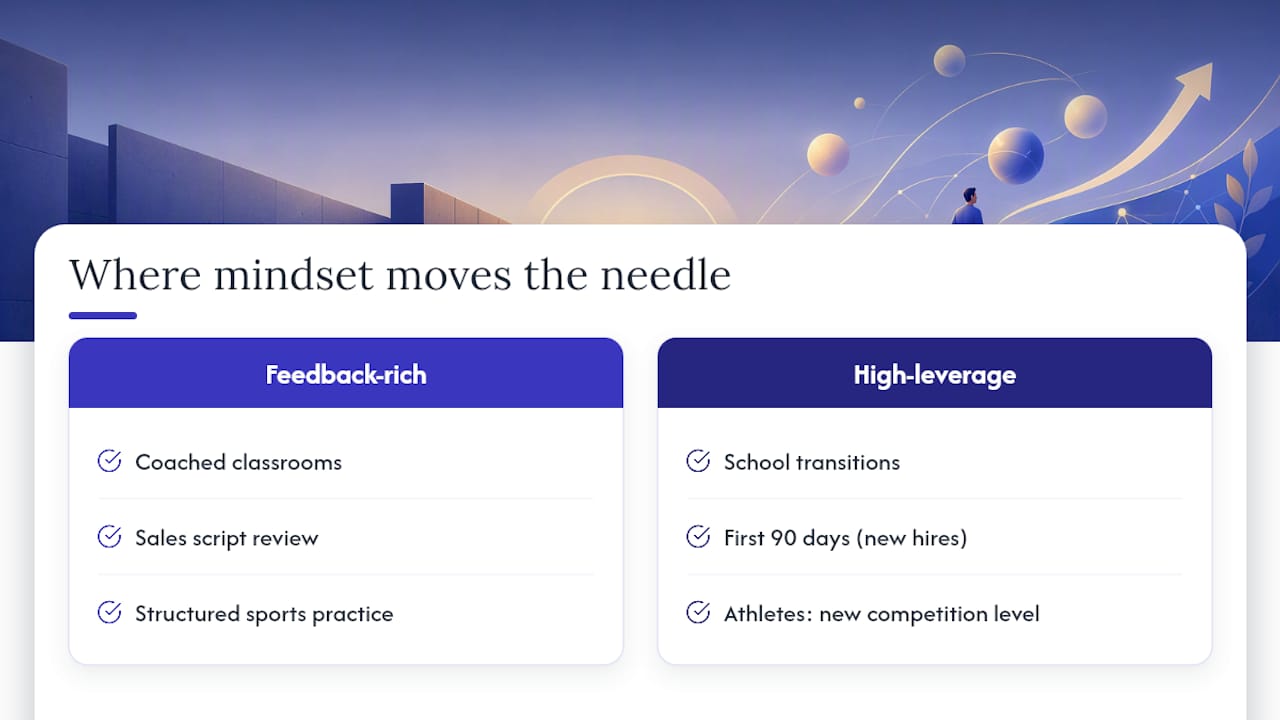
Outside those conditions, the picture gets murkier. A one-off pep talk about “believing in yourself” rarely changes behavior on its own. Growth mindset messaging without instruction on strategy, without a coach or manager reinforcing it, and without a chance to practice tends to fade fast. That gap between what mindset promises and what actually sticks is where a lot of workplace training goes wrong: it treats mindset as a slogan instead of a skill that needs the same repetition any other skill needs.
How to actually build a growth mindset
Shifting mindset is less about affirmations and more about changing what you measure and how you talk about setbacks. Here’s a practical sequence:
- Convert outcome goals into process goals. Instead of “close five deals this month,” set “make twenty prospecting calls using the revised script and track objections.” The process goal is something you control every day; the outcome goal isn’t.
- Praise the strategy, not just the result. When giving feedback to a teammate, athlete, or student, say what they did that worked (“you paused before responding to the objection”) rather than just “great job.” Process praise in early learning has been tied to stronger beliefs that ability grows with effort, and, in one study, to better outcomes years later.
- Build a feedback loop, not a feedback event. Ask for one specific piece of input after every attempt: a shift review, a scrimmage, a client call. Log what changed and whether it worked.
- Target transition points. New role, new season, new grade level, new market. These moments are when a short mindset intervention has the best odds of taking hold, because old habits haven’t calcified yet.
- Make iteration visible. Keep a simple log: what you tried, what happened, what you’ll adjust. This turns “I failed” into “I ran an experiment,” which is a completely different internal story.
Pro Tip: Replace “how did it go?” with “what’s one thing you’d change next time?” in every debrief, whether it’s a sales call, a game, or a class presentation. The question itself trains the mindset.
What the research actually shows, and where it gets shaky
The strongest evidence for growth mindset interventions comes from studies targeting specific transitions with structured support, not blanket motivational messaging. Gunderson and colleagues found that children who received more process praise developed stronger incremental beliefs about intelligence, and that this shift predicted academic achievement years later.
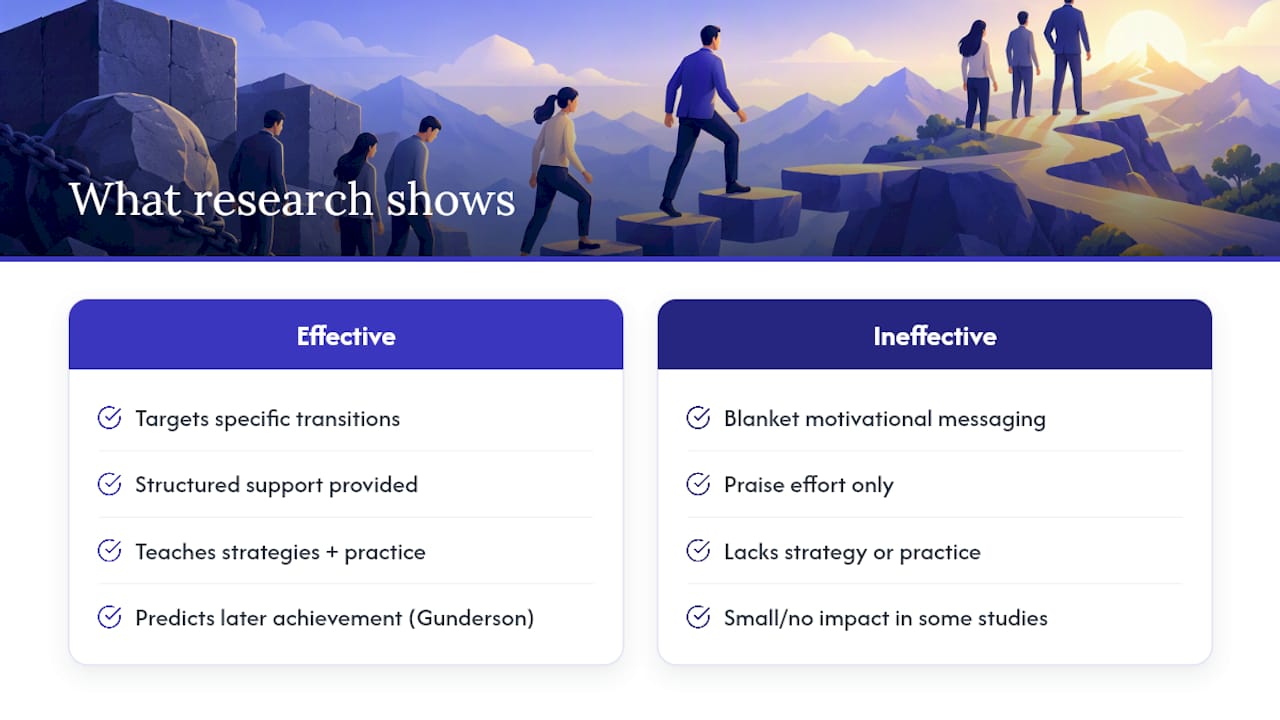
But the research isn’t uniformly glowing. Meta-analytic work has found effects that vary widely by context, sample, and how faithfully an intervention was delivered. Some studies find small or no measurable impact on achievement, which means mindset training isn’t a guaranteed fix on its own.
Dweck herself has pushed back on how the concept gets applied in practice:
Growth mindset is not just “try hard.” Effective change requires teaching strategies, feedback-rich practice, and environments that reinforce growth behaviors.
That’s the core of what Stanford’s Center for Teaching and Learning calls out directly: praising effort with no instruction on strategy creates a “false growth mindset,” where people say the right words but haven’t changed how they actually approach a task. The fix isn’t more encouragement. It’s pairing belief with method, practice, and an environment that expects both.
What thirty years on courts and in real estate taught me about mindset
I’ve watched this play out on the volleyball court and in real estate offices for over thirty years, and the pattern never changes. The agent who treats a rejected offer as data keeps closing. The one who treats it as a verdict on her worth stops making calls. Same with athletes: the ones who ask “what’s my next rep going to fix?” outlast the ones who wait to feel talented enough.
Training, not selling, works the same way. You don’t talk someone into confidence. You give them a script to practice, a rep to review, and a peer to compare notes with, then you let the reps do the convincing.
— Middy
Workshops built around practice, not pep talks
If this article convinced you that mindset shifts need structure, not slogans, that’s exactly what our formats are built for. The Interactive workshop walks sales teams through script review and feedback loops instead of a one-time motivational hit. Teams wanting a deeper reset can book the Half day training, which builds the feedback culture that makes any mindset shift stick past the first week.

Schools and youth programs looking for the student-facing version can look at Find Your Lane, built around the same process-over-outcome principles covered here. Reach out to see which format fits your group.
Where to go for more on this research
For deeper reading: Stanford’s Center for Teaching and Learning on Dweck’s original framing, HBS Online’s comparison of the two mindsets, and Cognistry’s guide for managers building practice-based learning systems.
Sources
- Growth Mindset vs. Fixed Mindset: What’s the Difference? | HBS Online
- Process praise predicts children’s motivational frameworks and later academic achievement (Gunderson et al.)
- Growth mindset | Center for Teaching and Learning | Stanford University
FAQ
What are five characteristics of a growth mindset?
People with a growth mindset seek out challenges, treat effort as the path to skill, ask for specific feedback, persist through setbacks, and credit success to preparation rather than raw talent. These traits show up across school, sports, and work.
Has growth mindset been debunked?
No, but the research is more mixed than early coverage suggested. Meta-analytic findings show effects vary by context and implementation, so blanket mindset messaging without structured practice and feedback tends to underperform, while targeted interventions during key transitions show more consistent results.
What is the difference between Dweck’s growth mindset and a fixed mindset?
Dweck’s framing holds that a growth mindset treats intelligence and ability as developable through strategy and effort, while a fixed mindset treats them as static traits you either have or lack. The two aren’t fixed categories; most people shift between them depending on the situation.
What are five characteristics of a fixed mindset?
People with a fixed mindset avoid challenges that risk exposing weakness, see extra effort as embarrassing, give up quickly after failure, get defensive about criticism, and attribute success purely to natural talent. This pattern makes setbacks feel like permanent verdicts rather than fixable problems.
How can managers or coaches promote a growth mindset without it feeling forced?
Praise the strategy behind a result, not just the outcome, and build a regular feedback loop so people get specific input after every attempt. Process praise tied to real strategy discussion works better than generic encouragement.
Leave a Reply