
Executive presence for women is the learnable mix of gravitas, clear communication, and authentic credibility that gets your ideas heard and your leadership endorsed. It’s not a personality trait you’re born with. Middy Matthews has built a career teaching people this exact skillset, and the numbers back her up: women in C-suite roles grew from 17% in 2015 to 29% in 2024. The gap is closing because more women are training for presence, not just hoping for it.
TL;DR:
- Women in executive roles have increased from 17% in 2015 to 29% in 2024 due to more women practicing presence-building skills.
- Gravitas involves staying composed under pressure and signaling leadership without appearing emotionless, which can be practiced and improved.
- Strategies like explicitly naming your team, asking for the floor, and amplifying colleagues can boost authentic presence while navigating workplace double binds.
- Online presence requires technical adjustments such as proper lighting, clear vocal delivery, and strategic use of chat features for visibility and credibility.
- Rehearsed practice with feedback over weeks builds genuine confidence, making presence sustainable rather than relying on quick hacks or one-time efforts.
Table of Contents
- What Is Executive Presence for Women, Exactly?
- Why Does the Double Bind Make This Harder for Women?
- What Strategies Actually Build Presence Without Losing Authenticity?
- How Does Presence Change on Zoom and in Hybrid Meetings?
- How Do You Choose the Right Coaching, Workshop, or Course?
- How Does Middy Matthews Apply “Training, Not Selling” to Presence?
- Your 30-Day Plan to Build Presence
- A Note From Middy on Steady Practice Over Quick Fixes
- Ready to Build Presence That Holds Up in the Room?
- Sources
- FAQ
What Is Executive Presence for Women, Exactly?
Executive presence breaks down into three working parts: gravitas, communication, and appearance paired with authenticity. Each one is a skill you can practice, not a fixed trait you either have or don’t.
Gravitas is how you hold steady under pressure. It shows up when a deal falls apart in a meeting and you’re the one who says, calmly, “Here’s what we do next,” instead of scrambling for blame. It’s not about staying silent or stoic. It’s about signaling that you can absorb bad news and still lead the room toward a decision.
Communication is the pillar most people underestimate. Fluency matters, but structure matters more. Leaders who open with the point, back it with two or three reasons, and close with a clear ask get perceived as more authoritative than leaders who wander toward a conclusion. A meta-analysis of 45 studies found that female leaders tend to be more transformational than their male counterparts, a style that correlates directly with leadership effectiveness. That’s not a consolation prize. That’s a documented edge.
Appearance and authenticity work together, not against each other. This isn’t about a dress code. It’s about making choices, in how you speak, dress, and carry yourself, that reflect what you actually value, so the polish reads as consistency rather than costume.
In practice, the three pillars show up as specific behaviors:
- Pausing before answering a hard question instead of filling silence with hedges
- Naming a clear recommendation instead of listing five options with no preference
- Dressing and speaking in a way that feels like you on your best day, not a copy of someone else
- Acknowledging pressure out loud (“this is a tight timeline, here’s how we’ll handle it”) rather than pretending it isn’t there
Why Does the Double Bind Make This Harder for Women?
The double bind is real, and it changes the math on presence for women in ways men rarely have to navigate. Show too much authority and you’re labeled difficult. Show warmth without asserting authority and you’re seen as likable but not leadership material. Research on this pattern shows women are penalized for being overly dominant, and that making warmth explicit, crediting colleagues, naming your team, mitigates that penalty without costing you authority, according to Texas McCombs’ guidance on executive presence for women.
Workplace dynamics compound the bind. Watch for these patterns, because they erode presence quietly over months, not in one dramatic moment:
- Getting interrupted mid point in meetings, then having to restate the same idea to be heard
- Having an idea repeated back by someone else and credited to them
- Feeling pressure to over-prepare and over-qualify statements just to be taken as seriously as a less-prepared peer
- Noticing you’re rarely in the room when high-visibility assignments get handed out
None of these are accidents you should absorb quietly. They’re patterns worth documenting, because a single incident is easy to dismiss, but three emails showing the same idea getting appropriated over two months is a pattern a sponsor or manager can act on.
What Strategies Actually Build Presence Without Losing Authenticity?
The tactics that work share one trait: they’re practiced, not performed once and forgotten. Confidence isn’t a mood you summon before a big meeting. It’s evidence you accumulate.
Start with how you structure speech. Before you open your mouth in a high stakes meeting, know your point, your two or three supporting reasons, and your ask. Close with the ask restated, not a trailing question. This single habit does more for perceived authority than any posture tip.
- Name the team explicitly. Instead of “I think we should move forward,” try “The team and I ran the numbers, and here’s the recommendation.” This makes your collaborative style visible without diluting your authority.
- Ask for the floor directly. “I want to finish this point before we move on” works better than trailing off when interrupted. Practice the phrase until it’s automatic.
- Amplify a colleague publicly. When someone on your team makes a smart point that gets ignored, repeat it and credit them by name. This builds your reputation as someone who elevates others, which research ties to lower likability penalties for women in authority.
- Claim credit in writing. If your idea gets restated as someone else’s, respond fast and polite: “Glad that resonated. That’s the direction I outlined in Tuesday’s email.” A quick, documented correction beats a public confrontation.
- Build a sponsorship pact, not just a network. A mentor gives advice. A sponsor uses their own credibility to advocate for you in rooms you’re not in. Ask directly: “Would you be willing to mention my work when the promotion committee meets?”
Pro Tip: Record yourself running through a two-minute pitch on your phone once a week. Watch it back with the sound off first, then the sound on. You’ll catch filler words and posture habits faster than any coach can point them out.
Peer review sharpens all of this. A ninety-second rehearsal in front of one trusted colleague before a big meeting catches more problems than an hour of solo practice in front of a mirror.
How Does Presence Change on Zoom and in Hybrid Meetings?
Presence signals shift online, and ignoring that shift costs you credibility before you say a word. Audio quality and vocal clarity materially affect how competent you sound on a call, more than most people realize.
Run this check before any meeting that matters:
- Test your microphone separately from your camera; built-in laptop mics often distort at higher volumes
- Position your light source in front of your face, not behind you
- Frame your camera at eye level, not looking down from above or up from below
- Slow your pace by roughly 10% compared to in-person speech; audio lag eats the ends of fast sentences
Vocal delivery matters as much as the tech. Speak from a lower, steadier register rather than letting your pitch rise when you’re nervous, and finish sentences with a downward inflection instead of trailing up into a question. In group calls, raise your hand deliberately or type “queuing up a point” in chat rather than waiting for a gap that may never come. Use chat to amplify a colleague’s idea in real time; typing “great point, adding to this” does the same work as speaking up out loud.
How Do You Choose the Right Coaching, Workshop, or Course?
Development options fall into three lanes, and each trades time for depth differently. A single workshop gives you a fast reset on habits but little individual feedback. A multi-week course builds skills gradually with peer accountability. One-on-one coaching costs more and moves slower, but it targets your specific blockers.
Before committing money or calendar time, check these criteria:
- How much of the session is actual rehearsal versus lecture; presence improves through repeated practice, not passive listening
- Whether feedback is individualized or generic
- Cohort diversity, since practicing in front of people at different seniority levels mirrors real workplace stakes
- Whether the program includes a measurable assignment, like a recorded pitch reviewed against a rubric
- Coach bios, sample syllabi, and outcome data you can actually verify before signing up
A related field worth a look for organizations building broader training partnerships is specialty professional development programs, which follow a similar logic: credentialed practice beats theory every time.
How Does Middy Matthews Apply “Training, Not Selling” to Presence?
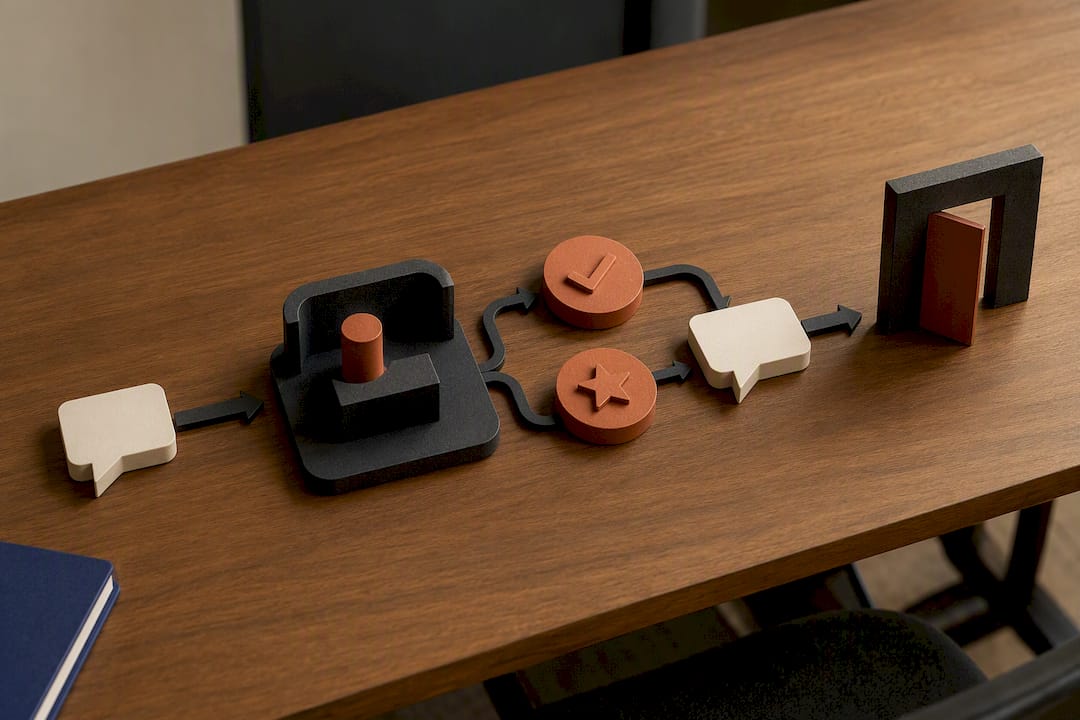
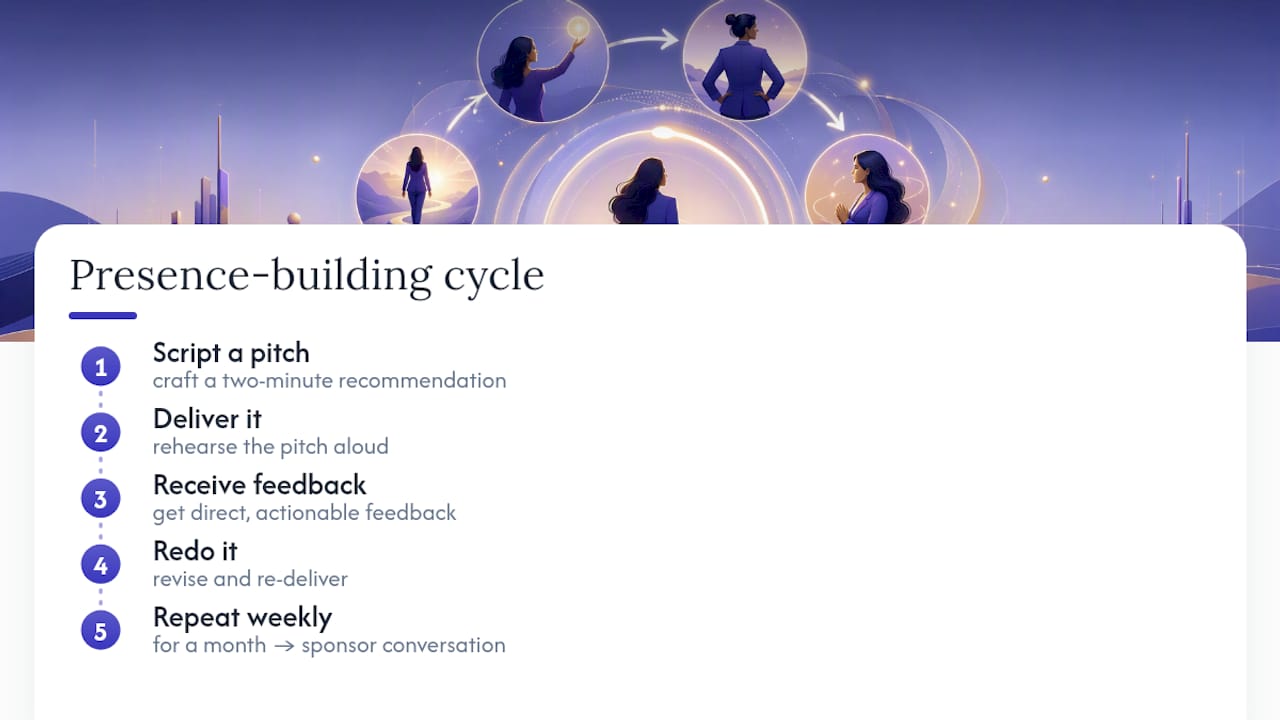
Middy’s core philosophy, Training, Not Selling, maps directly onto these pillars. Workshops run on rehearsal, not lecture: participants script a pitch, deliver it, get direct feedback, and redo it. One anonymized example from her sessions: a mid-level leader who rehearsed a two-minute recommendation weekly for a month, then used a sponsor conversation to get that recommendation in front of a decision-maker. Presence built through repetition, not a single confidence hack.
Your 30-Day Plan to Build Presence
Small, weekly commitments beat one big overhaul. Here’s the structure:
- Week 1: Get a feedback snapshot from two trusted colleagues, then run the audio, lighting, and camera check above.
- Week 2: Practice one structured pitch daily and form an amplification pact with a peer who will name your ideas in meetings, and vice versa.
- Week 3: Apply the pitch publicly in a real meeting, then send a written follow up claiming credit for your recommendation.
- Week 4: Have a direct sponsor conversation and start tracking outcomes, meeting invitations, credit given, promotions discussed.
A Note From Middy on Steady Practice Over Quick Fixes
Competitive sports taught me that presence under pressure comes from reps, not pep talks. The athletes and sales teams who held up best were the ones who rehearsed the hard moment before it happened. Skip the hacks. Run the 30-day plan, track what shifts, and trust the compounding.
— Middy
Ready to Build Presence That Holds Up in the Room?
Reading about presence gets you started. Rehearsing it with feedback from someone who’s coached both Olympic-level athletes and top sales teams is what actually changes how a room responds to you. Middy runs women’s leadership keynotes and workshops built entirely around practice, scripting a pitch, delivering it live, getting direct feedback, and redoing it, rather than sitting through a lecture and hoping something sticks.

Organizations bringing in experienced speakers can expect sessions heavy on rehearsal and light on theory, with participants leaving with a recorded pitch and specific feedback they can use immediately. If you’re planning an event or leadership offsite, check the sales training approach behind her sessions or explore booking Middy as your keynote speaker to see which format fits your group.
Sources
- Women CEOs: Breaking the glass ceiling (Baker College blog)
- Transformational, transactional, and laissez-faire leadership styles: a meta-analysis comparing women and men (PubMed)
- The rules of executive presence are shifting in a way that benefits women (IMD)
FAQ
What Are the 7 C’s of Executive Presence?
Definitions vary across sources, but most versions center on confidence, credibility, connection, clarity, consistency, composure, and communication, with gravitas and authenticity woven through all seven.
What Traits Do Successful Female Leaders Share?
Research points to transformational leadership, decisiveness paired with warmth, resilience under pressure, clear communication, sponsorship of others, authenticity, and the ability to project calm during setbacks, traits confirmed across a meta-analysis of 45 leadership studies.
What Is the Best Leadership Program for Women?
The strongest programs prioritize rehearsal over lecture, individualized feedback, and measurable assignments; workshops built around practice, like Middy’s Training, Not Selling approach, tend to produce more durable change than one-time talks.
Is Executive Presence Different for Women Than for Men?
Yes. Women navigate a double bind that penalizes overt dominance while rewarding warmth, so tactics like naming the team and amplifying colleagues carry more weight for women building presence than for men in similar roles.
Can Executive Presence Really Be Learned?
Yes. Presence is built through repeated practice, rehearsed pitches, recorded feedback, and small high stakes exposures accumulated over weeks, not an innate trait some people simply have.
Leave a Reply