
Pick DISC when the goal is team communication and fast behavior change, and pick MBTI when the goal is individual coaching and career depth. DISC is quicker to teach and easier to apply in a single workshop. MBTI takes longer but gives leaders more to work with in one-on-one development. Neither one belongs in a hiring decision by itself.
TL;DR:
- DISC is best for quick team exercises focused on observable behavior, with results accessible within 30 questions and under an hour.
- MBTI provides deeper insights into individual thought and decision-making preferences but requires longer assessments of 72 to over 100 questions.
- Use DISC for rapid, shared vocabulary in team development and MBTI for slow, comprehensive coaching over multiple sessions or months.
- Neither assessment should be used alone for hiring decisions, and results must be paired with real practice and coaching to produce lasting behavioral change.
Table of Contents
- What DISC measures and how it’s used in organizations
- What MBTI measures and how it’s used in organizations
- How DISC and MBTI stack up side by side
- Where each assessment actually earns its keep
- Where these tools run into trouble
- A short checklist before you pick a vendor
- Turning assessment results into practiced habits
- What most leaders get wrong about these assessments
- Where a workshop turns insight into habit
- Sources
- FAQ
What DISC measures and how it’s used in organizations
DISC sorts behavior into four styles: Dominance, Influence, Steadiness, and Conscientiousness. Everything DiSC, the most widely used version in corporate settings, builds its whole model around one question: how does this person tend to act at work? That focus on observable behavior, rather than internal preference, is what makes it fast to teach and fast to apply.
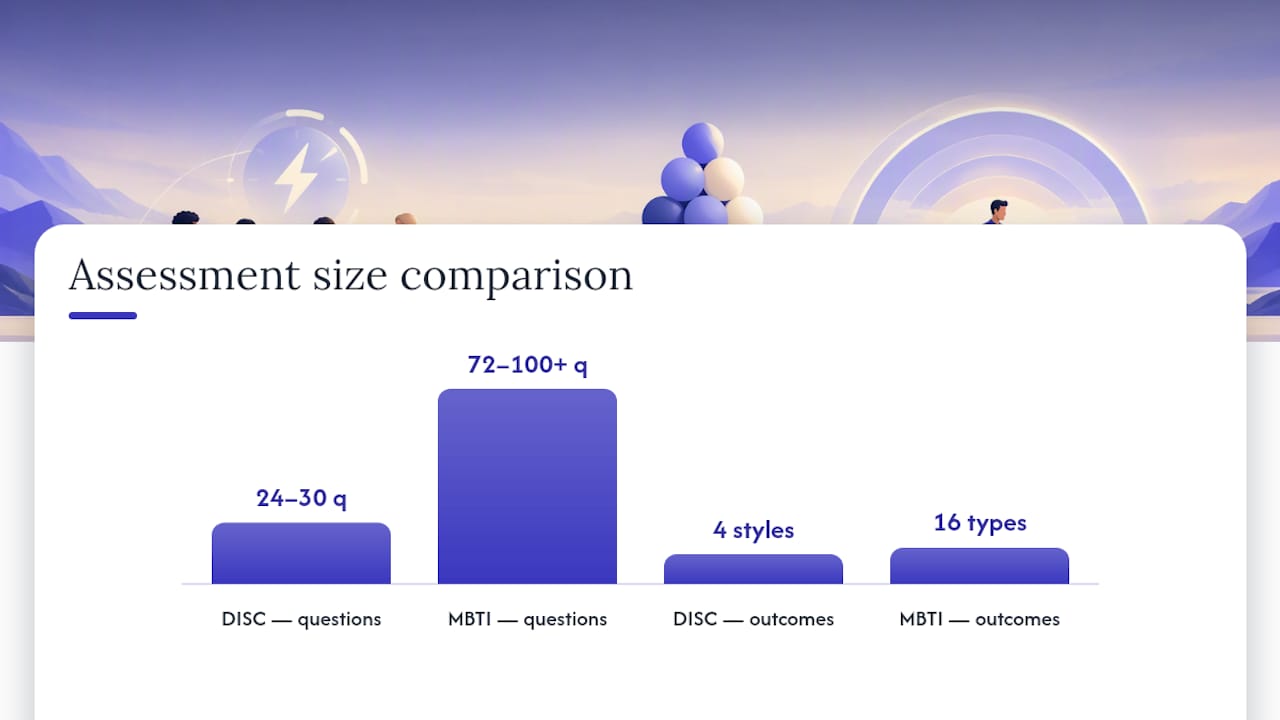
The questionnaire itself is short. Most versions run 24 to 30 questions, which means a team can complete it, get their results, and start a discussion in under an hour.
That speed shows up in how organizations use it:
- Running a team workshop to reduce friction between conflicting work styles
- Training a sales team to read and adjust to a client’s communication style
- Coaching a new manager on how to talk to each direct report differently
- Resolving a specific, named conflict between two coworkers
The reliability evidence backs up the practical case. Everything DiSC reports a median test-retest reliability of about .86, which the research report itself ties to large-sample analyses supporting the underlying model. For a tool meant to spark a 90-minute conversation, that is a strong number.
What MBTI measures and how it’s used in organizations
MBTI works from a different premise. Instead of asking how someone behaves, it asks how someone prefers to take in information and make decisions. Four preference pairs (extraversion or introversion, sensing or intuition, thinking or feeling, judging or perceiving) combine into one of 16 types. The Step II version breaks each pair into finer facets for people who want more nuance than the basic type gives them.
Getting there takes longer. Standard forms run 72 to 100 or more questions, and that length is the tradeoff for depth: MBTI surfaces more about how a person thinks, not just how they act in a meeting.
Because of that depth, MBTI tends to show up in slower, more individual settings:
- Executive coaching engagements that run over several sessions
- Career development conversations, including role fit and long-term planning
- Leadership programs where self-awareness is the actual product
- Team-building exercises focused on decision-making style rather than daily behavior
Publisher research on MBTI Form M reports test-retest coefficients around .81 to .86 across its four scales, which is respectable. The catch, and it matters: that reliability applies to the individual scales, not to the stability of someone’s four-letter type as a whole, especially for people who score near the midpoint on any dimension.
How DISC and MBTI stack up side by side
| Dimension | DISC (Everything DiSC) | MBTI |
|---|---|---|
| What it measures | Observable workplace behavior | Cognitive preferences and decision-making style |
| Typical question count | 24 to 30 questions | 72 to 100 or more questions |
| Primary workplace use | Team dynamics, sales enablement, conflict resolution | Individual coaching, career development, executive leadership |
| Reported reliability | Median test-retest ~.86 | Test-retest .81 to .86 across scales |
| Learning curve | Low, results are usable within a single session | Higher, results reward slower, guided interpretation |
Everything DiSC’s own research report shows scale reliabilities averaging around .83 across a sample of more than 50,000 respondents, which is the kind of sample size that makes the circumplex model behind DISC hard to dismiss as guesswork.
The single most useful takeaway for a practitioner planning a program: DISC’s short format and behavioral focus make it the right tool when the room needs a shared vocabulary fast. MBTI’s length and preference focus make it the right tool when one person needs to understand themselves slowly and thoroughly. Trying to force either one to do the other’s job wastes the format’s strength.
Where each assessment actually earns its keep
The choice usually comes down to how much time you have and whether the goal is the room or the individual.
- A sales team keeps talking over each other in client calls. A 90-minute DISC workshop gives them a shared language for style differences and a concrete list of behaviors to adjust before the next call.
- A newly promoted director struggles with delegation. A multi-session MBTI coaching program digs into decision-making preferences and builds a development plan that outlasts any single workshop.
- An onboarding cohort needs a fast icebreaker that also teaches something useful about teamwork. DISC’s short questionnaire fits the time slot without draining the day.
- A leadership bench needs a longer runway toward self-awareness before a promotion decision. MBTI’s depth suits a coaching relationship that runs for months, not an afternoon.
Success looks different for each: DISC success shows up as changed meeting behavior within weeks, MBTI success shows up as sustained coaching progress over a quarter or more.
Pro Tip: When both perspectives matter, use DISC for the team session and reserve MBTI for the one or two leaders getting individual coaching. They answer different questions and rarely compete for the same slot.
Where these tools run into trouble
Both instruments have real limits, and ignoring them is how a useful development tool turns into an expensive mistake.
- Neither should anchor a hiring decision on its own. Practitioner guidance treats DISC and MBTI as development tools, not selection filters.
- MBTI’s four-letter type can shift for people who score near the midpoint on any scale, so treat a type as a snapshot, not a permanent label.
- Reliability numbers describe individual scales, not the stability of a whole type or profile, a distinction worth repeating to any team that starts treating results as fixed identity.
- Run either assessment through a certified facilitator, pilot it with one team first, and pair results with real performance data instead of letting the label stand alone.
A short checklist before you pick a vendor
Before signing on with any provider, get clear on what you actually need.
- Define the goal: team communication, individual coaching, or both.
- Confirm how much time participants can give, since MBTI’s length is a real constraint on a packed schedule.
- Check the budget against whether you need a certified facilitator on-site or can run a self-serve report.
- Ask about data privacy and how long results are retained.
Then push the vendor on specifics:
- Ask for sample reports before committing to a full rollout.
- Ask what published or peer-reviewed research backs their version of the instrument.
- Ask what certification their facilitators hold and how much training it required.
- Ask whether your organization owns the data or the vendor does, and whether it exports cleanly.
Once you’ve settled on a tool, pilot it with one team, measure a real before-and-after (meeting length, feedback quality), then build in a follow-up coaching cadence before rolling it out further. Leaders considering a data-driven complement to personality results, rather than a replacement for judgment, can find a useful parallel in how sales teams score leads with structured criteria instead of gut feel alone.
Turning assessment results into practiced habits
I’ve spent over 30 years between competitive sports and real estate, and one thing holds true in both: knowing your style doesn’t change your results, practicing a new behavior does. That’s the whole idea behind Training, Not Selling.
In my workshops, a DISC or MBTI result is a starting point, not a finish line. We take the language from the assessment and turn it into role play: how does a high-D salesperson actually soften their pitch with a cautious client, word for word? How does an S-type leader push back in a meeting without losing their footing? The label matters less than the rehearsal.
The point of any assessment is what your team does differently on Monday morning, not what letter or color they got on Tuesday.
— Middy
What most leaders get wrong about these assessments
The conventional advice treats DISC and MBTI like a fork in the road: pick one, roll it out, done. That’s backwards. The real question isn’t which instrument is better, it’s which problem you’re solving, and most organizations skip that step entirely.
I’d also push back on how often teams treat these results as a ceiling instead of a floor. A DISC profile tells you how someone tends to show up, not how they’re capable of showing up under coaching. I’ve watched a high-S salesperson become genuinely assertive once they practiced the exact words, not once they read a report about it.
If you take one thing from this comparison, make it this: buy the shortest, cheapest tool that gets your specific job done, then spend the money you saved on follow-up coaching. A perfect assessment with no practice behind it changes nothing. A decent assessment paired with real rehearsal changes behavior within weeks.
Where a workshop turns insight into habit

Assessment results only matter once someone practices with them. Our interactive workshop turns DISC-style insights into rehearsed sales conversations, and our half-day leadership training does the same for MBTI-informed coaching goals. Proposals can be tailored based on a team’s specific results.
Sources
FAQ
Is there a known DISC profile for Elon Musk?
There’s no verified, publisher-confirmed DISC profile for any specific public figure, since these results come from private assessments, not public data. Claims you see online about a named executive’s DISC type are speculation, not documented results.
What was Barack Obama’s Myers-Briggs type?
MBTI results are self-reported and confidential, so there’s no official, publisher-confirmed type on record for any public figure. Online lists assigning a type to a named leader are guesses based on public behavior, not administered test results.
Which DISC personality type is considered the rarest?
Published data on population frequency by DISC type isn’t publicly documented by Everything DiSC in a way that supports a reliable ranking. Treat any claim about a “rarest” DISC type as unverified rather than a documented statistic.
How many DISC personality types are there in total?
The core DISC model has four primary styles (Dominance, Influence, Steadiness, Conscientiousness), and Everything DiSC further breaks these into more specific profiles by blending adjacent styles. There isn’t a standardized “12 types” version across DISC publishers, so any list claiming that number should be checked against the specific publisher’s own model.
Can I convert someone’s DISC result into an MBTI type?
Not reliably. Comparative research shows only modest correlations between DISC and MBTI scales, so any crosswalk chart is a rough conversation starter, not a validated conversion.
Leave a Reply