
Active listening in sales means hearing the words, catching the emotion underneath them, and reflecting both back so the buyer feels understood, not processed. Get that right and discovery calls surface real pain instead of surface complaints, demos get built around what actually matters, and follow-up rates climb. Research on talk to listen ratios backs this up, and HubSpot’s technique library gives reps the exact moves to practice.
TL;DR:
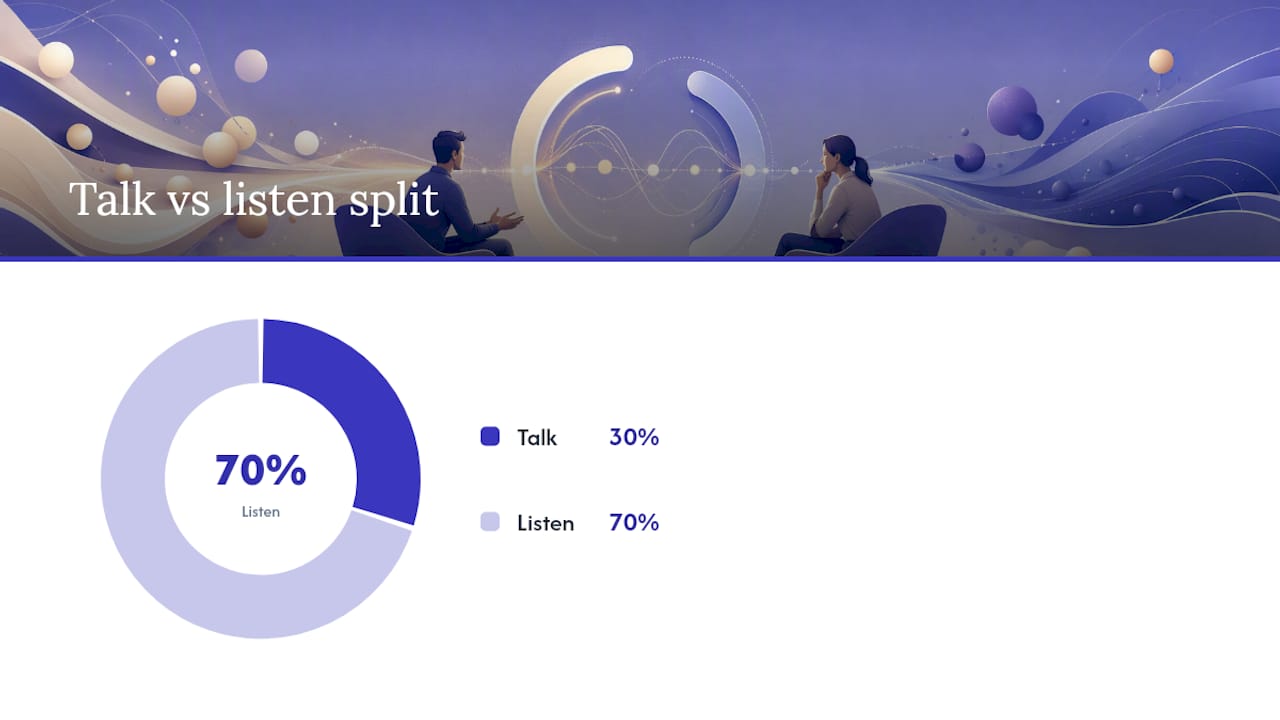
- Maintaining a talk-to-listen ratio around 30/70 and avoiding interruptions are key indicators of effective listening that drive sales progress.
- Using frameworks like LARA and HEAR helps sales reps practice and embed structured listening habits that improve discovery and objection handling.
- Listening during calls should focus on understanding the core issues and keywords, especially on video calls where body language cues are limited.
- Regular, short training sessions with role-play and call review are more effective for building listening habits than one-off workshops or theoretical advice.
- Specific metrics such as paraphrase count, silence duration, and follow-up questions provide concrete ways to measure and improve listening skills.
Table of Contents
- Why Active Listening Sales Skills Actually Move Revenue
- Frameworks That Turn Listening Into a Repeatable Skill
- Techniques That Work on the Next Call You Take
- Where Listening Breaks Down (And How to Fix It)
- Building a Listening Training Program Your Team Will Actually Use
- Listening in Action: Discovery, Objections, and the Close
- Why Middy Matthews Teaches Listening as a Trainable Habit
- What the Research Actually Supports (And What It Doesn’t)
- Turn Listening Skills Into a Team Habit, Not a Slide
- Sources
Why Active Listening Sales Skills Actually Move Revenue
Most sales training treats listening like a soft skill, something nice to have next to the scripts and objection handlers. That’s backward. Listening is how you find out whether the deal is even real before you burn thirty minutes on a demo nobody asked for.
Here’s what changes when a rep actually listens instead of waiting for their turn to talk:
- Discovery calls surface the buyer’s actual constraint, not the generic pain point they lead with.
- Demos get built around what the prospect said mattered, so fewer calls end in “let me think about it.”
- Objections get handled at the root instead of getting talked over.
- Rapport builds faster because the buyer feels heard, not sold to.
Top sales performers consistently show higher listen time on calls, and analysts treat talk-to-listen ratio as a measurable proxy for listening quality. Reps who talk less and ask more tend to close more, and it’s not because silence is magic. It’s because every second they’re not talking, they’re gathering intelligence they’ll need for the next ten minutes of the call.
Remote selling raises the stakes. On a video call you lose half your normal read on a room, no shifting in the chair, no glance at a colleague, so the listening has to work harder through fewer channels. Reps who lean on slides early in a call also tend to shut down the back and forth that discovery depends on. If you’re pulling up a deck in the first five minutes of a first call, you’re not listening. You’re presenting to someone you haven’t understood yet.
Frameworks That Turn Listening Into a Repeatable Skill
Listening well isn’t a personality trait. It’s a sequence you can teach, drill, and score. Two frameworks make it concrete enough for a sales floor.
LARA stands for Listen, Acknowledge, Respond, Ask, and it works as a loop you cycle through every couple of minutes on a call, not a one-time move.
- Listen — let the prospect finish the thought completely, including the pause after it.
- Acknowledge — a short verbal nod (“that makes sense given your timeline”) that costs nothing and buys trust.
- Respond — address what they actually said, not the pitch you had queued up.
- Ask — a follow-up question that goes one layer deeper than where they stopped.
A prospect says their current vendor is “fine, just slow to respond.” A rep running LARA doesn’t jump to a feature pitch. They acknowledge (“slow response time is a common frustration”), respond (“that usually means an escalation gap somewhere”), then ask, “What happens on your end when a ticket sits for more than a day?” That question usually gets to the real cost.
HEAR works as a quick self-check during the call: Halt what you’re about to say, Engage with eye contact or full attention, Anticipate less and absorb more, Reflect the core point back before moving on. It’s less a sequence and more a habit interrupt for reps who are naturally quick talkers.
Layered under both frameworks are four levels of listening worth recognizing in yourself and your reps:
- Level 1, ignoring — waiting for a gap to talk.
- Level 2, selective — hearing only what confirms the pitch.
- Level 3, attentive — following the words accurately.
- Level 4, empathic — hearing the words and the concern behind them.
Most reps operate at Level 2 without knowing it. Insert a LARA checkpoint every three to four minutes on a discovery call and you force yourself back up to Level 3 or 4 before you drift.
Techniques That Work on the Next Call You Take
These are moves you can use today, not concepts to study. Each one has a specific trigger point in a call.
- Count three seconds of silence after the prospect stops talking. Most reps fill that gap immediately, which cuts the prospect off from elaborating. Waiting even a beat longer usually pulls out the deeper detail they were about to add.
- Paraphrase without parroting. Repeating a prospect’s exact words back sounds robotic. Instead, compress it: “So the real issue is approval delays, not the tool itself” lands better than restating their sentence verbatim.
- Use open questions that don’t presuppose an answer. Swap “Are budget constraints an issue?” for “How does budget usually get decided on something like this?” The second one can’t be answered with a flat no.
- Check your assumptions out loud. “I might be reading this wrong, but it sounds like the team’s already tried a fix and it didn’t stick, is that fair?” This single move catches more misread deals than any script.
- Capture keywords, not full sentences. Jot the exact words a prospect uses for their pain, budget, or timeline. Referencing their own language later in the call, or in a demo two days out, signals you were actually listening rather than taking generic notes.
Video calls need their own adjustments. Keep your eye line near the camera lens instead of the notes window, so it reads as attention rather than distraction. Nod at natural points instead of talking through them. Sit forward slightly when the prospect is explaining something complex. Small, but it changes how present you seem on a screen where body language reads thinner than in person.
Pro Tip: Keep a two-column notepad during calls: one side for what the prospect said, one side for what you think it means. Reviewing the gap between those two columns after the call is the fastest way to catch where you assumed instead of listened.
Where Listening Breaks Down (And How to Fix It)
Most listening failures aren’t about attention span. They’re structural habits that feel productive in the moment and cost the deal later.
- Interrupting with a premature solution. A rep hears half a problem, recognizes a familiar shape, and jumps to the fix before the prospect finishes describing it. Fix this with a drill: record calls and count interruptions per call, then set a target of zero for a week.
- Leaning on slides too early. A deck presented in the first ten minutes of a call replaces conversation with narration. Cut slide count on first calls by half and replace the time with questions.
- Hearing words without checking understanding. A rep nods along but never confirms the takeaway, so the demo gets built on a guess. Add a mandatory paraphrase before the call moves to the next topic.
- Multitasking during calls. Email notifications, a second monitor, a Slack ping mid sentence, all of it. The fix isn’t willpower. It’s closing every other window before the call starts, every time.
None of these are character flaws. They’re habits, which means they’re trainable the same way a golf swing or a sales pitch is trainable, through repetition and a coach who catches the pattern you can’t see yourself.
Building a Listening Training Program Your Team Will Actually Use
Techniques don’t stick without structure around them. Structured frameworks combined with role-play and call review measurably accelerate how fast a team adopts better listening habits, far more than a one-time workshop slide deck ever will.
Role-play works best in short, scored sessions rather than long open-ended practice. A ten-minute simulated discovery call with two observers, one tracking interruptions and one scoring question depth, gives reps specific feedback instead of a vague “good job.” Rotate who plays the prospect so reps also learn to spot their own bad habits from the other side of the table.
Call review should track behaviors, not just outcomes. Revenue tells you the deal closed. It doesn’t tell you why. A simple scoring rubric gives coaches something concrete to point to:
| Metric | Target | Why It Matters |
|---|---|---|
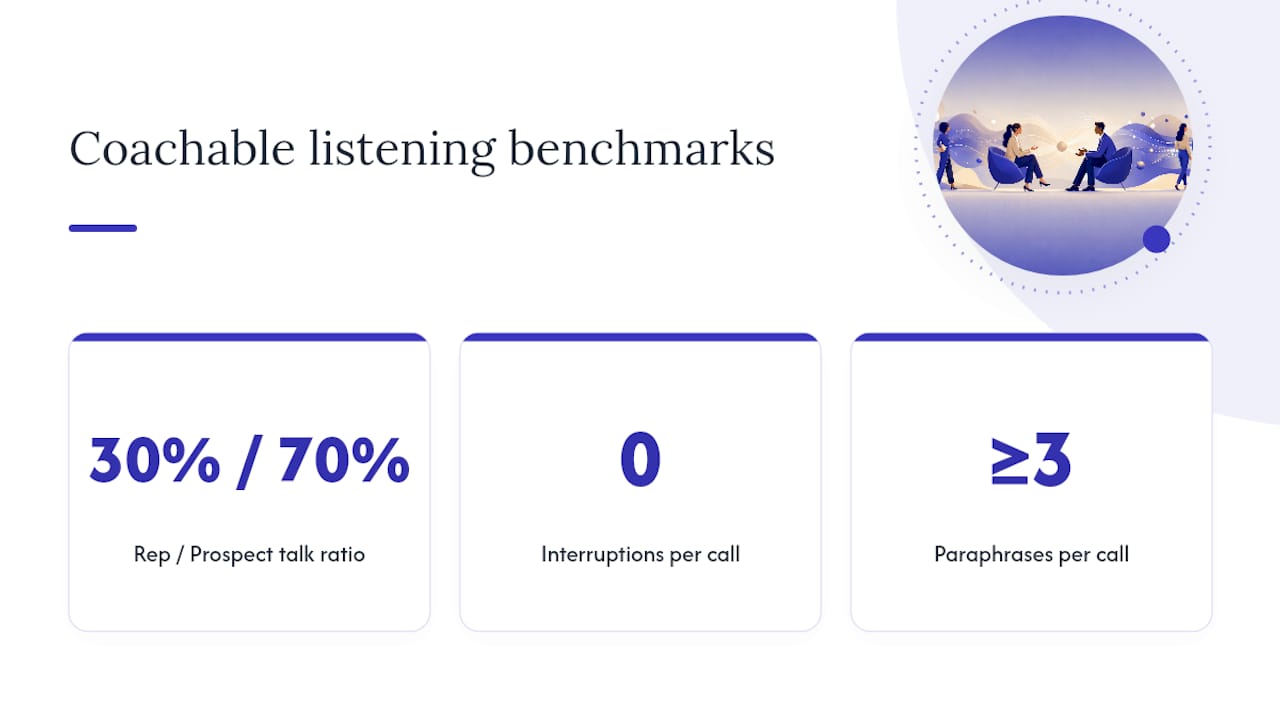
| Talk to listen ratio | Around 30/70 | Signals the rep is gathering, not pitching |
| Interruption count | Zero per call | Shows discipline in letting prospects finish |
| Paraphrase count | Three or more per call | Confirms understanding is actually happening |
| Follow-up question rate | Two or more per prospect statement | Measures depth, not just activity |
Coaching for listening works better when it measures specific behaviors rather than outcomes alone, because a rep can improve talk ratio and paraphrase count in a single week if a coach flags it directly.
Make the cadence weekly, not quarterly. A short scheduled role-play plus one recorded call review, every week, beats a single annual training day by a wide margin because listening habits decay fast without reinforcement. Some teams supplement this with anonymized call analytics that flag talk ratio automatically, which gives coaches a starting point before they even listen to the recording.
Listening in Action: Discovery, Objections, and the Close
Seeing the frameworks applied in sequence makes them easier to run for real.
- Discovery, LARA in motion. Prospect: “Our current process just feels clunky.” Rep listens fully, acknowledges (“clunky usually means extra steps somewhere”), responds without pitching, then asks, “Where does it slow down the most, at intake or at approval?” That single question usually narrows a vague complaint into a specific, fixable problem.
- Objection handling with paraphrase and probe. Prospect: “This feels like more than we need right now.” Rather than defending the price, the rep paraphrases: “So it’s less about the value and more about timing?” Then probes: “What would need to be true in the next quarter for this to feel necessary?” That reframes the objection instead of arguing against it.
- The recap that confirms and moves forward. At the close of a call, instead of a generic “sounds good, I’ll follow up,” the rep confirms specifics: “So the priority is fixing approval delays before Q3, and budget sign off runs through your ops lead. I’ll send a proposal built around that by Thursday.” Confirmed understanding plus a concrete next step is what actually earns the follow-up.
Why Middy Matthews Teaches Listening as a Trainable Habit
Over 30 years split between competitive sports and real estate taught Middy Matthews the same lesson twice: technique without repetition doesn’t survive contact with a real opponent, or a real prospect. That’s the logic behind her “Training, Not Selling” philosophy. Listening isn’t a talking point in her workshops, it’s a drilled behavior.
Formats vary by team need: a keynote paired with a 90-minute practice lab for larger groups, or a half-day session built entirely around recorded role-play for smaller sales teams. The goal in every format is the same: reps leave able to run LARA on a real call, not just recite it.
What the Research Actually Supports (And What It Doesn’t)
The evidence on listening in sales is more specific than most training decks admit. It’s not “listen more” in the abstract. It’s talk ratio near 30/70, zero interruptions, three or more paraphrases a call. Those numbers are coachable in a way “be a better listener” never was.
Where conventional sales advice falls short is treating listening as innate, something a rep either has or doesn’t. It’s a mechanical skill, closer to a golf swing than a personality trait, which means it degrades without practice and improves with specific, scored repetition.
If you take one thing from this, prioritize the framework over the mindset. Telling a rep to “care more about the customer” changes nothing measurable. Giving them LARA, a paraphrase quota, and a weekly recorded call review changes their calls within a month. Behavior change comes from structure, not sentiment, and that’s exactly why frameworks built for team coaching, not personal enlightenment, are the ones worth adopting first.
— Middy
Turn Listening Skills Into a Team Habit, Not a Slide
Reading about talk ratios and paraphrase counts won’t change a single call your team runs next week. Middy’s workshops are built around that gap between knowing the frameworks and actually running them under pressure, with live role-play, recorded call review, and drills built specifically around LARA and HEAR rather than a slide about “communication skills.”

Formats scale to what your team actually needs: a keynote for a full sales kickoff, a half-day workshop with scored role-play for a smaller team, or a training block built into an existing sales meeting cadence. Various organizations have used these types of sessions to improve listening skills from selective to attentive levels within a quarter, using drills that maintain effectiveness beyond the workshop. The same discipline applies outside sales too. Professional advisory teams, like the client-facing work described by Chosen Estate Planning, depend on the same listening rigor to build trust with clients making high-stakes decisions.
If your team’s discovery calls are running long on talk time and short on real pain discovered, start with sales training built to actually stick and book a session that fits your team’s size and format.
Sources
The frameworks and metrics here draw from a small set of sources worth knowing directly. NCBI’s clinical summary defines active listening as a learned skill with concrete steps, not an innate trait. HubSpot’s technique guide supplies the tactical moves, from keyword capture to silence. Forbes connects talk to listen ratio to top performer behavior. QUOTA Training provides the coaching rubric and role-play structure used in the training section above.
- Active listening techniques to use on your next sales call — HubSpot
- Four Behaviors To Make Active Listening Your Superpower In Sales — Forbes
- Sales call listening skills: Train reps to close more deals — QUOTA Training
Leave a Reply