
Transactional leadership relies on rewards and clear rules to drive short-term performance; transformational leadership relies on vision and inspiration to drive long-term engagement and innovation. Neither one wins outright. The research backs both, depending on the job, the team, and the timeline, and the strongest leaders we’ve trained tend to run both at once.
TL;DR:
- Use transactional leadership for routine, regulated, or commission based work, where clear rules support consistency, but avoid letting rewards crowd out intrinsic motivation.
- Choose transformational behaviors for innovation, change, and specialist development, but pair vision and coaching with clear expectations to keep teams from becoming directionless.
- A synthesis of 625 samples and more than 200,000 participants linked transformational leadership with performance and attitudes, though effects varied by occupation, culture, and time.
- Set clear goals and fair rewards, then add individualized coaching; avoid responding only after crises, a pattern linked to lower satisfaction and higher turnover.
Table of Contents
- The basics: definitions and core behaviors of each style
- Breaking it down: side-by-side differences and practical implications
- When transactional leadership works best
- When transformational leadership works best
- What the evidence says: meta-analyses and boundary conditions
- How to choose, blend, or develop the right mix for your team
- Where these ideas actually came from
- How each style shapes culture and engagement
- How to actually assess which style you’re leading with
- Case studies: where each style succeeded or failed
- Comparing outcomes: performance, innovation, and turnover
- A practitioner’s take on blending both styles
- Where to go next if you want this built into your team
- FAQ
- Sources
The basics: definitions and core behaviors of each style
Transactional leadership runs on exchange. You do the work, you get the reward; you miss the mark, you get corrected. It’s built on structure, and it’s measurable almost immediately.
Transformational leadership runs on buy-in. You paint a picture of where the team is headed, you challenge people to think differently, and you coach the individual, not just the role.
Both styles get described using the same handful of components, and researchers commonly measure them with instruments like the Multifactor Leadership Questionnaire.
- Transactional core behaviors: contingent reward (clear “if you do X, you get Y” agreements), active management-by-exception (monitoring for deviations and correcting early), and passive management-by-exception (stepping in only after something breaks).
- Transformational core behaviors: idealized influence (leading by example), inspirational motivation (setting a compelling vision), intellectual stimulation (pushing people to question assumptions), and individualized consideration (coaching each person based on their own needs).
Once you know these labels, you’ll start spotting them in every manager you’ve ever worked for.
Breaking it down: side-by-side differences and practical implications
The two styles split cleanly along a few practical lines, and seeing them side by side makes the trade-offs obvious.
- Focus: transactional zeroes in on the task and the metric; transformational zeroes in on the person and the mission.
- Motivation source: transactional leans on external rewards like bonuses or quota bumps; transformational leans on internal drive, purpose, and growth.
- Timeframe: transactional delivers fast, visible results; transformational builds slower but compounds over quarters and years.
- Measurement: transactional success shows up in output numbers like sales closed or defects caught; transformational success shows up in engagement scores, retention, and innovation metrics.
Picture a sales floor running on a straight commission structure versus a product team running a two-week innovation sprint with no fixed script. The commission floor hits its number fast, but it rarely produces anyone who sticks around once a better offer appears elsewhere. The sprint team might miss its first deadline, but the ideas that come out of it often outlast the original assignment.
Morale and turnover track the same split. Transactional environments can feel fair and predictable, which some people genuinely want, but overdo the rulebook and people start treating the job like a vending machine: insert effort, expect reward, leave when the machine stops paying out. Transformational environments tend to build loyalty and sharper problem-solving, but only when the vision is backed by real follow-through. A vision with no structure underneath it reads as empty talk fast.
When transactional leadership works best
Some environments don’t need inspiration. They need consistency.
- Routine operations: assembly lines, data entry, and repeatable processes benefit from clear expectations and predictable consequences.
- Regulated or safety-critical work: aviation checklists, clinical protocols, and financial compliance tasks need rules followed exactly, not reinterpreted creatively.
- Commission-based sales: when the metric is the job, contingent reward aligns incentives cleanly and immediately.
The risk shows up when leaders lean on this style too long. Overreliance on extrinsic rewards can flatten intrinsic motivation, and passive management-by-exception, waiting for a fire before responding, tends to breed resentment and higher turnover rather than discipline.
When transformational leadership works best
Some work can’t be scripted. It has to be built by people who actually care about the outcome.
- Innovation and product development: teams solving undefined problems need intellectual stimulation more than a checklist.
- Change management: mergers, restructures, and culture shifts require a vision people can rally behind, not just a memo.
- Knowledge work and professional growth: engineers, consultants, and specialists respond to individualized coaching far better than to quota pressure.
The risk here is just as real. Charisma without structure turns into motivational speeches that never translate into process, and a leader who inspires without setting clear expectations can leave a team energized but directionless.
What the evidence says: meta-analyses and boundary conditions
Researchers have tested both styles against performance and attitude outcomes for decades, and a few patterns hold up consistently.
- Both styles show a positive relationship with performance, so the question isn’t “which one works” but “which one works here.”
- Transformational leadership tends to show a stronger pull on team-level and creative outcomes, while transactional leadership holds its own on standardized, repeatable tasks.
- The augmentation hypothesis, a long-running idea in this research, holds that transformational behaviors add measurable value on top of a solid transactional baseline, rather than replacing it.
- Context changes the math: job type, project size, and national culture all moderate how much either style actually moves outcomes.
A large recent synthesis covering 625 samples and more than 200,000 participants found that transformational leadership positively predicts performance and attitudinal outcomes, but the strength of that effect varies by occupation, culture, and time. That’s the key takeaway: transformational leadership isn’t a universal fix, it’s a lever whose pull depends on where you’re standing.
Separate research on project teams found that transformational leadership had a stronger association with project success than transactional leadership, though project size and type shifted that effect. And the consistent warning across this body of work: passive management-by-exception correlates with lower satisfaction and higher turnover, making it the one transactional habit worth cutting first.
How to choose, blend, or develop the right mix for your team
Start with a diagnostic, not a decision. Ask how predictable the work is, how much innovation the role actually requires, how experienced the team is, and what the culture already rewards. A team of new hires running a fixed process needs different inputs than a seasoned team solving a problem nobody’s solved before.
- Lock in transactional basics first: clear goals, fair contingent rewards, and consistent follow-through on commitments.
- Cut passive management-by-exception immediately: waiting for a crisis to respond isn’t delegation, it’s neglect, and the data on turnover backs that up.
- Layer in individualized coaching: short, regular one-on-ones where you ask more than you tell.
- Add recognition tied to values, not just numbers: public acknowledgment that connects someone’s work to the bigger mission reinforces both styles at once.
- Measure both sides: track output metrics and attitudinal indicators like engagement and retention, then adjust.
Pattern-oriented research backs this sequencing: leaders who pair transformational behaviors with contingent reward and low passive management-by-exception tend to see the highest subordinate satisfaction and commitment, not leaders who pick one lane and stay there.
If you want a practical starting point for the coaching layer, our manager as coach approach turns ordinary one-on-ones into something closer to individualized consideration than status updates.
Pro Tip: Before adding a single transformational practice, audit how often you’re only stepping in after something’s already gone wrong. Fix that first.
Where these ideas actually came from
The transactional and transformational distinction didn’t start as a management training slide. It traces back to Burns’s 1978 work on political leadership, which first separated leadership built on exchange from leadership built on shared purpose and moral elevation. Bass later adapted the framework for organizational settings in 1985, turning Burns’s broader political theory into something a manager could actually apply on a factory floor or in a sales office.
That shift mattered because it reframed leadership as a set of observable behaviors rather than a fixed personality trait. Earlier leadership theory leaned heavily on “great man” thinking, the idea that leaders were simply born with certain qualities. Bass’s framework said otherwise: contingent reward, inspirational motivation, and the rest could be learned, measured, and developed.
Subsequent decades of research built out measurement tools and refined the categories further, splitting management-by-exception into active and passive forms and tightening the definition of idealized influence. The core insight has held up remarkably well across nearly fifty years of study: people respond to both clear exchange and compelling vision, and the ratio that works best shifts with the job, not with fashion. That durability is part of why the framework still shows up in business school curricula and corporate training rooms rather than fading into whatever leadership theory came next.
How each style shapes culture and engagement
Culture forms around whatever gets rewarded and whatever gets ignored, and these two styles reward very different things.
A workplace leaning heavily transactional tends to build a culture of clarity and fairness, people generally know what’s expected and what happens if they hit or miss it. That predictability can feel like relief in environments that have been chaotic. But stretched too far, it can also train people to do exactly what’s measured and nothing more, because the system never asked for anything beyond the metric.
A workplace leaning transformational tends to build a culture of initiative and shared ownership. People bring ideas forward because they feel some stake in where things are headed, not just in hitting a number. Engagement scores in these environments often reflect that sense of purpose, assuming the vision is backed by consistent action rather than slogans on a wall.
The honest answer is that culture rarely survives on one style alone. A purely transactional culture can feel transactional in the worst sense, cold, score-keeping, disposable. A purely transformational culture without any structural backbone can feel inspiring for a month and directionless by the second quarter. The healthiest cultures we’ve seen in workshops blend both: clear expectations that people can count on, layered with a reason to care about the work beyond the paycheck.
How to actually assess which style you’re leading with
Most leaders assume they know their own style. Most are wrong, or at least incomplete, because self-perception and team perception often diverge sharply.
The most established tool for measuring this is the Multifactor Leadership Questionnaire, which breaks leadership behavior into the specific components we outlined earlier: contingent reward and management-by-exception on the transactional side, idealized influence, inspirational motivation, intellectual stimulation, and individualized consideration on the transformational side. It’s used across decades of peer-reviewed research precisely because it breaks a vague label like “inspiring” into behaviors a team can actually rate.
Beyond formal instruments, a few lower-cost methods work well in practice: structured 360-degree feedback that asks direct reports specific behavioral questions rather than general impressions, retention and engagement tracking over time to see whether a leadership shift actually changes outcomes, and simple before-and-after comparisons when a team adopts new one-on-one or recognition practices.
The goal of any assessment isn’t to label a leader as one type or the other. It’s to find the gap between the behaviors a leader thinks they’re showing and the behaviors their team actually experiences, then close it.
Case studies: where each style succeeded or failed
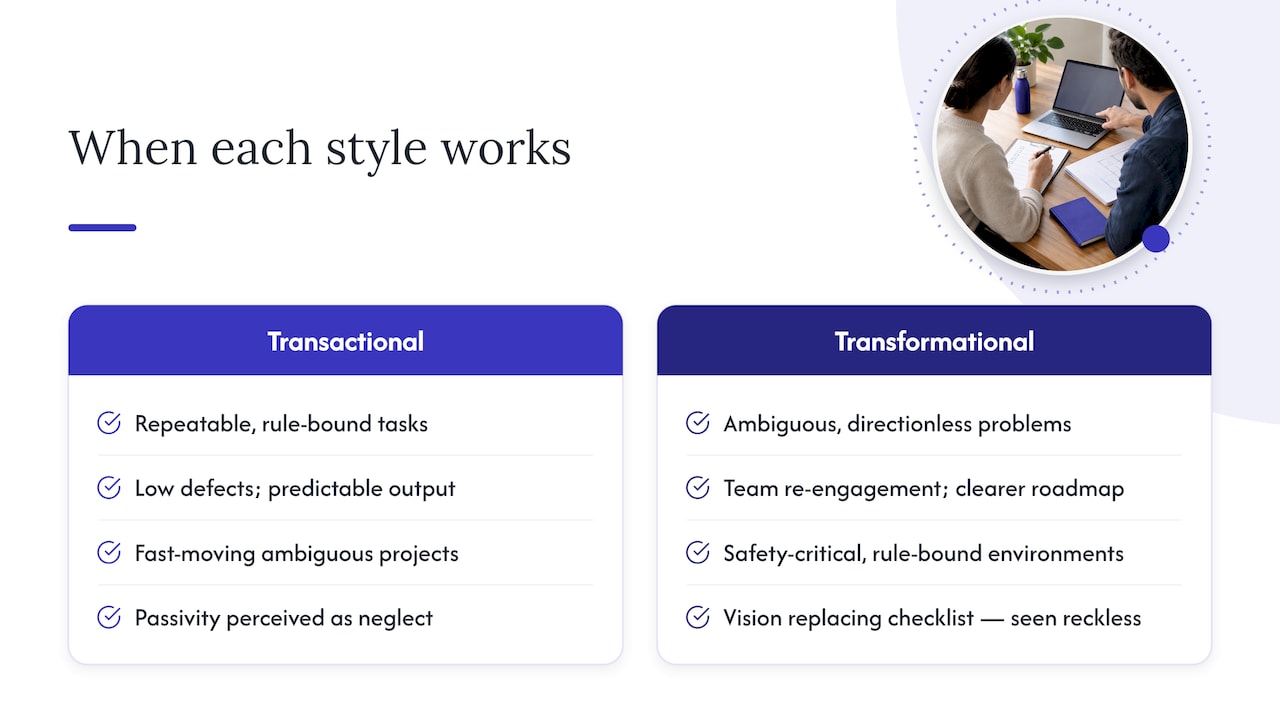
Picture two managers running similar teams in a manufacturing plant. One runs active management-by-exception, checking quality metrics daily and correcting small deviations before they become expensive. Defect rates stay low, output stays predictable, and the team understands exactly what’s expected. That’s transactional leadership doing what it does best, because the task itself is repeatable and the stakes of error are high.
Now picture a product team at a software company facing a stalled roadmap. A manager who keeps issuing more rules and tighter deadlines sees morale drop and turnover rise, because the problem isn’t a lack of structure, it’s a lack of direction. A manager who instead runs a vision session, invites the team to challenge the existing roadmap assumptions, and coaches individuals on where their skills fit the new direction tends to see the team re-engage, because the work finally has a reason behind it.
The failure cases are just as instructive. A transactional leader dropped into a fast-moving, ambiguous project often defaults to passive management-by-exception simply because there’s no clear metric to monitor actively, and that absence of engagement reads as neglect. A transformational leader dropped into a safety-critical, rule-bound environment can come across as reckless if vision-setting replaces the checklist rather than sitting alongside it. Neither failure is really about the leader’s character. It’s a mismatch between style and context, which is the same lesson the research keeps circling back to.
Comparing outcomes: performance, innovation, and turnover
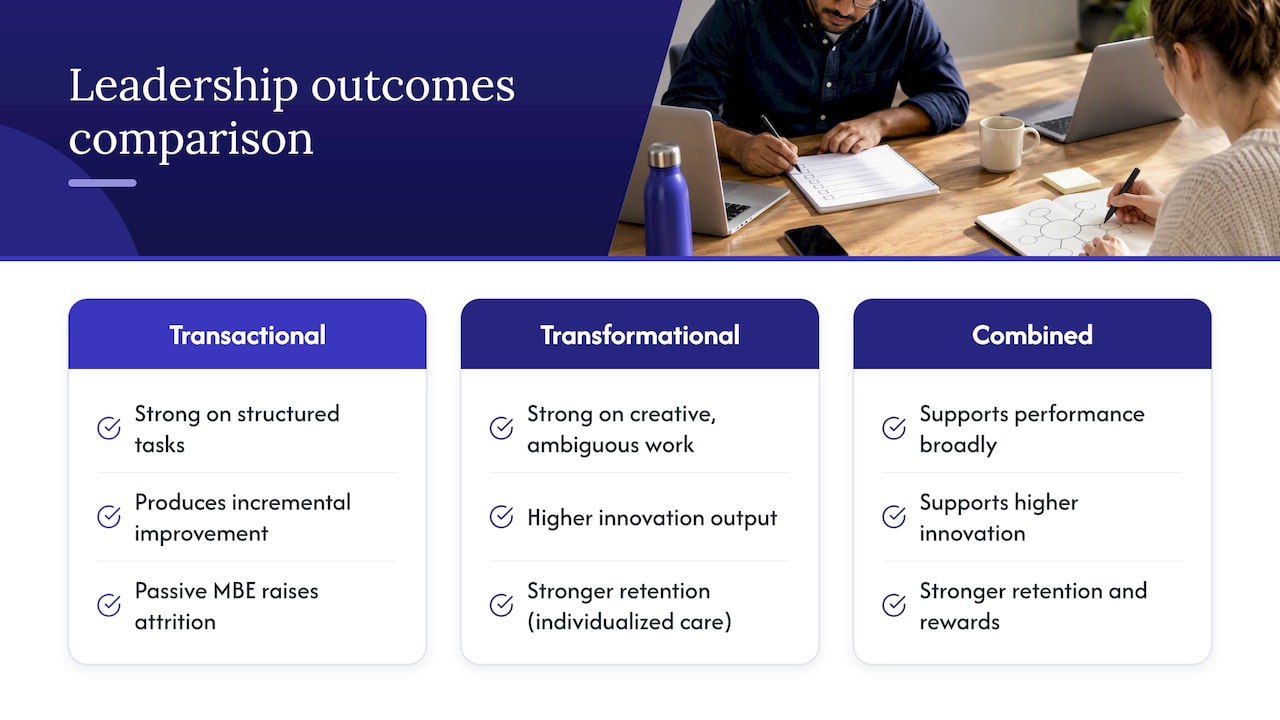
When you line the two styles up against hard outcomes, the pattern holds steady across contexts. Team performance on structured, repeatable tasks tends to respond well to transactional clarity, contingent reward keeps people aligned with the metric that matters. Team performance on ambiguous, creative work tends to respond better to transformational input, because intellectual stimulation and vision-setting are what actually unlock new approaches.
Innovation rates show the clearest split. Transformational behaviors consistently correlate with higher innovation output, largely because intellectual stimulation explicitly invites people to question the existing approach instead of just executing it. Transactional environments can still produce incremental improvement, especially through active management-by-exception catching small inefficiencies, but breakthrough thinking rarely comes from a rewards ledger.
Turnover tells the most consistent story of all. Passive management-by-exception, the transactional behavior where a leader only engages after something breaks, shows up repeatedly as a driver of dissatisfaction and attrition. Transformational behaviors, particularly individualized consideration, tend to correlate with stronger retention, because people are less likely to leave a leader who’s actively coaching them toward something they care about.
None of this means transactional leadership drives people away and transformational leadership keeps them. It means the specific behaviors inside each style carry very different weight, and the leaders getting the best results on all three measures, performance, innovation, and retention, tend to run contingent reward and individualized consideration together rather than picking a camp.
A practitioner’s take on blending both styles
Most of the sales and leadership teams we’ve trained don’t fail because they picked the wrong style. They fail because they never built the transactional floor before trying to inspire anyone. Our coaching approach starts with the basics, clear expectations, honest feedback, scripts people actually understand, before asking anyone to buy into a bigger vision.
In workshops, we pair vision exercises with measurable follow-up almost immediately, because inspiration without a next step just fades. A team that leaves a session excited and never gets a concrete habit to practice will be back where they started in two weeks. That pairing, structure first, meaning layered on top, is the part most leadership training skips.
— Middy
Where to go next if you want this built into your team
If you recognize your team somewhere in this comparison, that’s usually the point where a workshop does more good than another article. Our leadership trainings are built around the same idea we just walked through: get the transactional basics solid, then coach the individual, not just the role. That’s the core of Coached, Not Bossed., our half-day leadership training built for teams trying to move past quota pressure and into real development conversations.

For sales teams specifically, Trained, Not Sold. Applies the same blended thinking to the sales floor, pairing measurable practice with the relationship-building skills that actually retain clients long after the first close. Reach out to book a session and we’ll tailor the mix to where your team actually is right now, not where a generic training assumes you are.
FAQ
Can you give me an example of transactional leadership?
A sales manager offering a bonus for hitting quota, or correcting a process error the moment it’s spotted, is practicing transactional leadership. Both rely on a clear exchange: meet the expectation, get the reward or avoid the correction.
Is Bill Gates a transactional or transformational leader?
Public accounts of Gates typically emphasize vision-driven, long-term thinking around technology and philanthropy, traits associated with transformational leadership. No peer-reviewed leadership assessment of him specifically exists, so this remains an interpretation rather than a measured finding.
What are the 5 C’s of transformational leadership?
Definitions of a “5 C’s” framework vary across sources and aren’t part of the core academic model, which centers on idealized influence, inspirational motivation, intellectual stimulation, and individualized consideration. If you encounter a 5 C’s list, treat it as a secondary framework rather than the established research standard.
What are the disadvantages of transactional leadership?
Transactional leadership can flatten intrinsic motivation when overused, since people start working only for the reward attached to the task. Passive management-by-exception, where a leader intervenes only after a problem surfaces, is also linked to lower satisfaction and higher turnover.
Sources
- Transformational leadership in context: A meta-analysis of 40 years of research
- Transformational versus transactional leadership styles and project success: A meta-analytic review
- Are the best leaders both transformational and transactional? A pattern-oriented analysis
Leave a Reply