
Use GROW for most one-on-one conversations. It’s the fastest coaching conversation framework to learn and the easiest to run in a single 20-minute slot. Switch to CLEAR when trust needs rebuilding first, or OSKAR when the person already knows the problem and just needs momentum. Whatever you pick, open with one question: “What do you want to walk out of this conversation with?”
TL;DR:
- GROW is the fastest coaching framework for quick sessions but should be supplemented with CLEAR or OSKAR when trust or clarity are low.
- Effective coaching relies on micro-skills like calibrated silence and reflective summaries to build trust and elicit honest responses.
- Coaching works best when aligned with the coachee’s readiness and goals, not just the chosen model, especially in performance versus developmental contexts.
- Preparation, such as writing prompts on sticky notes and setting clear commitments, significantly enhances coaching session productivity.
- Practice sessions and live workshops are essential for managers to transition from theory to confident, skillful coaching in real-world conversations.
Table of Contents
- What Is the Best Coaching Conversation Framework, and When Should You Switch?
- How Do You Run Each Coaching Framework Step by Step?
- What Does a Copy-Ready Coaching Session Agenda Look Like?
- What Are the Best Coaching Questions to Ask at Each Stage?
- What Coaching Micro-Skills Matter More Than Any Framework?
- Does Coaching Actually Improve Performance, and What Are Its Limits?
- What Does a 20-Minute GROW Coaching Conversation Actually Sound Like?
- Middy’s Take: Coaching Sales Teams Like an Athlete Trains, Not Like a Manager Corrects
- Want Your Managers Actually Running These Conversations, Not Just Reading About Them?
- Sources
What Is the Best Coaching Conversation Framework, and When Should You Switch?
Here’s the truth nobody tells new managers: the framework matters less than showing up with one. Most bad coaching conversations aren’t bad because the manager picked the wrong model. They’re bad because there was no model at all, just a vague sense that a “check in” needed to happen. Pick any one of these seven and you’ll outperform the manager who winged it.
- GROW (Goal, Reality, Options, Will): the default choice for weekly one-on-ones and quick performance talks. A cycle often runs about 20 minutes, according to MindTools, though it scales to a full hour for bigger goals.
- CLEAR (Contract, Listen, Explore, Action, Review): built for conversations where trust or clarity is shaky. The contracting step up front makes it slower but sturdier, around half an hour to nearly an hour.
- OSKAR (Outcome, Scaling, Know how, Affirm, Review): a solution-focused model for someone who already understands the problem and just needs a path forward, typically a short session.
- Seven Questions: a stripped-down check-in format for coaches who need speed over depth, closer to 10 minutes, ideal for standing team huddles.
- PPCM (Positive Psychological Coaching Model): a multi-session architecture built on relationship building, strengths profiling, and goal setting, developed through the work Van Zyl and colleagues catalog in their systematic review. This one spans multiple sessions over time.
- Coaching Conversation Canvas: a visual, worksheet-style structure useful for career or life planning talks where the coachee benefits from seeing the conversation mapped out.
- Dialogical or experiential approaches (including chairwork): used inside a longer session when someone is stuck emotionally, not just strategically stuck. These need more coach skill and should be layered onto a base framework, not used alone.
Short cycles fit weekly check-ins, sales call debriefs, and any moment where the goal is narrow. Multi-session models like PPCM fit career transitions, leadership development, or anything where the “goal” itself needs to be discovered before it can be pursued. If you’re not sure which bucket you’re in, ask yourself one question: does this person know what they want, or do we need to find out together? Known goal, use GROW or OSKAR. Unclear goal, use CLEAR or PPCM’s early phases.
How Do You Run Each Coaching Framework Step by Step?
Knowing the acronym doesn’t help you in the room. What helps is having the actual line to say when the silence gets uncomfortable. Here’s how to run the four most common models with real prompts attached.
- GROW, Goal. Ask: “What does a good outcome from this conversation look like?” Keep pushing until the answer is specific, not “get better at closing,” but “close two more deals this month without discounting.”
- GROW, Reality. Ask: “What’s actually happening right now?” and then, critically, “What have you already tried?” This second question stops you from suggesting something they’ve already attempted and failed.
- GROW, Options. Ask: “What are three ways you could approach this?” Resist filling the silence. If they stall, prompt with “What would you try if you knew you couldn’t fail?”
- GROW, Will. Ask: “Which one will you actually do, and by when?” Vague commitments (“I’ll try to call more people”) don’t count. Push for a number and a date.
CLEAR follows a similar shape but front-loads trust. The Contract step is a single sentence: “What do you want from me in this conversation, advice, a sounding board, or just someone to think out loud with?” That one question prevents half the frustration in coaching relationships, because most people don’t actually want advice. Listen and Explore work like GROW’s Reality and Options, just slower and with more paraphrasing back to the coachee. Action and Review mirror Will, but Review adds a loop: “How will we both know this worked?”
OSKAR skips reality-digging almost entirely, which is what makes it fast. Outcome asks the same question as GROW’s Goal. Scaling asks: “On a scale of one to ten, where are you today?” followed immediately by “What’s already working that got you that far?” That second question is the model’s secret weapon, it forces the coachee to notice their own competence instead of only their gap. Know how asks what resources, skills, or support would move the number up by one point. Affirm and Review close the loop by naming progress and setting the next check-in.
The Seven Questions model is closer to a checklist than a conversation. It runs through: What’s on your mind? What’s important about it? What have you tried? What did you learn? What options do you have? What will you do? How can I help? It’s built for speed, not depth, and it works well as a template for Slack-based or five-minute hallway coaching.
PPCM and the Coaching Conversation Canvas aren’t single-session scripts, they’re the scaffolding you hang single sessions on. PPCM’s five phases (relationship, strengths profiling, visioning, goal setting, and eventual re-contracting) mean a manager running quarterly development conversations might spend one entire session just profiling strengths before ever setting a goal. The Frontiers review notes that most coaching tools aren’t locked to one phase. A strengths-based question can show up in session one or session six.
Dialogical and experiential techniques, including chairwork, belong in the toolkit but come with a caution label. These methods work by having a coachee physically or verbally engage with a different perspective, sometimes literally speaking as a different “version” of themselves. Research on dialogical coaching suggests it can accelerate emotional shifts that pure question-and-answer models move through more slowly, according to a preprint from Pugh and Broome. Use it only after you’ve built rapport, and only if you’ve had some training in it. It’s not a first-session tool.
Pro Tip: Write your framework’s four or five prompts on a sticky note before the conversation starts. The goal isn’t to sound scripted, it’s to free up your brain to actually listen instead of scrambling for the next question.
What Does a Copy-Ready Coaching Session Agenda Look Like?
A session without a timebox turns into a therapy hour or a status update, neither of which is coaching. Here’s a structure you can lift directly into your calendar invite.
Pre-session (2 minutes, before you even sit down): Send one line: “Come with one thing you want to make progress on today.” This single prompt does more for session quality than any framework, because it forces the coachee to arrive with an agenda instead of waiting for you to supply one.
Time allocation by session length:
Recording commitments: Don’t rely on memory. Have the coachee type their own commitment into a shared doc or message thread in their own words, not yours. People follow through more reliably on language they chose themselves.
Closing script: “So the one thing you’re doing before we talk again is [X], by [date]. What might get in the way?” That last question matters more than it seems, naming the obstacle in advance makes it far less likely to derail the plan.
Follow-up checklist:
- Confirm the commitment in writing within 24 hours.
- Set a specific check-in date, not “soon.”
- Ask one accountability question at the next touchpoint: “Where are you on [X]?”
- Note what worked in the framework itself so you can adjust next time.
If you manage a sales team, this structure pairs naturally with call debriefs. Coaching Beats Commanding walks through how to move from exploration to action without slipping into telling people what to do.
What Are the Best Coaching Questions to Ask at Each Stage?
The framework gives you structure. The questions are what actually move the conversation. Below is a working prompt bank organized by stage, pull from it freely instead of trying to remember your framework’s exact wording every time.
Opening and focus setting:
- “What’s the one thing you want to be different by the end of this conversation?”
- “If we only had ten minutes, what would you want to spend it on?”
Exploratory and reframing prompts:
- “What’s the story you’re telling yourself about this?”
- “If your best mentor were watching this situation, what would they notice that you’re missing?”
- “What would you say if you weren’t worried about sounding foolish?”
Options and brainstorming prompts:
- “What’s an option you’ve dismissed too quickly?”
- “What would the boldest version of this look like?”
- “What’s the smallest possible first step?”
If you catch yourself talking more than that, you’ve slipped into advising, not coaching.
- “On a scale of one to ten, how committed are you to this right now?”
- “What would make that a nine or ten?”
Scenario-specific mini-scripts:
- Performance conversation: “Walk me through what happened, step by step, no editorializing yet.”
- Career planning: “In three years, what does a normal Tuesday look like for you?”
- Confidence building: “Tell me about a time you handled something harder than this.”
The Positivepsychology technique library pairs well with this bank, especially its notes on motivational interviewing, which sharpens how you handle resistance without pushing back directly.
What Coaching Micro-Skills Matter More Than Any Framework?
Frameworks tell you what to ask. Presence determines whether the person actually answers honestly. You can run a technically perfect GROW session and still get shallow answers if the coachee doesn’t trust that you’re actually listening rather than waiting for your turn to talk.
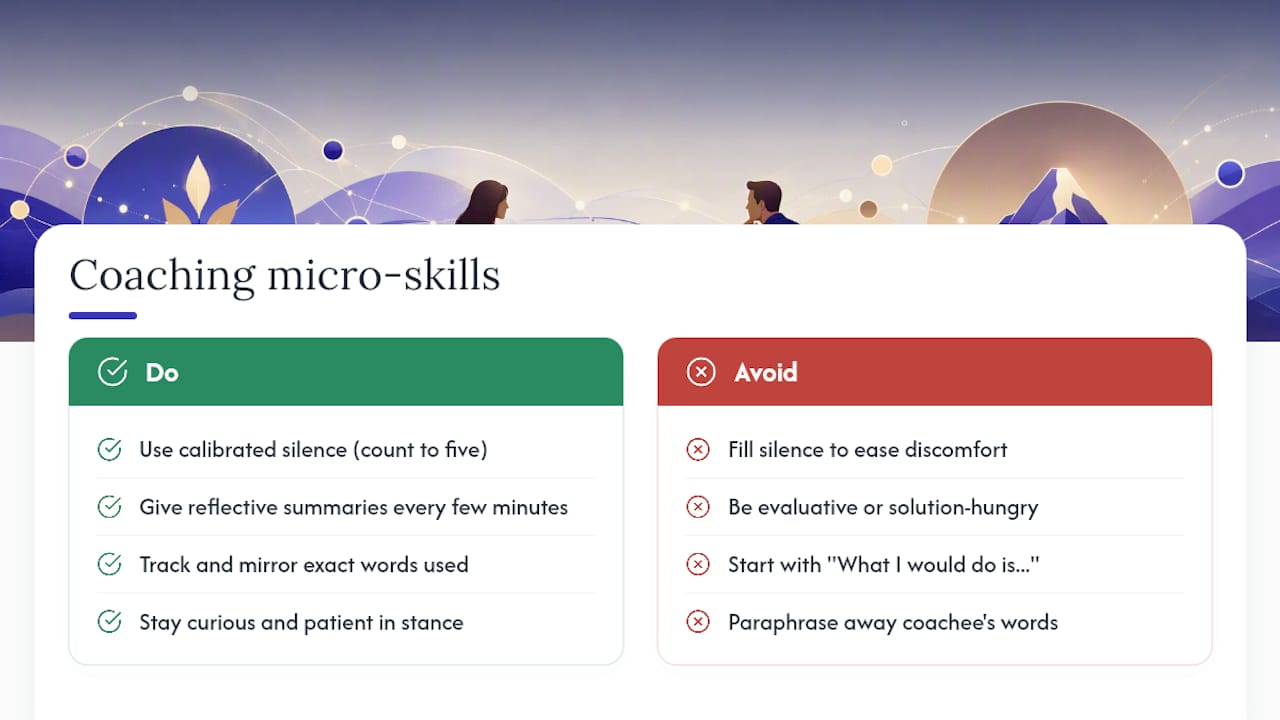
Presence, in coaching terms, is less about what you say and more about who you’re being in the room, curious instead of evaluative, patient instead of solution-hungry. A few concrete micro-skills carry most of that weight:
Calibrated silence. After you ask a good question, count to five in your head before saying anything else. Most people fill silence out of discomfort, and that’s exactly the moment the coachee is forming their real answer.
Reflective summaries. Every few minutes, say back what you heard in your own words: “So it sounds like the real issue isn’t the client, it’s that you don’t trust your own pricing.” This does two things: it proves you were listening, and it often surfaces a truth the coachee hadn’t said out loud yet.
Tracking language. Notice the specific words someone repeats (“stuck,” “behind,” “not ready”) and reflect those exact words back. Dialogic research backs this up directly: most client responses follow the coach’s linguistic lead, meaning the words you choose in your questions shape the words the coachee reaches for in their answers, according to the Institute of Coaching.
Limiting advice. The hardest skill for former top performers turned managers. If you catch yourself starting a sentence with “What I would do is,” stop and turn it into a question instead: “What have you considered doing?”
Pro Tip: Record yourself running one coaching conversation (with permission) and count how many sentences end in a question mark versus a period. If less than half end in a question mark, you were managing, not coaching.
Does Coaching Actually Improve Performance, and What Are Its Limits?
Workplace coaching works, but not uniformly, and the research is honest about that. A meta-analysis reviewing learning and performance outcomes across workplace coaching interventions found consistently positive effects, while flagging that the field still needs clearer data on which mechanisms and moderators drive those results, according to research published on PMC.
The effect isn’t in question, coaching helps people learn and perform better in organizational settings. What’s still being sorted out is why it works for some pairings and situations more than others, and which specific techniques carry the most weight inside a broader coaching relationship.
GROW’s staying power comes from its flexibility rather than any claim to superiority. It’s used widely enough that Google’s own internal manager guidance recommends it, largely because it adapts to both a five-minute hallway conversation and a structured quarterly review without changing shape.
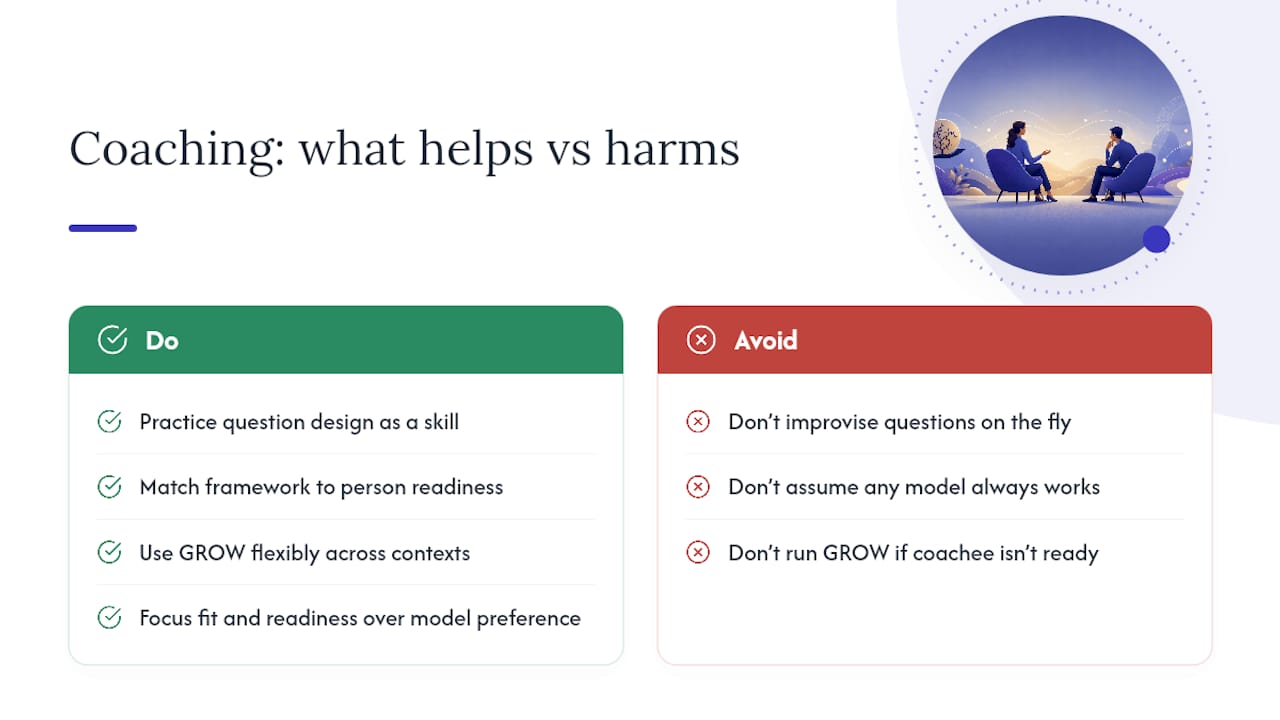
The dialogic research point matters more than it first appears: because most client responses track the coach’s own word choices, a poorly worded question doesn’t just fail to help, it can actively steer someone toward a shallower answer than they were capable of giving. That’s a strong argument for treating question design as a skill you practice, not something you improvise on the fly.
The practical caveat across all of this: fit and readiness matter more than model choice. A brilliant GROW session with someone who isn’t ready to change will produce a tidy action plan nobody follows. Match the framework to where the person actually is, not to which model you happen to like running.
What Does a 20-Minute GROW Coaching Conversation Actually Sound Like?
Reading about a coaching conversation framework and running one are different skills. Here’s a compressed, time-stamped example mapped to GROW, adapted for a sales manager coaching a rep who’s missed quota two months running.
- (0:00 to 2:00, Contracting/Opening) Manager: “We’ve got 20 minutes. What do you want out of this?” Rep: “I want to figure out why my close rate dropped.” [Micro-skill: naming the time boundary out loud, GROW step: pre-Goal framing]
- (2:00 to 6:00, Goal) Manager: “If this conversation goes well, what’s different by Friday?” Rep: “I’d have a clear reason my last five calls didn’t convert.” [GROW step: Goal, note the specificity]
- (6:00 to 12:00, Reality) Manager: “Walk me through your last call, no editorializing.” Rep describes rushing the discovery portion. Manager reflects: “So it sounds like you’re moving to pricing before they’ve said what’s actually driving the search.” [Micro-skill: reflective summary, GROW step: Reality]
- (12:00 to 16:00, Options) Manager: “What are two things you could change on your next call?” Rep suggests slowing discovery and asking one more open question before pricing. Manager stays silent for five seconds after asking “What else?” [Micro-skill: calibrated silence, GROW step: Options]
- (16:00 to 20:00, Will) Manager: “Which one will you try on your very next call?” Rep commits to asking two additional discovery questions before mentioning price. Manager: “How will you know it worked?” [GROW step: Will, closing with a measurement question]
Swap the sales-specific content for a customer complaint, a promotion conversation, or a student athlete’s practice slump, and the skeleton holds. Only the Reality-stage questions change to match the domain.
Middy’s Take: Coaching Sales Teams Like an Athlete Trains, Not Like a Manager Corrects
“Training, Not Selling” isn’t just a philosophy for how reps talk to clients, it’s a lens for how managers should talk to reps. Most sales coaching conversations default to correction: here’s what you did wrong, here’s the script, go fix it. That’s managing, not coaching, and it produces compliance instead of skill.
The athletic parallel is direct. No competitive team improves by only reviewing game tape and pointing out mistakes. They rehearse specific moves, over and over, in low-stakes practice reps, before the moment that counts. A GROW conversation about a missed sale should end the same way a good practice session does: with one specific behavior the rep will rehearse, not a lecture on effort.
Coaching vs. Managing: Sales Lessons from the Sideline digs deeper into why teams that get coached, not corrected, build resilience that outlasts any single bad quarter.
— Middy
Want Your Managers Actually Running These Conversations, Not Just Reading About Them?
Reading a coaching conversation framework and running one under pressure, in front of a rep who’s already defensive, are two different skills entirely. Workshops can help close that gap with live practice, not just slide decks of theory.

Half-day sessions can put managers through real coaching reps, complete with feedback on where they slipped into telling instead of asking, and takeaway templates built around the exact scripts covered here. Teams walk out having practiced the conversation, not just watched someone else demonstrate it. If your sales managers are still defaulting to “here’s what you should do” instead of asking the questions that build a rep’s own judgment, Sales Training Ideas That Actually Stick breaks down what a workshop actually covers session by session. Reach out to check available dates and get a program built around your team’s actual coaching gaps.
Sources
- GROW model — MindTools
- The effectiveness of workplace coaching: A meta-analysis of learning and performance outcomes from coaching — PMC
- The science of dialogue | Institute of Coaching
- Positive psychological coaching tools and techniques: A systematic review and classification — Frontiers
- Positivepsychology
Leave a Reply