
Use goal-mapped activities from six categories: icebreakers, energizers, ideation, problem-solving, team-building, and reflection. Pick based on your objective first, group size second. Three you can run today.
- Two Truths and a Twist: build rapport (5 minutes, any size)
- Silent Brainstorm: surface ideas without groupthink (10 minutes, 6 to 20 people)
- One-Minute Paper: lock in learning (3 minutes, any size)
As of 2021, more than half of workers admitted to multitasking during virtual meetings. That single number explains why static slide decks fail and structured, hands-on workshop exercises don’t.
Key Takeaways
The most effective interactive workshop activities are chosen by objective first, sequenced from low-stakes to higher-vulnerability, and always closed with a concrete follow-up action.
| Point | Details |
|---|---|
| Match activity to objective | Choose icebreakers, energizers, ideation, or reflection based on your goal, not habit. |
| Sequence for trust | Start low-stakes and save deeper reflection exercises until the group has built rapport. |
| Adapt tools, not intent | Swap whiteboards, polls, and breakout rooms for in-person tools without changing the activity’s purpose. |
| Debrief every time | Use what happened, what it means, what you’ll do to convert exercises into real takeaways. |
| Follow up to make it stick | Middy’s Training, Not Selling approach pairs activities with micro-practice and 14-day check-ins so insights survive past the workshop. |
Table of Contents
- Interactive Workshop Activities Organized by Category
- How Do You Choose the Right Activity for Your Group?
- How Do You Adapt Interactive Activities for Virtual or Hybrid Groups?
- How Do You Debrief and Measure Whether an Activity Worked?
- Three Session Templates You Can Copy Directly
- Make Activities Stick: Training, Not Selling
- Sources
Interactive Workshop Activities Organized by Category
Every activity below is built to run with almost no setup. Grab what fits your time slot and skip the rest.
Icebreakers
1. Two Truths and a Twist
Goal: warm up the room without forcing vulnerability. Time: 5 minutes. Group size: any. Materials: none. Steps: each person shares three statements about themselves, two true and one false; the group guesses which is fake. Variation: theme it to the workshop topic (“two things I’ve learned about sales, one I made up”). Virtual adaptation: use chat polls so nobody feels put on the spot in front of a camera.
2. Would You Rather, Career Edition
Goal: quick energy and light laughter. Time: 5 minutes. Group size: any. Materials: a list of five work-related dilemmas. Steps: read a dilemma, participants move to a side of the room (or react in chat) to vote. Variation: let the group submit their own dilemmas beforehand.
3. One-Word Check-In
Goal: surface the room’s current mood before diving into content. Time: 3 minutes. Group size: any. Materials: none. Steps: go around and have each person say one word describing how they’re arriving today. Virtual adaptation: drop the word into a shared chat instead of speaking aloud.
Energizers
4. Desk Stretch and Reset
Goal: reset attention mid-session. Time: 3 minutes. Group size: any. Materials: none. Steps: lead a 90-second standing stretch, then have participants name one thing they’ll focus on for the next block.
5. Rapid-Fire Trivia
Goal: rebuild energy after a heavy content block. Time: 7 minutes. Group size: 8 or more. Materials: 5 to 8 trivia questions tied loosely to the session theme. Steps: split into teams of three, read questions, teams shout or type answers. Variation: make it industry trivia to reinforce content.
6. Human Bingo
Goal: get people moving and talking to someone new. Time: 10 minutes. Group size: 15 or more. Materials: bingo cards with prompts like “has worked here over 10 years.” Steps: participants mingle to find someone matching each square. Virtual adaptation: swap bingo cards for a shared spreadsheet grid participants fill in through breakout rotations.
Ideation and Brainstorming
7. Silent Brainstorm
Goal: generate volume without letting the loudest voice dominate. Time: 10 minutes. Group size: 6 to 20. Materials: sticky notes or a shared digital board. Steps: everyone writes ideas silently for 5 minutes, then posts them; the group clusters similar ideas together. This format lines up with what SessionLab’s facilitation library recommends for teams that need convergence, not just chatter.
8. Round-Robin Storytelling
Goal: build on ideas collaboratively rather than pitching solo. Time: 12 minutes. Group size: 4 to 8 per group. Materials: none. Steps: one person starts an idea in one sentence, the next person adds a sentence, and so on until the idea is fully built.
9. Reverse Brainstorm
Goal: unstick a group that’s circling the same three ideas. Time: 15 minutes. Group size: any. Materials: whiteboard or shared doc. Steps: ask “how could we guarantee this fails?” then flip every answer into a preventive action. Variation: run it in pairs before combining as a full group.
Decision-Making and Problem-Solving
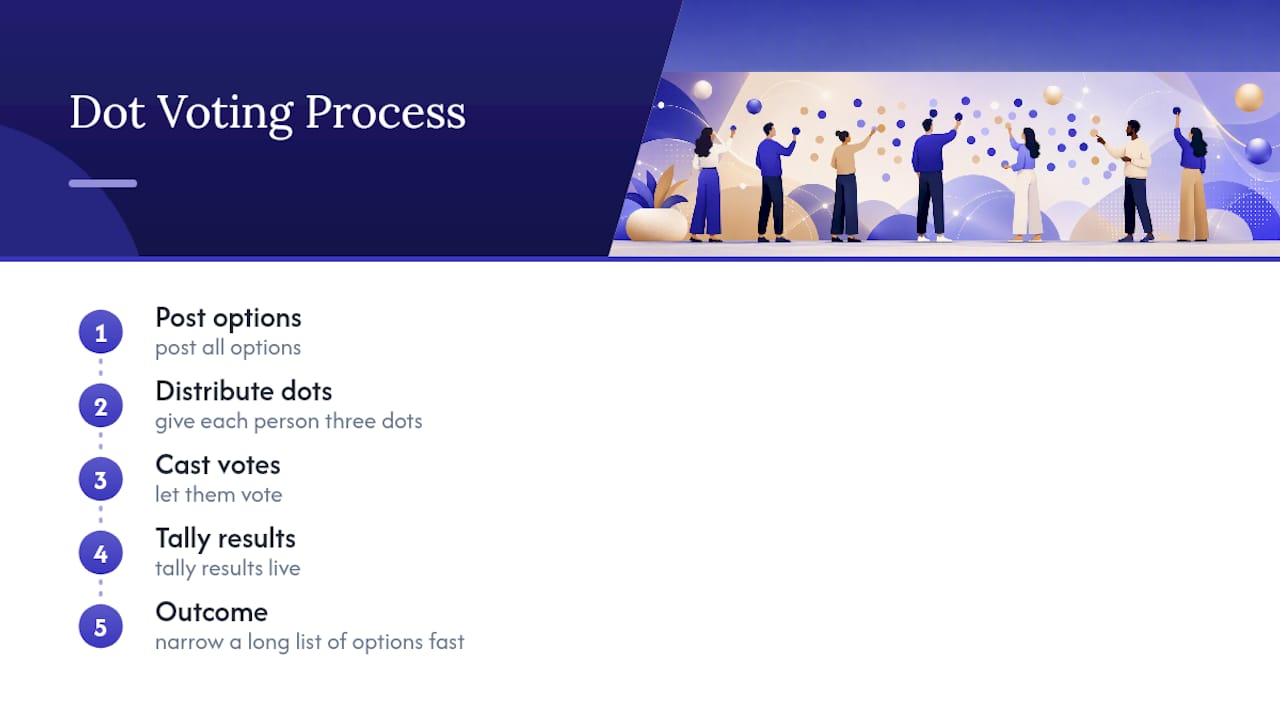
10. Dot Voting
Goal: narrow a long list of options fast. Time: 5 minutes. Group size: any. Materials: sticky dots or a polling tool. Steps: post all options, give each person three dots, let them vote, tally results live.
11. Case Clinic
Goal: apply a framework to a real, current problem. Time: 20 minutes. Group size: 4 to 6 per group. Materials: one real challenge written on a card. Steps: one person presents their problem for 3 minutes, the group asks clarifying questions only, then offers ideas without the presenter defending or explaining.
12. Pro-Con-Fix
Goal: pressure-test a proposed decision before committing. Time: 15 minutes. Group size: any. Materials: three-column worksheet. Steps: list pros, then cons, then for every con write one fix that would neutralize it.
Team-Building
13. Back-to-Back Drawing
Goal: build communication awareness through a shared task. Time: 10 minutes. Group size: pairs. Materials: paper, pens, a simple image. Steps: partners sit back to back; one describes an image using only words while the other draws it, no peeking. Structured team-building games like this tend to work best early in a program, when trust still needs to be built rather than assumed.

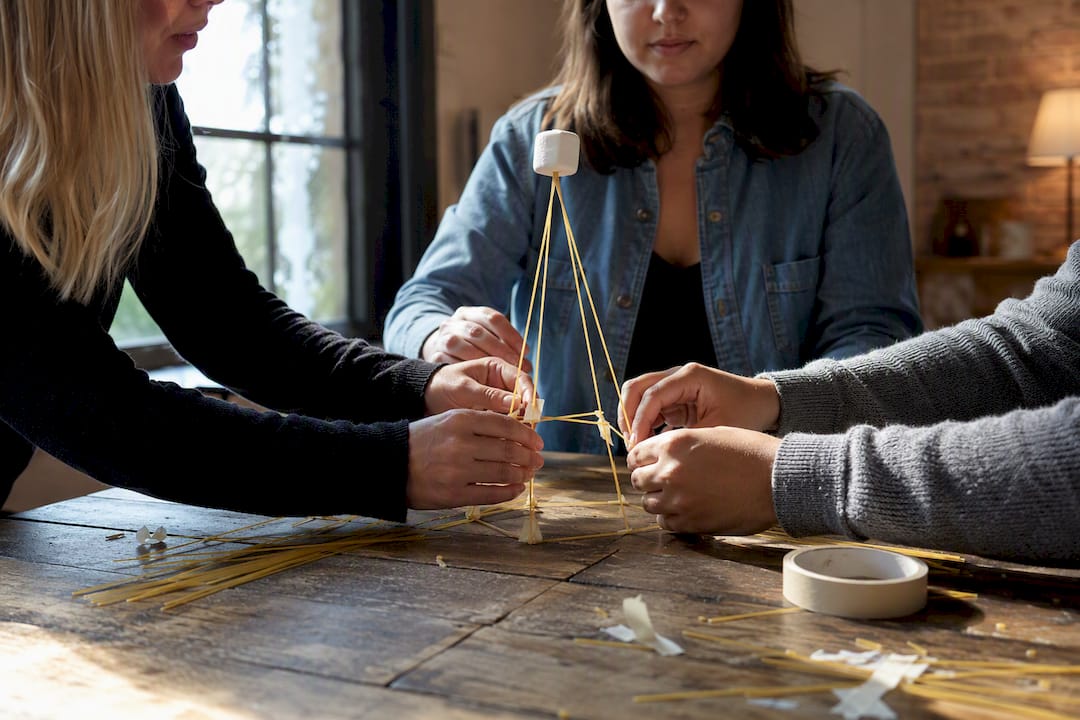
14. Marshmallow Challenge
Goal: expose how teams actually collaborate under a deadline. Time: 18 minutes. Group size: 4 per team. Materials: 20 sticks of spaghetti, one yard of tape, one marshmallow. Steps: build the tallest freestanding structure that holds the marshmallow on top within the time limit.
15. Appreciation Circle
Goal: reinforce trust at the close of a longer program. Time: 10 minutes. Group size: any, works best under 15. Materials: none. Steps: each person names one specific thing they appreciated about a colleague’s contribution that day.
Reflection and Learning Transfer
16. One-Minute Paper
Goal: lock in the day’s key takeaway before people scatter. Time: 3 minutes. Group size: any. Materials: index cards or a shared form. Steps: ask “what’s the one thing you’ll do differently starting Monday?” and collect answers.
17. Start, Stop, Continue
Goal: turn reflection into a concrete action list. Time: 10 minutes. Group size: any. Materials: three-column worksheet or shared doc. Steps: participants write what they’ll start doing, stop doing, and continue doing based on the session.
18. Fishbowl Debrief
Goal: surface honest reactions from a subset of the group. Time: 15 minutes. Group size: inner circle of 5, outer circle any size. Materials: chairs arranged in two circles. Steps: the inner circle discusses the day’s biggest insight while the outer circle listens silently, then swaps.
19. Gallery Walk
Goal: let participants absorb each other’s work at their own pace. Time: 12 minutes. Group size: any. Materials: flip charts or shared digital boards from earlier activities. Steps: post all group outputs around the room, let people walk and leave comments on sticky notes.
20. Commitment Cards
Goal: convert insight into accountability. Time: 5 minutes. Group size: any. Materials: index cards, stamped envelopes optional. Steps: each person writes one commitment, seals it in an envelope addressed to themselves, and you mail it back in two weeks.
Pro Tip: Never open with an activity that asks people to reveal something personal. Facilitator guides on inclusion consistently recommend low-stakes warmups for new groups and holding deeper reflection exercises until trust has actually formed.
How Do You Choose the Right Activity for Your Group?
Run through this checklist before you finalize your agenda:
- Define the objective first. Are you building rapport, generating ideas, or reinforcing a skill? The activity follows the goal, never the other way around.
- Check group size and energy level. A silent brainstorm works for 20 people; a fishbowl debrief falls apart past 12.
- Confirm the time you actually have. Buffer 20% more than an activity’s stated time. Groups always take longer than the instructions suggest.
- Consider accessibility and cultural background. Physical activities need a seated alternative. Prompts that assume a shared cultural reference point can alienate part of the room.
- Match the cognitive load to where people are in the day. Heavy problem-solving right after lunch is a mistake nine times out of ten.
Watch for three red flags: activities that force personal vulnerability before trust exists, exercises requiring materials that might not arrive on time, and anything with 15 minutes of setup for a 3-minute payoff. Psychological safety has to be established before people participate honestly, and no icebreaker script fixes that if you skip the sequencing.
Pro Tip: Think of your session as an energy arc, not a flat line. Open low-stakes, climb into higher cognitive load through the middle, then taper back down into reflection before people leave the room.
How Do You Adapt Interactive Activities for Virtual or Hybrid Groups?
Match the tool to the task, not the other way around. Whiteboarding tools handle visual ideation. Polling tools handle quick temperature checks. Breakout rooms handle small-group work that would otherwise get dominated by one voice in a large call.
- Ideation and brainstorming: a shared digital whiteboard works well; if bandwidth is a concern, drop prompts into a shared Google Doc instead and let people type in real time.
- Decision-making: live polling replaces dot voting almost exactly; a simple reaction emoji works if the polling tool isn’t available.
- Team-building and problem-solving: breakout rooms of 3 to 4 people, time-boxed to 8 minutes, keep energy up better than one long breakout.
- Reflection: a shared form or chat thread replaces index cards without losing the exercise’s structure.
Well-designed virtual activity templates consistently improve participation and reduce the drift that happens when cameras go off and attention wanders. For accessibility, always give a camera-off option and, where possible, send prompts ahead of time so participants who process information more slowly can prepare instead of freezing on the spot.
How Do You Debrief and Measure Whether an Activity Worked?
Use a three-step debrief every time: what happened, what it means, what you’ll do about it.
- What happened? Ask participants to describe, factually, what occurred during the activity.
- What’s the insight? Push past description into interpretation: “what did that tell you about how this team makes decisions?”
- What’s the action? Close every debrief with a concrete next step, even a small one.
For quick measurement, run a two-question exit poll: a 1 to 5 scale on “this activity helped me understand the topic better” plus one open-text field for “what would you change?” Track participation rate and idea count as simple proxies for engagement, especially in remote sessions where multitasking during virtual meetings is common enough that low participation numbers deserve a second look, not a shrug.
Three Session Templates You Can Copy Directly
Each template below mixes categories deliberately so energy rises and falls instead of staying flat.
Swap any block for another activity from the same category. A silent brainstorm can replace round-robin storytelling in Template A without breaking the flow, since both fill the same ideation slot.
Make Activities Stick: Training, Not Selling
Running a great activity is only half the job. The other half is what happens after people leave the room, and that’s where most workshops quietly fail.
An activity that ends without a follow-up step is entertainment, not training. The exercise has to connect to something the participant does differently on Monday morning, or the insight evaporates within 48 hours.
Concrete follow-ups that make the difference:
- Assign one micro-practice tied directly to the activity’s insight.
- Pair participants for peer coaching check-ins within a week.
- Schedule a 14-day follow-up to ask what actually got applied.
- Tie activity outputs to a real KPI or next step the team already tracks.
This is the same discipline behind sales training that actually holds up after the workshop ends.
Why I Design Every Session Around Practice, Not Performance
I’ve watched a single well-placed activity change how a team talks to each other for months afterward. What sticks isn’t the exercise itself. It’s the accountability structure wrapped around it, the follow-up that makes the insight impossible to ignore.
Want Help Running These With Your Team?
You can run every one of these activities yourself with the instructions above, and I hope you do. But if you’re planning a corporate training day, a sales team offsite, or a leadership session where the stakes are higher than a Tuesday afternoon meeting, having someone facilitate who’s built a career on practice-led learning changes what the room actually walks away with.
My workshops and keynotes are built on the same principle behind everything above: training beats selling every time, because training gives people something they can actually use. Clients who bring me in get immediate application exercises built around their real challenges, structured practice time instead of passive listening, and accountability steps that outlast the session itself. If you’re deciding between a keynote, a full workshop, or something in between, see how sales training that actually sticks works and get a sense of what fits your group.
Sources
- Polly
- Interactive workshop activities for virtual collaboration | MiroBlog
- High-performing teams need psychological safety — HBR
- Mines
Recommended
- Wellness Keynote Ideas for Healthcare Teams Facing Burnout – Middy Matthews | Keynote Speaker
- Corporate Wellness Speaker | Middy Matthews | Habits, Not Hacks.
- Keynote Topics That Work for Credit Union Conferences – Middy Matthews | Keynote Speaker
- Hiring a Women in Leadership Keynote Speaker: A Planner’s Guide – Middy Matthews | Keynote Speaker
Leave a Reply