
Stop reflexively saying “sorry” at work. When you bump a meeting, ask a question, or send a follow-up email, swap it for something like “Thanks for your patience” or “I appreciate your time.” Reflexive apologies drain your credibility; sincere ones, saved for actual mistakes, keep their weight. Below is the full method: why you do this, what it costs you, and a step-by-step plan with scripts to fix it.
TL;DR:
- Reducing reflexive apologies enhances your credibility by preventing perceptions of uncertainty and over-deference in decisions and negotiations.
- Replacing “sorry” with gratitude or accountability statements preserves warmth without undermining assertiveness or authority.
- Practicing a structured audit, pause, and script replacement helps transform habitual filler apologies into confident communication habits.
- Cultural differences influence apology norms, so tailoring language adjustments based on team and regional context maintains effective and respectful interactions.
- Training methods like role-plays and peer feedback outperform willpower, ensuring sustainable habit change for more assertive and genuine workplace expressions.
Table of Contents
- Why We Over-Apologize at Work
- What Over-Apologizing Actually Costs You
- How Do You Break the Habit of Saying Sorry?
- Phrases to Use Instead of “Sorry”
- A One-Week Practice Audit You Can Run Today
- Won’t Dropping “Sorry” Make Me Seem Rude?
- How Should You Respond to Feedback Without Over-Apologizing?
- Do Apology Norms Change Across Cultures at Work?
- Can You Be Assertive and Still Empathetic?
- Middy’s Perspective: Why Training Beats Willpower Here
- Build Confident Communication Across Your Team
- Sources
- FAQ
Why We Over-Apologize at Work
Most reflexive apologies aren’t about manners. They’re about conditioning. Many people, women especially, are taught early that taking up space requires an advance apology, a kind of verbal toll paid just to speak. Forbes reporting on workplace confidence ties this pattern directly to authority dynamics: people who feel less entitled to their opinions hedge them with “sorry” before stating a fact, asking a question, or disagreeing with a boss.
There’s also a purely mechanical piece. “Sorry” becomes filler, the verbal equivalent of “um,” inserted automatically before a sentence has even formed. Research on speech habits shows filler phrases lock in through sheer repetition and only loosen with deliberate attention, which is exactly why awareness alone rarely fixes it. You need practice, not just intention.
Here’s the split that matters:
- A sincere apology addresses a real mistake and takes responsibility for a specific outcome.
- A reflexive hedge apologizes for existing: asking a question, having a scheduling conflict, or disagreeing with an idea.
Only the first one belongs in your vocabulary at full strength.
What Over-Apologizing Actually Costs You
Every unnecessary “sorry” chips away at how decisive you sound, and decisiveness is what colleagues use to judge whether you’re ready for more responsibility. Harvard Business Review links habitual apologizing directly to reduced visibility for leadership roles, because managers read hedged language as uncertainty even when the underlying idea is solid.
The pattern shows up hardest in negotiation. Someone who apologizes for asking about salary, timeline, or scope has already signaled they expect to be told no. It shows up in meetings too: an idea introduced with “Sorry, this might be a dumb question, but…” gets less airtime than the same idea stated flat.
The trade-off is simple: every apology you spend on something minor is one you can’t spend where it counts. Reserve the word for genuine accountability moments, and it keeps its power when a real mistake happens.
How Do You Break the Habit of Saying Sorry?
Breaking this habit works the same way breaking any speech pattern works: audit it, interrupt it, replace it, then rehearse the replacement until it’s automatic. Here’s the sequence.
-
Audit for one week. Every time “sorry” leaves your mouth or your keyboard, jot it down. Note the trigger: a meeting interruption, a late reply, a scheduling ask. You can’t fix what you haven’t measured.
-
Pause for three seconds before you speak. Career coaches recommend this exact timing because it’s long enough to intercept the reflex but short enough that no one notices the gap. Use it anywhere you feel the word forming.
-
Swap in a prepared phrase. Don’t improvise mid-sentence. Have three or four go-to lines memorized for common situations: running late, interrupting, following up. The section below gives you a full set.
-
Practice out loud, not just in your head. Role-play the swap with a colleague or say it into your phone before a meeting where you know you’ll be tempted. Repetition builds the new default the same way repetition built the old one.
-
Know when to hold the line on a real apology. If you missed a deadline that affected someone else’s work, that’s not a moment for “Thanks for your patience.” That’s a moment for direct accountability language, which you’ll find in the scripts section next.
Pro Tip: Keep a sticky note on your monitor with your top two replacement phrases for the week. Seeing them repeatedly does more for retention than any mental reminder.
Phrases to Use Instead of “Sorry”
Once you’ve got the pause down, the next piece is having the right words ready. CNBC’s rundown of workplace phrasing offers a solid starting set, and you can adapt these to your own voice:
- Interrupting in a meeting: “Can I jump in here?” instead of “Sorry to interrupt.”
- Late email reply: “Thanks for your patience while I got to this” instead of “Sorry for the delay.”
- Asking a clarifying question: “Quick question before we move on” instead of “Sorry, dumb question, but…”
- Rescheduling: “I need to move our time; here’s what works instead” instead of “Sorry, I have to reschedule.”
- Real mistake: “I take full responsibility for the error. Here’s how I’ll fix it by Friday.”
Notice the tone difference. The first four stay warm without shrinking you. The last one doesn’t hedge at all, because a genuine mistake calls for direct ownership, not a soft landing.
A One-Week Practice Audit You Can Run Today
Turn the plan into a measurable habit change with a structured week, following the tracking method The Ladders outlines for automatic speech patterns.
- Log every “sorry” in meetings, chat, and email for five workdays. Mark each one “warranted” or “reflex.”
- Run two daily drills: the three-second pause before speaking, and one scripted replacement rehearsed out loud before a meeting you expect to trigger it.
- Recruit a peer to flag reflexive apologies in real time during a call or meeting. Ask them for a simple tally, not a running commentary.
- Tally your reflex count at week’s end and set a target to cut it by half the following week.
Pro Tip: Ask your peer reviewer for specific moments, not general impressions. “You said sorry twice in the 10 a.m. standup” is useful. “You seemed apologetic today” isn’t.
Won’t Dropping “Sorry” Make Me Seem Rude?
This is the concern almost every woman raises first, and it’s a fair one. The Forbes analysis of confident workplace language is clear that the fix isn’t dropping warmth. It’s relocating it. Gratitude and acknowledgment carry warmth just as well as an apology does, without the self-diminishing undertone.
A few ways to keep both:
- Pair a direct statement with genuine appreciation: “Thanks for flagging that, here’s the fix” reads as warm and competent.
- Acknowledge the other person’s time or effort explicitly instead of apologizing for taking up space in the conversation.
- Save actual vulnerability for moments that call for it. If you’re genuinely uncertain about a decision, saying so plainly (“I’m not confident in this number yet”) lands better than a vague “sorry” that obscures what you actually mean.
Dropping filler apologies doesn’t erase empathy. It makes the empathy you do show land harder, because it’s no longer buried under ten reflexive ones a day.
How Should You Respond to Feedback Without Over-Apologizing?
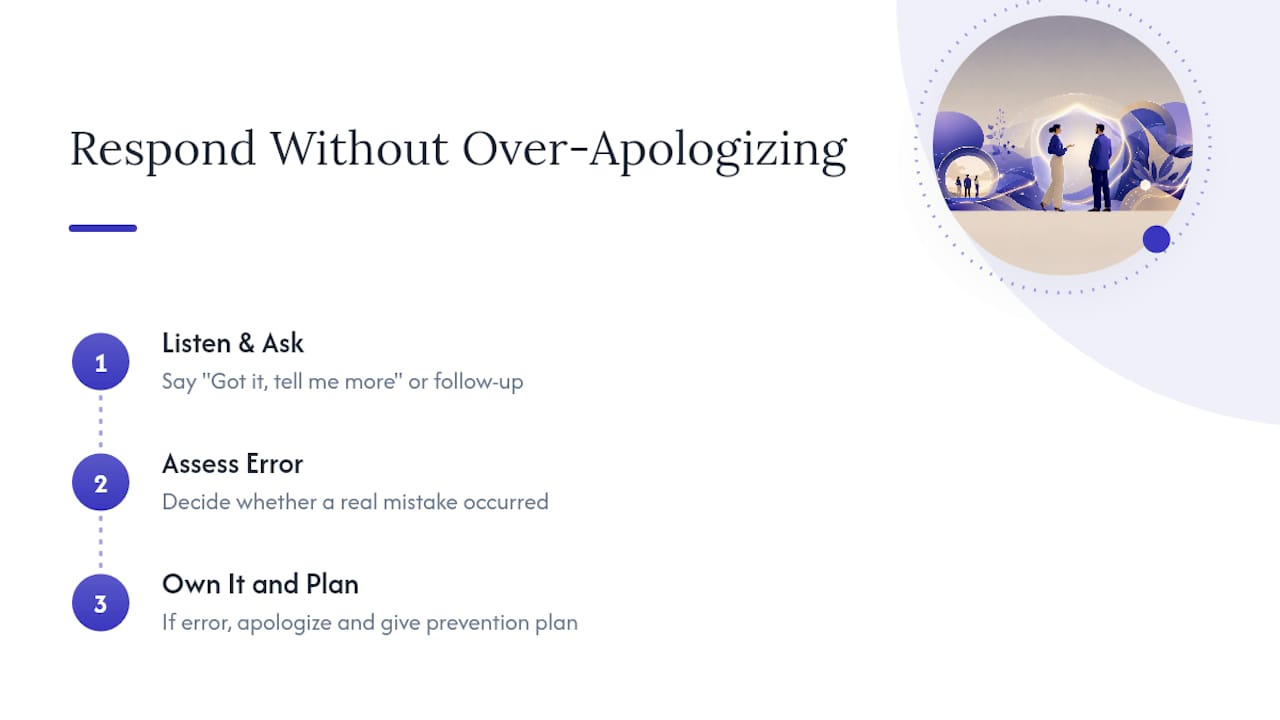
The instinct to say “sorry” spikes hardest right after criticism, which is exactly when it does the most damage. Apologizing before you’ve even processed the feedback signals defensiveness, not receptiveness, and it can shut down the conversation before your manager finishes making the point.
Replace the opening apology with a listening statement. “Got it, tell me more about what you’re seeing” or “That’s useful, let me ask a follow-up” keeps you in the conversation instead of retreating from it. Save the word “sorry” for after you’ve understood the issue, and only if an actual mistake caused it.
If the feedback points to a real error, this is one of the moments where a direct apology belongs. The CNBC guidance on accountability phrasing recommends pairing responsibility with a plan: “I take responsibility for missing that detail. Here’s how I’ll prevent it next time.” That sentence does more work than five apologies stacked together, because it shows you heard the feedback and already have a fix in motion.
Teams that practice giving feedback this way tend to get more useful input over time, since people learn that raising an issue leads to problem solving instead of a wall of guilt. If you’re on the giving end of feedback, resources on delivering feedback people can actually hear can help you frame it so the other person doesn’t default to over-apologizing either.
Do Apology Norms Change Across Cultures at Work?
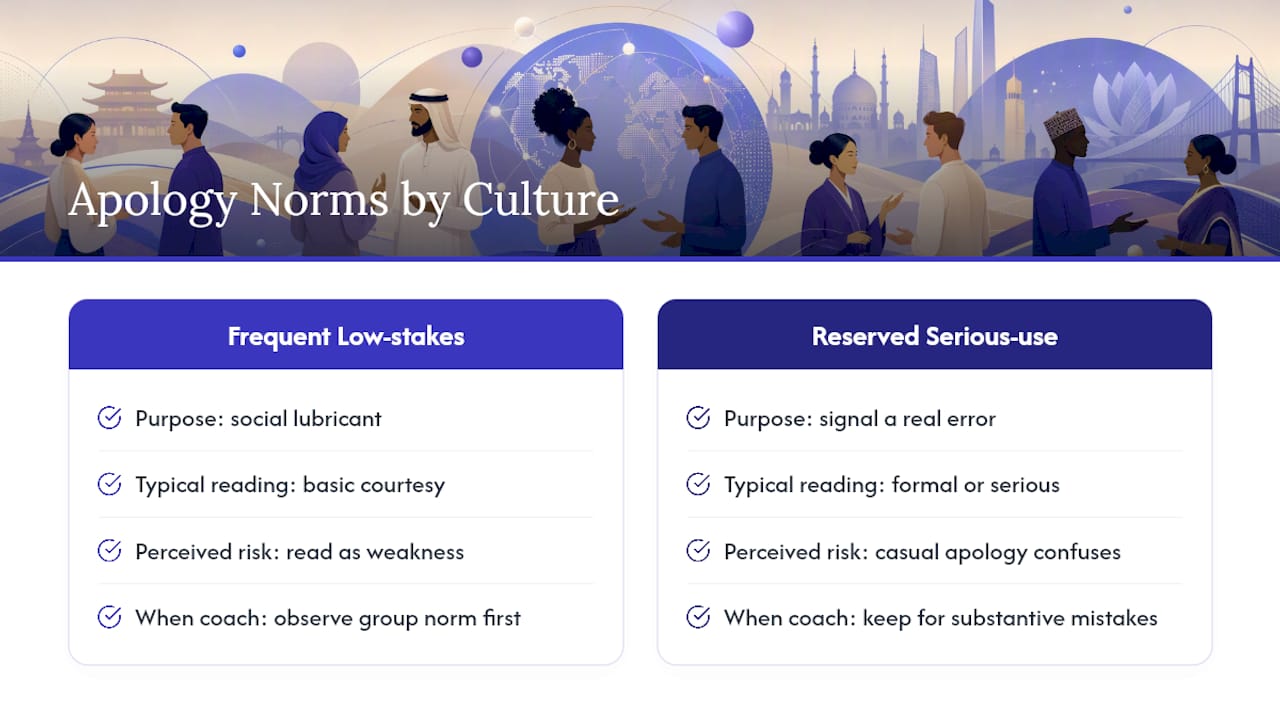
Apology language isn’t universal, and treating it as if it is trips up plenty of professionals working across regions or teams. Some workplace cultures use frequent, low-stakes apologies as a social lubricant that keeps interactions smooth. Others treat apologies as reserved almost exclusively for serious errors, and a casual “sorry” in a business email can read as oddly formal or even confusing.
This matters most in mixed teams and client-facing roles. A colleague who apologizes often isn’t necessarily lacking confidence. They may be following a norm that reads as basic courtesy where they’re from. Reading that as weakness, or assuming your own regional norm is the professional default, both lead to real misreads.
The practical fix isn’t picking a single “correct” apology style for every interaction. It’s paying attention to context. If you manage or work closely with a multicultural team, notice how apologies function in your specific group before you coach anyone toward dropping them. A rule that makes sense for a fast-paced sales floor won’t necessarily translate to a client relationship built on different norms. What stays constant everywhere is the core principle: apologies should track to something real, not fill silence out of habit.
Can You Be Assertive and Still Empathetic?
Assertiveness and empathy aren’t opposites, even though a lot of workplace advice frames them that way. The goal isn’t to talk like a robot with no warmth. It’s to stop using self-diminishment as your only tool for showing you care.
Empathy shows up in how you listen, how you acknowledge someone’s effort, and how you handle their mistakes when the roles are reversed. None of that requires apologizing for your own competence. You can tell a colleague “I hear that this is frustrating, and here’s what I can do” without a single “sorry” anywhere in the sentence, and it lands as more caring, not less, because it’s specific.
The balance gets tested most in disagreement. Disagreeing directly (“I see it differently, here’s why”) paired with genuine curiosity about the other person’s view reads as confident and collaborative. Disagreeing while apologizing for disagreeing reads as unsure of your own position, which tends to invite more pushback, not less. Drop the hedge, keep the curiosity, and you get both halves at once.
Middy’s Perspective: Why Training Beats Willpower Here
Willpower doesn’t fix speech habits. Training does. This reflects the premise of a “Training, Not Selling” approach, applied here to communication instead of sales conversations: you don’t talk yourself out of a habit, you rehearse a new one until it’s the automatic one.
A workshop version of this looks like a script audit (reviewing real emails and meeting notes for reflexive language), paired role-play drills, and structured peer feedback rounds. Teams that build this into a recurring practice, not a one-time talk, are the ones who actually see the habit shift stick. The leadership exercises built around new manager training work on the same principle: skill first, confidence follows.
— Middy
Build Confident Communication Across Your Team
A one-week audit changes your own habits. A workshop changes your whole team’s default language, which is a bigger lever if you’re managing client-facing staff, a sales floor, or a group of new managers who all learned the same self-minimizing patterns on the job. Middy’s sales training sessions built to actually stick run on the same audit, swap, and rehearse structure covered above, just scaled to a room instead of one person.

These sessions work especially well for new managers stepping into their first leadership role, sales teams who negotiate daily and can’t afford to hedge, and client-facing staff whose language shapes how customers perceive the whole company. Instead of a single motivational talk that fades by Friday, the format uses live script rewrites and group role-play so the new habit gets practiced in front of peers, not just described. If your team’s communication could use a reset, check Middy’s training formats and book a session that fits your group’s size and goals.
Sources
- Stop Over-Apologizing at Work
- Want To Come Across More Confident At Work? Stop Saying ‘I’m Sorry’
- The power of a sincere apology
- Stop saying ‘I’m sorry’ at work: What to say instead
- How to stop apologizing at work and what to say instead
FAQ
What Is a Narcissistic Apology?
A narcissistic apology centers the speaker instead of the person harmed, using phrases like “I’m sorry you feel that way” to deflect responsibility rather than own a specific action.
How Can I Stop Apologizing So Much?
Run a one-week audit of every “sorry” you say, insert a three-second pause before speaking, and replace reflexive apologies with phrases like “Thanks for your patience” or “Following up on…” while saving real apologies for actual mistakes.
Is Not Apologizing a Red Flag?
Never apologizing at all, even after genuine mistakes, is a red flag for accountability. The goal isn’t zero apologies. It’s reserving sincere ones for real errors instead of scattering reflexive ones through routine conversation.
How Do You Accept an Apology When You’re Still Upset?
You can acknowledge the apology honestly (“I appreciate you saying that, I still need some time to process it”) without pretending the issue is resolved before you’re ready, which keeps the exchange genuine on both sides.
Leave a Reply