A good speaker briefing template covers nine things: event basics, audience profile, purpose and success measures, session format and timing, key messages and boundaries, AV and logistics, stakeholders and deadlines, deliverables you need from the speaker, and how the content gets used afterward. Below you’ll find the full breakdown of each field, a copy-and-paste template with a filled example, and the timeline that keeps you from chasing a speaker three days before the event.
TL;DR:
- A speaker brief must clearly outline the event format, audience profile, and success measures to ensure the speaker targets the right content and tone.
- Confirm AV details and recording policies during the pre-event call to prevent technical issues and clarify content reuse rights before the event day.
- Sending the essential fields within 48 hours of booking and scheduling a technical rehearsal at least 24 hours prior can drastically reduce last-minute surprises.
- The key success factors include defining one or two concrete behaviors you want the audience to try after the session and clearly stating topics to avoid.
- Internal presenters typically need less detailed briefs, but complex or high-stakes events benefit from longer, more comprehensive templates with internal context stored in an appendix.
Table of Contents
- What Belongs in a Speaker Briefing Template?
- The Copy-and-Paste Speaker Brief Template
- When Should You Send the Speaker Brief?
- Common Speaker Briefing Mistakes (And Quick Fixes)
- How Long Should Your Speaker Brief Actually Be?
- When It’s Time to Bring in a Professional Speaker
- Templates and Guides Worth Bookmarking
- Sources
- FAQ
What Belongs in a Speaker Briefing Template?
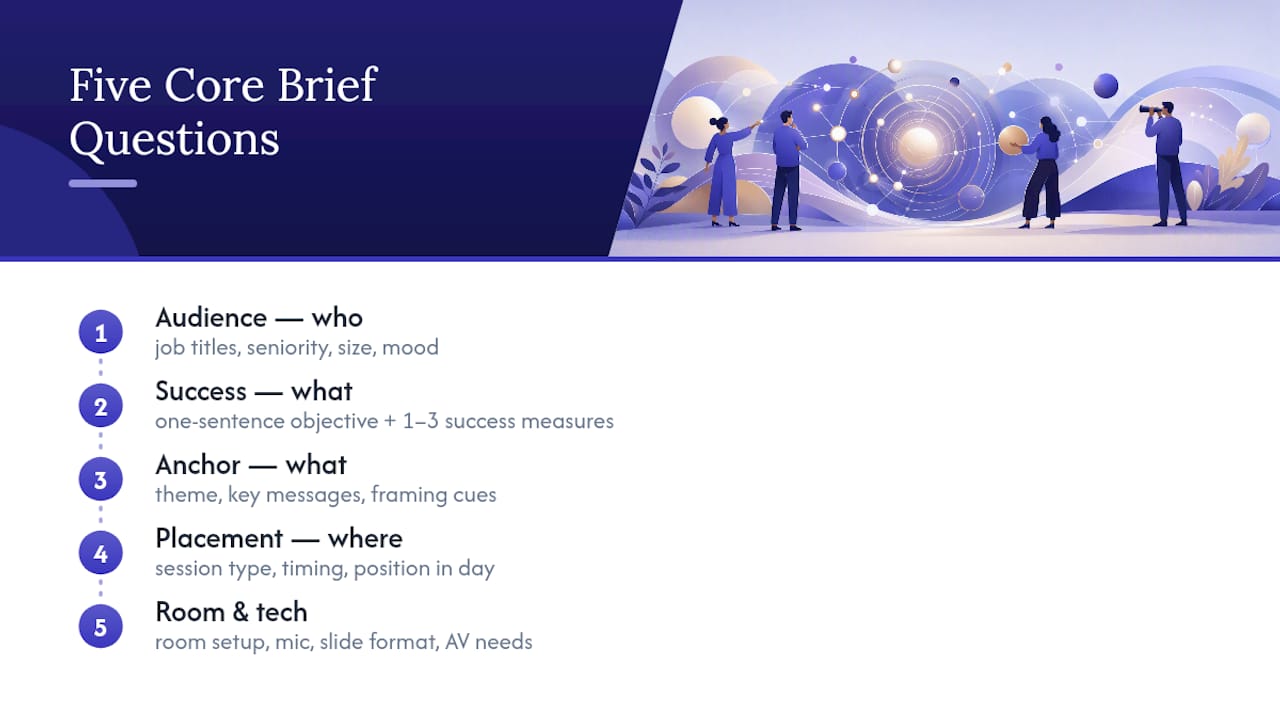
A speaker brief is not a formality. It’s the document that decides whether your keynote lands or falls flat, and most planners underestimate how much weight it carries. A strong brief answers five core questions: who’s in the room, what success looks like, what the speaker should anchor their talk to, where the session sits in the program, and what the room and tech actually look like. Miss any one of those, and you end up with a speaker who’s technically prepared but talking past your audience.
Here’s the full breakdown of what to include, and why each field earns its place.
Event basics. Name of the event, date, start and end time, format (in person, virtual, hybrid), venue or platform, and exactly where the keynote sits in the day. A speaker opening a conference needs a different energy than one closing it after three hours of breakout sessions. Note the expected audience size too. Fifty people in a boardroom and 500 in a ballroom call for different pacing and different mic setups.
Audience profile. This is where most briefs go thin, and it’s the field speakers say they wish organizers filled out better. List job titles, seniority mix, industries represented, and how much they already know about your topic. A room of first-year agents needs different framing than a room of brokers who’ve heard every sales pitch twice. Note the mood too: are people energized, burned out, skeptical after a rough quarter, celebrating a record year? A speaker who knows the room’s temperature before walking on stage adjusts their opening in ways that make or break the first five minutes.
Purpose and desired outcomes. State the primary objective in one sentence, then list one to three concrete measures of success. Think in terms of what you want the audience to think, feel, or do differently after the session. That “think/feel/do” framing is the single most useful cue you can give an experienced speaker, because it tells them what to build toward instead of leaving them guessing.
Session format and timing. Is this a solo keynote, a fireside chat, a panel? How long is the speaking portion, and how much time is set aside for questions? State any hard slide limits and whether the speaker needs to leave room for a live demo or audience polling.
Theme, key messages, and boundaries. Share the event theme and any messages the organization wants reinforced. Just as important: name topics that are off limits. If there’s a sensitive internal issue, a recent layoff, a legal matter, or a competitor you’d rather not have mentioned by name, say so directly. Speakers can’t read your organization’s politics from a blank brief.
Practical logistics and AV requirements. Room setup, mic type (handheld, lavalier, headset), slide format and aspect ratio, whether the session will be recorded or livestreamed, and arrival and rehearsal windows. Marketplaces that book speakers professionally flag AV specs and recording rules as the fields most often left out and most likely to cause a scramble on event day, especially for hybrid setups with a remote audience watching a livestream.
Stakeholders and approvals. Name the primary point of contact, the person with final sign-off on content, and anyone from legal or PR who needs to review slides. Attach deadlines to every approval step, not just a vague “soon.”
What you need from the speaker. Bio length and format, headshot specs, slide deck deadline, any promotional copy for social media, and how expense reimbursement works. This is the list a speaker’s team turns into their own internal checklist, so precision here saves you a dozen follow-up emails.
Post-event use. Spell out whether you’ll record the session, whether that recording can be shared publicly, who owns photography rights, and what the feedback process looks like. Agencies that build these templates for a living treat core sections like event overview, audience profile, and success measures as the backbone every brief needs, regardless of event size. Nail these down before the event, not after, and you avoid the awkward conversation about whether a clip can go on your homepage.
The Copy-and-Paste Speaker Brief Template
You don’t need a fifteen-page document. You need the right fields, clearly labeled, so the speaker can respond fast. Label each field as Essential, Recommended, or Optional. That structure alone cuts down on email back-and-forth, because speakers know exactly what to answer first when their schedule is tight.
Essential fields (send immediately after booking):
- Event name, date, time, and format
- Audience size, roles, and seniority mix
- Primary goal and one to three success measures
- Session type and exact duration, including Q&A time
- Key messages to hit and topics to avoid
- Primary contact name and phone number
Recommended fields (send within the first week):
7. Audience mood and any recent context they’d recognize
8. AV setup, mic type, and slide format
9. Recording and livestream policy
10. Bio, headshot, and slide deck deadlines
Optional fields (add if relevant):
11. Related sessions on the agenda to reference or avoid repeating
12. Photography and content reuse permissions
13. Dress code or venue-specific notes
Here’s what a filled brief looks like for a 25-minute keynote:
Event: Regional Sales Kickoff, March 12, 9:00 to 9:30 AM, in-person ballroom, 300 agents. Audience: mid-career real estate agents, mixed experience, energized but wary of “another sales pitch.” Goal: shift mindset from chasing leads to building trained relationships; success means agents leave with one script change they’ll try this week. Format: solo keynote, 20 minutes plus 5 for Q&A. Messages to hit: training beats selling. Avoid: mentioning last year’s brokerage merger. Contact: Jamie Torres, ops director.
That’s the level of detail a speaker actually needs. Anything beyond it belongs in an appendix, not the main brief.
When Should You Send the Speaker Brief?
Send the initial brief the moment the speaker is booked, ideally three to six months out for a major conference, and never less than two weeks before a smaller event. Marketplaces that place professional speakers regularly recommend that earlier window because it gives the speaker time to research your audience and tailor examples instead of pulling from a generic deck.
- Send the Essential fields within 48 hours of confirming the booking.
- Schedule a 20-minute pre-event call two to four weeks out. Use it to confirm the outcome you want, lock the final title and time slot, walk through AV needs, and clarify any recording or reuse permissions.
- Run a technical rehearsal 24 to 48 hours before the event, checking mic levels, slide formatting, and any live demo elements.
- Confirm final logistics the morning of the event, including arrival time and green room location.
A structured pre-event call built around outcomes, AV, and deadlines removes most last-minute changes before they become event-day fires.
Pro Tip: Book the technical rehearsal slot on the calendar before you even confirm the speaker fee. Rehearsal time gets squeezed out first when schedules tighten, and it’s the one step that catches AV mismatches before an audience is watching.
Common Speaker Briefing Mistakes (And Quick Fixes)
Planners who’ve run dozens of these events tend to repeat the same handful of errors, and each one has a fast fix.
- Sending the brief too late. Fix: send Essential fields within 48 hours of booking, no exceptions.
- Vague success measures like “inspire the audience.” Fix: name one behavior you want people to try afterward.
- Assuming the speaker knows your audience. Fix: write the mood and seniority mix in plain language, not just job titles.
- AV surprises on event day. Fix: confirm mic type and slide format on the pre-event call, not by email.
- Confusion over recording and reuse rights. Fix: state permissions in writing before the event, not after.
- Missing deliverable deadlines. Fix: attach a specific date to every ask, bio, headshot, slides, all of it.
The brief that customizes best isn’t the longest one. It’s the one where the “avoid” and “success measure” fields are filled out honestly. A speaker can build an entire talk around one clear sentence about what the room needs to walk away doing differently, and that single field often does more work than three pages of background.
Pro Tip: If you only have time to fill out three fields before a rushed booking, make them audience mood, success measure, and topics to avoid. Those three shape a speaker’s opening more than anything else in the document.
How Long Should Your Speaker Brief Actually Be?
Length depends on stakes, not habit. A two-page brief is plenty for most keynotes, and speaker agencies that write these professionally generally recommend keeping the main document short while pushing supplementary detail into an appendix.
Go longer only when the speaker is new to your organization, the event carries unusual political weight, or multiple stakeholders need to weigh in on messaging. A seasoned keynote speaker who’s worked corporate stages for years needs less hand-holding than a first-time internal presenter stepping in front of leadership. Use an appendix for internal context that matters but would clutter the main document: org charts, past incident details, or background on a sensitive initiative. Whatever the length, the main brief should always carry the audience profile, the success measure, and the AV specs. Everything else can flex.
— Middy
When It’s Time to Bring in a Professional Speaker
A polished brief only gets you so far if the person on stage doesn’t already know how to read a room and adjust in real time. Internal presenters are great for updates and Q&A, but when the goal is shifting mindset, not just delivering information, that’s a different skill set entirely.

The keynotes and workshops are built around a simple idea: training beats selling, every time, for agents, corporate teams, and young leaders alike. The sessions include themes of resilience and team dynamics and are designed to be memorable for sales conferences and leadership offsites. If you’re planning a kickoff, a leadership summit, or a team culture event and want a speaker who works from a tight, well-built brief instead of a canned deck, take a look at sales training ideas built to stick and reach out to check available dates.
Templates and Guides Worth Bookmarking
A few resources are worth keeping alongside your own template. Brett Wiskar’s guide breaks down the core questions every speaker brief should answer, including the deliverable deadlines that prevent last-minute surprises. Cisco’s standardized speaker request PDF shows how corporate teams structure admin fields for fast turnaround. If you’re building reusable templates for your own team, a templates library can help you store and adapt formats across events. For defining success measures beyond audience sentiment, engagement tracking methods like polling and post-event metrics give you something concrete to report back on.
Sources
- The Speaker Brief Template Event Organisers Use to Get a Great Session — Brett Wiskar
- What Should Be in a Keynote Speaker Brief? — Chartwell Speakers
- How to Create a Great Speaker Brief in 6 Steps — Splash
- Speakers
FAQ
What’s the best way to introduce a speaker at an event?
Keep the introduction brief, focusing on name, one or two credentials relevant to this specific audience, and the reason this talk matters to them right now. Skip the full résumé; the brief you send the speaker should already tell you what to highlight.
What format should a speaker brief follow?
The clearest format groups fields into Essential, Recommended, and Optional so the speaker can respond fast even under a tight deadline. Cover event basics, audience profile, purpose, format and timing, key messages, logistics, stakeholders, deliverables, and post-event use.
What’s the right format for introducing a guest speaker?
Mention the guest speaker’s name, their connection to the topic, and one line about why this audience specifically benefits from hearing them. Pull that framing straight from the “purpose and outcomes” field in your brief so the introduction matches what the speaker is actually about to deliver.
Can you show an example of a filled-out event brief?
Yes. A short example: a 25-minute sales kickoff keynote for 300 agents, with the goal of shifting mindset from chasing leads to building trained relationships, and one topic (a recent merger) flagged as off limits. That level of detail, event basics, audience, goal, and boundaries, is enough for most sessions.
How far in advance should I send a speaker briefing template?
Send the Essential fields within 48 hours of confirming the booking, and aim for three to six months of total lead time on major conferences. Never send it fewer than two weeks before even a small internal event.
Leave a Reply