
Office housework is the unpaid, un-promoted labor of running the office: the meeting notes, the birthday cards, the onboarding help nobody assigned but somebody always does. It matters because the median woman spends roughly 200 more hours a year on this work than the median man, a full month of time that could go toward the visible, promotable projects that actually move a career. This article breaks down where that time goes, why it lands unevenly, and what both individuals and managers can do about it.
TL;DR:
- Assign rotational roles for recurring office tasks to prevent overburdening the same individuals, especially women, with invisible labor.
- Track hours spent on non-promotable work regularly to reveal patterns and inform fair redistribution of office housework.
- Normalize workload audits and shared visibility tools to make invisible tasks measurable and prevent default assignments based on social pressure.
- Cultivate a culture that values and reports operational labor, rather than rewarding helpfulness that remains untracked and unrewarded.
- Implement manager-led policies like clear rotation schedules and performance reviews that explicitly account for office housework contributions.
Table of Contents
- What Counts as Office Housework
- What the Research Actually Shows
- Why This Work Keeps Landing on the Same People
- How Employers Can Fix the System, Not the Individual
- What You Can Do Right Now
- The Five-Point Manager Checklist
- Planning Your Career Around, Not Office Housework
- Cultural Variations in Who Does the Office Housework
- The Toll on Mental Health and Job Satisfaction
- How Company Culture Keeps This Pattern Alive (or Kills It)
- Companies That Have Actually Moved the Needle
- Middy’s Perspective: Fix the System, Not the Volunteer
- Book a Workshop That Actually Rebalances the Workload
- Sources
- FAQ
What Counts as Office Housework
Office housework covers the tasks that keep a team running but rarely show up in a performance review. Think of the person who always takes meeting notes, or the one who quietly organizes the holiday party while everyone else focuses on their quarterly numbers. Forbes documents the pattern across most large organizations, and it usually breaks down into a short list of recurring jobs:
- Taking and distributing meeting notes
- Planning office parties, celebrations, or team lunches
- Arranging catering for client visits or offsites
- Serving on internal committees (culture, diversity, social)
- Helping new hires get oriented and answering their questions
- Tidying shared spaces, kitchens, and conference rooms
Researchers split this labor into two buckets. Social maintenance work builds relationships and morale, like mentoring or event planning. Object maintenance work keeps physical or administrative systems running, like restocking supplies or formatting reports. Social maintenance occasionally earns someone a reputation as a connector. Object maintenance almost never does, no matter how well it’s done.
What the Research Actually Shows
The headline number is hard to ignore: women lose about 200 hours a year, roughly a month of full-time work, to tasks that don’t count toward advancement. That figure alone should reframe how any organization thinks about “who’s a team player.”
The gap in a sentence: women spend the equivalent of a month more per year on office housework than men, time that doesn’t show up on a single performance scorecard.
The academic picture is more nuanced than “all office housework hurts women.” A 2020 study on office housework and promotion found that:
- Social-maintenance tasks sometimes predicted promotion, particularly when they built visible relationships across departments.
- Object-maintenance tasks generally did not predict promotion for anyone, regardless of gender.
- The relationship between task type and advancement varied by context, tenure, and industry, so no single rule holds everywhere.
That nuance matters because it means the fix isn’t “stop doing anything helpful.” It’s knowing which helpful things build your case and which quietly drain it. Layered on top of the general pattern, research also points to a heavier burden on women of color, who report being asked more often to represent diversity efforts, sit on additional committees, and handle emotional labor that white colleagues are rarely asked to carry.
Why This Work Keeps Landing on the Same People
Most office housework starts with a request for volunteers, and volunteer-based systems default to whoever is most likely to say yes. In practice, that’s disproportionately women, who face more social pressure to accept these requests in the first place.
Then there’s the double bind. Refuse the ask, and a woman risks being seen as uncooperative or not a team player. Say yes repeatedly, and she gets typecast as the office’s default administrator instead of its next leader. Men who decline the same request rarely absorb either penalty, and research and commentary from Harvard Business Review confirm the pattern holds across industries.
A few forces keep this cycle running:
- Unstated norms about who “naturally” handles logistics and relationships
- Managers who don’t track who volunteers for what, so the pattern stays invisible
- A culture that rewards visible confidence over quiet reliability
How Employers Can Fix the System, Not the Individual
Telling individual employees to “just say no” treats a structural problem like a personal failing. The more durable fix is systemic, and it starts with removing the volunteer model entirely.
- Replace open calls for volunteers with assigned rotations. Whoever ran last month’s team meeting notes isn’t automatically running next month’s.
- Audit non-promotable work by role and identity. Track who’s doing what and for how long, then look for patterns before they calcify into expectations.
- Apply standardization principles to office workflows. Frameworks like 5S, originally built for manufacturing floors, translate well to digital and administrative work: sort tasks by importance, standardize who owns recurring ones, and sustain the system with regular review.
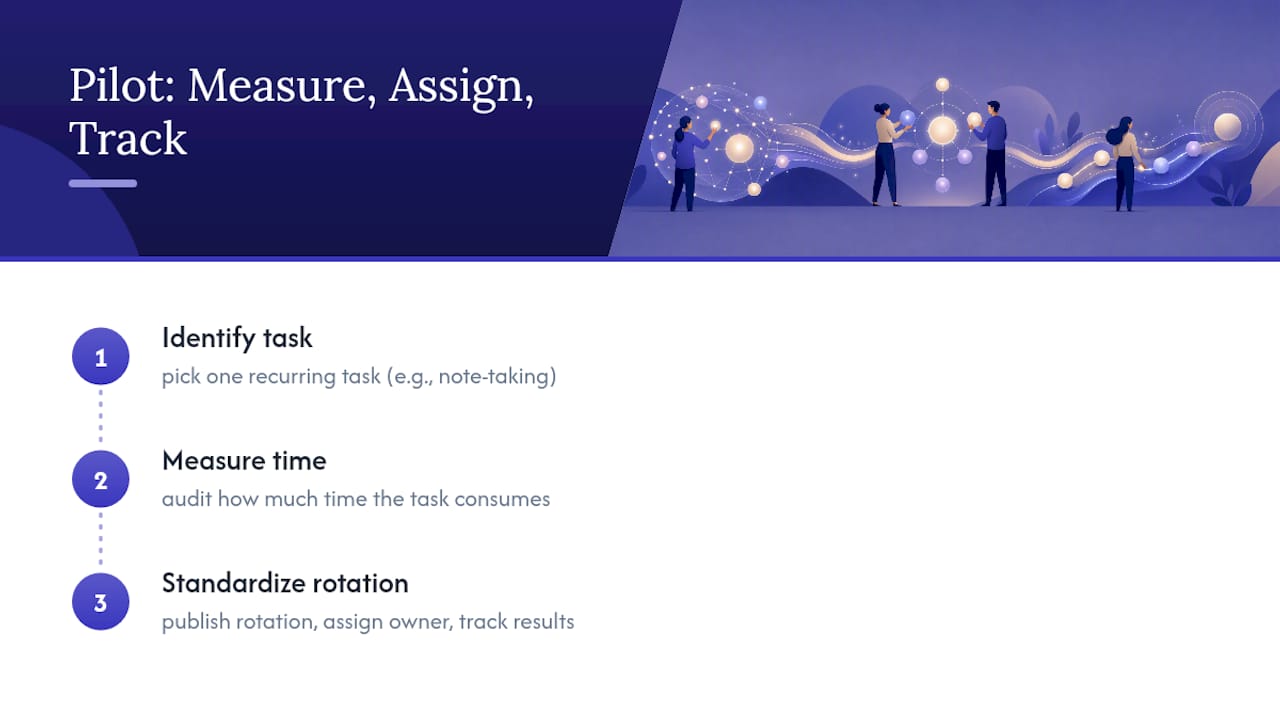
- Pilot the change on one recurring task first. Rotate note-taking or event planning publicly for a quarter, measure hours and perception shifts, then expand what works.
Pro Tip: Start your pilot with the single most complained-about task in your office. It’s usually the easiest to fix and the fastest way to build support for a bigger rotation system.
Tools that create shared visibility help here too. A team workspace that standardizes recurring assets and assignments makes it much harder for the “who’s doing this” question to default to the same person every time.
What You Can Do Right Now
Waiting for your organization to fix this system-wide can take years. In the meantime, you can protect your own time with a few concrete moves.
- Track your hours. Log the time you spend on note-taking, planning, and admin for two weeks. Bring the number, not the feeling, to your next one-on-one.
- Use a short, neutral script. Try: “I can’t take this on right now, but Jordan hasn’t had a rotation yet.” Redirect without apologizing.
- Propose a swap. Offer to keep handling one recurring task in exchange for a visible stretch assignment, like leading a client presentation or owning a project update to leadership.
- Escalate when patterns repeat. If you’re the default choice three times in a row, that’s a pattern worth naming directly to your manager, not something to absorb quietly.
Pro Tip: Frame your tracked hours as operational data, not a complaint. “This task takes me four hours a week that I can’t spend on X” lands very differently than “I feel like I do too much.”
Cleaning up your own inbox habits can also reclaim real time. A structured approach to email organization cuts down on the small administrative drag that adds up across a week.
The Five-Point Manager Checklist
Managers who want to fix this on their team don’t need a massive initiative. They need five habits, applied consistently.
- Audit current distribution. Pull the last six months of who handled recurring tasks and look at the pattern honestly.
- Build a transparent rotation. Publish it. Nobody should have to guess whose turn is next.
- Record every assignment. A shared log turns invisible labor into visible, countable work.
- Tie the record to performance conversations. If someone carried more than their share, that belongs in the review, not just a thank-you email.
- Review the metrics quarterly. Track hours spent, who’s doing the work, and how it breaks down by demographic. If the same names keep surfacing, the rotation isn’t working yet.
Simple metrics work best: total hours per task type, a rough demographic split, and whether requests get resolved faster once ownership is clear. None of this requires new software, just a shared spreadsheet and the discipline to update it.
Planning Your Career Around, Not Office Housework
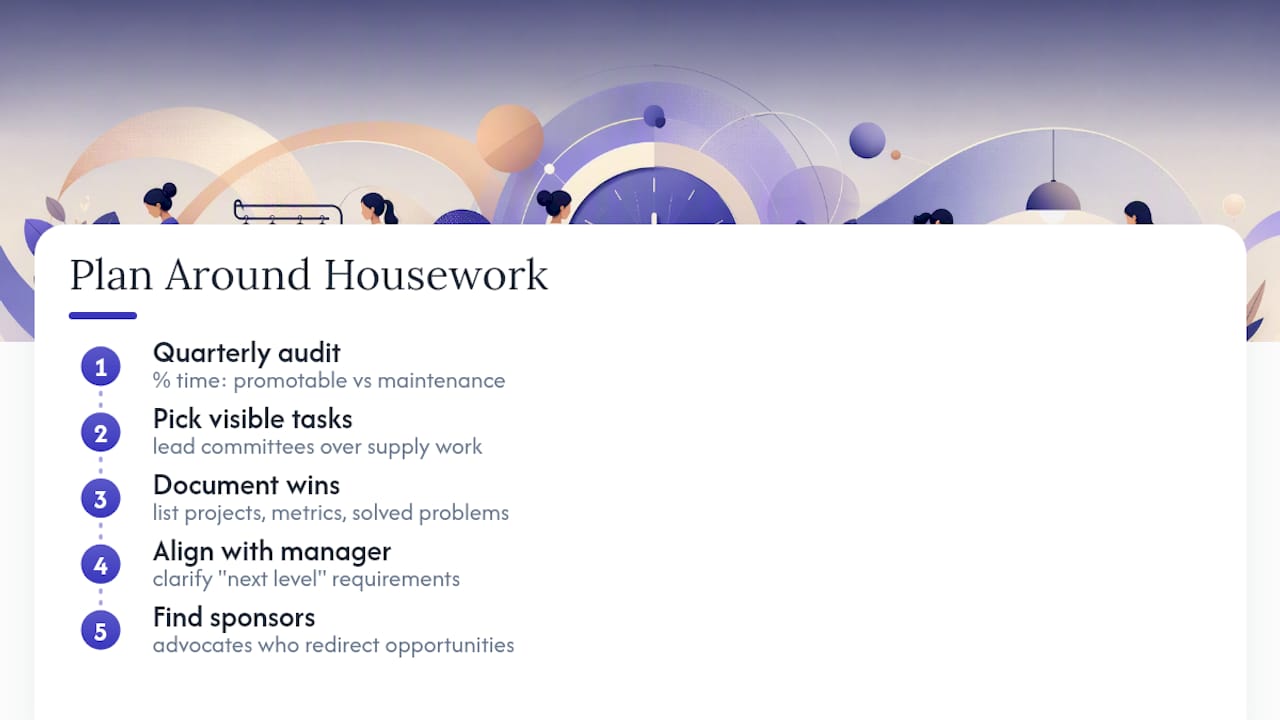
The women who navigate this well aren’t the ones who avoid all administrative work. They’re the ones who treat it as a resource to spend deliberately, not a debt that accumulates by default. That starts with an honest audit of your own workload every quarter: what percentage of your time went to visible, promotable projects versus invisible maintenance work?
When you do take on office housework, choose tasks with some visibility built in. Leading a committee that reports directly to leadership carries more career weight than organizing supply closets, even though both get labeled “extra work.”
It also helps to build a documented record of your promotable contributions separate from your administrative load. Keep a running list of projects you’ve led, metrics you’ve moved, and problems you’ve solved. When performance review season arrives, that record does the talking instead of your memory. Pair that with periodic conversations with your manager about what “next level” actually requires. If office housework isn’t part of that requirement, and it usually isn’t, you have grounds to renegotiate your time allocation on the spot.
Mentorship and sponsorship play a role too. A sponsor who advocates for you in rooms you’re not in can redirect opportunities toward you before the “who wants to help with X” email even goes out. That’s a very different position than being the automatic answer to every logistics question.
Cultural Variations in Who Does the Office Housework
The gendered pattern behind office housework isn’t universal in shape, even if it’s common in outcome. In hierarchical corporate cultures common in parts of Asia and Latin America, junior employees of any gender often absorb administrative and hosting duties as a rite of passage, though women in those roles frequently stay in them longer than men do as they advance. In flatter Scandinavian workplace cultures, shared administrative duty tends to be more evenly distributed by design, reflecting broader norms around collective responsibility, though even there, informal social-planning tasks still skew toward women.
In many US and UK offices, the volunteer-based system described earlier dominates, which is precisely why it defaults so heavily to women who feel more social pressure to say yes. Remote and hybrid workplaces have added a new wrinkle: virtual meeting facilitation, chat moderation, and “keeping the team connected” duties have become a digital-era version of office housework, and early patterns suggest they’re falling along similar gender lines.
None of this means the fix looks different by culture. Wherever the default sits, whether it’s seniority, gender, or both, the remedy is the same: replace informal defaults with visible, tracked, rotated assignments. Culture explains why the pattern takes different shapes. It doesn’t excuse leaving it unmanaged.
The Toll on Mental Health and Job Satisfaction
Carrying a disproportionate share of unrewarded work wears on people in ways that show up long before a performance review does. The math is straightforward: hours spent on non-promotable tasks are hours not spent on the work that builds confidence, recognition, and a sense of forward motion. Over time, that gap breeds a specific kind of fatigue, the feeling of being busy and invisible at once.
Employees who feel stuck doing office housework often report lower job satisfaction, not because the tasks themselves are unpleasant, but because the effort goes unacknowledged while colleagues doing “real” project work get the credit. That mismatch between effort and recognition is a well-documented driver of burnout in general, and office housework is a concentrated version of it. The double bind adds another layer of strain: women who decline these tasks report guilt and anxiety about how they’ll be perceived, while women who accept them report resentment about being overlooked for advancement anyway. Neither choice feels good, which is exactly why the fix has to happen at the system level rather than asking individuals to simply choose better.
The upside is that the same changes that fix the promotion problem also relieve the psychological load. When tasks are rotated and tracked instead of defaulted, nobody carries the guilt of refusing or the resentment of always accepting. Visibility itself is a form of relief.
How Company Culture Keeps This Pattern Alive (or Kills It)
Office housework survives in cultures where “helpfulness” and “team spirit” get praised in the abstract but never measured in the specific. If a company celebrates the person who organized the holiday party in an all-hands email but never mentions it in her performance review, the culture has just taught everyone watching that this kind of work is nice to have and irrelevant to advancement. That contradiction is where the resentment starts.
Cultures that reduce office housework tend to share a specific trait: they treat operational labor as data, not goodwill. Instead of a vague thank-you, managers add non-promotable work to workload dashboards alongside billable or project hours. That single shift changes the incentive structure for everyone, because work that’s tracked is work that can be redistributed, questioned, and eventually valued.
The deeper cultural fix is normalizing refusal without penalty. That requires leadership to model it visibly, a manager publicly declining to always be the one taking notes, a director rotating committee assignments instead of asking for volunteers. Culture change rarely happens through a memo. It happens when the people with the most social capital spend some of it changing the default.
Companies That Have Actually Moved the Needle
A handful of organizations have treated this as a solvable operations problem rather than a personality issue, and the approach tends to look similar across industries: name the task, assign it deliberately, and measure the result.
The pattern recommended by workplace researchers, and increasingly adopted by HR teams, starts small on purpose. A team picks one recurring task, note-taking is the most common starting point, and moves it from an open volunteer ask to a published rotation. Guidance on 5S adapted for digital workflows suggests mapping exactly how much time a task consumes before standardizing who owns it, because the audit itself often reveals savings nobody expected. Teams that ran this kind of pilot typically report two outcomes: the task takes less time once it’s standardized, and the rotation removes the social tension of asking “whose turn is it” out loud.
The through-line across every documented success is the same: someone made the invisible work visible first, then built a system around what they found. No pilot works if it skips the measurement step, and no system holds if leadership stops reinforcing it after the first quarter.
Middy’s Perspective: Fix the System, Not the Volunteer
Telling women to simply refuse office housework misses the point. The problem isn’t a lack of backbone. It’s a system that defaults to whoever says yes, then punishes them for saying yes too often. That’s a training and leadership design failure, not an individual one.
A clear system that removes the ask in the first place, combined with workshops walking leaders through fair rotation design and giving employees scripts for redirecting requests, can produce measurable results, fewer hours lost to unassigned admin, and clearer visibility on who’s doing what. The teams that see lasting change are the ones that treat this as a leadership skill to build, not a favor to request.
— Middy
Book a Workshop That Actually Rebalances the Workload
There are other routes to fixing this: a policy memo, a DIY spreadsheet audit, a one-off HR training. Most of them stall because nobody in the room has practiced the actual conversation, the redirect script, the fair-rotation pitch to a skeptical team lead, out loud before trying it live. Middy’s workshops close that gap by rehearsing the exact scripts and rotation designs your leaders need, so the fix doesn’t die in a slide deck.

Sessions typically walk teams through a workload audit, script practice for redirecting non-promotable requests, and coaching for managers building their first rotation system. Organizations that run this kind of training report clearer role visibility and fewer hours quietly absorbed by the same one or two people. If you’re planning a leadership offsite or a women’s leadership event, Middy’s planner guide walks through what a booking looks like, and the sales training resources show how the same behavior-change approach applies across teams, not just individuals. Reach out through Middy to check dates and start building your session.
Sources
- ‘No reward or recognition’: why women should say no to ‘office housework’ | Women | The Guardian
- Office housework and promotion (2020 study)
- “Office Housework” Gets in Women’s Way — Harvard Business Review
FAQ
What are the five C’s of women’s work?
There’s no single, widely agreed-upon “five C’s” framework specific to office housework. Definitions vary by source, so treat any list you find online with caution rather than as an established standard.
How do I manage office work and housework at home together?
The two aren’t the same category, but the imbalance often mirrors each other: women disproportionately absorb unpaid, unrewarded labor in both settings. The same fix applies in spirit, track the hours, make the load visible, and negotiate a fairer split rather than defaulting to whoever says yes first.
What are some basic office tasks that count as office housework?
Common examples include taking meeting notes, planning office events, arranging catering, serving on internal committees, and helping onboard new employees. These tasks are essential to daily operations but rarely factor into promotion decisions.
What does “office housework” actually mean?
Office housework refers to non-promotable administrative and social-maintenance tasks, like scheduling, note-taking, and event planning, that keep an office running but carry little weight in performance reviews or promotion decisions.
Does refusing office housework hurt your reputation?
It can, depending on how it’s handled. Research on the double bind shows women who decline these tasks sometimes face social backlash that men rarely experience for the same refusal, which is why a redirect script tends to work better than a flat no.
Leave a Reply