
The strategies that actually move student motivation share one trait: they make progress visible, protect a student’s sense of choice, and connect the work to something the student cares about. Start with micro-goals, before-and-after learning snapshots, and predictable feedback routines. They cost little class time and pay off fast. The research and the classroom-ready list below explain why, and how to run them this week.
TL;DR:
- Visible progress through before-and-after snapshots and micro-goals helps students recognize their specific improvements and boosts motivation.
- Strategies that support autonomy, competence, and relatedness, such as choice-rich tasks and peer feedback, work best when combined with clear structure and feedback routines.
- Using brief, targeted surveys before and after implementing strategies can effectively measure shifts in student confidence, interest, and perceived manageability.
- Tailoring motivation approaches to students’ cultural backgrounds and individual circumstances enhances their effectiveness and prevents misinterpretation of disengagement.
- Embedding small wins, relevance framing, and progress visibility into daily routines fosters intrinsic motivation and sustains students’ persistence over the long term.
Table of Contents
- Student Motivation Strategies You Can Use This Week
- Why These Strategies Work: SDT and Expectancy-Value-Cost
- A Three-Step Routine to Pick and Test a Strategy
- Adapting Strategies for Online, Blended, and In-Person Classes
- Simple Ways to Measure Whether It’s Working
- What Coaching Athletes Taught Middy About Classroom Motivation
- Intrinsic Motivation Matters More Than Rewards, Most of the Time
- Culture and Economic Background Shape How Motivation Shows Up
- Technology and Gamification Can Help, If They’re Not the Whole Plan
- Parents and Guardians Can Reinforce What You’re Already Doing
- Try This One Thing First
- Bring These Strategies Into Your Building’s Professional Development
- Sources
Student Motivation Strategies You Can Use This Week
Every strategy on this list traces back to the same research base: Self-Determination Theory and the Expectancy-Value-Cost framework, which you’ll see explained in full further down. For now, treat this as your working toolkit. Strategies near the top require the least setup and tend to produce the fastest visible shift in engagement. Strategies near the bottom take more scaffolding but reach students the quick fixes miss.
1. Before-and-after learning snapshots. Have students save an early draft or first attempt, then compare it to a later version. Implementation step: keep a simple folder (physical or digital) for one recurring assignment type. Classroom example: a writing teacher has students revisit their September paragraph in December and mark three concrete improvements. Equity note: students with inconsistent attendance may need you to help them locate or reconstruct their “before” sample.
2. Tiny Triumph reflections. End a lesson with one sentence: “Today I got better at ___.” Implementation step: build 90 seconds into your closing routine, every day, same format. Classroom example: exit tickets that ask only for one specific win, not a summary of the whole lesson. This tactic, along with visible progress tracking generally, is associated with increased persistence and stronger engagement with learning in classroom-level reports.
Pro Tip: Pair Tiny Triumphs with a weekly scan, not a daily grade. Reading them for five minutes on Friday tells you who’s coasting and who’s stuck. Grading them daily just turns a motivation tool into more homework, for both of you.
3. Micro-goal setting. Break a large assignment into weekly or even daily targets students set themselves. Implementation step: give students a template with three blanks, this week’s target, how they’ll know they hit it, one backup plan. Classroom example: a research paper broken into “find five sources,” “write one paragraph,” “revise for clarity” instead of one looming deadline. Equity note: students juggling jobs or family caregiving need flexible micro-goal windows, not rigid daily checkpoints.
4. Predictable feedback routines. Return work on a schedule students can count on, and use the same format every time. Implementation step: pick one feedback structure (glow, grow, next step) and never deviate. Classroom example: math quizzes returned every Monday with the same three-line comment structure.
5. Choice-rich tasks that preserve structure. Offer two or three approved formats for an assignment, not an open field. Implementation step: give students a menu of three project formats tied to the same rubric. Classroom example: a book report as a video, a poster, or a written essay, all graded on identical criteria. Structure still matters here; unlimited freedom without a clear rubric tends to backfire.
6. Relevance framing and purpose prompts. Open a unit by naming exactly where the skill shows up outside your classroom. Implementation step: write one sentence connecting the lesson to a job, hobby, or real decision students will face. Linking material to students’ actual lives and future goals has a consistent record of raising both interest and performance.
7. Mastery-focused rubrics. Grade against a skill standard, not against classmates. Implementation step: rewrite one rubric this month to describe what mastery looks like instead of what earns which letter grade. Classroom example: a science lab rubric describing “identifies a controlled variable” rather than “matches the answer key.”
8. Peer feedback structures. Train students to give specific, actionable feedback to each other using sentence stems. Implementation step: teach one feedback stem (“I noticed… I wonder…”) and require it in partner work. Equity note: pair students thoughtfully; peer feedback can sting for students already anxious about performance, so model the tone first.

9. Low-stakes success opportunities. Build in small, ungraded or lightly graded wins early in a unit before the stakes rise. Cornell’s teaching resources point to early success experiences as a direct driver of continued participation. Classroom example: a five-question warm-up quiz worth almost nothing, just to build confidence before the real assessment.
10. Growth-mindset prompts. Replace praise for being “smart” with praise for the process. Implementation step: swap one stock phrase (“great job!”) for a process-specific one (“you tried three approaches before that worked”).
11. Transparent teacher messages. Tell students explicitly why you’re assigning something and what skill it builds. Implementation step: add one sentence to your instructions, “This matters because…”
12. Brief reflective journals. A weekly two-minute writing prompt about what felt hard and what felt manageable. Classroom example: “What’s one thing you’d do differently next time?”
13. Autonomy-supportive options. Let students choose their own topic within fixed parameters, or pick their own partner for a low-stakes task.
14. Scaffolding and signposting. Break multi-step directions into numbered, visually distinct chunks so students always know where they are in a task. This matters more than teachers usually assume, especially for students newer to a subject or working in a second language.
Why These Strategies Work: SDT and Expectancy-Value-Cost
Two frameworks explain almost everything on that list. The first is Self-Determination Theory, developed by researchers Edward Deci and Richard Ryan. SDT holds that people are motivated when three psychological needs are met: autonomy, competence, and relatedness.
- Autonomy means feeling like you have real choices. Choice-rich tasks, autonomy-supportive options, and student-set micro-goals all target this need.
- Competence means feeling capable of improving. Before-and-after snapshots, mastery rubrics, and low-stakes success opportunities all target this need.
- Relatedness means feeling connected to your teacher and peers. Peer feedback structures and transparent teacher messages target this need directly.
Classrooms that pair these supports with clear structure, not chaos, see the strongest engagement gains, according to Edutopia’s synthesis of SDT research.
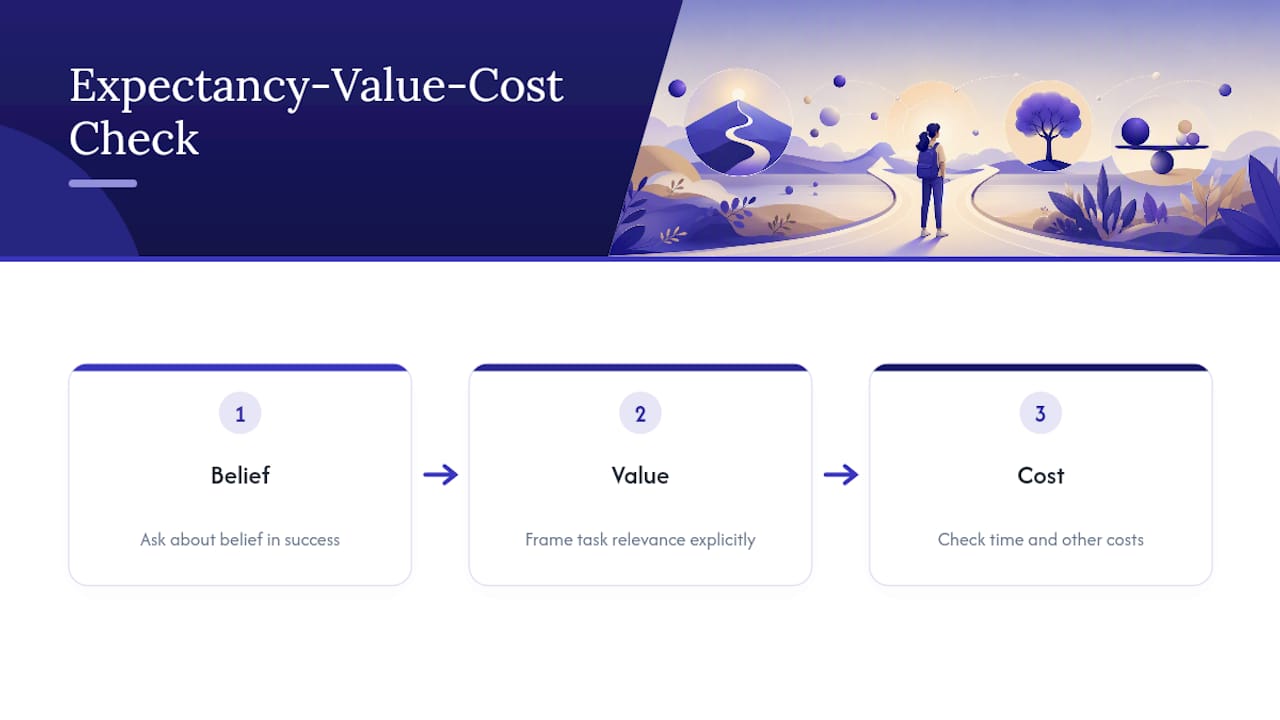
The second framework, Expectancy-Value-Cost, gives you a diagnostic lens. A student disengages for one of three reasons:
- Expectancy problem: “I don’t think I can do this.” (Fix with scaffolding, low-stakes wins, mastery rubrics.)
- Value problem: “I don’t see why this matters.” (Fix with relevance framing, purpose prompts.)
- Cost problem: “This takes more than it’s worth to me.” (Fix with micro-goals, clearer time expectations, reduced busywork.)
A student who skips homework might look lazy, but an expectancy check often reveals they simply don’t believe they can succeed at it. Same behavior, completely different fix.
A Three-Step Routine to Pick and Test a Strategy
Don’t try all fourteen strategies at once. Run this cycle instead.
- Diagnose (10 minutes). Ask three quick questions: Do you think you can do this? Does this matter to you? Is this worth the time it takes? A one-question version works as an exit slip if you’re short on time.
- Micro-trial (1 to 2 weeks). Pick one or two strategies matched to what the diagnosis revealed. If it’s an expectancy problem, trial low-stakes success opportunities. If it’s cost, trial micro-goal setting. Set one simple success criterion in advance, like “70% of students complete the exit ticket without prompting.”
- Measure and iterate. Check behavior signals (participation, completion rates) against your success criterion, then run the same three-question mini-survey again. If nothing moved, the diagnosis was probably wrong, not the strategy.
Pro Tip: Write your success criterion down before you start the trial, not after. Teachers who wait to define “success” until they see the results almost always talk themselves into believing whatever happened was progress.
For students with attendance gaps, language barriers, or learning differences, build in an equity check at step one: ask whether the diagnosis question itself made sense to them, and adjust the wording rather than assuming disengagement.
Adapting Strategies for Online, Blended, and In-Person Classes
Modality changes which psychological need is easiest to support. Face-to-face classrooms tend to make autonomy and relatedness supports easier; students read your tone and pick up on peer energy without extra effort from you. Online settings need more deliberate scaffolding and signposting because that ambient social feedback disappears.
Six quick adaptations worth trying:
- Run 30-second video check-ins instead of long async comments for online courses.
- Post scaffolded exemplars (annotated sample work) before every online assignment.
- Use structured breakout protocols with a named role for each student in blended discussions.
- Record short “progress snapshot” videos where you narrate what improved in a student’s work.
- Add explicit numbered checklists to every blended assignment, no matter how obvious the steps feel to you.
- Build a five-minute synchronous reflection slot into blended sessions, even if the rest of the unit is async.
Online routine: a weekly, clearly signposted micro-assignment with a visible “what this builds toward” note attached. Face-to-face routine: peer “Glows and Grows” partner shares, five minutes, twice a week. Blended routine: explicit written checklists paired with one short synchronous reflection at the end of the week.
Simple Ways to Measure Whether It’s Working
You don’t need a research grant to know if a strategy is landing. A three-question Expectancy-Value-Cost mini-survey, answered on a 1 to 5 scale, tells you most of what you need:
- “I feel confident I can succeed at this task.” (expectancy)
- “This task matters to me.” (value)
- “This task feels manageable given my time.” (cost)
The five-step motivational planning process built around this framework recommends running the survey before and after a two to four week trial, then comparing the shift alongside behavioral signals.
| Signal | What it tells you |
|---|---|
| Participation rate | Whether engagement is rising during the trial window |
| Assignment completion | Whether cost or expectancy barriers are easing |
| Voluntary revision rate | Whether students see value in improving, not just finishing |
| Reflection quality | Whether students are internalizing progress, not just going through motions |
Run the cycle for four weeks: week one to baseline, weeks two and three to trial, week four to resurvey and decide whether to keep, adjust, or drop the strategy.
What Coaching Athletes Taught Middy About Classroom Motivation
Thirty years across competitive sports and real estate taught Middy Matthews one consistent lesson: people commit to what they can see themselves improving at, not to what they’re told to feel excited about. That’s the same logic behind before-and-after snapshots and micro-goals. Athletes track splits and reps; students can track drafts and daily wins the same way.
Two patterns show up again and again in workshop settings. A team that replaces vague praise with specific, process-focused feedback sees commitment rise within weeks. A group given small, structured choices, not unlimited freedom, tends to outperform a group given either total control or none at all.
Training, not selling, means giving someone the tools to see their own progress instead of convincing them to feel motivated. The same principle that works with a sales team works with a classroom of fifteen-year-olds.
Intrinsic Motivation Matters More Than Rewards, Most of the Time
Extrinsic motivators, grades, prizes, points, get compliance fast. Intrinsic motivation, the drive that comes from genuine interest or a sense of accomplishment, gets persistence. The distinction matters because most classroom systems default to extrinsic tools: stickers, bonus points, leaderboard rankings.
Those tools aren’t wrong, but they’re limited. A student chasing a grade often stops the moment the grade is secured. A student chasing mastery keeps going because the work itself feels worth finishing. This is where SDT and Expectancy-Value-Cost overlap directly with intrinsic motivation: when a task supports autonomy, competence, and relatedness, and a student sees clear value and manageable cost, intrinsic interest tends to follow without you engineering it directly.
The practical move isn’t to ban extrinsic incentives. It’s to use them sparingly, for short-term compliance on genuinely low-interest tasks, while building your core strategies (relevance framing, mastery rubrics, visible progress) around intrinsic drivers for anything you want students to carry forward. A student who finishes a project because a grade is attached learns to chase grades. A student who finishes because they wanted to see their own before-and-after improvement learns to chase improvement, in your class and the next one.
Culture and Economic Background Shape How Motivation Shows Up
Motivation strategies don’t land the same way for every student, and the gap is rarely about effort. A student working an after-school job has less time for optional extra-credit tasks, which is a cost problem, not a value problem, even though it can look identical from the front of the room. A student from a household where higher education wasn’t the norm may need more explicit relevance framing because the “obvious” payoff of school isn’t obvious at home.
Cultural background shapes how comfortable students are with certain strategies too. Some students come from educational cultures where public praise feels uncomfortable rather than motivating, so a “Tiny Triumph” shared aloud might land better as a private written note for them. Peer feedback structures can also carry different weight depending on whether a student’s cultural background treats disagreement with a peer as constructive or disrespectful.
None of this means abandoning a strategy. It means checking your assumptions about why a student isn’t responding before concluding the strategy failed. The Expectancy-Value-Cost lens is especially useful here, because it forces you to ask which of the three levers, belief, value, or cost, is actually the barrier for that specific student, rather than assuming one blanket explanation covers your whole roster.
Technology and Gamification Can Help, If They’re Not the Whole Plan
Digital tools can make progress visible faster than paper ever could. A points dashboard, a badge system, or a simple progress bar taps the same psychological lever as a before-and-after snapshot: it shows a student where they started and how far they’ve moved. Used well, that’s a legitimate motivation strategy, not just decoration.
The risk is treating gamification as a substitute for the underlying work of relevance and autonomy. A leaderboard can motivate short-term competitive students while quietly demotivating students near the bottom, which undercuts the relatedness need SDT identifies as essential. The fix is usually to track individual growth rather than rank against peers, a badge for “most improved,” not just “highest score.”
On the workload side, tools that automate parts of feedback delivery can free up the time teachers need to make feedback loops genuinely predictable rather than sporadic. Reducing the manual burden of grading is one practical way to make the “predictable feedback routines” strategy from earlier sustainable across a full course load, instead of something that only survives the first two weeks of a semester.
Parents and Guardians Can Reinforce What You’re Already Doing
Motivation strategies stick better when what happens at home doesn’t contradict what happens in your classroom. A student practicing micro-goal setting at school benefits when a parent asks “what’s your target this week?” instead of “did you get an A?” The second question reinforces the extrinsic frame; the first reinforces the process frame you’re trying to build.
A short note home explaining one strategy, in plain language, can go further than a lengthy conference. Something as simple as “we’re using before-and-after snapshots this term; ask your student what they’ve improved at” gives a parent a specific, low-effort way to reinforce the work without needing to understand the whole framework.
Guardians juggling multiple jobs or limited school experience themselves may not have bandwidth for elaborate involvement, and that’s fine. The goal isn’t homework help. It’s alignment, making sure the language of progress and effort used at school doesn’t get undercut by a purely grade-focused conversation at home.
Try This One Thing First
If you take one idea from this list, make it visible progress. Students act on what they can see, and most classrooms hide progress inside a grade book nobody reads until report cards. Fix that first; everything else gets easier.
One-week challenge: Run a Tiny Triumphs week. Monday through Friday, ask one specific prompt at the end of class: “What’s one thing you did better than yesterday?” Nothing graded, nothing elaborate. Watch what changes by Friday.
— Middy
Bring These Strategies Into Your Building’s Professional Development
Reading a list is one thing. Running a staff-wide micro-trial across twenty classrooms at once is another, and that’s where structured professional development earns its keep. Middy’s workshop formats build directly on the toolkit-and-practice model covered here: a keynote to set shared language around motivation, a half-day workshop where staff pick and pilot strategies against their own rosters, and follow-up coaching to review what the four-week measurement cycle actually showed.

Each format delivers something concrete instead of inspiration alone: a facilitator guide for the workshop session, a micro-trial planning template staff can adapt to their subject area, and a toolkit built around the same diagnose-trial-measure cycle outlined above. Schools and PD leads who want a shared, buildingwide version of this cycle rather than fourteen teachers experimenting in isolation can review sales and staff training formats built to actually stick and adapt the same structure for a faculty setting, then reach out to check available dates for a keynote or workshop session.
Sources
- To Increase Student Engagement, Focus on Motivation — Edutopia
- Five steps to improve student motivation (PAR NSF preprint)
- Teachers’ motivational strategies and student motivation across teaching modalities — Taylor & Francis
- Motivation in the classroom — Center for Educational Effectiveness (UC Davis)
Leave a Reply