
An after action review is a short, structured team reflection that compares what you intended to happen against what actually happened, then turns the gap into assigned, timebound improvements. It’s not a venting session and it’s not a performance review. Run one when:
- A project, launch, or campaign wraps, win or lose
- Something breaks unexpectedly, an incident, a missed deadline, a client blowup
- You’ve just run a drill, pilot, or exercise and want to bank the lessons before the next one
The value only shows up if the findings actually change the next attempt. Skip that step, and an after action review is just a meeting with better vocabulary.
Key Takeaways
An after action review works when it produces a documented action plan with a named owner, a firm deadline, and a measurable outcome, not just a good conversation.
| Point | Details |
|---|---|
| Use the four-question framework | Ask what was intended, what happened, why, and what changes next time. |
| Follow the four-phase cycle | Design, prepare, implement, and disseminate each need a distinct deliverable. |
| Match format to stakes | Run 15-minute checks for routine work and formal AARs for major incidents. |
| Protect psychological safety | A no-blame facilitator role separates fact-finding from fault-finding. |
| Bring in facilitation when candor stalls | Middy’s workshops coach teams to rehearse fixes, not just discuss them. |
Table of Contents
- The Four Core AAR Questions Every Facilitator Should Know
- How Does the Four-Phase AAR Process Actually Work?
- Who Should Be in the Room, and How Do You Keep It Blame Free?
- When Should You Run a Quick Check vs. a Formal Review?
- How Do You Turn Findings Into an Action Plan That Sticks?
- A Ready-to-Use AAR Template You Can Copy Today
- What Usually Derails an AAR, and How Do You Fix It?
- Middy Matthews’ Coaching Perspective on Making AARs Stick
- Bring In a Facilitator When Your Team Can’t Get Past the Politics
- Where to Find the Official AAR Guides and Templates
- Sources
The Four Core AAR Questions Every Facilitator Should Know
Every effective after action review process runs on four questions. Keep them in this order:
- What did we intend to accomplish? Establishes the target before anyone argues about the outcome.
- What actually happened? Facts only. No interpretation yet.
- Why did it happen that way? This is where root causes surface, systems, timing, communication gaps.
- What will we do differently next time? Converts insight into a commitment.
These four questions, outlined clearly in explainers on the AAR process, work because they separate fact from judgment. A facilitator script for question three might sound like this: “Walk me through the decision point. What information did you have at that moment?” That phrasing invites explanation, not defense.
Pro Tip: If someone answers question three with a name instead of a process, redirect immediately: “What about the process let that happen?” Names close conversations. Systems open them.
How Does the Four-Phase AAR Process Actually Work?
An after action review follows four phases, according to the WHO’s after-action review guidance: Design, Prepare, Implement, and Disseminate. Treat each as a distinct deliverable, not a vibe.
Design. Set the scope, the objectives, who the findings are for, and whether you need a full AAR or a lighter quick-look report (QLR).
Prepare. Build your data collection checklist, pull timelines, logs, or customer feedback, and send pre-reads so the session isn’t spent catching people up.
Implement. Run the session with a set agenda, timed segments, a named facilitator, and a dedicated note-taker separate from whoever is leading.
Disseminate. This phase gets skipped constantly, and it’s the one that matters most. It’s where you produce the report, the action plan, and the follow-up cadence.
Organizations that treat AARs as one-time meetings rather than a four-phase cycle tend to relearn the same lessons repeatedly, because nothing from phase three ever survives into training or standard operating procedure, a pattern FEMA’s After-Action Review User Guide calls out directly.
Who Should Be in the Room, and How Do You Keep It Blame Free?
Get the participant list wrong and the whole exercise collapses into finger pointing or, worse, polite silence. A few rules that hold up:
- Include everyone who touched the decision or the outcome, not just leadership.
- Invite external subject-matter experts only when the internal group lacks the technical context to evaluate a root cause.
- Keep senior leadership present for visibility, but never let them dominate the “why” discussion, that’s where junior staff usually have the sharpest read.
Ground rules matter as much as attendance. Confidentiality outside the room, equal airtime regardless of title, and a facilitator who actively blocks blame language. That last point isn’t optional. Guidance from the COPS office on conducting after action reviews is blunt about it: blame kills candor, and once candor dies, the review is just theater.
Pro Tip: Assign three distinct roles before the session starts: facilitator, note-taker, and a subject-matter validator who checks that observations are technically accurate. Combining any two of these roles is how sessions lose objectivity.
When Should You Run a Quick Check vs. a Formal Review?
Timing decides whether an AAR produces sharp insight or foggy guesswork. Run it while memory is still fresh, ideally within one to two weeks of the event for typical projects and team activities. For major incidents, FEMA’s guidance points toward a Quick-Look Report within roughly a month to alert leadership fast, followed by a full formal AAR once the dust settles. Public health events follow a similar logic: WHO’s toolkit recommends completing larger-scale reviews within a few months of a major incident, while it’s still actionable.
Match the format to the stakes:
- 15 minutes: A quick huddle after a routine task, sales call, weekly sprint. Four questions, no report.
- 60 minutes: A standard project debrief with a written summary and two or three action items.
- Multi-hour or multi-day: Reserved for major incidents, product failures, or events with cross-team impact, where a full AAR report and action planning workshop are warranted.
If you’re debating between a QLR and a full AAR, ask one thing: does leadership need to act on this before the full review is even finished? If yes, write the QLR first.
How Do You Turn Findings Into an Action Plan That Sticks?
An after action review that ends with “good discussion, thanks everyone” has failed. FEMA identifies four standard products worth knowing: the full AAR report, the quick-look report, the after-action briefing, and the action plan itself. The action plan is where accountability lives.
Write every recommendation with three fields, no exceptions:
- Owner — one named person, never “the team.”
- Deadline — a specific date, not “soon” or “next quarter.”
- Success metric — how you’ll know the fix actually worked.
Then schedule a follow-up touchpoint, 30 and 90 days out works well for most teams, to check whether actions closed or stalled. This is the step FEMA’s user guide frames as institutionalizing findings: linking them to training updates or revised procedures so the lesson outlives the meeting.
| Point | Details |
|---|---|
| Every action needs an owner | Assign one named person per recommendation, never a team or department. |
| Deadlines beat intentions | Attach a specific date to each action item, not a vague timeframe. |
| Follow-up closes the loop | Check progress at 30 and 90 days to confirm actions were completed. |
A Ready-to-Use AAR Template You Can Copy Today
Paste this into your meeting notes or project tool before your next session:
- Scope and objective: What event or project is being reviewed, and why now
- Participants: Names and roles, including the facilitator and note-taker
- Timeline of events: A factual sequence, no interpretation yet
- The four questions: Intended outcome, actual outcome, root causes, next-time changes
- Observations: Validated by the subject-matter reviewer before the session ends
- Action items: Owner, deadline, success metric for each
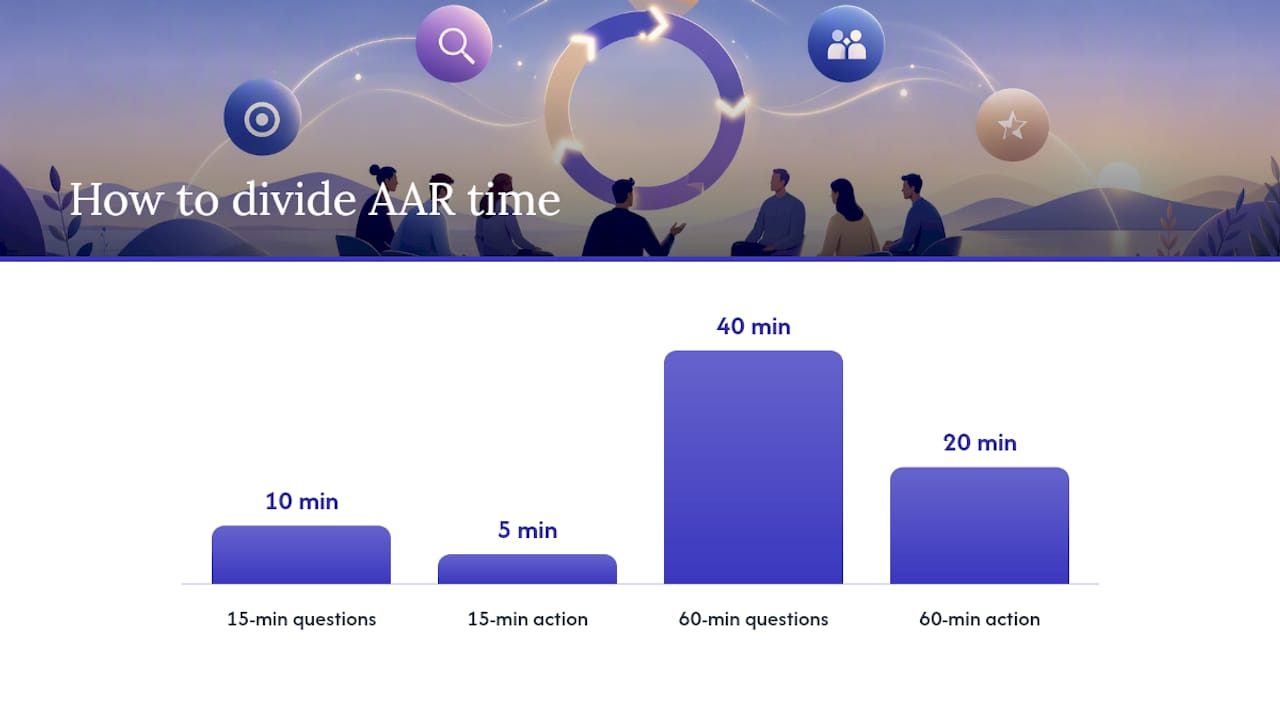
For timing, a 15-minute session spends roughly 10 minutes on the four questions and 5 on assigning one action item. A 60-minute session gives each question about 10 minutes, leaving 20 for action planning. A multi-hour format, the structure Asana’s after-action review template maps well, dedicates the first hour to data review, the middle stretch to discussion, and the close to drafting the action plan together.
Store completed AARs with a consistent naming convention, project name, date, AAR type, and tag by department or theme so future teams can search past lessons before repeating them.
What Usually Derails an AAR, and How Do You Fix It?
Most failed after action reviews share the same handful of problems:
- Blame creeps in. Fix it by stating ground rules out loud before question one, every single time.
- Findings stay vague. “Communication needs to improve” isn’t actionable. Force specificity: which channel, which handoff, which moment.
- No follow-through. An action plan with no owner or deadline is a wish list, not a plan.
- Wrong people in the room. Too few perspectives, and you miss root causes. Too many, and candor drops.
You’ll know your AARs are working when action items actually close, when SOPs get updated instead of just discussed, and when the same mistake stops showing up review after review.
Middy Matthews’ Coaching Perspective on Making AARs Stick
Most after action reviews stall for the same reason bad sales coaching stalls: people confuse identifying the problem with fixing it. I’ve watched teams nail the four questions and still repeat the same mistake three months later, because nobody rehearsed the new behavior. Coaching works because it doesn’t stop at insight. If a recommendation is “communicate delays earlier,” the next step is a five-minute role play where someone actually says the words out loud before the real situation hits. An AAR without rehearsal is just a smarter way to feel bad about the same outcome twice. Facilitation and practice have to travel together, or the lesson doesn’t survive contact with next week.
— Middy
Bring In a Facilitator When Your Team Can’t Get Past the Politics
Some teams run tight, honest after action reviews on their own. Others hit the same wall every time: whoever runs the meeting is also whoever gets blamed for the outcome, and candor evaporates the moment it matters most. That’s the gap Middy fills. Rather than another generic facilitation framework, Middy brings 30 years of competitive sports and real estate experience into the room, coaching teams to turn hard findings into practiced behavior instead of another bullet point nobody revisits.

Middy’s workshops don’t just diagnose what went wrong, they build the rehearsal into the session itself, the same approach detailed in sales training built to actually stick. If your last few reviews produced good notes and zero behavior change, that’s the signal to bring in outside facilitation. Reach out to book a workshop and get your next AAR to actually change how your team performs.
Where to Find the Official AAR Guides and Templates
- WHO’s after-action review guidance: best for public health and emergency response events.
- FEMA’s After-Action Review User Guide: comprehensive framework for major incidents.
- COPS step-by-step AAR guide: built for law enforcement reviews.
- Asana’s AAR template: fastest option for routine team debriefs.
Sources
- WHO: After-action review guidance
- FEMA: After-Action Review User Guide (Nov 2023)
- Asana: After-action review template
- COPS: How to Conduct an After Action Review (step-by-step guide)
Recommended
- Ditch the Script That Never Sounded Like You – Middy Matthews | Keynote Speaker
- Questions to Ask Before You Book a Keynote Speaker – Middy Matthews | Keynote Speaker
- From the Starting Line to the Sale: A Sports Keynote for Revenue Teams – Middy Matthews | Keynote Speaker
- Train Like an Athlete, Sell Like a Pro: A Keynote Framework – Middy Matthews | Keynote Speaker
[…] a tight after-action review immediately afterward. Track decision time, the outcome, and whether the team actually followed the […]