
If your outcome is behavior change, run a half-day session at minimum. If you need real alignment on priorities, block a full day. If the goal is trust-building plus a strategic reset, take two days. The reason is simple: decisions and commitments take time you can’t rush, and the biggest agenda mistake I see is cramming a two-day conversation into a 90-minute slot.
The rule that should anchor every agenda you build: keep it to roughly 20% presentation and 80% facilitated discussion. Talking heads don’t create ownership. Structured conversation does.
- A 90-minute lab for a single skill or decision
- A one-day agenda for team alignment and prioritization
- A two-day retreat for strategy resets and trust-building
Table of Contents
- What Is a Leadership Workshop, and What Should It Produce?
- Why a Structured Agenda Beats a Loose Discussion Outline
- Sample Workshop Itinerary Templates You Can Adapt Today
- What Do Fully Worked Sample Agendas Look Like?
- How Do You Facilitate a Leadership Session Well?
- What Pre-Work and Follow-Up Make an Agenda Succeed?
- Build a One-Page Planning Template Before You Run the Room
- What Middy Matthews Brings to a Leadership Workshop Agenda
- Where Conventional Agenda Advice Gets It Wrong
- Book Middy for Your Next Leadership Session
- Sources
What Is a Leadership Workshop, and What Should It Produce?
A leadership workshop agenda is not a meeting with a fancier name. It’s a time-boxed, facilitated session built to produce something specific: a decision, alignment across a team, or a practiced behavior that didn’t exist before people walked in. If your session ends with people saying “great discussion” and nothing else, the agenda failed, no matter how good the content felt.
Before you touch a timeline, define the outcome you’re designing for. Measurable outcomes look like this:
- Alignment — the team can state the same three priorities in the same words
- Prioritized moves — a ranked list of what gets done first, second, third
- Named owners — every action has one person attached, not a committee
- Observable behavior change — a manager runs a different kind of conversation next week
The outcome you pick determines the format. Alignment problems often resolve in a single focused day. Behavior change, like coaching skills or feedback practice, usually needs paired practice and a follow-up window, which pushes you toward a half-day workshop plus a 90-day check-in cycle rather than one long session.
Why a Structured Agenda Beats a Loose Discussion Outline
A written agenda does four things a loose outline never will: it gives people shared context before they walk in, it forces the facilitator to decide what actually matters, it protects time for decisions instead of letting conversation eat the clock, and it creates a paper trail for accountability afterward. Teams that show up without one tend to spend the first 30 minutes figuring out why they’re there.
A few rules of thumb worth memorizing:
- Aim for 20% presentation, 80% discussion across the whole day
- No single block runs longer than 45 minutes without a clear transition or activity change
- Build in visible buffer time, 15 to 20% of total runtime, rather than hoping you land on schedule
- Every block should produce something tangible. If a session generates no decision, artifact, or owner, cut it
The most common mistake I see planners make is scheduling for content instead of outcomes: they list topics (“communication,” “strategy,” “culture”) instead of deciding what decision or behavior each block needs to produce. The second most common mistake is skipping buffer time entirely, which guarantees the closing session gets cut, and the closing session is usually where owners and dates get assigned.
Pro Tip: Write the output of each block before you write its title. If you can’t name what the room will have by the end of a session, that session isn’t ready to go on the agenda yet.
Sample Workshop Itinerary Templates You Can Adapt Today
Three lengths cover almost every leadership workshop scenario. Each one follows the same underlying spine: open, diverge into discussion, converge on decisions, close with owners.
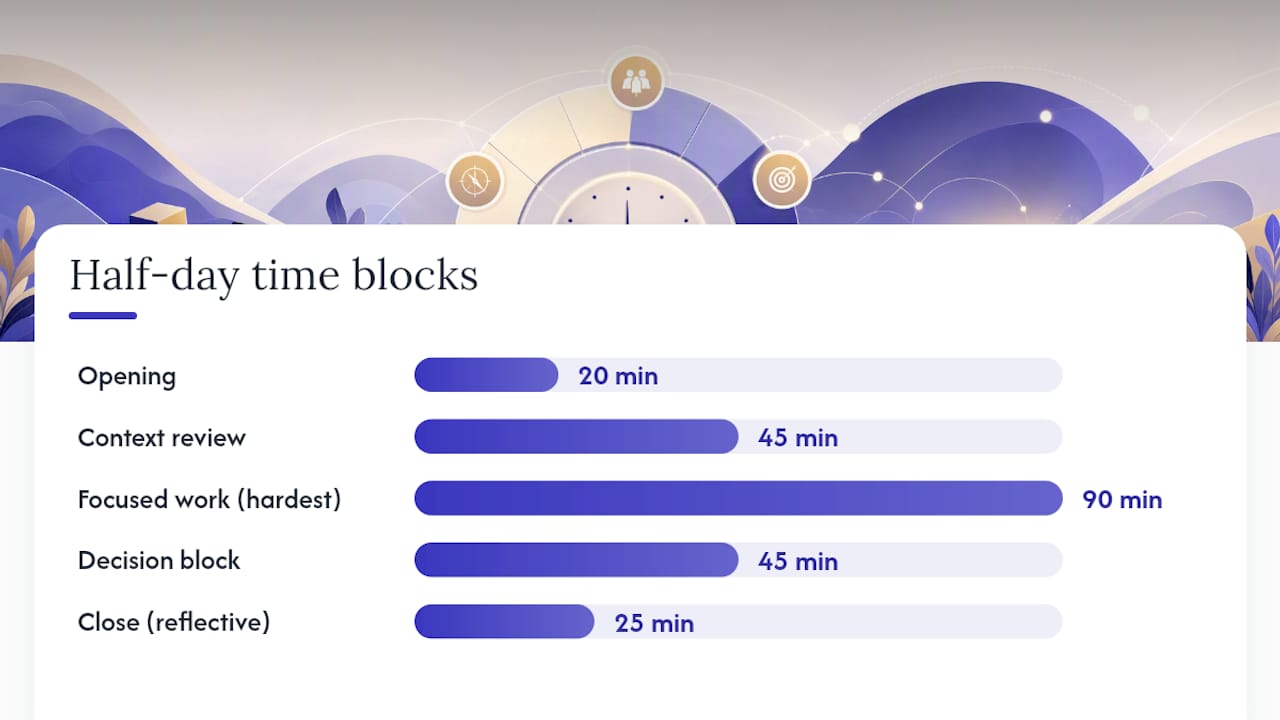
Half-day template (3 to 4 hours)
| Time Block | Purpose | Output | Owner |
|---|---|---|---|
| Opening (20 min) | Frame the goal, set ground rules | Shared context | Facilitator |
| Context/state review (45 min) | Surface current reality, data, or feedback | Common starting point | Facilitator |
| Focused work (90 min) | Small-group work on the core problem | Draft priorities or options | Small groups |
| Decision block (45 min) | Converge, rank, and commit | Ranked decisions | Full group |
| Close (25 min) | Assign owners and dates | Action list with names attached | Facilitator |
Full-day template
Morning runs context and diagnosis: a state-of-the-business review, followed by a diverge session where small groups generate options against the day’s central question. A working lunch keeps momentum, since a full stop tends to drain energy that’s hard to rebuild. The afternoon is where the real work happens: deep-dive sessions on the two or three priorities that matter most, then a decision block where the group commits to a ranked plan. Close the day the same way you’d close a half-day session, with named owners and dates, not vague intentions.

Two-day retreat template
Day one opens with arrival and relationship-building, then moves into a state-of-business review and early priority-setting. Evening should include unstructured time, since informal conversation and reflection improve decision quality the next morning far more than a packed agenda does. Day two starts with a synthesis of what surfaced overnight, moves into the core decision-making blocks, and ends with committed next steps, owners, and dates written down before anyone leaves the room. Retreats that skip walking breaks or outdoor time tend to run out of steam by the second afternoon.
Across all three templates, the energy arc matters as much as the content. Put your hardest thinking in the first two-thirds of any day, save lighter or more reflective work for the end, and never schedule a heavy decision block right after lunch.
What Do Fully Worked Sample Agendas Look Like?
Templates tell you the shape. Sample agendas show you the minute-by-minute reality, and detailed timing consistently helps non-expert facilitators execute better than a loose outline does.
1. The 90-minute lab. Use this for a single skill, like giving feedback, or a narrow decision.
- 0:00 to 0:10, Opening and framing: state the one skill or decision this session covers
- 0:10 to 0:35, Demonstration or short input: model the behavior, keep it under 25 minutes
- 0:35 to 1:05, Paired practice: participants try the skill with a partner, observer checklist in hand
- 1:05 to 1:20, Debrief: what worked, what felt hard, what will you try next week
- 1:20 to 1:30, Commitment: each person names one thing they’ll do differently by Friday
2. The one-day alignment session. Built on the university-tested single-day structure: registration and introductions, a session on organizational focus, a block on effective leadership, a session on personal leadership style, and an action-planning close.
- 8:30 to 9:00, Registration and coffee
- 9:00 to 10:30, Introductions and purpose setting, using a 1-2-4-All format so every voice gets heard before the group discusses
- 10:45 to 12:00, State-of-business review and affinity mapping on the challenges that surfaced
- 1:00 to 2:15, Priority-setting with dot voting to narrow a long list to the top three
- 2:30 to 4:00, Action planning: each priority gets an owner, a date, and a first step
3. The two-day strategic retreat. Day one builds trust and surfaces the real issues; day two converts that material into decisions. Materials should include printed or digital priority lists, sticky notes or a digital whiteboard for affinity mapping, and a shared decisions log that stays visible the entire time. Assign a notetaker separate from the facilitator so the person running the room isn’t also chasing action items.
Every sample above ends the same way: a named owner, a specific date, and a written record. That’s not a formality. It’s the difference between a workshop and a nice conversation people forget by Monday.
How Do You Facilitate a Leadership Session Well?
Good facilitation follows an arc: open, diverge, converge, close. Skip the diverge phase and you get groupthink. Skip converge and you get an unfinished conversation that never becomes a decision. Most agendas fail not because the content is wrong, but because the facilitator tries to converge too early, before the room has actually surfaced its real disagreements.
Match your method to your goal instead of defaulting to the same activity every time:
- Brainwriting for generating options quietly before group discussion drowns out quieter voices
- World Café for surfacing input across a larger group without one conversation dominating the room
- Premortem for stress-testing a decision before you commit to it
- Fishbowl for surfacing disagreement between leaders in front of the wider team
- Dot voting for converging quickly once options are on the table
Status dynamics quietly wreck more workshops than bad content does. If the most senior person in the room speaks first, everyone else calibrates to that opinion instead of forming their own. A simple fix: collect input in writing or in small groups before anyone speaks to the full room, and have the most senior leader speak last, not first.
Capture outputs where everyone can see them, on a shared board, a visible flip chart, or a live document, not in a facilitator’s private notebook. A decision that isn’t visible tends to get relitigated later because half the room isn’t sure it actually happened.
Pro Tip: If you’re running an observer checklist for a skills-practice session, give the observer three specific behaviors to watch for, not a blank sheet. Vague feedback (“that felt off”) teaches nothing; specific feedback (“you asked two closed questions in a row”) is something a person can actually fix.
What Pre-Work and Follow-Up Make an Agenda Succeed?
The agenda you run is only half the job. What happens before and after determines whether the session sticks.
- Send pre-work five to seven days out. A short survey, a handful of stakeholder interview questions, or a one-page data pack gets people arriving with context instead of cold.
- Confirm logistics 48 hours before. Room layout, tech checks, printed materials, and accessibility needs should all be locked, not scrambled the morning of.
- Assign a decisions log owner during the session itself, someone whose only job is capturing what got decided, by whom, and by when.
- Send a follow-up summary within 24 hours, listing every decision, owner, and date in one short email.
- Schedule 30, 60, and 90-day check-ins before the room disperses. A 90-day action plan tied to a specific practice setting is what turns a good session into a lasting one.
Skip step five and you’ll find, three months later, that the energy in the room evaporated the week after everyone went back to their inboxes.
Build a One-Page Planning Template Before You Run the Room
A one-page workshop planning template forces clarity you don’t get from a blank document, and it means another facilitator could pick up your plan and run it without you in the room.
| Field | What Goes Here |
|---|---|
| Goal and outcomes | The one decision or behavior change this session must produce |
| Participants and roles | Who attends, who facilitates, who owns the decisions log |
| Timed blocks | Each session with start time, purpose, and expected output |
| Materials | Slides, worksheets, sticky notes, or a shared digital board |
| Follow-up | Who sends the summary, and the 30/60/90-day check-in dates |
Run this checklist 48 hours before the session:
- Owners for each pre-assigned decision block are confirmed, not just invited
- Pre-work has actually come back, not just been sent
- Tech is tested in the actual room, not just on your laptop at home
- Buffer time is visible on the printed or shared agenda, not just in your head
If you’re deciding whether your event needs a facilitator, a trainer, or a keynote speaker to anchor the day, it’s worth asking the right questions before you book so the format actually matches your goal.
What Middy Matthews Brings to a Leadership Workshop Agenda
Middy’s approach to leadership sessions runs on a simple distinction: coaching people through a decision beats commanding them into one. That shapes every agenda she touches. Instead of a morning of slides, sessions built around her ‘Training, Not Selling’ philosophy protect time for practiced conversation, honest self-assessment, and commitments participants actually believe in, because they built them.
The agendas that hold up three months later aren’t the ones with the best content. They’re the ones where people left the room having said out loud, in front of their peers, exactly what they’d do differently and by when.
Thirty years of competitive sports and real estate taught a version of this that translates directly to a conference room: a team that names its next move together, out loud, follows through more often than one that gets handed instructions.
Where Conventional Agenda Advice Gets It Wrong
Most agenda advice treats structure as the whole job: get the timing right, balance the blocks, and the workshop takes care of itself. That’s incomplete. The real failure point isn’t the timeline, it’s vague endings. I’ve seen beautifully timed agendas produce nothing because the last 20 minutes got sacrificed to a discussion running long, and nobody walked out with a name and a date attached to anything.
The conventional wisdom also overrates content variety. Planners stack five topics into one day because it looks thorough on paper. It isn’t. A single well-run decision, with real discussion time and a committed owner, beats five rushed topics every time.
If you take one thing from this guide, protect the close before you protect anything else. Build your buffer time around the ending, not the middle, because that’s where the actual value of the session either gets locked in or quietly disappears.
— Middy
Book Middy for Your Next Leadership Session
Middy is the alternative to hiring a generic facilitator for your next leadership workshop: instead of a borrowed template and a stranger reading slides, you get thirty years of competitive sports and real estate experience built directly into the agenda design, with sessions structured around coaching, not commanding.
That’s the practical edge for planners using this guide: rather than piecing together a template and hoping the facilitation holds up in the room, Middy builds the agenda around your team’s actual decisions and runs the energy arc herself, open, diverge, converge, close, so the closing block never gets sacrificed. Her sales training approaches that actually stick apply the same discipline: practiced commitment over passive listening, every time.
If your next session needs a facilitator who treats the closing 20 minutes as the most important part of the day, reach out to book a workshop or keynote and start the conversation about your team’s specific outcome.
Sources
- Leadership Retreat Agenda: Sample Framework & Ideas | Heritage
- Leadership Summit Agenda Template | DMP Creative
- Workshop Planning Template: A Fill-In One-Pager | Workshop Weaver
- Leadership Skills Workshop Template (AI Generator + Examples) – AiPPT
- Leadership Workshop Agenda (example) — University-hosted PDF
Recommended
- Hiring a Women in Leadership Keynote Speaker: A Planner’s Guide – Middy Matthews | Keynote Speaker
- What the Best Women’s Leadership Keynotes Have in Common – Middy Matthews | Keynote Speaker
- Sales Keynote Speaker vs. Sales Trainer: Which Does Your Event Need? – Middy Matthews | Keynote Speaker
- How to Choose a Keynote Speaker for Your Sales Kickoff – Middy Matthews | Keynote Speaker
Leave a Reply